Kamakura Sculpture (Kei-school)
The workshop revolution after the 1180 burning of Nara: Unkei, Kaikei, Tankei, and the yosegi-zukuri multi-block construction that scales from 8.4-metre gate-guardians to 16 cm portable bronzes. The cluster reads what happened to Japanese sculpture after Heian elite-patron production was, in a single fire, removed.
The 1180 fire as a starting position
In late 1180, the Taira clan burned Tōdai-ji and Kōfuku-ji as part of the Genpei War (1180–1185). The Tōdai-ji Great Buddha Hall was destroyed; the Daibutsu itself was damaged; Kōfuku-ji lost most of its sculptural programme; Nara’s monastic infrastructure was, in a single night, removed. The post-1180 reconstruction programme (coordinated by the priest Chōgen, 1121–1206, under the patronage first of the Taira and then of the Minamoto and Hōjō regents) generated, across the next forty years, the largest single concentration of new Buddhist sculpture in Japanese history.
The reconstruction was the institutional opening into which the Kei-school workshop rose. Unkei (c.1150–1223), Kaikei (active c.1183–1223), Tankei (Unkei’s eldest son, 1173–1256), Kōshō (Unkei’s younger son), Jōkaku, and the wider workshop of named and unnamed sculptors took the principal Tōdai-ji and Kōfuku-ji commissions and, between roughly 1185 and 1220, produced the body of work that defines Kamakura sculptural realism for the modern art-historical reader.
This cluster reads thirteen articles against that programme. The articles cover the school’s monumental and portable output, its signed-and-dated corpus, the workshop technique (yosegi-zukuri joined-block construction; inlaid crystal gyokugan eye technique; kirikane cut-gold-leaf surface programme), and the comparison against the Heian style that the Kei school explicitly displaced.
What the school did
Three technical and stylistic features distinguish Kei-school output from earlier Japanese Buddhist sculpture:
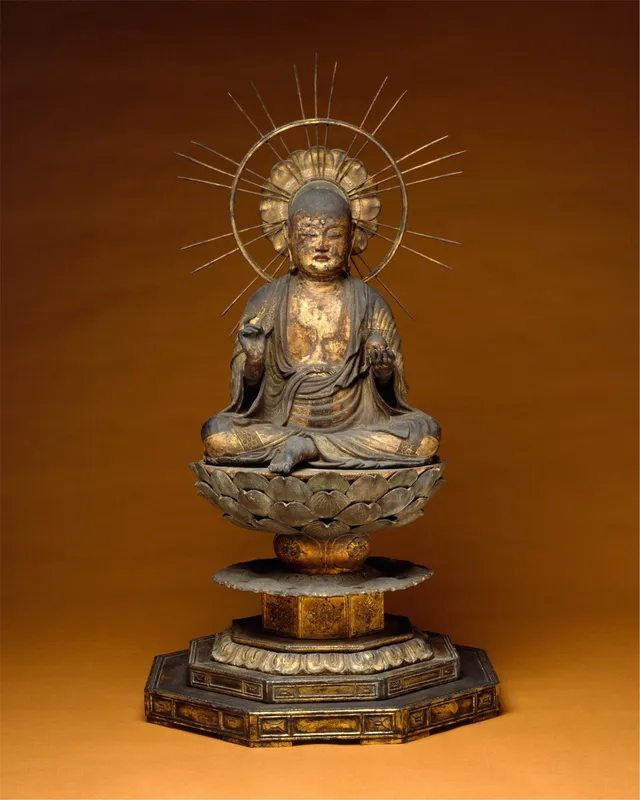
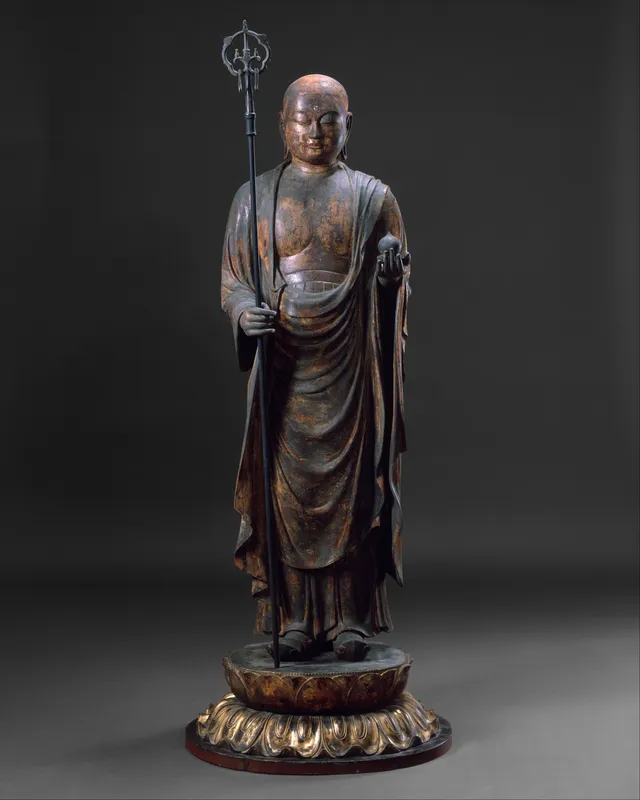
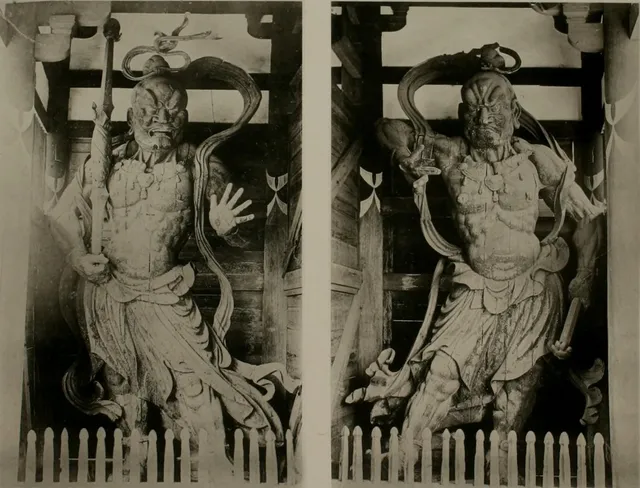
Yosegi-zukuri at scale. The joined-block construction technique (multiple seasoned blocks of hinoki cypress joined along vertical lines and hollowed internally) was not invented by the Kei school. It is documented in late-Heian production from the late tenth century onward. What the Kei school did was scale the technique radically. The 1203 Nandaimon Niō by Unkei and Kaikei stand 8.4 metres tall and are each constructed from approximately three thousand separately-carved blocks. The 69-day completion window recorded in the recovered inscription evidence is feasible only because the multi-block technique allows distributed parallel carving by a workshop of dozens: each carver working on a single block, all blocks coming together as the final assembly. The same technique, executed at portable scale, produces the Met 2015.300.250 Kaikei Jizō of c.1202 at 55.9 cm. The single workshop economy supports both endpoints.
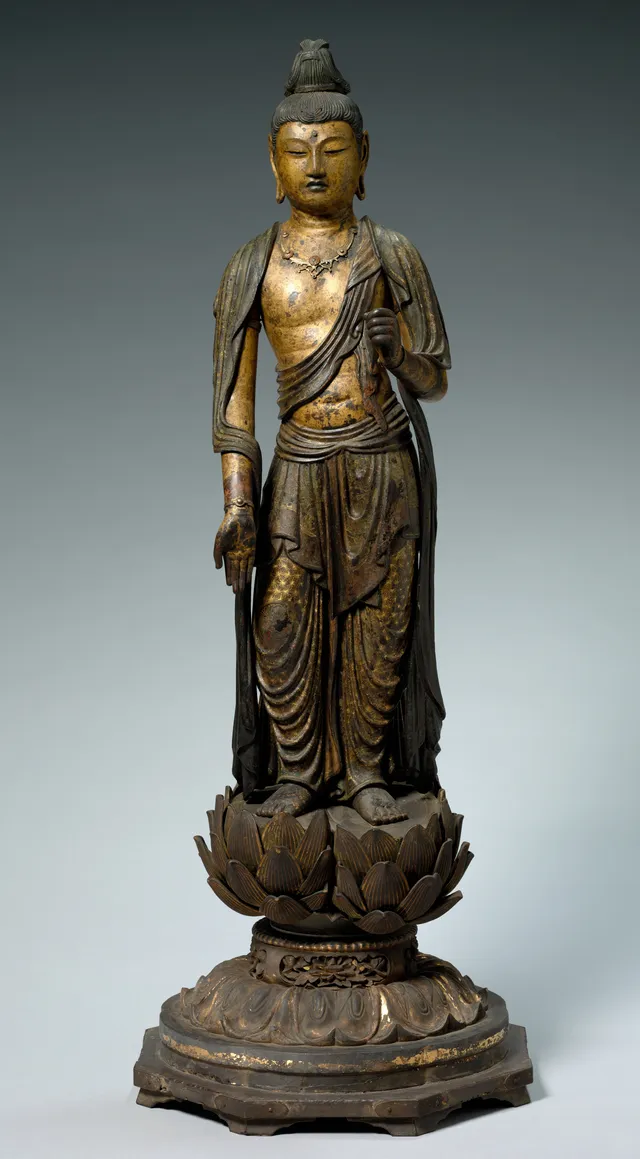
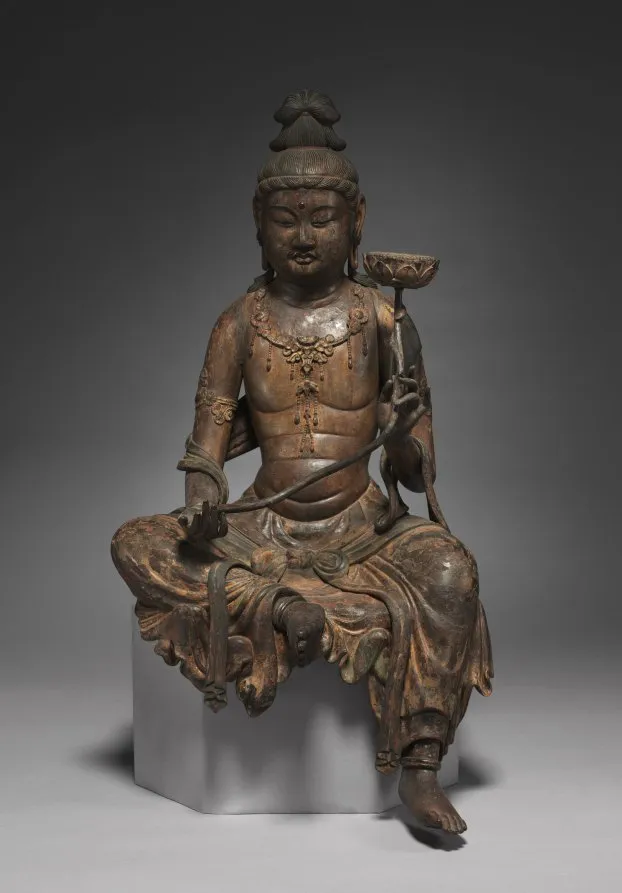
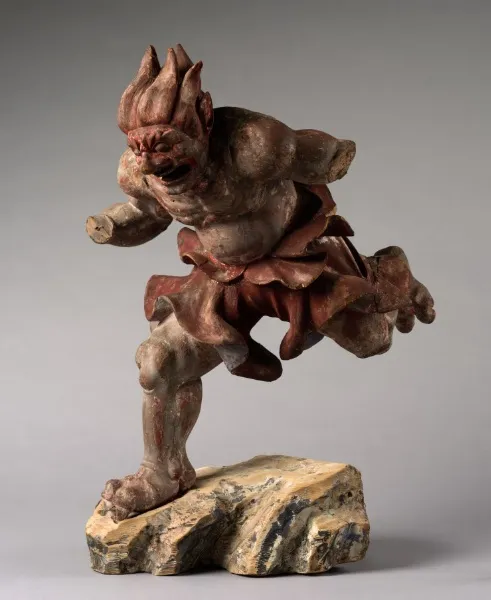
Inlaid crystal gyokugan eyes. The Kei school did not invent this either (the earliest documented use is at Chōraku-ji in Nagano in 1151), but the school’s adoption made the technique standard for high-end Buddhist sculpture in Japan for the next four centuries. The eyes are rock-crystal lenses set behind the carved face from the inside, with the pupil painted in lacquer on the back of the crystal and the iris colour set behind that. The optical effect is the slight following gaze that a real eye produces under changing light, and that flat-painted Heian eyes do not. The technique is documented across this cluster: the Hokuendō Mujaku, the Kaikei Jizō, the 1291 Intan Jizō, the Cleveland 1919.913 Kannon all use it.
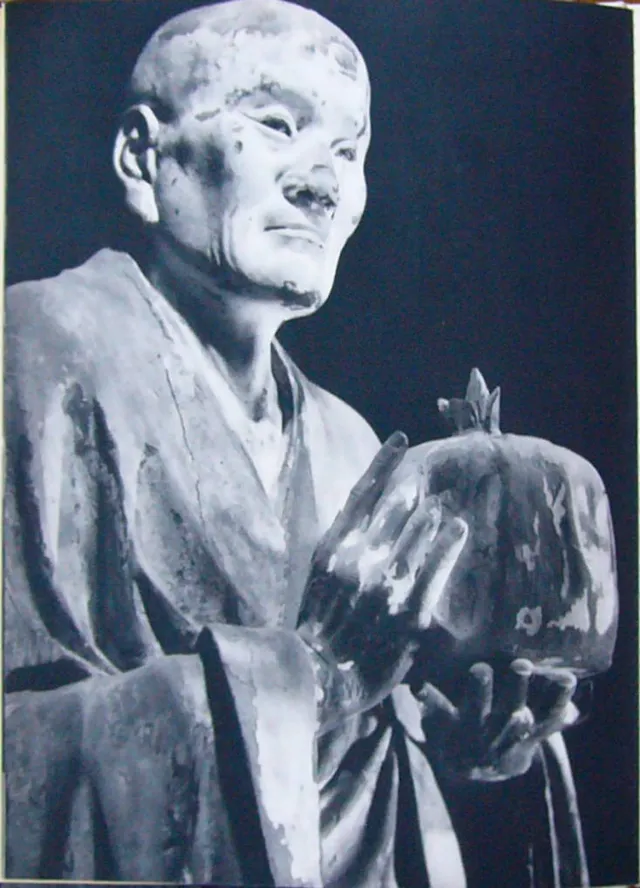
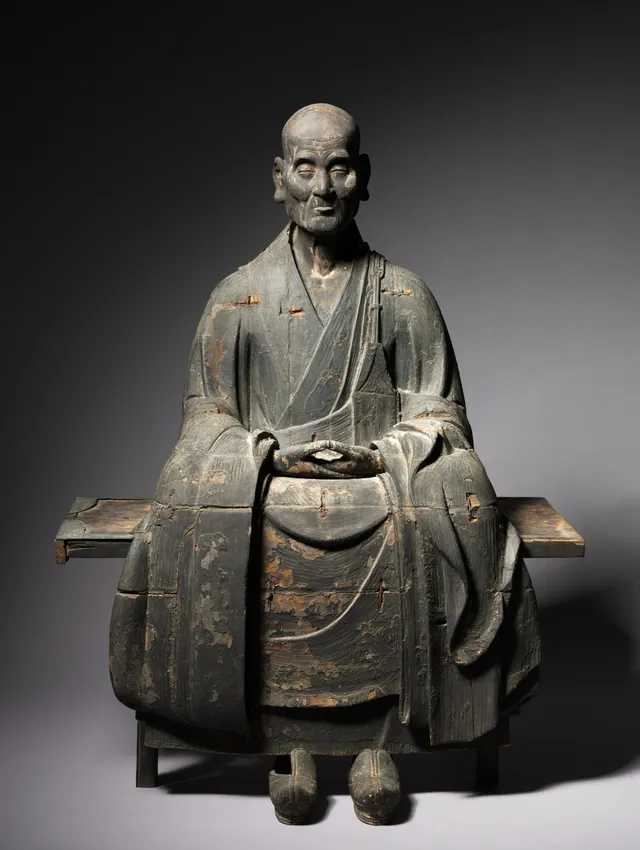
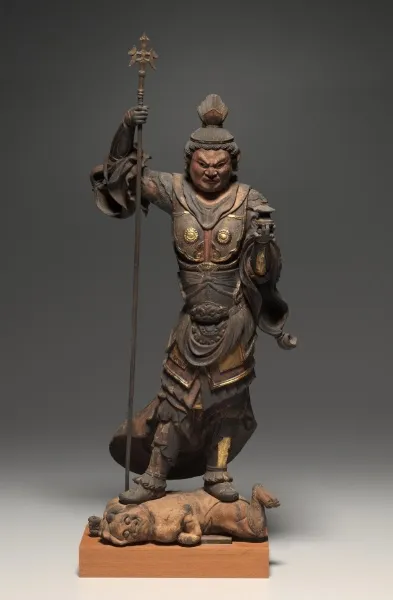
Portrait realism. The Kei school’s most novel achievement, on present scholarly consensus, is the portrait of a particular person. The Hokuendō Mujaku and Seshin (c.1212) by Unkei imagine the fourth-century Indian Yogācāra masters as specific old men with sunken cheeks, asymmetric mouths, and the accumulated weight of long-lived particular bodies. The Kōshō standing portrait of Kūya at Rokuhara-mitsu-ji (c.1207, the figure with six tiny Amidas emerging from the open mouth) is the same school working on a Japanese historical figure rather than an Indian one. The Cleveland 1970.67 Hottō Kokushi chinsō portrait extends the tradition into late-Kamakura Zen portrait practice. The realist register the school perfected is the technical answer to a workshop economy that needed something Heian production did not supply: the specific recognisable particular face.
What the cluster covers
The thirteen articles map across the school’s output endpoints:
Public monumental. The 1203 Nandaimon Niō at 8.4 metres each, completed in 69 days by Unkei, Kaikei, Jōkaku, and Tankei. The 1254 Sanjūsangen-dō chief Senju Kannon by Tankei at 82, two years before his death; the late bookend of the school’s monumental output.
Interior portrait. The Hokuendō Mujaku (c.1212) by Unkei; the Cleveland Hottō Kokushi chinsō by a Kei-affiliated late-Kamakura workshop.
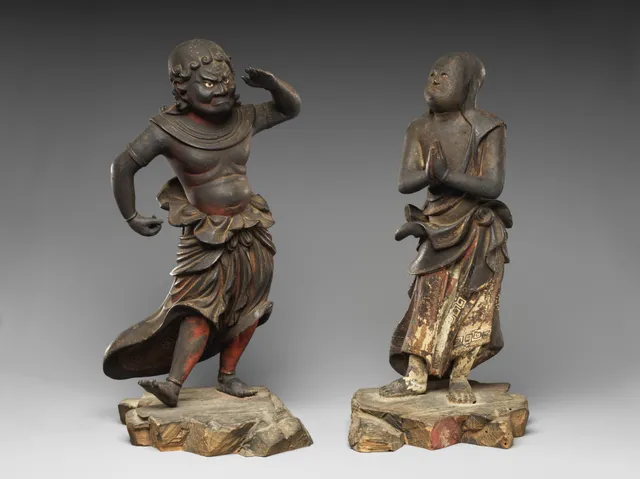
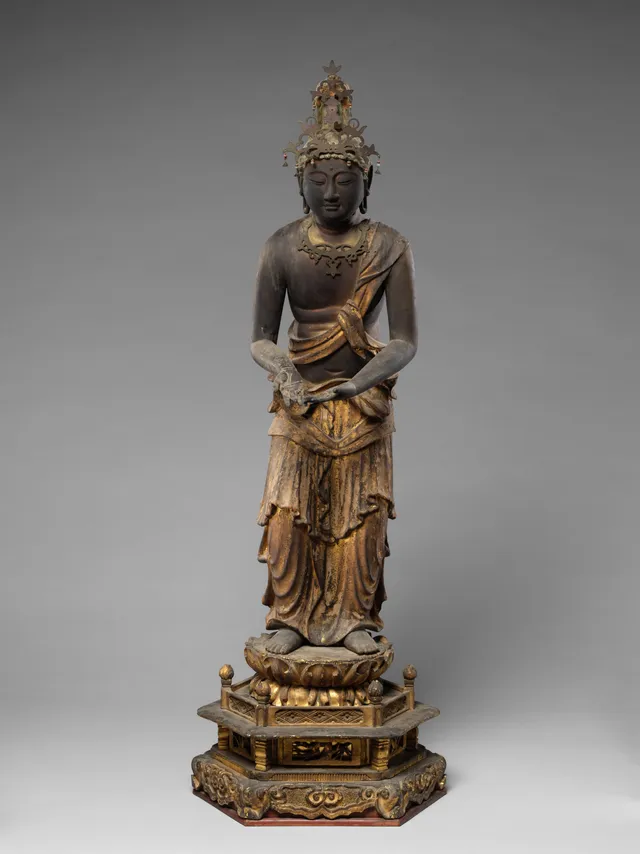
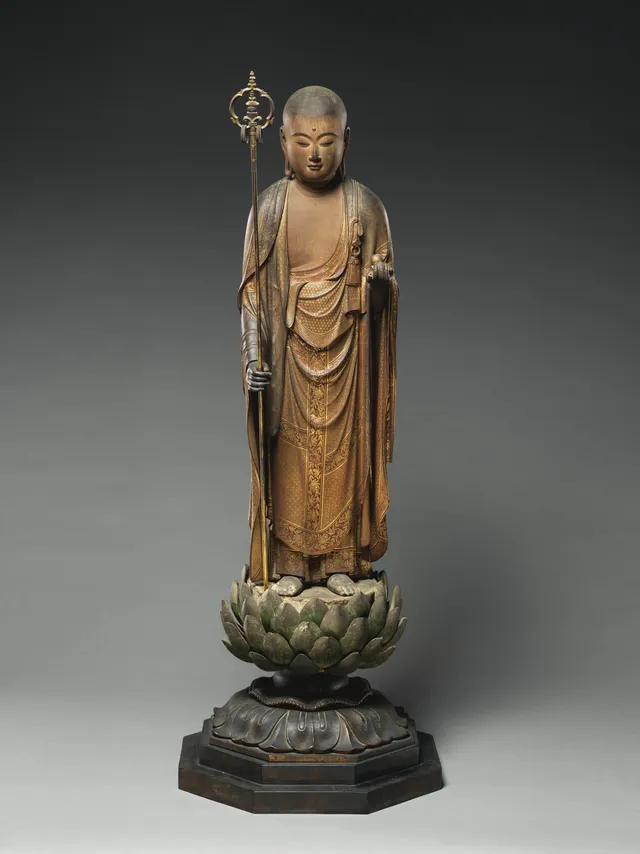
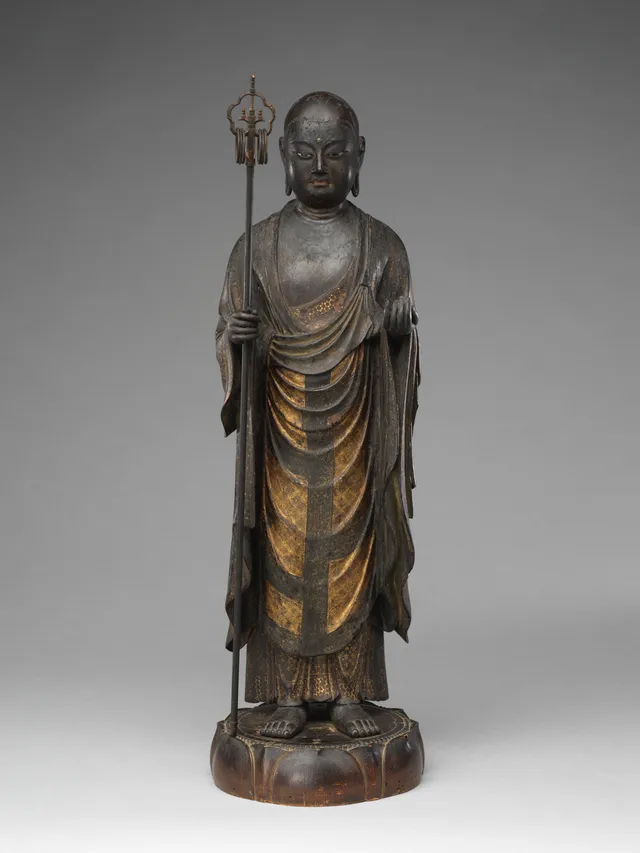
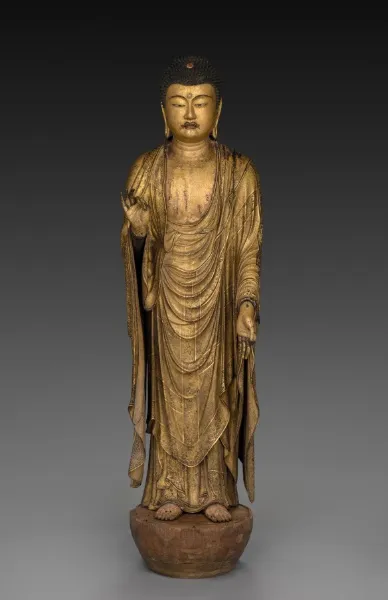
Portable devotional. The Met 2015.300.250 Kaikei Jizō of c.1202; the Met 2023.640 Intan Jizō (1291) as the late-Kamakura In-school descendant of the same workshop economy; the Cleveland 1919.913 early-Kamakura Kannon; the Met 18.93 standing Jizō; the Met 12.134.17-18 Kannon-Seishi attendant pair.
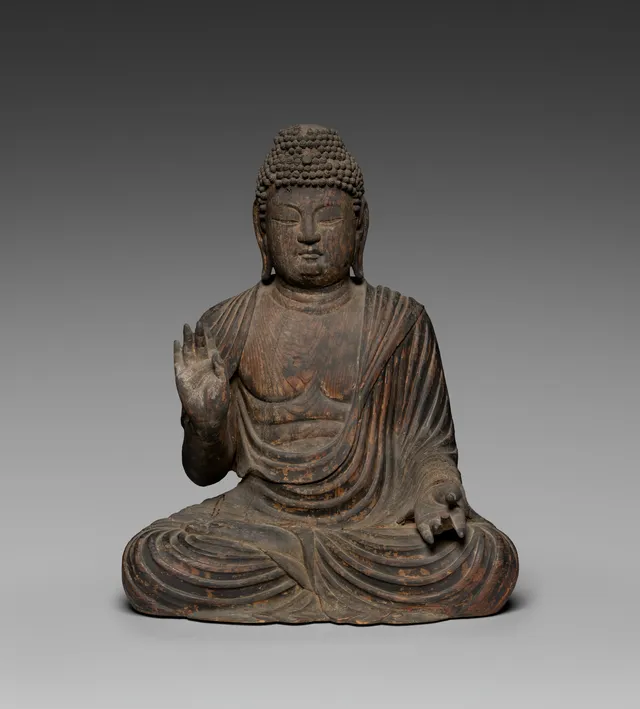
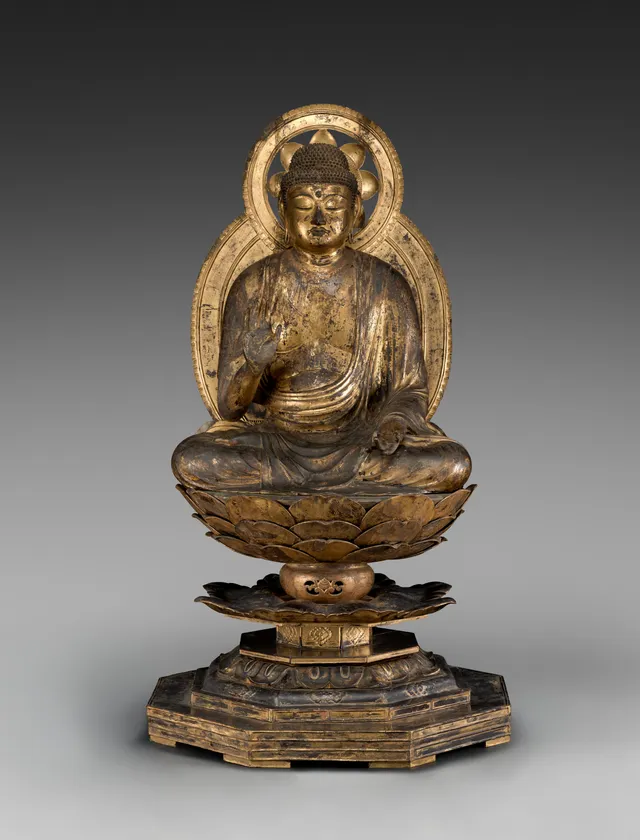
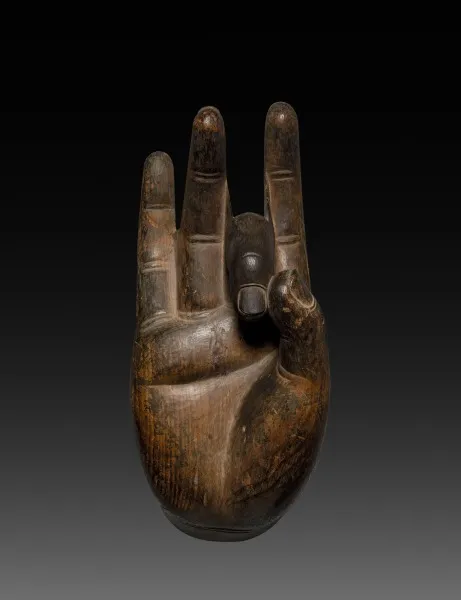
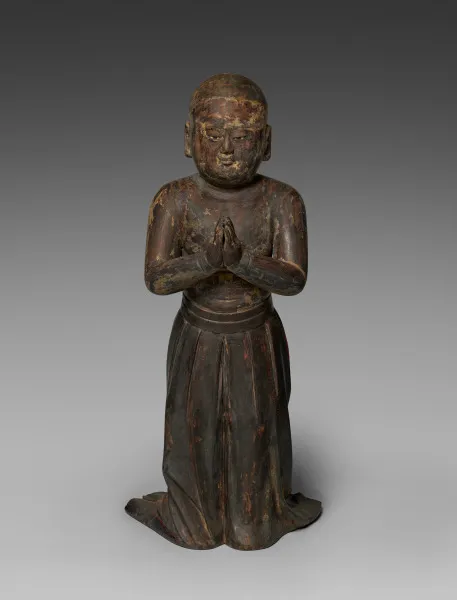
Comparanda and edges. The Cleveland 1973.85 Heian seated Buddha in Jōchō-style is the Heian-late comparandum against which the Kei-school work explicitly reads: what the school did not want to keep doing. The Nara Buddha hand-fragment is the surviving piece of a c.1180 figure whose face has been lost, included for what the fragment alone can carry. The Shōtoku Taishi at age two is the Kamakura sculptural reception of the Shōtoku cult.
What to read first
Three entry points:
The reader who wants the workshop economy should start with the 1203 Nandaimon Niō. The 69-day completion window for two 8.4-metre figures is the single most legible piece of evidence for how the Kei workshop actually functioned, and it carries forward into every later article in the cluster.
The reader who wants the interior portrait mode should start with the Hokuendō Mujaku (c.1212). It is the school’s most-articulated example of an imagined likeness: Unkei carving a man who had no living sitter and no surviving image, and producing what reads as a specific particular individual.
The reader who wants the signed corpus should start with the Met 2015.300.250 Kaikei Jizō and follow through to the Met 2023.640 Intan Jizō (1291). Kaikei’s An’amida-butsu signature programme (religious-name-as-signature, recoverable from interior inscription) is the cluster’s most legible attribution evidence and the foundation of post-1980s Kamakura sculptural scholarship.
The attribution problem
Most of what we call “the Kei school” is attributed work, not signed work. The signed corpus is small. Kaikei is the most-extensively-signed Japanese Buddhist sculptor of his period (signed-work census at roughly forty figures and growing), but Unkei is documented through commissions and inscriptions far more than through personally-signed individual works. The per-figure attribution within multi-figure programmes (which of the Nandaimon Niō is Unkei’s hand, which is Kaikei’s; which of the Hokuendō Mujaku and Seshin pair was personally carved by Unkei rather than by Kōshō or other workshop members) is in most cases unresolved on present evidence.
The cluster carries this honestly. Each article’s AttributionCallout flags the basis of the attribution (inscription evidence, temple records, stylistic argument), names the contestation where it exists in modern scholarship, and is explicit about what is and is not resolvable from currently-published material. The reader should treat the Kei-school attribution landscape as a live scholarly question rather than a closed one, with the 1988–1993 Nandaimon Niō conservation programme (which recovered the per-figure inscription evidence that anchors the 1203 dating and the four named principals) as the closest thing the field has to a model for what targeted modern conservation can recover.
What the cluster does not cover
Three things sit at the edge of the Kamakura-sculpture cluster and are not here:
- In-school and En-school production in detail. The In-school (院派, the Kyoto-based imperial-household sculptural tradition) and the En-school (円派) operated alongside the Kei school through the Kamakura period and produced substantial output. The cluster covers In-school work through the 1291 Intan Jizō and references En-school work as context, but does not currently carry dedicated In-school or En-school programme articles.
- Heian sculpture in depth. The Cleveland 1973.85 Heian seated Buddha is the cluster’s Heian comparandum; the broader Heian sculptural tradition (Jōchō-style Pure Land programmes, Heian shōrai-zō portrait traditions, the Heian regional sculptural witnesses) sits in the Pure Land and cross-cutting clusters.
- Edo-period sculptural revival. The Edo-period Kei-school revival (the Shichijō workshop, Tankei-descendant ateliers) and the late-Edo Buddhist sculptural revival under Enkū and Mokujiki: out of scope for this cluster. The terminus is roughly the end of the Kamakura period (1333).
What stays open
Two systemic gaps:
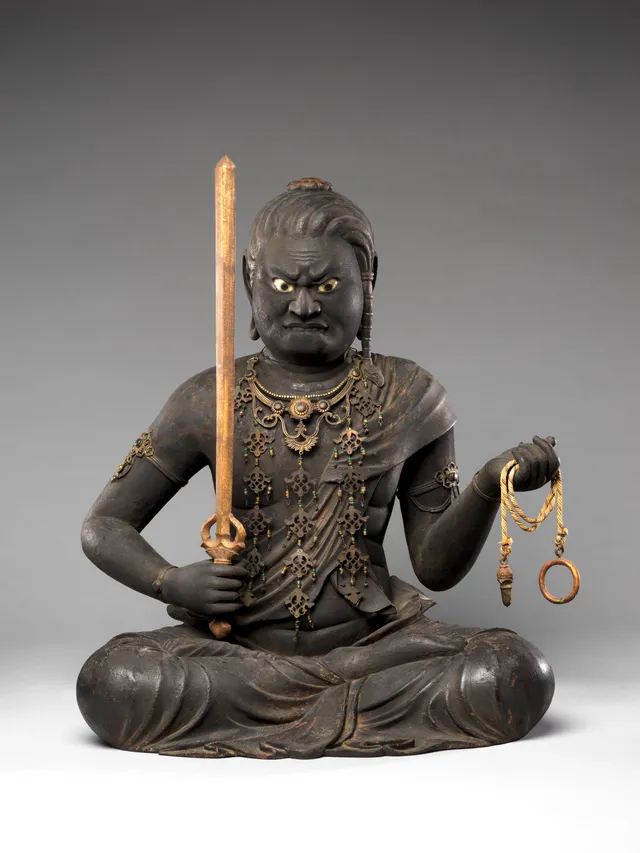
The cluster’s coverage of Unkei’s personally-signed work is currently thin. Of the small group of figures with surviving Unkei inscriptions or with Kamakura-period attribution direct to Unkei (the Izu commissions of the 1180s, the Hokuendō programme of 1212, the Tōdai-ji Daibutsuden figures of c.1218), the cluster covers the Hokuendō pair and references the Nandaimon work in detail but does not yet have a dedicated article on the Izu commissions or on the c.1218 Daibutsuden output. The Izu work in particular (the Ganjōju-in Buddha, the Hokke-dō Bishamonten and Fudō, both with surviving Unkei inscriptions) would substantially close the early-career Unkei picture.
The second open question is the Kōshō standing Kūya at Rokuhara-mitsu-ji (c.1207). It is the single most-reproduced Kei-school work in popular publication and is referenced repeatedly across the cluster as the canonical Kōshō piece. The bodhi corpus has a Rokuhara-mitsu-ji Jizō article that covers the temple cluster context but does not yet have a dedicated Kūya portrait article. This is the highest-leverage single gap.
In this cluster
20 articles
No articles match that filter.