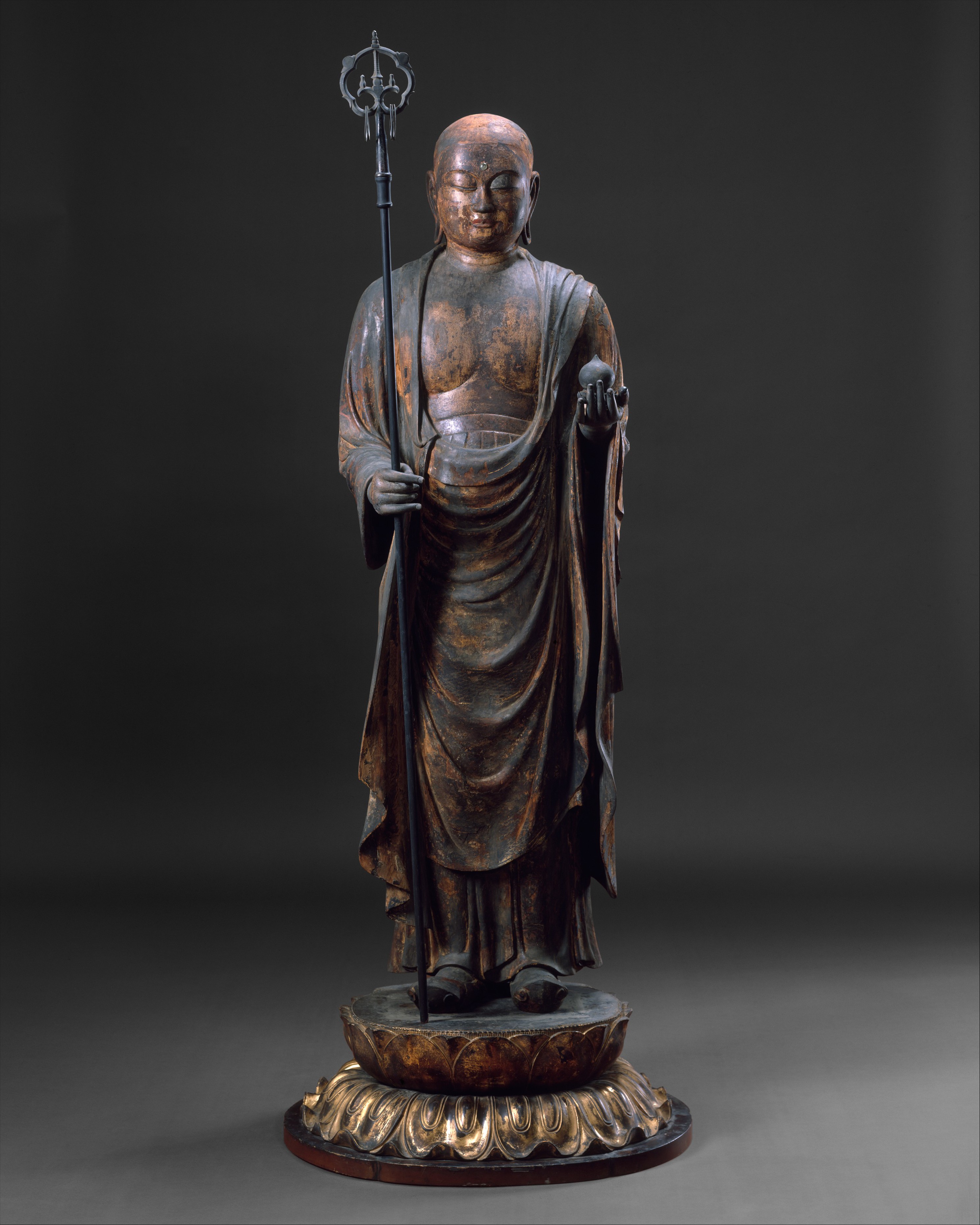
A standing Kamakura Jizō at adult-eye-level, Rogers Fund 1918
- Title
- Jizō, the Bodhisattva of the Earth Store
- Period
- Kamakura period (1185–1333), late 12th to mid-13th century
- Region
- Japan
- Medium
- Wood with lacquer, gold leaf, cut gold leaf (kirikane), and color
- Dimensions
- Figure with base 181.6 × 72.4 × 57.4 cm; with staff 188.6 cm
- Collection
- The Metropolitan Museum of Art
- Accession
-
18.93 - Rights
- The Metropolitan Museum of Art, OASC (CC0 public domain). Rogers Fund, 1918 (acc. 18.93)
Jizō, the Bodhisattva of the Earth Store. Japan, Kamakura period, late 12th to mid-13th century. Wood with lacquer, gold leaf, cut gold leaf (kirikane), and color. Figure with base 181.6 × 72.4 × 57.4 cm; with staff 188.6 cm. The Metropolitan Museum of Art, Rogers Fund, 1918, acc. 18.93. CC0 / public domain.
The figure stands at adult-eye-level and above
This is a Jizō you do not look down at. The figure rises to 181.6 cm without the staff and 188.6 cm with it — six feet and a hand-width — which means the carved head sits a fraction above the eye-level of an adult viewer in the gallery and the staff finial rises higher still. The standard for Jizō sculpture in the Heian and Kamakura periods is more often modest — half-life-size altar figures suited to a side hall — and the larger standing Jizōs that have survived in Japanese temple holdings are most often documented as principal images, honzon 本尊, of dedicated Jizō halls (Jizō-dō 地蔵堂).
That scale changes how the iconography reads. Most readers know Jizō first through the small roadside jizō shrines whose stone figures are kneeling height. Met 18.93 is the temple-scale figure, the one the lay donor circled and bowed to; the one the deathbed-rite officiant addressed; the one the lay practitioner imagined descending to lead the soul.
The cintamani and the six-ringed shakujō
The two attributes are the iconographic signature of Jizō in his standing-monk form.
The shakujō ring-count is iconographically prescriptive. A four-ringed or eight-ringed staff would read differently. The six-ringed shakujō is specifically Jizō’s; it carries the rokudō 六道 (six paths of rebirth) cosmology onto the figure as a portable attribute. This is the same iconographic register that produces roku Jizō 六地蔵, the six-figure roadside Jizō programme distributed across the six realms.
The dating bracket: late 12th or early 13th
The Met catalog dates the figure “late 12th–mid-13th century.” That is a deliberately wide bracket — roughly 1180 to 1250 — and the curators have not narrowed it for a reason worth reading.
The drapery falls in soft, flowing folds; the robe lines have the long curvilinear rhythm associated with the late Heian transition into the early Kamakura, before the Kei-school production register tightened the surface and sharpened the carving. The face is calm rather than animated. The body modelling is restrained. None of this is a workshop signature — there is no inscription, no dedicatory deposit published, no documented workshop chain — but the stylistic register reads as transitional rather than mature-Kamakura.
What the bracket excludes is the post-1250 late-Kamakura register that the Intan Jizō (Met 2023.640, signed and dated 1291) typifies — tighter folds, more compressed surface, more declarative carving. Met 18.93 sits earlier in the arc. Where exactly it sits between 1180 and 1250 is the question the Met catalog refuses to answer with the evidence available.
The surviving polychrome and kirikane
The most readable register on the figure is its lower half. The upper torso has lost most of its surface — bare wood is visible at the head, neck, shoulders, and chest — but the robe from the hip down preserves enough of the original kirikane 截金 (cut gold leaf) patterning, polychrome ground, and gold-leaf lacquer to read the surface as it was conceived.
Kirikane is a Kamakura production register: a sheet of pure gold leaf is cut into narrow strips and applied with brush and lacquer to the prepared surface, producing geometric patterns — meanders, key patterns, lozenges — that read as embroidered cloth at distance and as fine line at close inspection. The technique was perfected in the second half of the 12th century, became standard for Kei-school and contemporary workshop Buddhist sculpture in the 1200s, and tapered off into formula by the 14th century.
On Met 18.93 the kirikane patterns visible on the lower robe — gold lines tracing geometric and floral motifs against a darker red ground — are exactly the register one would expect on a late-12th- or early-13th-century standing Jizō from a serious workshop. They are not Kei-school by attribution; they are Kei-school in production language, the same shared technical vocabulary that the workshop world of Nara and Kyoto held in common after Unkei and Kaikei standardised it.
The asymmetric surface loss is itself informative. Figures of this scale stood on altars in temple halls; the upper portion of a standing figure was always more exposed to incense smoke, oil-lamp soot, candle wax, devotional touch, and centuries of dust accumulation. The lower body, screened by altar cloths and offerings, was generally better protected. The pattern of loss on Met 18.93 — upper torso stripped, lower robe preserved — is what one expects from an altar figure that was in active devotional use for many centuries before passing into the museum register.
Rogers Fund 1918: the Bosch Reitz era
The figure entered the Met through the Rogers Fund in 1918, six years after the Pier-era Kannon and Seishi pair (Met 12.134.17 & .18) and four years after Pier’s Temple Treasures of Japan (1914). By 1918 Garrett Chatfield Pier had left the Met for service in the First World War and the Asian Art department was under Sigisbert Chrétien Bosch Reitz (1860–1938), Dutch-born curator who had succeeded Pier in 1915.
Bosch Reitz’s tenure (1915–1927) is the second institutional generation of Met Japanese collecting. Where Pier had been an aggressive buyer in the Japanese market during the Meiji-to-Taishō transition — when Japanese temples were dispersing collections under the legal-and-financial pressures of the late-19th-century anti-Buddhist policies — Bosch Reitz inherited a market that was already cooler and a curatorial register that was more selective. The Rogers Fund continued to underwrite acquisitions through this period, drawing on the $5 million bequest of Jacob S. Rogers (1824–1901), whose 1901 gift remained the most flexible single funding source for the Met’s Asian Art department into the 1920s.
The 1918 acquisition of Met 18.93 was specifically a Bosch Reitz purchase, drawing on Rogers Fund, in the institutional second-generation register. The dealer through whom the figure came to New York is not in the published catalog record, and bodhi has not opened the Met departmental archive. Pier-era Yamanaka & Co. and Mayuyama dealer channels both remained active in the 1915–1925 period and either is plausible.
The third Met Jizō: a corpus of three
After the 2015 Burke gift brought the Kaikei Burke Jizō (Met 2015.300.250, c. 1202, 56.3 cm, signed inside) and after the 2023 Irving acquisition brought the Intan 1291 Jizō (Met 2023.640, 135.9 cm, signed and dated), Met 18.93 became the senior member of a Met-resident corpus of three standing-monk Jizōs spanning the Kamakura period:
- Met 18.93 (late 12th–mid-13th c., 188.6 cm with staff) — the unsigned, transitional, late-Heian-into-early-Kamakura figure; Rogers Fund 1918.
- Met 2015.300.250 (c. 1202, 56.3 cm, signed Kaikei inside) — the small Kei-school workshop figure, originally Kōfuku-ji.
- Met 2023.640 (1291, 135.9 cm, signed Intan) — the late-Kamakura In-school synthesis figure, Kōfuku-ji 1906 dispersal chain.
The three together — across roughly 110 years and three production registers — show the arc of Kamakura Jizō sculpture in a single institutional collection. Met 18.93 is the earliest, the largest, and the only one of the three without a securely documented workshop. It is also the only one to have entered the Met before 1950.
The Met holds a fourth standing Jizō, the Kamakura figure at Met 42589 (object ID 42589, accession 28.111.1), but it sits below the three primary works in scale and in surface preservation. The corpus that anchors the Met’s Jizō holdings is the three above.
What stays open
-
The workshop. No inscription, no dedicatory deposit published, no documented chain. The kirikane and the drapery register suggest a serious late-Heian or early-Kamakura production atelier, but the workshop cannot be named with the available evidence.
-
The original temple. Met 18.93 is unattached to any documented Japanese temple of origin in the public record. A figure of this scale was a honzon somewhere; the somewhere is unrecorded.
-
The pre-1918 dealer chain. Yamanaka & Co. and Mayuyama are both plausible for a 1915–1918 acquisition. Action if visited: Met departmental archives for the Rogers Fund purchase correspondence.
-
The yosegi construction. Bodhi assumes joined-block construction from the scale and standard period practice, but the Met catalog does not confirm. Action if a conservation scan appears: verify the construction and record any dedicatory cavity contents.
-
The shakujō finial. The six-ring count is iconographically secure but the specific finial form — whether it carries the standard ring-bearer (kan) above a peach-shape head or a regional variant — is best read from closer imaging than the Met OA provides.
Related
- Met 2023.640: Intan’s 1291 Jizō
- Met 2015.300.250: Kaikei’s Burke Jizō
- Jizō Bosatsu: reading the saviour of the six realms
- Met 19.140a-c: the 1269 standing Amida
- Met 12.134.17 & .18: the Kannon-Seishi attendant pair, Rogers Fund 1912
- Kamakura bodhisattva surface: kirikane as production register
- Yosegi-zukuri: multi-block joined-wood construction