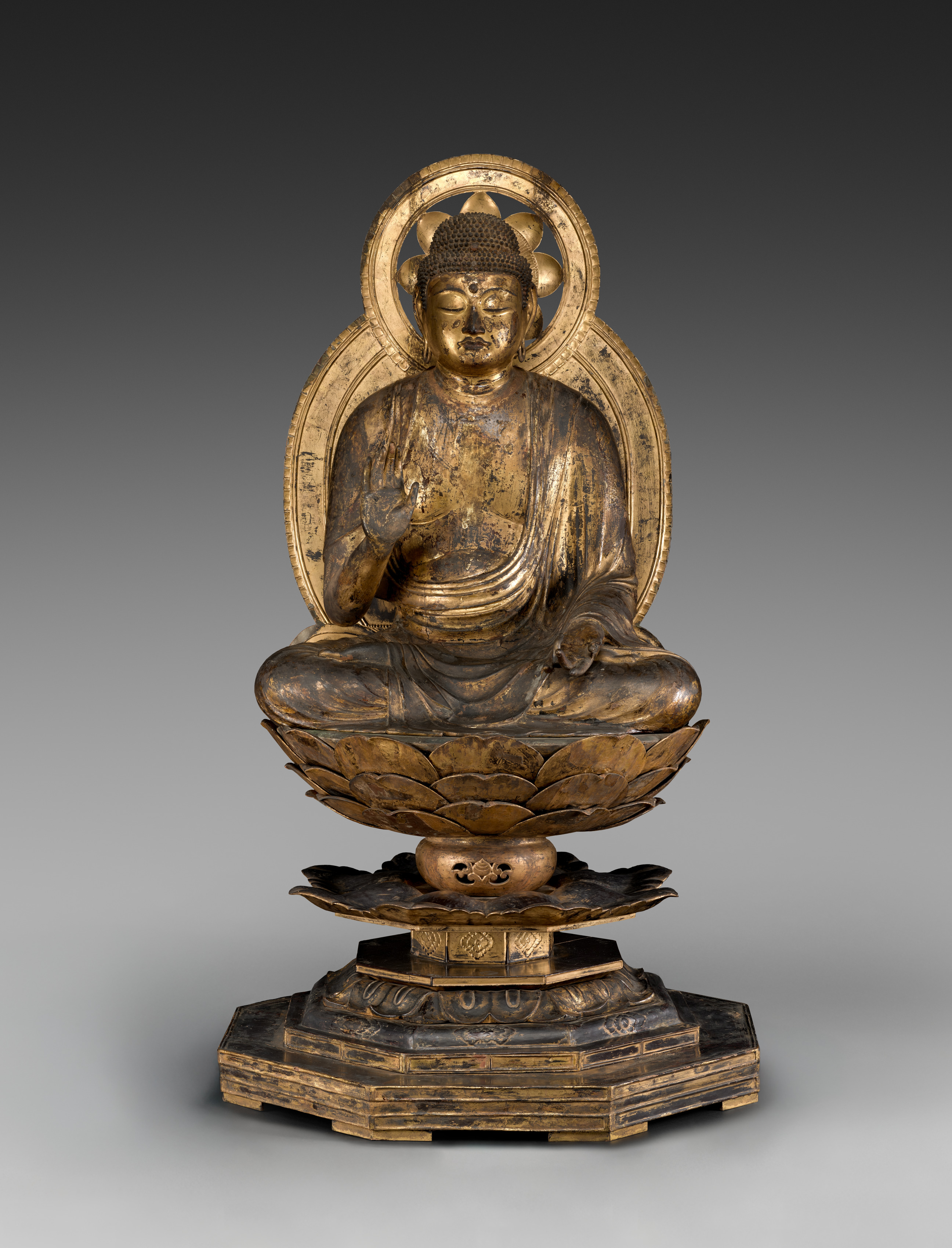
A Heian seated Buddha in the Jōchō style, 1100s
- Title
- Seated Buddha (possibly Yakushi Nyorai) — Cleveland 1973.85, late Heian, 1100s
- Period
- Late Heian period (794–1185), 1100s
- Region
- Japan, Nara — from a small temple in the Kōfukuji precincts
- Medium
- Gilded wood (multiple hollowed wood blocks joined and finished in lacquer and gold)
- Dimensions
- Overall 145.4 cm (57 1/4 in.); figure 88.2 cm (34 3/4 in.); pedestal 57.2 cm (22 1/2 in.)
- Collection
- The Cleveland Museum of Art
- Accession
-
1973.85 - Rights
- Public domain (CC0). The Cleveland Museum of Art, gift of Takako Setsu and her husband, Iwao, in memory of her father-in-law, Inosuke Setsu, and his long friendship with Sherman E. Lee. Open Access, Cleveland Museum of Art.
Cleveland 1973.85 — late Heian seated Buddha, 1100s. Yosegi-zukuri joined-wood construction, the technique perfected by Jōchō at Byōdō-in (1053) and the working idiom of his Nara successors. The figure sat in a small temple in the orbit of Kōfukuji until at least 1906.
The right hand says ‘fear not’
Walk up to gallery 235B at Cleveland and the first thing you do is read the right hand. It is held at chest height, palm out, fingers extended: the abhaya mudra, senshō-in in Japanese, the gesture that means do not be afraid. The hand sits at exactly the height a person seeking reassurance would meet it. That placement is not accidental. Late-Heian sculptors had inherited from Jōchō a near-mathematical interest in where the bodily gestures sat in relation to the worshipper’s body: the eyes lowered to meet a kneeling figure, the right hand raised to chest height so the gesture was read before the figure was seen.
The face is broad and quiet. The eyes are nearly closed. The hair is worked in regular tight curls around the cranial protuberance, the uṣṇīṣa, that marks the figure as a Buddha and not a bodhisattva. Drapery falls across the chest in calm parallel folds, and across the crossed legs in a regular sequence that gives the lower body its triangular silhouette. Nothing about the figure is muscular or dynamic. This is the wayō idiom (the Japanese style) of the long 12th century, settled and continuous with what had been done at Hōjō-ji and Byōdō-in in the previous century.
The left hand is wrong
The left hand is a later replacement. Look at the wrist and the join is visible: a discontinuity in the gilded surface, a slightly different tone of wood beneath, the carving register a step off the rest of the figure. The hand rests palm-up on the lap, fingers loosely curled. It is plausibly a generic dhyāna (meditation) hand added by a later restorer trying to make the figure read coherently after damage.
The problem is that the original left hand carried the figure’s identity. A Buddha’s right hand is almost always raised in abhaya or varada; the right hand reads as intent toward the worshipper. The left hand, by contrast, holds the diagnostic attribute. If it held a small jar (yakushi-tsubo, the medicine pot), the figure was Yakushi Nyorai, the Medicine Master Buddha. If it lay open and empty, the figure was Shakyamuni, the historical Buddha. If it held a lotus, the figure was Amida.
Cleveland’s wall text is honest about this. The left hand is a replacement, so its original gesture, a clue to this Buddha’s identity, is unknown. What the museum gives is a hedge (it may have been Yakushi, or it may have been Shakyamuni), anchored on a single physical observation that the curator does not want to lose: the exposed left foot.
Hollowed wood, joined and lacquered
The CMA description gives the construction precisely: Composed of a number of hollowed-out pieces of wood that were then covered with lacquer and gilding. That is yosegi-zukuri (寄木造), joined-wood construction. The figure is not carved from one block. It is assembled from several blocks of dry cypress, each of which has been hollowed from inside before joining, so the finished form is a thin shell rather than a solid mass.
Three things follow from that choice. First, the wood is stable: solid blocks of green cypress at this scale would split as they dried; hollowed blocks have nowhere left to release tension. Second, the figure is light: a 145 cm gilded figure that you can move with three or four people, not a forklift. Third, the wood inside the shell is available. The cavity could be (and at Byōdō-in, Tōdai-ji, and Kōfuku-ji often was) loaded with dedicatory deposits: relics, sutras, names of the patrons. We have no record of what is inside Cleveland 1973.85, because it has not been opened. The 1906 photograph predates X-ray investigation, and CMA has not reported a CT pass on the figure.
The technique is what Jōchō (d. 1057) perfected for the great Amida at Byōdō-in (see Byōdō-in Amida, Jōchō, 1053). Jōchō did not invent joining wood (it had been done in fragments since the Asuka period), but he was the first to systematise the technique for monumental images, and his workshop’s methods were transmitted directly to the Nara busshi (sculptor-monks) of the 11th and 12th centuries, the predecessors of Kaikei and Unkei. The CMA figure sits inside that transmission, made by someone in a small Nara workshop in the 1100s who was working in Jōchō’s grammar without Jōchō’s signature.
The Jōchō style, two generations later
The phrasing CMA uses, sculpted in the Jōchō style, associated with the sculptor of the Amida at Byōdō-in in Uji, is the curator-careful version of a claim that needs unpacking. Jōchō died in 1057. The CMA figure is 1100s, anywhere from forty to a hundred and forty years later. The work cannot be by Jōchō. Style, in this catalog phrasing, is shorthand for workshop inheritance and the body of formal habits that Jōchō codified: the broad face, the lowered eyes, the symmetrical body, the regular drapery, the yosegi shell, the gilded surface, and the proportional reading of the worshipper’s eyeline.
Mōri Hisashi, Sculpture of the Kamakura Period (Weatherhill, 1974), reads the long 12th century as a period in which two idioms coexisted in Nara. The wayō idiom, descended from Jōchō, continued to be the production language of the established temple workshops well into the time the Kei-school in the same city was already breaking with it. Cleveland 1973.85 reads as wayō: the body is symmetrical and unstressed, the drapery does not break into the deep undercut folds of the Kei-school works of the 1180s onward, the eyes are not inlaid crystal but carved-and-painted, and the surface is the calm gilded register of the earlier Heian tradition.
That is the right way to read this figure. Not as a Jōchō original (it is not), and not as a Kei-school precursor (it is also not), but as a figure made in the continuing wayō idiom of a Nara sub-temple in the 1100s, by a busshi whose name we do not know, working in a workshop that traced its lineage back through Jōchō’s Hōjō-ji programme to Kōfuku-ji itself.
A small temple in the precincts of Kōfukuji
CMA gives the original setting as one of the small temples surrounding Kōfukuji, a major Buddhist temple in Nara. Kōfukuji in the late Heian period was an enormous institutional complex: the tutelary temple of the Fujiwara, a Hossō-school monastic university, with a precinct that included not only the main golden hall and the five-storey pagoda but a constellation of tatchū (sub-temples) on the surrounding plateau. Each tatchū housed its own principal image. Many were destroyed in the 1180 Taira raid that razed the main precinct; the surviving Buddhist sculpture of the long 12th century at Kōfukuji is what was salvaged from that fire and what was made in the rebuild between 1180 and 1212 (see Hokuendō Miroku, 1212).
Cleveland 1973.85 does not appear in the documented Kōfukuji rebuild list. The figure either survived the 1180 raid in a sub-temple that escaped the fire, or was made in the immediate post-raid generation (the 1180s-1190s) in continuation of the older idiom. Either reading is consistent with the dating CMA gives (1100s), with the wayō style, and with the credible terminus ante quem of the 1906 photograph.
The 1906 photograph
The single most useful documentation note in the CMA record is the conservation line: A 1906 photo taken at Kōfukuji shows this sculpture without a halo or left hand. The photograph itself is not reproduced on the CMA web entry, and bodhi has not located the print. The line nevertheless carries three load-bearing pieces of information.
First: the figure was at Kōfukuji in 1906, more than half a century before it left Japan. It is documented in its inherited setting. Second: the damage we see now (the missing original left hand, the missing halo) was already present in 1906. The replacement left hand and the present (also probably replaced) halo are pre-1906, not post-1906 restoration. Third: 1906 is a terminus ante quem for the dispersal. Whatever caused the figure to move from the Kōfukuji precinct into private hands happened between 1906 and the period (probably the post-war decade) when it reached the Setsu dealership.
The dispersal pattern is consistent with what we know about Japanese Buddhist sculpture in the early 20th century: the haibutsu kishaku anti-Buddhist disestablishment of the 1860s and 1870s, the Meiji land-reform that removed temple endowments, and the related sales of temple holdings to dealers in Tokyo and Osaka, fed a steady current of pieces from sub-temples and small precincts onto the antique market through the late Meiji and Taishō periods. By the time Inosuke Setsu was active as a dealer (roughly the 1930s through the 1960s) it was not unusual for a Heian sub-temple Buddha to be held by a Tokyo firm.
Setsu Takako, Iwao, and Sherman E. Lee, 1973
The credit line is unusually personal, and it is worth reading slowly: Gift of Takako Setsu and her husband, Iwao, in memory of her father-in-law, Inosuke Setsu, and his long friendship with Sherman E. Lee. Three generations of the Setsu family and one Cleveland museum director are named on one line.
Inosuke Setsu founded Setsu Gatōdo (瀬津雅陶堂), one of the established Tokyo dealerships for Japanese antiquities and early Buddhist art. Sherman E. Lee — Cleveland’s director from 1958 to 1983 — first knew Inosuke during his service as a Monuments, Fine Arts and Archives officer in occupied Japan, 1946–1948. That working relationship deepened across the 1950s and 1960s as Lee built Cleveland’s Japanese collection into one of the strongest outside Japan, working through a small set of Tokyo dealers: Mayuyama, Setsu Gatōdo, and Yamanaka. After Inosuke’s death, his son Iwao continued the firm, and Iwao’s wife Takako made the 1973 gift jointly with him.
The CMA Archives finding aid lists a correspondence file Setsu Gatōdo Co., Ltd. (Iwao Setsu), 1973–1983 in Sherman Lee’s director’s office records. The 1973 gift opens that ten-year correspondence bracket — the moment the dealer relationship was reframed as a personal one, with a piece given rather than sold.
Yakushi, Shaka, and the iconographic question
The hedge — Yakushi or Shaka — is worth pinning down. Cleveland’s wall text uses Yakushi or Shakyamuni; Wikidata gives Medicine Master Buddha (Yakushi Nyorai) as the primary alternate title; bodhi has flagged the Yakushi reading as the most likely. None of those three positions can promote itself to certainty without the original left hand, which is gone. What we can do is rehearse the evidence.
For Yakushi:
- The exposed left foot over the outer robe is sometimes cited (e.g. in Bogel and other Western surveys of Japanese Buddhist sculpture) as an iconographic preference for Yakushi over Shaka. It is not consistent, but it is suggestive.
- Kōfuku-ji’s precinct held important Yakushi images — the Tōkondō Yakushi triad and the Yakushi triad lineage from the original 8th-century foundation. A Yakushi sub-temple figure is institutionally plausible at Kōfukuji.
- The gilded surface and the relatively settled posture read consistent with a Yakushi commission for a small precinct temple — Yakushi was the medicine Buddha, the protector of the sick, and his images were the staple of small temple worship.
For Shaka:
- The right-hand abhaya gesture is the standard preaching/reassurance mudra of Shakyamuni and is canonical to Shaka iconography.
- Without the medicine jar, no Yakushi identification is positive.
For Amida (a third candidate that CMA does not raise but is worth flagging for honesty):
- An Amida left hand could be in dhyāna/concentration mudra with thumbs touching at the lap, exactly the posture of the modern replacement. The replacement hand would not be diagnostic; the original could plausibly have been an Amida-style hand.
- The Kōfukuji precinct is institutionally a Hossō establishment, and Amida cult was not its principal devotional centre. This weighs against Amida as the original identification.
The honest residual claim is: Yakushi most likely, Shaka second, Amida possible but institutionally unlikely. bodhi will record the figure as seated Buddha (possibly Yakushi Nyorai) and link it to Yakushi Nyorai and the twelve heavenly generals without forcing the identification.
What stays open
Three open questions sit behind this figure and we name them explicitly.
The dating. The CMA record dates the figure 1100s. That is a hundred-year window covering the entire 12th century, before, across, and after the 1180 Taira raid. Stylistically the figure reads pre-Kei-school, which would push it earlier in the century rather than later — but a sub-temple workshop continuing the wayō idiom into the 1190s is also plausible. A definitive dating would need a CT pass on the hollow cavity and a dendrochronological reading of the cypress, neither of which has been published.
The original setting. One of the small temples surrounding Kōfukuji is as far as the CMA evidence will go. There is no surviving temple-history record identifying which precinct sub-temple this figure was the principal image of, no inscription on the figure, and the 1906 photograph documents its presence at Kōfukuji proper without identifying the building. Bodhi has not located that photograph in the published Kōfukuji documentation, but the print is presumably in the CMA accession file from 1973.
The dispersal date. We have a 1906 terminus ante quem at Kōfukuji and a 1973 terminus ad quem at Cleveland. The figure was at Setsu Gatōdo before 1973, and probably moved into the dealership during Inosuke Setsu’s working years (1930s–1960s). The exact transit date is not documented in the public record.
Related
- Byōdō-in Amida, Jōchō, 1053 — the canonical Heian image
- Yosegi-zukuri — multi-block construction
- Cleveland 1982.264 — dry-lacquer bodhisattva head fragment
- Yakushi Nyorai and the twelve heavenly generals
- Hokuendō Miroku, 1212 — Unkei’s solo Kōfukuji programme
- Nikkō Bosatsu — sun attendant of Yakushi
Sources
-
CMA Open Access API record (CC0). Confirms: 1973.85; gilded wood; overall 145.4 cm, figure 88.2 cm, pedestal 57.2 cm; date 1100s (Heian); gallery 235B Japanese; provenance Setsu Takako 瀬津孝子, Tokyo → CMA 1973; credit line 'Gift of Takako Setsu and her husband, Iwao, in memory of her father-in-law, Inosuke Setsu, and his long friendship with Sherman E. Lee'; conservation note 'A 1906 photo taken at Kōfukuji shows this sculpture without a halo or left hand.'
-
CMA description verbatim: 'Composed of a number of hollowed-out pieces of wood that were then covered with lacquer and gilding, this sculpture served as an image of worship in one of the small temples surrounding Kōfukuji, a major Buddhist temple in Nara, Japan. Like many Buddhas, this figure has its right hand positioned in a gesture meaning *fear not*. The left hand is a replacement, so its original gesture, a clue to this Buddha's identity, is unknown. However, as the left foot is exposed over the garment, in lotus position, it may have been created as a Medicine Master Buddha, Yakushi Nyorai in Japanese, or the Buddha of our era, Shakyamuni.' Cleveland positions the work as Jōchō-style; Wikidata cross-reference (Q60740344) lists alternate title 'Medicine Master Buddha (Yakushi Nyorai).'
-
[3]2026-05-12The Cleveland Museum of Art Archives clevelandartarchives.libraryhost.com/repositories/2/archival_objects/25142CMA Archives finding aid: correspondence file 'Setsu Gatōdo Co., Ltd. (Iwao Setsu), 1973–1983' from Sherman E. Lee's director's office records. Bookends the period of the dealer-museum relationship; the 1973.85 gift opens that ten-year correspondence bracket.
-
[4]2026-05-12The Cleveland Museum of Art Archives clevelandartarchives.libraryhost.com/repositories/2/resources/86CMA Asian Art department finding aid. Confirms Sherman Lee (CMA Director 1958–1983) worked with a small set of Tokyo dealerships through the 1950s–70s, named in the records as Mayuyama, Setsu Gatōdo, and Yamanaka.
-
Standard English-language survey on the late-Heian → Kamakura transition. Mōri locates the wayō (Japanese-style) idiom of the long 12th century as the working idiom of the Nara monastic workshops descended from Jōchō (d. 1057). The CMA seated Buddha sits inside that idiom — gilded-wood, frontally symmetrical, calm drapery, broad and unstressed body — without the muscular surface and inset crystal eyes of the later Kei-school works begun in the 1180s.
-
Catalog essay on Jōchō and the post-Jōchō Nara workshops. Confirms that Jōchō trained as a busshi (Buddhist sculptor) attached to Kōfukuji before the Hōjō-ji commissions of the 1020s, and that the Kōfukuji and sub-precinct sculptors of the long 12th century continued to work in his idiom — symmetrical body, regular drapery, hollowed yosegi shell — well into the period when the Kei-school in the same city was already breaking with it.
-
Background context. Kōfukuji's precinct historically included many smaller affiliated temples (tatchū / sub-temples) on the surrounding plateau; the temple itself was repeatedly partially destroyed (notably 1180 in the Taira raid, and again by fire in the 19th century) and reconstructed. The 1906 photograph predates the Taishō-era Kōfukuji rebuilding programmes and so is a credible terminus ante quem for the figure's presence on the precinct.
-
Confirms: Sherman Emery Lee (April 19, 1918 – July 9, 2008), Director of the Cleveland Museum of Art 1958–1983. He built the Japanese collection at Cleveland into one of the strongest outside Japan; he was also wartime Monuments Officer in occupied Japan (1946–1948), which is when he first knew Inosuke Setsu.
-
Wikidata catalog entry. Lists alternate title 'Medicine Master Buddha (Yakushi Nyorai)' alongside the conservatively-hedged CMA title, registering Yakushi as the most frequently named candidate identity for the figure in the secondary literature.