Kaikei's Burke Jizō, c. 1202: signed inside, Kōfuku-ji originally
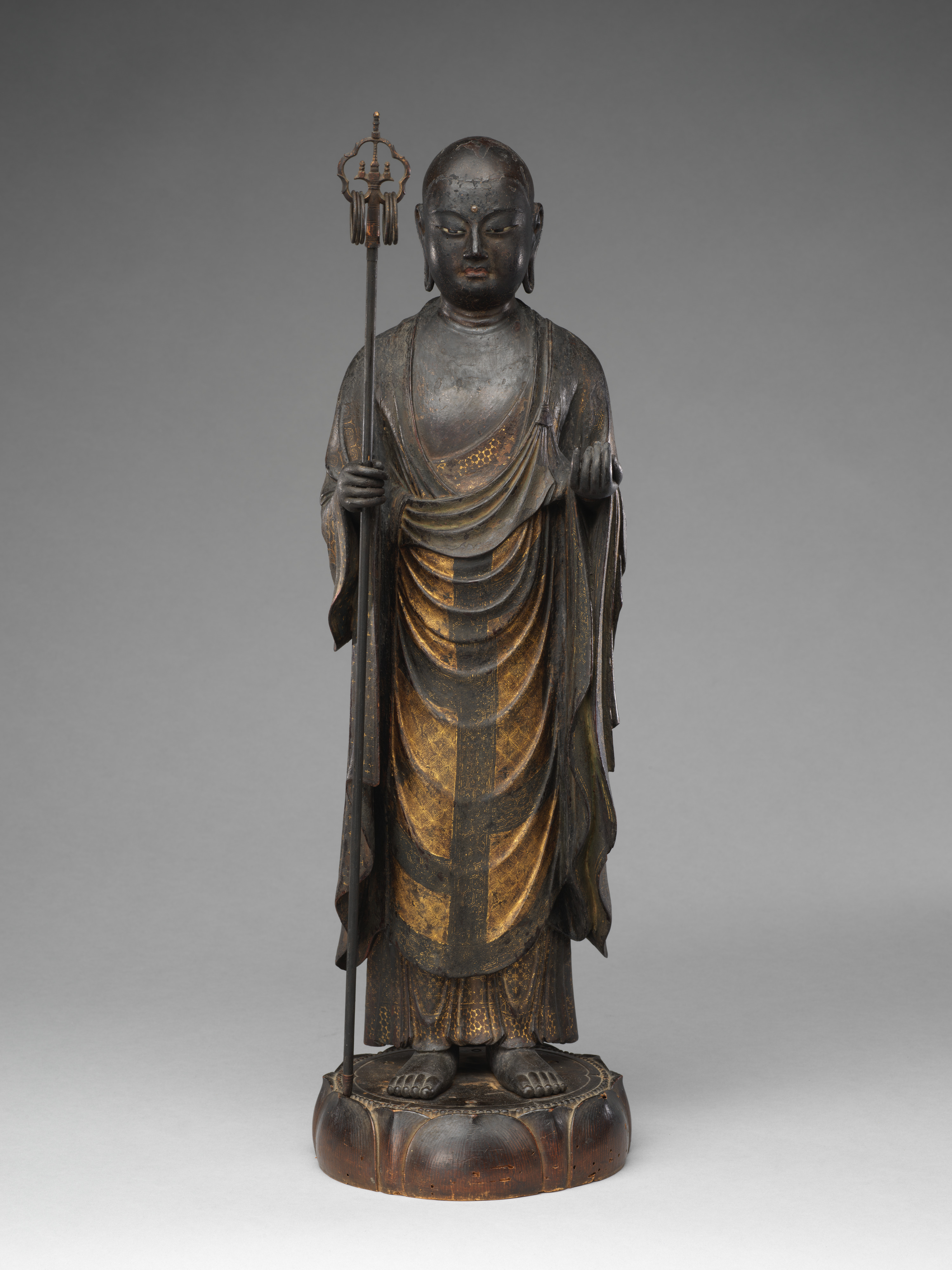
- Title
- Jizō Bosatsu (地蔵菩薩) — Kaikei, c. 1202, Met 2015.300.250a,b (Burke Collection)
- Period
- Kamakura period (1185–1333), c. 1202
- Region
- Yamato / Nara
- Medium
- Lacquered Japanese cypress (*hinoki*), color, gold, cut gold (*kirikane*), inlaid crystal (*gyokugan*); *yosegi-zukuri* joined-block construction with hollow interior
- Dimensions
- H. 55.9 cm; W. 17.1 cm; D. 17.1 cm; base diam. 17.1 cm
- Collection
- Metropolitan Museum of Art, New York (Burke Collection, 2015)
- Accession
-
2015.300.250a, b - Rights
- Public Domain. The Metropolitan Museum of Art, Mary Griggs Burke Collection, Gift of the Mary and Jackson Burke Foundation, 2015 (acc. 2015.300.250a, b). Met Open Access (OASC).
Kaikei, Jizō Bosatsu, c. 1202. Met 2015.300.250a,b. The inscription inside the figure attests Kaikei's hand; the visible surface argues for the dating: *An Amida Butsu* signature phase, *kirikane* cut-gold rigour, *gyokugan* crystal eyes.
The Met’s wall label says “Kaikei, c. 1202.” The inscription that backs that label is sealed inside the figure, in the hollow under the lacquered cypress shell. You cannot see it from the gallery floor. Most of the Met’s Japanese sculpture holdings are dated by stylistic argument; the Burke Jizō is dated by the wood it came carved with: by what the workshop placed in its body cavity in the early years of the thirteenth century, intending the inscription to outlast every viewer who would ever stand in front of the face.
That distinction matters because the Kamakura sculptural canon is unusually well-attested for early-medieval Buddhist art. The 1203 Tōdai-ji Niō, the 1212 Hokuendō Miroku, the Boston MFA Miroku of 1189: they share the Kei-school habit of placing nōnyū-hin (内納入品, body-cavity dedications) inside the figure: sutras, dedicatory inscriptions, sometimes a list of donors and the names of the carving team. These deposits convert stylistic argument into documentary attribution. The Burke Jizō is in that documented club. It is signed in the same idiom and the same hand-period as the Tōdai-ji Niō, completed the year after.
The inscription inside
The Met catalog entry, accessed via the Open Access API, gives the firm anchor: “Kaikei, c. 1202.” The Wikipedia Burke Jizō entry, which compiles the available scholarly references on this work, names the placement: an inscription on the interior of the figure identifies Kaikei as the carver. The exact transcribed text is not in the Met’s public-facing description; the inscription is documented in the conservation record rather than the catalog wall-text.
What the inscription does is collapse the dating argument to a single sentence. Without it, the work would still read as Kei-school early thirteenth century on stylistic grounds (the gyokugan crystal eyes, the kirikane cut-gold robe register, the yosegi-zukuri joined-block construction, the An Ami-phase facial type) all converge on the 1190s–1210s. With it, the date narrows to the same year as Kaikei’s documented work on the Tōdai-ji Niō.
This is the rarest kind of attribution evidence in Japanese Buddhist sculpture: a contemporary inscription by the workshop, naming the sculptor, placed inside the figure rather than visible on the surface. The reading does not depend on later scholarship. The inscription is the scholarship.
Carving the cypress
55.9 cm. That is the first physical fact, and it is the one most often skipped. The Burke Jizō is hand-portable scale: not architectural, not altar-presence scale, not the full-height standing Jizō you find in the principal hall of a Kōfuku-ji sub-temple. It is the size of an object that lived in a private chapel, on a portable altar, in a donor’s residence, or in a temple sub-hall niche where the worshipper stood close. The closeness is built into the carving choices.
Yosegi-zukuri, the joined-block construction, is the Kei-school workshop default by 1200. Multiple blocks of seasoned hinoki (Japanese cypress) joined along vertical lines, the interior hollowed out: partly to prevent cracking as the wood dries, partly to lighten the figure, partly to create a chamber for body-cavity dedications. The Burke Jizō does all three. The hollowing is what made the inscription possible.
The eyes are gyokugan: rock-crystal lenses set behind the carved face from the inside, the pupil painted on the back of the crystal in lacquer or ink, the iris colour set behind that. The technique enters Kei-school work in the 1170s (the earliest documented use is at Chōraku-ji, Nagano, in 1151) and by 1200 is universal in Nara-region sculpture. The effect is wet-eyed: the figure looks at you with a small refractive shift as you walk past, the way a real eye refracts light differently than a flat painted surface.
The robe surface is kirikane: cut gold leaf, applied in geometric registers (small squares, rectangles, fine diagonal hatch) over a lacquered ground. The cutting is done with a sharp blade and a steady hand, the leaf adhered with a thin animal-glue size. Anne Doran, writing in Tricycle Magazine, calls out the cut-gold register specifically: lacquered Japanese cypress, color, gold, and kirikane, inlaid with crystal. The kirikane on a 55.9 cm figure is finer than on a 2 m altar piece; the scale forces a smaller cut.
The hands hold the standard Jizō attributes: shakujō (錫杖) ringed staff in the right hand, cintāmaṇi (如意宝珠) wish-granting jewel in the left. The shaven head and the monk’s robes complete the canonical iconography. The general Jizō iconographic register is covered in the iconographic-reading guide and is not re-covered here. The point in this article is what Kaikei did with the canonical register, not what the canonical register is.
What Kaikei did is the body. Doran’s observation is exact: the figure is “gently curving … body tipped forward and shoulders set back.” The frontal pose is not flat. The torso leans forward at the waist, not aggressively, not dramatically, but enough that the figure addresses the viewer rather than standing aloof. The shoulders are pulled back into the upright register the way a monk’s shoulders pull back when standing patient and attentive. This is the Kei-school naturalism in miniature: an idealised body type, but the body type of a real person standing for a long time without strain.
An Amida Butsu (1192–1209)
Kaikei (active c. 1183–1223) signed his earliest extant work (the 1189 Miroku now at the Boston MFA) as “Busshi Kaikei” (仏師快慶), Buddhist sculptor Kaikei. The signature is on a sutra placed inside the figure’s cavity. Three years later, in 1192, on the seated Miroku at Daigo-ji Sanbōin, he changed his sign-off to An Amida Butsu (安阿弥陀仏), “An Amida Buddha,” the Sanskrit an written in bonji (Sanskrit-letter form). From 1192 until at least 1209, he used this as his artist-name (gō) on the works he wished to sign.
The Burke Jizō (c. 1202) sits in the middle of that seventeen-year An Ami phase. Mōri Hisashi’s Sculpture of the Kamakura Period (Weatherhill, 1974) is the standard English-language synthesis that consolidates the three-phase Kaikei chronology: early Busshi Kaikei before 1192, An Amida Butsu 1192–1209, later Hokkyō Kaikei after his elevation to the honorary monastic rank of hokkyō in 1210. The chronology is built from inscriptions (An Amida Butsu signed works versus Hokkyō Kaikei signed works), and the 1210 cutoff is the inscriptional anchor that divides the second phase from the third. The Burke Jizō falls cleanly in the second phase.
Why does the phase matter for what you see? The An Ami period is where Kaikei consolidates the technical signatures most legible in this figure: the rigorous kirikane register, the soft idealised face type that pulls back from the more dramatic gyokugan portraiture register Unkei was developing in parallel, the contained calligraphic line of the drapery. Kaikei in this phase is not the Niō Kaikei. The Niō are co-directed with Unkei, larger-than-life-scale, post-Heike-war public commissions for the Tōdai-ji rebuilding. The Burke Jizō is private-scale, single-author, devotionally interior: the same workshop hand, but the version of that hand that worked on commissions where the viewer would stand close.
Kōfuku-ji, Chōgen, and the Song current
The Burke Jizō was originally at Kōfuku-ji, the Hossō headquarters in Nara, the same temple whose Hokuendō programme (1208–1212) Unkei would carve a decade later. Kōfuku-ji had been burned in the 1180 Heike War alongside Tōdai-ji; the long Kamakura reconstruction provided the patronage corridor that employed both Unkei and Kaikei through the 1190s and 1200s.
The supervising priest of the Tōdai-ji rebuilding was Chōgen (重源, 1121–1206), who travelled to Song China three times before his appointment. Chōgen brought back continental architectural and sculptural conventions: the daibutsuyō (大仏様) timber construction, but also exposure to Song Buddhist painting and sculpture, and through that to a softer, more naturalistic body type than the Heian Japanese precedent had used. The Kaikei An Ami face (round, full-cheeked, slightly idealised) reads as one of the more direct absorptions of the Song body type into Japanese sculpture. The Wikipedia Burke Jizō entry names this lineage explicitly: the An Ami style is “influenced by Song dynasty art through abbot Chōgen’s China visits.”
Chōgen’s patronage circuit is the lever. Kaikei worked on Chōgen-supervised projects (the 1203 Niō documentary record names Chōgen as the supervising priest, and Kaikei as one of the named sculptors). The Burke Jizō, made at the same time and originally housed at the same temple complex, is the smaller private-scale companion to that institutional public work: a hand-scale Kaikei in the same year as the 8.4 m Niō.
After 1906: Galerie Janette Ostier, the Burkes, the Met
Kōfuku-ji deaccessioned the figure in 1906 under the long economic aftermath of the Meiji-period shinbutsu bunri (神仏分離, separation of Shinto from Buddhism, 1868) and haibutsu kishaku (廃仏毀釈, anti-Buddhist violence). The 1868–1875 expropriation wave is the better-known phase; the 1900s deaccessions are the long aftermath, when temples that had survived the immediate crisis still had to sell holdings to meet operating costs. Kōfuku-ji’s losses across that century are extensive. The Burke Jizō is one piece in a much larger diaspora.
After 1906 the figure moved through private collections in Japan and Europe. In April 1970, the type designer Jackson Burke (1908–1976) and his wife Mary Griggs Burke (1916–2012) acquired it from Galerie Janette Ostier in Paris. Ostier ran one of the principal Paris-based East Asian art galleries of the postwar period; the Burkes assembled their collection over the 1960s–1990s through Ostier and through New York dealers. On Mary Griggs Burke’s death in 2012, the collection was bequeathed in two parts (Japanese and Korean) to the Met and the Minneapolis Institute of Art. The 2015 accession year on the Met catalog reflects the formal transfer of title, not the date of last private ownership.
The Burke Collection acquisition is the third Met sub-collection of Japanese Buddhist sculpture, alongside the Packard Collection (entered in 1975) and the earlier nineteenth-century holdings. The 1975 Packard acquisition gives the Met its Heian Buddhist painting and Mikkyō handscroll spine; the 2015 Burke acquisition gives it the Kamakura sculpture spine. The Burke Jizō is one of the Kei-school anchors of that 2015 spine.
What stays open
What we have is firm: Kaikei, c. 1202, Kōfuku-ji originally, signed inside, An Ami phase, 55.9 cm lacquered hinoki with gyokugan and kirikane.
What we do not have is the original altar context. Was the figure a single private commission for a Kōfuku-ji donor? Was it part of a paired Jizō-Kannon set, of which the Kannon is now lost or held elsewhere? Was it the principal figure of a small sub-hall or one figure in a multi-figure altar? The Met catalog is silent on this. The Wikipedia entry is silent. The 1906 deaccession records (if Kōfuku-ji retains them) would be where to look; they are not in the published English-language scholarship at the time of writing.
There is also the question of the exact inscription text. The Wikipedia entry says the inscription identifies Kaikei. The Met API entry confirms the c. 1202 dating that the inscription would support. Whether the inscription gives an exact day, names a donor, names a dedicatee, or specifies the original altar context: none of that is in the public record. A conservation report on the figure (Met conservation, presumably internal) would carry the answers. Until that record surfaces in published form, the Burke Jizō dating reads as inscription-attested-c.-1202, with the inscription’s full content held in reserve.
The work is firm enough to anchor the Kei-school chronology. It is open enough that the next decade of scholarship could deepen it considerably.
Related
- A standing Kamakura Jizō at adult-eye-level, Rogers Fund 1918
- Tōdai-ji Nandaimon Niō, 1203: the documented Unkei-Kaikei collaboration carved the year after the Burke Jizō.
- Kōfuku-ji Hokuendō Mujaku, c.1212: the Kōfuku-ji late-Unkei programme a decade after the Burke Jizō was made for the same temple.
- Sanjūsangen-dō Tankei Senju Kannon, 1254: the Kei school’s monumental late bookend, by Kaikei’s contemporary’s son.
- Hōryū-ji Kondō Shaka triad, 623: the Asuka starting position against which the Kamakura naturalistic mode reads as departure.
- Cleveland 1983.75 Jizō welcoming descent: Jizō in the substituted-bodhisattva raigō tradition.
Sources
-
[1]2026-05-12The Metropolitan Museum of Art, New York collectionapi.metmuseum.org/public/collection/v1/objects/53175Met Open Access API entry. Confirms: accession 2015.300.250a,b; period Kamakura; date c. 1202; lacquered hinoki + color + gold + cut gold + inlaid crystal; 55.9 × 17.1 × 17.1 cm with base diam. 17.1 cm; public domain (CC0); credit line 'Mary Griggs Burke Collection, Gift of the Mary and Jackson Burke Foundation, 2015'. The direct www.metmuseum.org/art/collection/search/53175 URL could not be retrieved; the Open Access API returns the same record.
-
Source for: original Kōfuku-ji provenance; 1906 temple deaccession under the long Meiji *shinbutsu bunri* / *haibutsu kishaku* aftermath; April 1970 Burke acquisition at Galerie Janette Ostier, Paris; 2012 bequest to the Met realised in 2015. Also flags the *An Ami* phase (1192–1209) context and the Chōgen / Song-dynasty patronage circuit.
-
Names the work — 'Standing Jizo Bosatsu by Kaikei. Kamakura period, c. 1202.' Doran's observation that the figure is 'gently curving … body tipped forward and shoulders set back' is the load-bearing physical reading for the patient-observer section here. Also gives the Anne Doran citation rather than a generic critic-quote.
-
Kaikei's earliest extant signed work — also from Kōfuku-ji originally. Signed 'Busshi Kaikei' (仏師快慶) in a sutra placed inside the cavity, pre-dating the *An Amida Butsu* artist-name adoption that begins with the 1192 Daigo-ji Sanbōin Miroku. The Boston Miroku gives the *terminus post quem* for any Kaikei phase-chronology argument.
-
Standard English-language synthesis of Kamakura sculpture; the volume that consolidates the three-phase Kaikei chronology (early *Busshi Kaikei* signed phase pre-1192; *An Amida Butsu* phase 1192–1209; later *Hokkyō Kaikei* phase). Cited at work level; page numbers not verified against a library copy.
-
Temple of original housing for the Burke Jizō before the 1906 deaccession. The Burke Jizō is not currently listed in Kōfuku-ji's published holdings — it is in the diaspora that left the temple between 1868 and the early twentieth century.