The Kannon that carries the lotus dais
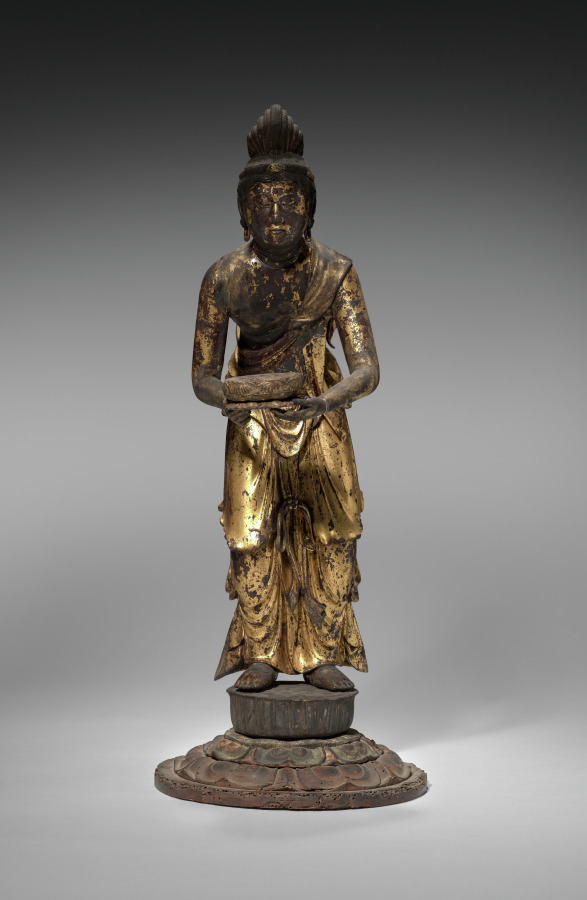
- Title
- Kannon (観音菩薩像)
- Period
- Kamakura
- Medium
- Wood with lacquer and gold leaf
- Dimensions
- With base: 69.2 × 27.7 × 29 cm. Without base: 59.1 × 18.8 × 28 cm.
- Collection
- The Cleveland Museum of Art
- Accession
-
1919.913 - Rights
- Public domain (Cleveland Museum of Art Open Access, CC0). Accession 1919.913. Gift of Ralph King, 1919.
Standing Kannon. Japan, Kamakura period (1185–1333), early 1200s. Wood with lacquer and gold leaf; 59.1 × 18.8 × 28 cm (without base). The Cleveland Museum of Art, Gift of Ralph King, 1919.913. Public domain (CC0).
The attendant left behind
Cleveland 1919.913 is a Kannon who has lost the rest of her programme. The figure stands at c.59 cm without the base, in early-Kamakura wood, with lacquer surfaces and gold-leaf overlay, and she holds a wide flat lotus dais (rendai) at the chest with both hands. The dais is the canonical attribute of the Pure Land raigō Kannon: the platform on which the soul of the dying believer is to be carried up into the western paradise, in the moment Amida descends through the cloud-cover to receive the faithful at the threshold of death.
In a complete raigō triad — the Met’s separately-displayed 12.134.17-18 attendant pair is the most familiar American example — the Kannon with the lotus dais stands or kneels at the viewer’s left; the Seishi with hands folded in gasshō stands at the viewer’s right; a central Amida, larger than the attendants, stands or sits behind them and performs the welcoming-descent mudra (raigō-in). The triad is iconographically incomplete without all three figures. Cleveland 1919.913 is, by itself, a fragment.
What happened to the Amida and the Seishi is not, in the published Cleveland Open Access record, documented. The provenance traces back through Mrs. Henry Golden Dearth and Ralph King (the early-20th-century New York collector and Cleveland trustee through whose 1919 gift the work entered the museum) but does not extend back into a documented temple of origin. The likeliest interpretive frame: a Kamakura-period workshop triad was dispersed across the late-19th- or early-20th-century Japanese art market, the three figures were sold separately or the Amida and Seishi were lost to fire or to deaccession, and only the Kannon-with-dais survived to enter the Western collection.
Reading the figure
The body is tall and slender. The hips do not break — the figure stands frontally, weight distributed even between the two feet — but the body is softer than the Asuka and Hakuhō tradition would carve it: there is a slight lateral movement at the shoulders, the head inclines toward the dais at the chest, the long sleeves cascade in continuous vertical falls down the front of the body. The drapery is rendered in the late-12th-to-early-13th-century vocabulary the Kei school had refined out of the inherited Heian convention: parallel folds at the chest, edge-broken folds across the lower body, the surface preserving the rhythm of the carving rather than smoothing it out.
The face is small in proportion to the body. The eyes are nearly closed, the mouth a small horizontal line, the cheeks soft. The hair is dressed in the high coiled chignon the standard Kannon figure carries, with the Amida-image in the centre of the headdress — the canonical iconographic attribute that disambiguates Kannon from other bodhisattvas in the Amida-attendant register. The gilding on the figure is partial: the gold-leaf overlay has lifted across the centuries from the high-relief surfaces (the cheeks, the knees, the chest-band) and the underlying lacquer ground is visible across about a third of the figure’s surface.
The lotus dais is the load-bearing iconographic detail. It is a wide flat platform with three tiers of lotus petals carved into its underside, and the figure carries it forward from the chest with both hands at the same level — not raised in offering, not lowered in supplication, but held out at chest height, as if presenting it to a viewer standing at the figure’s eye-level. The reading the position invites is the moment in the descent: Kannon has descended with Amida and Seishi to the bedside of the dying believer, and the dais is the platform onto which the soul is about to step. The figure is not finished with the rite. She is in the rite.
The triad-fragment as a category
Across the Pure Land sculpture corpus in American museum collections, triad-fragment — a surviving attendant separated from its programme — is a recognisable subcategory. The Met’s 12.134.17-18 pair, separated from its Amida; the Cleveland 1919.913 Kannon, separated from both Amida and Seishi; comparable single attendants in the Asian Art Museum (San Francisco), the Freer-Sackler, and the Boston Museum of Fine Arts — together they form a sub-corpus of figures that were made to be read in triadic configuration and that now are read individually.
What the dispersal of the triads costs, iconographically, is the central narrative. The raigō programme is a moment-of-descent: Amida arrives, the attendants accompany, the dais collects the soul, the descent completes. Reading a single attendant without the rest of the cast collapses the moment into a fragment that no longer narrates. The viewer sees Kannon-with-dais but does not see what the dais is for; sees the inclined head but does not see what the head is inclined toward; sees the figure descending without the descent.
Reading 1919.913 against the Met 12.134.17-18 attendant pair
The Met’s 12.134.17-18 is the closest American comparandum. The two works are: both Kannon-with-dais attendants from Pure Land raigō programmes, both early-Kamakura, both wood with lacquer and gold-leaf overlay, both at near-comparable scale (the Met’s Kannon is 70.5 cm tall, similar to Cleveland’s 59 cm; the Met’s Seishi is 71.1 cm). The Met pair retains its co-attendant; Cleveland’s Kannon does not. Both pairs/figures have lost their central Amida.
What the side-by-side establishes is that the loss of the central Amida is the common condition. The triad-fragment subcategory exists because the central image was, in the dispersal patterns of the late-19th-century Japanese art market and in the workshop-replacement patterns of the temple sub-corpus, the figure most likely to be retained by the temple of origin (as the institution’s primary devotional image) and the attendants most likely to be sold off or lost. The pattern is asymmetric: an Amida-central figure survived more often than its attendants; the attendants survived only sometimes, and only sometimes together.
Read this way, the Met-12.134.17-18-and-Cleveland-1919.913 triangulation positions Cleveland’s Kannon as the more fragmentary of the two: not just separated from the central Amida, but separated also from its co-attendant Seishi. The triad survives, in the Cleveland holding, as a single bodhisattva carrying out a moment of the rite that the rest of the cast was once present for.
Ralph King and the 1919 gift
Cleveland 1919.913 entered the museum through a Ralph King gift in the museum’s second decade (the institution opened 1916). King was the early Cleveland board’s most active Asian-art collector and donor; the King-gift Japanese sculpture cohort of the late 1910s and 1920s established the foundational holdings the museum’s Japanese galleries are built around. The 1919 acquisition occurs roughly contemporary with the Met’s 19.140 Amida acquisition (Rogers Fund, 1919) — the same year — and within the same broader American institutional moment in which Kamakura Pure Land sculpture was entering American museum collections from the dispersing Japanese art market.
The provenance line traces back from King through Mrs. Henry Golden Dearth — Cornelia Brown Dearth, the New York collector whose late husband Henry (1864–1918) was an American Tonalist painter. Mrs. Dearth held the figure and other Asian-art objects from her husband’s collection through the 1910s. King’s acquisition from her or her estate is the link by which 1919.913 enters Cleveland. Beyond Mrs. Dearth the line is unknown.
The institutional moment is worth marking. 1919 is the year Fenollosa-circle Buddhist-art collecting reaches its earliest U.S.-museum endpoint: Cleveland 1919.913 enters Cleveland, Met 19.140 enters the Met, the Boston MFA’s Okakura-curated Japanese galleries are at their first generation of consolidation. The infrastructure under which American museums can hold Kamakura Pure Land sculpture is constructed in those years. Cleveland 1919.913 is a load-bearing piece in that construction.
What stays open
Three things stay open as the draft closes.
The first is the figure’s temple of origin. The provenance line does not extend back to a documented Japanese temple, and the figure is not inscribed. Whether the dispersal was caused by haibutsu kishaku (the early-Meiji anti-Buddhist sanctioning of the 1870s, which forced many temples to deaccession holdings), by 20th-century fire-loss of the rest of the programme, or by another dispersal cause is undeterminable from the open record. Cleveland’s Bulletin may carry more detail than the Open Access record exposes.
The second is the attribution. The figure is “early 1200s” and “Kamakura period” in the Cleveland record but not attributed to a workshop, a maker, or even a regional tradition. The Kei-school framing in this article is consistent with the figure’s stylistic vocabulary but is not, from the open record, supportable as a Tier-1 claim. A close workshop-attribution analysis would require either inscription evidence (absent) or comparative technical/conservation analysis the article does not currently have access to.
The third is the lotus-dais sub-iconography. The figure holds the dais at chest height with both hands. Kannon-with-dais figures across the raigō corpus hold the dais at varying heights and with varying gestural emphases — at the chest, raised toward the viewer, lowered toward the believer, presented in profile. The specific gestural variant in 1919.913 — straight-out at the chest, both hands at the same level — places the figure at a specific moment in the rite that the literature has not, to current published knowledge, systematically catalogued. The variant question is worth flagging for a future cross-corpus survey.
Sources
-
Cleveland Open Access CC0. Provenance: Mrs. Henry Golden Dearth → Ralph King → CMA 1919.
-
Comparandum: a documented Kamakura attendant pair that survived together; cited in §3 and §5.
-
Standard English-language source on Kamakura sculpture; the Kei-school and yosegi-zukuri scaffolding.
-
Acquisition-history and attribution scaffolding for Kamakura works in U.S. museums; cited at work level.
-
Kei-school context for the early-Kamakura attribution range.
-
Cited at series level; the specific 1919 or later bulletin entry for 1919.913 has not been located and is the likely source of further provenance or attribution detail.