Kirikane on a Kamakura bodhisattva: Cleveland 1983.18 and the cut-gold tradition
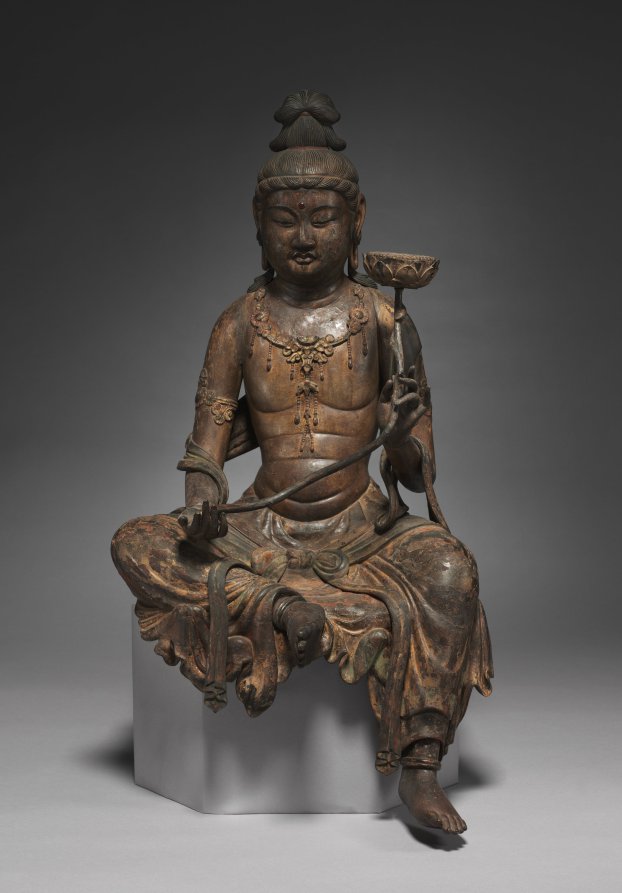
- Title
- Bodhisattva (菩薩立像)
- Period
- Kamakura period (1185–1333), mid-1200s
- Region
- Japan
- Medium
- Wood with traces of lacquer, polychromy, and cut gold leaf (kirikane)
- Collection
- Cleveland Museum of Art
- Accession
-
1983.18 - Rights
- CC0 (Cleveland Open Access). Leonard C. Hanna Jr. Fund.
Cleveland 1983.18: Bodhisattva. Wood with traces of lacquer, polychromy, and cut gold leaf (kirikane); Kamakura period, mid-1200s. Leonard C. Hanna Jr. Fund. CC0 (Cleveland Open Access).
Cleveland 1983.18 is a mid-1200s Kamakura wood bodhisattva preserving kirikane (切金, cut-gold leaf) along its textile-fold edges and hem-borders. Hairline strips and minute geometric shapes of beaten gold, adhered with bamboo and seaweed-glue tools, were the surface signature of the most expensively patronized In-school and Kei-school workshops of the period.
What the photograph shows
The figure is a seated bodhisattva in royal-ease posture — lalitāsana in the Indian iconographic terminology, hankafuza (半跏趺坐, half-lotus seated) or yugaza (royal ease) in the Japanese sculptural literature — with the left leg pendant from a rectangular wood plinth and the bare left foot resting at the front edge of the platform. The right leg is bent in front of the body with the right knee raised and the right foot tucked under the opposite thigh. The bodhisattva’s body is upright through the torso, head slightly inclined forward, gaze directed downward toward a viewer at the foot of the platform.
The body is bare from the waist up. This is bodhisattva attire in the Mahāyāna iconographic register — princely, not monastic — distinct from the monk-robed Jizō or the fully-clothed Buddha figures with which Kamakura sculpture more commonly populates a temple altar. The torso shows the Kei-school anatomical concern: pectoral muscle clearly modelled, clavicle defined under the skin, abdominal divisions read as low-relief rather than as carved decoration.
Across the bare chest hangs an elaborate jewelled programme: a thick rope-or-chain necklace with a central pendant, a lower necklace with multiple short-chain pendants and a heavier central drop, and a thin scarf or sash crossing the body diagonally over the right shoulder. The arms wear bossed armbands at the upper arm and at the wrist. The lower garment is a draped dhoti-form skirt that pools across the throne in the long vertical folds of the front and falls away in deep diagonal folds at the figure’s right side, with the foot-end of the garment extending forward across the top of the plinth.
The hands carry the iconographic programme. The figure’s left hand is raised at chest height and grips the long stem of a lotus; the lotus rises beside the left shoulder and opens into a chalice-shaped blossom or bud at the level of the head. The right hand rests on the right knee, palm-up, holding what appears to be a small object — at the photograph’s resolution the object reads ambiguously, possibly as a residual fragment, possibly as a wish-jewel (nyoi-hōju) or other small attribute.
The lotus-on-stem in the left hand is the diagnostic attribute. Among the Kamakura iconographic vocabulary, the long-stem lotus is the standard attribute of Kannon (Avalokiteśvara) in his various meditative seated forms; the seated royal-ease posture is consistent with the Suigetsu (Water-Moon), Yōryū (Willow), or generic-meditative seated Kannon variants. We hedge specific identification — the Suigetsu Kannon would more typically be paired with a moon-disc or a body of water, the Yōryū with a willow rather than a lotus, the Nyoirin most commonly with six arms — but the figure is most plausibly a two-armed Kannon in the seated meditative register, possibly from a triad context (Kannon and Seishi flanking Amida, with Kannon distinguished by the lotus and Seishi by the water-vessel).
The surface is the article’s subject. Polychromy survives in fragments over a urushi-lacquered ground; the lacquer reads dark amber-brown across the bare torso and the lower garment. Red and warm-orange pigment traces persist in the recesses of the carved drapery folds and across the underside of the chest scarf.
The most legible surviving surface decoration is the kirikane — gold-leaf patterning that has held in the recesses where the lacquer-binder bonded it most firmly to the wood. Visible kirikane reads at the catalog photograph’s resolution on the headband across the brow, on the upper-arm and wrist armbands, on the central pendants of the necklace, and along the curving hem-edges of the lower garment where the textile-fold turns over.1
The motif vocabulary is not fully resolvable: small geometric primitives (lozenges, dots) and short linear strips can be read on the armbands and headband; longer linear edge-strips run along the necklace pendants and the lower-garment hem. The most ambitious motifs (the floral medallions and the figural roundels that the touchstone Kei-school figures preserve) are not legible at the publication resolution, but the technique’s diagnostic signature is present.
The hair is dressed in a tall topknot bound with a thin band, with strands falling behind the ears and curving over the shoulders. The brow shows a small jewelled urna at its centre. The crown / hair-band area is the densest surviving zone of kirikane on the figure; whether the front of the topknot once carried a small Amida emblem (the diagnostic ornament that would lock the identification to Kannon, who carries Amida in his crown) is not securely visible at the publication resolution.
The face is full and slightly squared in the Kei-school manner, eyes downcast under heavy lids, mouth small with surviving dark-red lip pigment. The earlobes are elongated, modelled in the standard bodhisattva long-ear convention.
What the photograph does not resolve. The construction technique is not specified in the catalog record (whether the figure is yosegi-zukuri joined-block or ichiboku-zukuri single-block); on stylistic and chronological grounds, yosegi-zukuri is the most plausible inference for a seated figure of this scale.2 The interior cavity is not described.
No specific identification of which bodhisattva is depicted appears in the published descriptive text — Cleveland records the work simply as “Bodhisattva” — so the article’s Kannon inference, drawn from the lotus attribute and the seated meditative posture, is hedged rather than committed. The hands and the small object in the right palm cannot be read with full confidence: extremities on Kamakura wood bodhisattva figures are frequent restoration sites, and whether the present hands and the object they hold are original or replacement is not addressed by the catalog.
The pose, the proportions, the elaborate Kei-school chest ornament programme, and the sumptuous polychromy-and-kirikane surface programme all place the figure within the post-Unkei Kamakura sculptural mainstream at the elite-finish patronage tier; that frame is what the article reads against.
What kirikane is and how it was made
Kirikane (切金, also written 截金) is the technique of decorating a finished surface (most commonly a lacquered or pigment-prepared ground on Buddhist sculpture or painting) with extremely thin gold leaf cut into hairline strips and minute geometric or floral shapes, applied as a linear pattern across the surface field. The technique distinguishes itself from two adjacent surface-decoration practices: from the broad kindei (gold-pigment) wash, which is a paint-application of powdered gold suspended in a binder; and from the foil-pressing of intact gold leaf across whole surfaces, which produces the gilded ground that reads as a continuous reflective field. Kirikane is the linear, drawn application: a pattern made by laying many small pieces of gold leaf in a designed field, not a wash and not a continuous coat.3
The workflow is documented in the contemporary practice of the Tobunken (Tokyo National Research Institute for Cultural Properties) conservation programme and in the inherited working method of the late Eri Sayoko (江里佐代子, 1945–2007), the kirikane Living National Treasure designated by the Japanese government in 2002.4
Two sheets of gold leaf are pressed together with adhesive between them and burnished to produce a double-thickness leaf strong enough to handle without folding. The double leaf is then cut, on a soft cutting-pad (traditionally a deer-hide or leather block), with a bamboo knife held at low angle, into hairline strips of consistent width and into geometric primitives: diamonds, lozenges, small circles, floral elements. The cutting tool is bamboo, not steel: the bamboo edge is sharp enough to part the leaf cleanly and soft enough not to drag the leaf out of register.
The leaf elements are then transferred to the prepared surface with a hair-tipped brush charged with funori (布海苔), a binder made from boiled red seaweed (Gloiopeltis) reduced to a viscous solution, often in combination with nikawa (animal-skin glue). The funori-nikawa binder bonds the leaf to the lacquered ground through capillary action and surface tension as the binder dries; the leaf is positioned in the pattern with the brush, pressed gently into place, and burnished to set.
The pattern field is built one piece at a time. A medium-density floral-medallion pattern across the textile-fold edge of a Kei-school standing bodhisattva might require several thousand leaf pieces, each cut and placed by hand; the labor cost is the technique’s signature.
The diagnostic motifs are limited and consistent across the medieval corpus. The lozenge-grid (a diagonal-crossing pattern of straight strips) and the lattice-grid (a square-crossing pattern) are the most common field-patterns. The hōsōge (宝相華) floral medallion, a stylized rosette derived ultimately from Tang Chinese silk patterns, is the canonical floral element. The karakusa (唐草) scrolling-vine pattern is the canonical linear motif.
Figural roundels containing miniature bodhisattvas, lotus blooms, or auspicious symbols are reserved for the most ambitious commissions. The motifs are typically applied to the textile-fold edges of the carved drapery, the hem-borders of the lower garment, the rim of the halo and the mandorla flames, and the painted ground behind the figure.5
The technical-finish placement is governed by a logic the article calls visual-economy. The kirikane is laid where the carved sculptural surface invites a linear decoration: along the edges where one drapery-fold meets another, along the lower hem where the garment terminates, along the rim of the halo where the gold-leaf flame-pattern of the mandorla begins. These are the surface-zones where the eye, tracking the figure, naturally pauses; the kirikane works the pause.
The technique is not used to gild a figure (the figure may be polychromed or left in lacquered black); it is used to draw lines of gold across the polychromy or the lacquer, in a designed field-pattern that the patient looker resolves into a recognizable motif vocabulary.
In-school and Kei-school: workshop versus tier
The institutional question that the surviving kirikane corpus poses is whether the technique signals a particular workshop lineage or simply a particular tier of patronage. The two readings produce different cluster-maps of the surviving corpus and different inferences about Cleveland 1983.18.
The workshop reading. The In-school (院派, In-pa) and the En-school (円派, En-pa), the two principal late-Heian Buddhist sculpture lineages descended from the eleventh-century master Jōchō (定朝, d. 1057), held the dominant Kyoto aristocratic and high-clerical commissions through the Heian. Jōchō’s atelier developed the yosegi-zukuri (joined-block) construction system that allowed the production of larger figures with thinner walls, and the surface-decoration discipline that the late-Heian aristocratic patrons commissioned for those figures included kirikane as a standard high-end finish.
The In-school continued the Jōchō tradition into the Kamakura, particularly in the Kōya-san and Mt. Hiei programmes; the Kei-school (慶派, Kei-pa), the parallel Nara-based lineage descended from Kōkei, with Unkei (運慶, ca. 1150–1223) and Kaikei (快慶, active ca. 1183–1223) as its leading second-generation sculptors, emerged at the Tōdai-ji and Kōfuku-ji rebuilding programmes after the 1180 Taira burning and inherited the late-Heian technical-finish standards.6
On the workshop reading, kirikane on a Kamakura figure attests Kei-school or In-school workshop participation; the technique is the workshop’s surface signature.
The patronage-tier reading. The alternative reading is that kirikane was not a workshop secret but a tier-of-finish question: the technique was available across the late-Heian and Kamakura sculptural establishment, but it was so labor-intensive that only the wealthiest patrons (the imperial-court aristocracy, the senior Hokke, Kōya-san, and Mt. Hiei clerical houses, the early Kamakura shogunal house, the Hōjō regents’ commissions) could afford to commission it. On this reading, kirikane on a Kamakura figure attests not workshop affiliation but patron tier; the technique is the patron’s signature, not the sculptor’s.
The two readings are not mutually exclusive. The Kei-school workshops at Tōdai-ji and Kōfuku-ji were precisely the workshops that received the highest-tier patronage of the period (the Tōdai-ji reconstruction was directed by the monk-administrator Chōgen under imperial-and-shogunal patronage, and Rosenfield’s Portraits of Chōgen documents the institutional pipeline by which the technical-finish standards of the late Heian aristocratic workshops were carried into the Kamakura sculptural establishment).7
The Kei-school sculptors and the imperial-tier patrons reinforced one another: the patrons sought the Kei workshops because the Kei workshops could deliver the surface-finish discipline that patron-tier required, and the workshops developed that discipline because the patrons paid for it. To assign kirikane to one or the other is to draw a false distinction within an institutionally-coupled system.
What the distinction does mean for the Cleveland figure is this. Without an attribution to a specific workshop or to a specific patron, the kirikane on Cleveland 1983.18 attests participation in the patronage-and-workshop tier: a figure commissioned at the elite-finish standard, by a patron who could pay for it, executed by a workshop equipped to deliver it. Whether that workshop was Kei, In, or En, and whether the patron was imperial-court, regent-house, or temple-clerical, are open questions that the published record does not resolve. The Kei-school inference is the most plausible chronologically (the Kei workshops dominated the mid-thirteenth-century sculptural production), but the inference is hedged in the absence of inscriptional or interior-deposit evidence.
The reference figures: Kōfuku-ji Hokuendō Jizō, Tōdai-ji Sangatsudō Shukongōjin, Sanjūsangen-dō Tankei chief Senju Kannon
Three surviving figures with intact kirikane are the touchstone references against which the Cleveland surface programme is read. Each illustrates a different point in the kirikane chronology and a different state of preservation; together they bracket what the technique looked like at its most ambitious in the periods immediately preceding and contemporaneous with the Cleveland figure.
The Kōfuku-ji Hokuendō Jizō Bosatsu, attributed to Unkei and produced as part of the 1208–1212 Hokuendō rebuilding programme at the Kōfuku-ji in Nara, is the Kei-school touchstone for kirikane on a standing bodhisattva. The figure preserves cut-gold patterning along the hem-borders of the monk-robe and across the textile-fold edges of the inner garment in lozenge-grid and karakusa scrolling-vine motifs.8 The figure is dated to within four years by the Hokuendō building-history, attributed to Unkei by inscriptional and stylistic evidence, and preserved in essentially the state in which it was originally finished. It is the single most important surviving Kei-school figure for the kirikane question because it ties a specific technique to a specific master sculptor in a specific year.
The Tōdai-ji Sangatsudō Shukongōjin is the technical baseline. The Shukongōjin (執金剛神) is a wrathful guardian figure traditionally dated to the Nara period; the Sangatsudō (Hokkedō, 法華堂) was founded in 733 and the figure may date to that foundation, with subsequent kirikane refreshment in later restorations.
The figure preserves an exceptionally well-documented programme of cut-gold patterning across the armor and skirt textile-folds; its survival in such a state is owed to its hibutsu (秘仏, “hidden Buddha”) status with restricted access across more than a millennium. The figure is the canonical reference in the conservation literature for the kirikane technique at its most ambitious and most fully preserved.9
The Cleveland figure is six centuries younger and has not had the protective hibutsu seclusion; the comparison frames the Cleveland kirikane as the surviving partial witness to a programme that, in optimal conditions, looked more like the Sangatsudō Shukongōjin.
The Sanjūsangen-dō chief Senju Kannon by Tankei is the contemporaneous Kei-school anchor. Tankei (湛慶, 1173–1256) was Unkei’s eldest son and the leading Kei-school sculptor of the post-Unkei generation; the chief Senju Kannon is dated 1254 by the inscriptional record, contemporaneous with the dating of Cleveland 1983.18 (mid-1200s). The Tankei figure preserves kirikane on the chest scarf (jōbaku) and along the hem-edges of the lower garment in geometric diamond-grid and floral-medallion motifs.10
The chronological alignment is the closest among the surviving Kei-school touchstones; if Cleveland 1983.18 is a Kei-school figure (the most plausible workshop inference), it is closest in date and in workshop generation to the Tankei chief Senju Kannon. The kirikane vocabulary on the two figures is consistent within the limits of what the Cleveland photograph resolves.
Two further references frame the corpus. The Kaikei Amida and bodhisattva figures at Anyō-in, Hōkongō-in, and across the Kaikei corpus carry kirikane in similar motif programmes; the Kyoto National Museum’s 2017 monographic Kaikei exhibition documented the surface-decoration practice across the Kaikei attribution corpus.11
The In-school figures associated with the Kōya-san and Mt. Hiei programmes, exhibited periodically at the Nara National Museum, supply the parallel late-Heian and early-Kamakura In-school witness against which the Kei-school surface programme reads as the inheritor of an established discipline rather than the originator of a new one. The kirikane vocabulary across the In-school and Kei-school corpus is largely shared; differences are in motif density and placement-economy, not in technique.
Reading Cleveland 1983.18 against the touchstones
The Cleveland figure is anonymous, undated more precisely than mid-1200s, and uninscribed (or, more accurately, no inscription is published in Cleveland’s catalog text). What can be committed to and what must be hedged falls into three layers.
What is committed. The surface programme is securely a kirikane programme in the late-Heian and Kamakura technique: cut-gold leaf laid across the headband, the upper-arm and wrist armbands, the necklace pendants, and the curving hem-edges of the lower garment, in linear field-patterns of the standard motif vocabulary. The technique places the figure within the elite-finish patronage tier of mid-thirteenth-century Kamakura sculptural production.
The Kamakura wood-and-lacquer construction discipline, the polychromy-on-lacquered-ground programme of which the kirikane is the gold-leaf component, and the figure’s stylistic position in the post-Unkei sculptural mainstream are all consistent with the catalog’s mid-1200s dating. The medium recorded by Cleveland (wood with traces of lacquer, polychromy, and cut-gold leaf) describes the standard Kei-school finish-stack: carved wood (most plausibly yosegi-zukuri joined-block) coated in urushi lacquer, painted with mineral pigments suspended in glue, and finished with kirikane over the polychromy and lacquer.
The seated royal-ease posture, the bare torso with elaborate bodhisattva ornament, the lotus held in the left hand, and the small object resting in the right palm are consistent across the Kei-school seated-Kannon corpus.
What is plausibly inferred but not committed. The workshop is most plausibly Kei-school on chronological and stylistic grounds. The Kei-school workshops dominated the mid-thirteenth-century sculptural production, the surface-decoration discipline of the Kei workshops included kirikane as a standard high-end finish (per the Kōfuku-ji Hokuendō Jizō, the Sanjūsangen-dō Tankei chief Senju Kannon, and the Kaikei attribution corpus), and the Cleveland figure’s sculptural mode is consistent with the Kei-school visual programme. The In-school inheritance is the next-most-plausible alternative; the En-school is a possibility but a less likely one for a mid-thirteenth-century figure of this scale and finish.12
The identity of the figure is most plausibly Kannon (Avalokiteśvara) in a two-armed seated meditative register, on the basis of the long-stem lotus held in the left hand — the standard Kannon attribute — and the bare-chested bodhisattva-attired body, which excludes the monk-robed Jizō and the fully-clothed Buddha forms. Whether this is a Suigetsu (Water-Moon), Yōryū (Willow), or generic seated Kannon, and whether the figure was originally a freestanding image or one element of a triad, are open questions.
What is open. The specific Kannon variant cannot be securely determined; the confirming attribute that would lock the identification to a named Kannon form (a moon-disc-and-water for Suigetsu, a willow stalk rather than a lotus for Yōryū, the wish-jewel for Nyoirin, or a small Amida-Buddha emblem in the topknot to confirm Kannon at the level of category) is not securely visible. Cleveland records the work simply as “Bodhisattva,” and the article’s Kannon inference is hedged at the variant level even where it is plausible at the category level.
The temple-of-origin is unknown; no published provenance chain pre-dates the 1983 Hanna Fund acquisition. The interior-deposit state is unrecorded. The original polychromy programme (the ground colour of the body, the pigment identity of the lower garment, the trim colours of the hem) is partially recoverable from the surviving traces but not reconstructable to a high-confidence original-state reading without a Cleveland-published technical-study report.13
What the Cleveland figure offers, then, is a partial witness to the Kei-school surface-decoration discipline as practised at the elite-finish patronage tier in the mid-thirteenth century: enough kirikane survives to attest the technique and the workshop tradition, not enough to attribute the figure to a specific master or temple.
The figure is one of a small group of seated Kamakura bodhisattva figures with surviving kirikane in U.S. museum collections; it is more interesting than most because the kirikane is comparatively legible across multiple zones (headband, armbands, necklace pendants, hem-borders) and because Cleveland’s catalog records the technique by name. Most museum catalog records of comparable figures describe only “polychromy” or “lacquer with traces of gilding” without naming kirikane specifically; the catalog’s specificity is itself a curatorial choice that supports the article’s reading of the figure.
Related
- Raijin in pine — Cleveland 1972.64, a Kamakura storm god separated from Fūjin
- Prince Shōtoku at age two: Cleveland 1989.76
- The White Path between Two Rivers
- Nanbokuchō raigō: the twenty-five bodhisattvas
- Yakushi and the Twelve Generals
- Nikkō Bosatsu: Yakushi attendant
- Cinerary urn with Amida: a Heian bronze
Footnotes
-
The asymmetry of survival — kirikane intact in the carved recesses, polychromy worn from the prominences — is the standard pattern for Kamakura wood-and-lacquer bodhisattva figures across U.S. museum collections. The lacquer-bound gold leaf bonds more firmly to the wood substrate than the upper pigment layers, and the carved recesses are mechanically protected from handling-wear; the result is that on heavily worn figures the kirikane often reads more legibly than the polychromy that originally surrounded it. ↩
-
Construction technique on Cleveland 1983.18 is not specified in the catalog record. On the basis of mid-thirteenth-century Kamakura standing-bodhisattva sculptural practice, yosegi-zukuri (joined-block construction) is the dominant method and the most plausible inference for the figure; the alternative ichiboku-zukuri (single-block construction) was largely superseded for figures of this scale by the late Heian. A Cleveland-published condition report or interior-cavity examination would resolve the question. ↩
-
Hiromitsu Washizuka, Roger Goepper, et al., Transmitting the Forms of Divinity: Early Buddhist Art from Korea and Japan (Japan Society, 2003), discusses kirikane as one component of the late-Heian and early-Kamakura surface-decoration discipline, distinct from the broader gold-leaf foil-pressing and from the gold-pigment (kindei) wash practices. The catalog illustrates surviving kirikane on multiple Heian and Kamakura standing bodhisattva figures and treats the technique as a marker of elite aristocratic and high-clerical patronage. Cited for the cross-institutional kirikane corpus and the technical-finish standards of the period. ↩
-
For the contemporary practice of kirikane and the inherited working method, see the Tokyo National Research Institute for Cultural Properties (Tobunken) conservation programme on Buddhist surface-decoration (tobunken.go.jp, accessed 2026-04-26) and the published technical-instruction materials of the late Eri Sayoko (江里佐代子, 1945–2007), designated a Living National Treasure (人間国宝) for kirikane in 2002 (Wikidata Q11503060). The method as currently practiced — double-leaf preparation, bamboo-knife cutting on a soft pad, funori-and-nikawa binder, hair-tipped brush placement, gentle burnishing — is the inherited continuation of the medieval workshop method that the surviving Heian and Kamakura kirikane figures attest. The inherited method is the principal modern reference for the workflow. ↩
-
For the canonical kirikane motif vocabulary — lozenge-grid, lattice-grid, hōsōge floral medallion, karakusa scrolling vine, figural roundel — see Mark Schumacher’s photographic dictionary entry on kirikane (onmarkproductions.com/html/kirikane-cut-gold-leaf.html, accessed 2026-04-26) which collates institutional photographs from Hōryū-ji, Tōdai-ji, Kōfuku-ji, and the Kyoto and Nara temple corpus, and the Nara National Museum’s recurring exhibitions of Kōya-san and Nara temple holdings (narahaku.go.jp, accessed 2026-04-26). The motif vocabulary is conservative and stable across the Heian-to-Kamakura corpus; regional and workshop variation is in the density and the placement, not in the motif inventory. ↩
-
Hisashi Mōri, Sculpture of the Kamakura Period (Heibonsha / Weatherhill, 1974), is the standard English-language treatment of the Kei-school’s emergence at the Tōdai-ji and Kōfuku-ji rebuilding programmes after the 1180 Taira burning. Mōri tracks the Kei lineage from Kōkei (康慶, late twelfth century) through Unkei (ca. 1150–1223) and Kaikei (active ca. 1183–1223) to the second-generation Tankei (湛慶, 1173–1256), Kōben (康弁), Kōshō (康勝), Kōen (康円), and the Kaikei branch’s continuation under the An’amidabutsu pupils. Mōri treats kirikane as one component of the Kei-school’s inheritance from the late-Heian In-school surface-decoration discipline rather than as a Kei-original innovation. Cited for the workshop framework and the pipeline by which the late-Heian technical-finish standards passed into Kamakura sculptural production. ↩
-
John M. Rosenfield, Portraits of Chōgen: The Transformation of Buddhist Art in Early Medieval Japan (Brill, 2011), is the standard English-language monograph on Chōgen (重源, 1121–1206), the monk-administrator who directed the Tōdai-ji reconstruction after the 1180 Taira burning, and on the institutional patronage pipeline by which the Kei-school received its commissions. Rosenfield documents the Tōdai-ji commissions awarded to Unkei and Kaikei (the 1203 Niō, the Hokuendō programme, the Daibutsuden refurbishment) and the technical-finish standards that the new Kamakura sculptural establishment inherited from the late-Heian aristocratic-religious workshops. Cited for the patronage-and-workshop coupling that the patronage-tier reading of kirikane requires. ↩
-
For the Kōfuku-ji Hokuendō Jizō Bosatsu, attributed to Unkei and dated to the 1208–1212 Hokuendō rebuilding programme, see the Kōfuku-ji official cultural-properties documentation (kohfukuji.com/property/cultural-1, accessed 2026-04-26) and the standard Kei-school attribution literature consolidated in Mōri, Sculpture of the Kamakura Period, on the Hokuendō programme. The figure is the Kei-school touchstone for kirikane on a standing bodhisattva: cut-gold patterning along the hem-borders of the monk-robe and across the textile-fold edges of the inner garment, in lozenge-grid and karakusa scrolling-vine motifs, preserved in essentially the state in which the figure was originally finished. The dating-anchor (within four years of the 1208–1212 programme) and the attribution-anchor (Unkei by inscriptional and stylistic evidence) make this figure the single most important surviving Kei-school witness for the kirikane question. ↩
-
For the Tōdai-ji Sangatsudō (Hokkedō, 法華堂) Shukongōjin (執金剛神) as the canonical reference for kirikane at its most fully preserved, see the Tōdai-ji official cultural-properties documentation (todaiji.or.jp/en/about/cultural-properties, accessed 2026-04-26) and the Tobunken conservation literature on the figure (tobunken.go.jp). The Sangatsudō was founded in 733 and the figure may date to that foundation; the kirikane survives with exceptional clarity owing to the figure’s hibutsu (秘仏, “hidden Buddha”) status with restricted access across more than a millennium. The figure is the technical baseline against which Kamakura kirikane survival is measured; the Cleveland figure, six centuries younger and without the protective hibutsu seclusion, reads as a partial surviving witness to a programme that, in optimal conditions, looked considerably more elaborate. ↩
-
For the Sanjūsangen-dō (Rengeō-in) chief Senju Kannon by Tankei (湛慶, 1173–1256), dated 1254 by inscriptional record, see the Sanjūsangen-dō institutional documentation (sanjusangendo.jp/about, accessed 2026-04-26) and Mōri, Sculpture of the Kamakura Period, on the post-fire reconstruction of the Sanjūsangen-dō programme. The chief image was carved by Tankei in his eighty-second year and is the principal surviving Kei-school sculpture of the post-Unkei generation. The kirikane on the chest scarf (jōbaku) and along the hem-edges of the lower garment is in the geometric diamond-grid and floral-medallion motif vocabulary characteristic of the mid-thirteenth-century Kei workshop. The 1254 date makes this figure the closest dated Kei-school kirikane comparandum for Cleveland 1983.18 (mid-1200s). ↩
-
For the Kaikei (快慶, active ca. 1183–1223) attribution corpus and its surface-decoration practice with kirikane, see the Kyoto National Museum’s 2017 monographic exhibition on Kaikei (kyohaku.go.jp/eng/exhibitions/special, accessed 2026-04-26). The exhibition catalog documents kirikane on multiple Kaikei standing Amida and bodhisattva figures, with particular density on the Anyō-in seated Amida triad and the Hōkongō-in figures. Kaikei’s surface-decoration practice was distinct from Unkei’s in the proportional emphasis on sumptuous polychromy and gilding (the An’amida-butsu Kaikei branch of the Kei-school is associated with the Pure Land patronage tier, where elaborate surface-finish was theologically licensed by the deathbed-ritual function of Amida figures); kirikane was a standard component of that practice. ↩
-
The Kei-school inference is the most plausible workshop inference for Cleveland 1983.18 on the basis of mid-thirteenth-century Kamakura sculptural-establishment dominance, the consistency of the figure’s stylistic mode with the post-Unkei Kei-school visual programme, and the consistency of the kirikane vocabulary with the Kei-school surface-decoration discipline (per the Kōfuku-ji Hokuendō Jizō, the Sanjūsangen-dō Tankei chief Senju Kannon, and the Kaikei attribution corpus). The In-school (院派, In-pa) inheritance — the parallel Kyoto-based lineage descended from Jōchō and continuing into the Kamakura particularly in the Kōya-san and Mt. Hiei programmes — is the next-most-plausible alternative; the In-school surface-decoration discipline included kirikane as a standard component, and an In-school attribution would not be excluded by anything in the Cleveland catalog record. The En-school (円派, En-pa), the third late-Heian sculptural lineage, is a less likely possibility for a mid-thirteenth-century figure of this scale and finish but cannot be ruled out. The attribution is hedged to “Kei-school or In-school workshop tradition” rather than to a specific lineage. ↩
-
Open questions on Cleveland 1983.18: (1) bodhisattva identification — whether the figure can be identified by surviving stylistic-attribute evidence to a specific bodhisattva (Kannon, Jizō, Monju, Fugen, Seishi, or another); (2) workshop attribution beyond the Kei/In hedge; (3) construction technique — yosegi-zukuri versus ichiboku-zukuri; (4) interior cavity state and any dedicatory deposits; (5) pre-1983 provenance chain and probable temple-of-origin; (6) high-resolution IIIF reproduction or technical-study report sufficient to resolve the kirikane motif vocabulary, the polychromy programme, and the surviving lacquer state in detail; (7) a page-level citation in Mōri Hisashi, Sculpture of the Kamakura Period (Heibonsha 1974), for the specific kirikane discussion: the present article cites Mōri at the survey level only. ↩
Sources
-
Cleveland's catalog records the work as 'Bodhisattva,' Japan, Kamakura period (1185–1333), mid-1200s; medium recorded as 'wood with traces of lacquer, polychromy, and cut gold leaf (kirikane)' (the catalog text contains a minor typographic error 'cut gold lear' which the present article reads as 'cut gold leaf'); classified as sculpture; credit line Leonard C. Hanna Jr. Fund; CC0 (Cleveland Open Access). MANIFEST.tsv row cma-151328.jpg confirms accession, period, date, medium, classification, and credit line. The accession is single (no .a / .b component split). The figure is unattributed at the workshop level and unidentified at the specific-bodhisattva level (no identifying attributes are recorded in the published descriptive text); the figure is generically a bodhisattva in the standardized Kamakura sculptural mode.
-
Mōri Hisashi's *Sculpture of the Kamakura Period* (Heibonsha 1974, English translation in the Heibonsha Survey series) is the standard English-language survey of Kamakura sculpture and the most-cited single reference for the In-school (In-pa) and Kei-school (Kei-pa) workshops, the realist turn of Unkei and Kaikei, and the surface-decoration discipline of the period. Mōri treats kirikane as one component of the broader Kei-school revival of late-Heian elite surface-finish standards, alongside polychromy on lacquered ground and the gyokugan rock-crystal eye-inset. Cited for the workshop framework and the late-Heian-to-Kamakura technical inheritance that the Cleveland figure represents.
-
Catalog of the Japan Society's 2003 exhibition on early Buddhist sculpture in Korea and Japan, with substantive treatment of polychromy and kirikane surface-decoration on Heian and Kamakura figures. The catalog illustrates surviving kirikane on multiple Heian and early Kamakura standing bodhisattva figures and discusses the technique as a marker of elite Heian-aristocratic patronage that the Kei-school inherited and continued at the Kamakura courtly-shogunal patronage tier. Cited for the cross-institutional kirikane corpus and the technical-finish standards of the late Heian to early Kamakura.
-
Tobunken (the Tokyo National Research Institute for Cultural Properties) maintains a research and conservation programme on kirikane technique, including documentation of the tool-set (bamboo strips, hair-tipped brushes, funori seaweed-glue and nikawa animal-glue binders) and the leaf-cutting workflow. Contemporary kirikane practitioners — most prominently the late Eri Sayoko (江里佐代子, 1945–2007), designated a Living National Treasure (人間国宝) for kirikane in 2002 — preserve the working method that the medieval workshops developed. Cited for the technical-conservation literature on the cut-gold-leaf workflow.
-
Rosenfield's monograph on Chōgen (重源, 1121–1206), the monk-administrator who directed the Tōdai-ji reconstruction after the 1180 Taira burning, is the standard English-language treatment of the institutional patronage context for the Kei-school's emergence. Rosenfield documents the Tōdai-ji reconstruction commissions awarded to Unkei and Kaikei and the technical-finish standards (including kirikane and the Heian polychromy programmes) that the new Kamakura sculptural establishment inherited from the late-Heian aristocratic-religious workshops. Cited for the institutional patronage frame within which late-Heian kirikane practice continued into Kamakura sculptural production.
-
McCallum's monograph on the Zenkōji Amida triad and its medieval copies, with substantive treatment of the Heian-to-Kamakura sculptural corpus and the workshop, patronage, and surface-decoration practices of the period. Cited for the broader medieval-Japanese sculptural-religious context and the comparative framework for reading workshop-anonymous Kamakura bodhisattva figures.
-
The Kōfuku-ji Hokuendō Jizō Bosatsu, attributed to Unkei and dated to the 1208–1212 Hokuendō rebuilding programme, is the touchstone surviving Kei-school sculpture with kirikane intact on its drapery in a fully-documented state. The figure preserves cut-gold-leaf patterning along the hem-borders of the monk-robe and across the textile-fold edges of the inner garment in lozenge-grid and karakusa scrolling-vine motifs. Cited as the principal Kei-school comparandum for kirikane practice on a Kamakura wood bodhisattva.
-
The Tōdai-ji Sangatsudō Shukongōjin (a wrathful guardian figure), traditionally dated to the Nara period, preserves an exceptionally well-documented programme of kirikane patterning across its armor and skirt textile-folds. The figure is the canonical reference for kirikane in conservation literature; per Tobunken and ICOM-CC studies, the crystalline-clear preservation of the surface programme is owed to the figure's status as a hibutsu (秘仏, 'hidden Buddha') with restricted access across more than a millennium. Cited as the principal pre-Kamakura kirikane comparandum and as the technical baseline against which Kamakura kirikane survival is measured.
-
The Sanjūsangen-dō chief Senju Kannon by Tankei, dated 1254 by the inscriptional record, is the surviving Kei-school kirikane reference for the second-generation Kei workshop (Tankei was Unkei's eldest son and the workshop's leading sculptor in the post-Unkei generation). The figure preserves kirikane on the chest scarf (jōbaku) and along the hem-edges of the lower garment in geometric diamond-grid and floral-medallion motifs. Cited as the principal mid-thirteenth-century Kei-school kirikane comparandum, contemporaneous with the dating of Cleveland 1983.18.
-
Kyoto National Museum's 2017 monographic exhibition on Kaikei, the leading Kei-school sculptor of the late twelfth and early thirteenth century. The exhibition catalog documents kirikane on multiple Kaikei standing Amida and bodhisattva figures, with a particular density on the Anyō-in seated Amida triad and the Hōkongō-in figures. Cited as a principal recent museum-exhibition treatment of Kei-school surface-decoration practice with kirikane.
-
Bogel's monograph on early Mikkyō (esoteric) Buddhist iconic practice in Japan, with substantive treatment of the institutional and visual logic by which surface-decoration on Buddhist icons (including gold-leaf and pigment programmes) functioned within the Mikkyō ritual frame. Cited for the doctrinal-institutional frame within which the labor-intensive surface-decoration of elite Heian and early Kamakura figures (including kirikane) was understood by the patron-clergy that commissioned it.
-
Nara National Museum's recurring exhibitions of Kōya-san and Nara temple holdings include multiple Heian and Kamakura figures with kirikane intact, particularly the In-school (In-pa) figures associated with the Kōya-san and Mt. Hiei programmes. Cited as a principal exhibition venue and source of recent technical study of kirikane on standing bodhisattva figures comparable to Cleveland 1983.18.
-
Smarthistory's introductory essay on the Kamakura period, including the Kei-school sculptural establishment under Unkei and Kaikei. Cited as the standard publicly accessible introduction to the period; this article instead foregrounds the surface-decoration technique that the Smarthistory introduction treats only briefly.
-
Wikidata item for the kirikane technique. Wikidata records the term in Japanese (切金 / 截金), the application to Buddhist sculpture and painting, and the designation of Eri Sayoko as a Living National Treasure for the technique in 2002.
-
No dedicated Wikidata item for Cleveland 1983.18 has been located.
-
Eri Sayoko (江里佐代子, 1945–2007), the late kirikane Living National Treasure, designated by the Japanese government in 2002. Eri's documented practice and her published technical-instruction materials are the principal modern reference for the kirikane workflow as surviving Kei-school work attests it. Cited for the modern continuity of the technique.
-
Schumacher's photographic dictionary entry for kirikane: institutional photographs of kirikane on Hōryū-ji, Tōdai-ji, and Kōfuku-ji figures; the canonical motif vocabulary (lozenge-grid, lattice, hōsōge floral medallion, karakusa scrolling vine, figural roundel); and a Tier-2 secondary-literature synthesis. Cited as a Tier-2 institutional cross-reference. Onmark Productions site; its content dates from 2013–2022.