A Kamakura Kannon–Seishi attendant pair, late 12th–13th c.
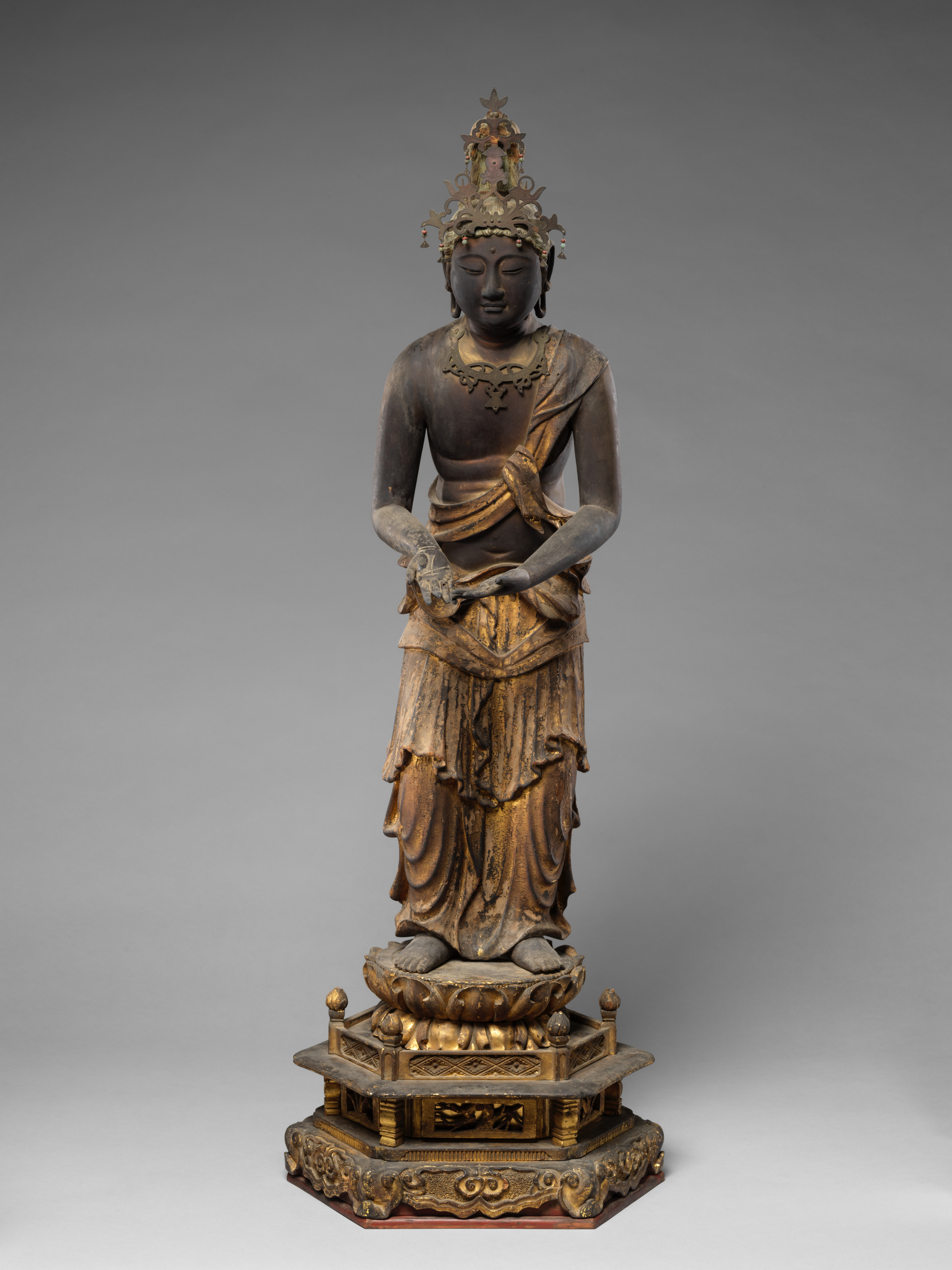
- Title
- Attendant Bodhisattva Kannon — Met 12.134.17, Kamakura, late 12th–13th c.
- Period
- Kamakura period (1185–1333), late 12th–13th century
- Region
- Japan
- Medium
- Wood with lacquer, gold paint, gold leaf, and inlaid crystal
- Dimensions
- Figure 33 × 9 1/2 × 13 in. (83.8 × 24.1 × 33.0 cm); pedestal 9 × 14 3/4 × 11 1/4 in. (22.9 × 37.5 × 28.6 cm)
- Collection
- The Metropolitan Museum of Art, New York
- Accession
-
12.134.17 - Rights
- Public Domain. The Metropolitan Museum of Art, Rogers Fund, 1912 (acc. 12.134.17). Met Open Access (OASC).
Met 12.134.17 — Attendant Bodhisattva Kannon, Kamakura late 12th–13th c. The right of an originally triadic composition; the Amida the figure flanked is lost.
Two thirds of an Amida triad
The two figures are a pair. They are the same scale (33 in figure on a 9 in pedestal), the same construction (yosegi-zukuri hollowed-block joined wood), the same surface programme (lacquered ground, gold paint, gold leaf, the Kei-school inlaid-crystal eyes), the same period (late 12th–13th century). They were carved together and they were intended to be displayed together. What they were not made to be displayed without is what we no longer have: the central Amida Buddha, considerably taller, that they flanked.
The Amida triad (Amida-sanzon) is the standard sculptural and painted configuration for Amida Pure Land devotion through the long Heian-to-Kamakura period. Amida central, larger; Kannon to the viewer’s right; Seishi to the viewer’s left. Kannon’s iconographic role within the triad is to receive the dying believer onto the lotus pedestal at the moment of raigō (the welcoming descent). Seishi’s role is to attend the wisdom side of the triad. In a sculptural triad the central Amida is typically 1.5–2× the height of the attendants, so the lost Amida that the Met pair flanked would have been 120–170 cm, plus pedestal and mandorla.
The disappearance of the central Buddha from a surviving attendant pair is the most ordinary fate of triadic compositions. Triads are damaged in temple fires; the central Amida is sometimes the largest and most fragile of the three; the figures are dispersed independently when a temple holding is sold. By the time Pier acquired the pair around 1912, the Amida had already been separated from them, possibly long enough that the Pier-source dealer no longer knew where the Amida had gone.
Kannon, lotus and crown
Met 12.134.17 is identified as Kannon by three iconographic registers. First: the small lotus stem held at chest height in the proper left hand. In the canonical raigō programme this lotus is the pedestal on which the dying believer’s soul will be placed and carried back to the Pure Land. The lotus is the mechanism of salvation. Second: the crown. Kannon’s crown in the Amida triad is conventionally surmounted by a tiny seated Amida image (the kebutsu), though that small Amida is often broken off or worn down. The Met figure’s crown carries the high frontal element that fits the kebutsu position, even where the tiny Amida itself is now lost. Third: the proper right hand held lower, palm out, in a calm welcoming gesture, the yogan-in (vow-giving) variant of varada, soft and receiving.
The body itself reads as a Kamakura attendant in raigō posture. The slight contrapposto (body weight shifted toward the proper right leg) is the standard sculptural shorthand for the figure is in motion, descending. A fully frontal pose would read static; a fully dynamic pose would lose the cult-image register. The slight shift is the threshold compromise.
Seishi, gesture and posture
Met 12.134.18 is identified as Seishi by the mirror-image complement. The mirror is structural: same scale, same construction, same surface, opposite contrapposto (the weight shifted to the proper left leg rather than the right), and a different attribute register. Where Kannon’s identifying feature is the lotus stem and the Amida-crown, Seishi’s identifying features are typically the water-pot motif on the crown (suihei or suibyō, a small water pot for the elixir of wisdom), and a gesture register that holds a sutra scroll or maintains a wisdom-mudra.
The Met catalog does not specify which Seishi-attribute survives on 12.134.18 in the pre-restoration state, and the figure’s hands in the current display register are not directly cited in the catalog. Bodhi reads the pair on the formal evidence (the mirror-image construction is sufficient) and notes that any Seishi-attribute reading is an inference from the iconographic norm rather than a CMA-supplied identification.
What is missing
The Amida is gone. The mandorla and the throne assembly are gone. The original temple is unrecorded. The original dedicatory deposits, which would, in standard Kei-school production, have been sealed inside the hollowed cavities of both figures and inside the Amida, are unrecorded.
What is left is the surface programme and the formal evidence. The crystal-eye gyokugan technique places the pair securely inside the Kei-school production language post-1180 (the technique is documented as a Kei-school workshop signature from the early 1180s onward in the documented Tōdai-ji rebuilding programme; see Tōdai-ji Niō, 1203). The lacquer-over-polychrome surface programme is standard Kamakura production. The yosegi construction is the Jōchō-descended technique that had become the production-standard idiom by the late 12th century (see Yosegi-zukuri — multi-block construction).
The Met catalog dating window (late 12th–13th century) is consistent with three plausible scenarios. The pair could be early-Kei-school work of the 1180s–1200s commissioned for a Pure Land temple in the immediate aftermath of the 1180 Taira raid; it could be late-Kei-school work of the 1230s–1260s commissioned for a provincial Pure Land institution; or it could be a 13th-century continuation of the Kei-school production language by a workshop downstream of the Nara busshi. Without dedicatory deposits or workshop inscription, the pair cannot be assigned more narrowly than the published 134-year window.
Construction: yosegi, lacquer, crystal eyes
The Met catalog records the medium as wood with lacquer, gold paint, gold leaf, and inlaid crystal. Each element of this stack is load-bearing in different ways.
The wood is hinoki cypress, almost certainly, on the standard Kamakura production assumption. The Met record does not specify the species, but no other softwood was in regular Kei-school use. The construction is yosegi-zukuri: multiple hollowed blocks joined, the hollow shell available for dedicatory deposits.
The lacquer serves as the surface preparation layer. Black or dark-brown urushi lacquer is applied over the carved wood as a sealing and stabilising ground; the polychrome and gilding sit on top of the lacquer. Most of the polychrome layer on the Met pair has worn back; what we see now is largely the gilded layer over the lacquer ground, with patches of the underlying wood visible where the entire surface stack has worn through.
The gold paint and gold leaf together produce the canonical Kei-school kondei-nuri surface: the leaf gives the high gloss on the smooth surfaces of the robes, the paint fills the recesses and the modelled drapery folds. The technique was inherited from the late-Heian wayō workshops but intensified in the Kei-school production language: more leaf, brighter ground, the gilding combined with the crystal eyes for the directed-gaze effect.
The inlaid crystal eyes (gyokugan, 玉眼) are the diagnostic Kei-school surface marker. The technique appears in documented form in the Kōfuku-ji rebuild generations beginning in the 1180s and persists as the production-standard for first-rank Kei-school commissions through the 13th century. Crystal inserts are placed from behind into the carved eye cavity, with the back of the crystal painted to give a focused iris-and-pupil effect; the resulting gaze tracks the viewer in a way that no painted-eye treatment can match.
Garrett Chatfield Pier and the 1912 acquisition
The Met provenance for the pair runs through Garrett Chatfield Pier. Pier (1875–1943) was Assistant Curator of Decorative Arts at the Met from 1907 to 1910, then on a series of Met-funded buying tours through Japan, China, and the broader region from 1911 to 1914. He published Temple Treasures of Japan (1914), his own account of the trips, with descriptions of the dispersal market and named dealers through which the Met built its Japanese collection in this window.
The 1912 acquisition of 12.134.17 & .18 fits the Pier purchase pattern: a paired set of Kamakura attendant figures, separated from a lost Amida, sold by a Japanese dealer into the New York market through Pier’s network. The Pier-source for this specific pair is not in the public catalog text and bodhi has not located the original 1912 acquisition correspondence in the Met archives; an on-site reading would resolve it.
The pair therefore enters the Met collection on the early end of the museum’s serious Japanese-sculpture build-out. The Met’s first major Buddhist-sculpture acquisitions are the 1912–1915 Pier-period Rogers-Fund purchases; the Mary Griggs Burke and Harry Packard collections (1975) and the broader institutional expansion arrive sixty-plus years later.
The Rogers Fund and the early-20th-century Met
The 12.134 accession prefix marks the work as a 1912 acquisition. The Met’s accession-number system uses year.lot.item: the 17th and 18th items of the 134th lot accessioned in 1912. The 1912 Met annual report records the Rogers Fund purchases of that year in detail; the Kannon-Seishi pair appears in that record.
Jacob S. Rogers (1824–1901), the locomotive-manufacturing magnate of Paterson, New Jersey, bequeathed approximately $5 million to the Metropolitan Museum on his 1901 death, at the time the largest single bequest the museum had received. The Rogers Fund became the principal acquisitions endowment for the Met’s first three decades of the twentieth century. The 1912 Japanese-sculpture purchases sit inside the first decade of the fund’s deployment.
Reading the 12.134.17 & .18 pair as Rogers-Fund acquisitions gives them a specific institutional position: they belong to the foundation layer of the Met’s Asian Art holdings, not to the postwar Burke / Packard / Mary Griggs Burke build-out. By the time Sherman Lee was building Cleveland’s collection through the Mayuyama and Setsu Gatōdo dealerships in the 1950s–70s, the Met’s foundational Pier-era Buddhist sculpture had already been on Fifth Avenue for forty years.
Where these figures sit
Reading the pair against the broader raigō sculpture-and-painting corpus, three connections matter most.
First: the raigō programme itself, which articulates the moment of welcoming descent. The Met itself holds a Kamakura-period Welcoming Descent of Amida with Bodhisattvas Kannon and Seishi hanging scroll (acc. 44.959), the painted comparator to the 12.134.17 & .18 sculptural pair. Read together, the two registers (sculpture and painting) document how the same iconographic programme was deployed in three-dimensional cult-image and two-dimensional devotional-painting modes through the same period.
Second: the Kei-school technical programme. The yosegi-zukuri-with-crystal-eyes surface is the production language that runs from the 1180 Tōdai-ji rebuild through the 13th-century continuation. The 12.134.17 & .18 pair stand inside that production language without being top-rank Kei-school commissions in the way that Kōfuku-ji’s Hokuendō Mujaku and Seshin (1212), Tōdai-ji’s Niō (1203), or Met 2015.300.250 (the Kaikei Jizō) are.
Third: the institutional history of the Pure Land cult. The Amida triad is the standard altar configuration for Pure Land devotional practice from the late Heian period onward; by the 13th century, when the Met pair was made, the cult was institutionalised across Tendai, Shingon, and the new Jōdo schools (Hōnen, 1133–1212; Shinran, 1173–1263). A sculpted triad like the one the Met pair belongs to could have stood at the altar of any of these.
What stays open
The original temple. The pre-1912 setting of the pair is unrecorded. Plausible candidates: a Pure Land sub-temple in the Kantō region (a documented Pier buying area), or a provincial-Tendai institution. Bodhi has not located a temple-inheritance line.
The lost Amida. Almost certainly destroyed in a temple fire or sold separately into the dispersal market and lost. There is no documented match for an Amida sculpture of the proportional scale (120–170 cm range) that could be reassociated with this pair in the surviving record.
The dedicatory deposits. Standard Kei-school yosegi triads carry deposits in all three figures; the deposits in 12.134.17 & .18 have not been published. A CT or endoscopic study would resolve the workshop attribution if dedicatory texts or named patrons are present.
The Seishi attribute. The catalog text does not specify which Seishi iconographic marker (the suihei crown, the sutra scroll, the joined-hands posture) is preserved on 12.134.18 in its current restored state. A direct examination of the figure’s hands and crown would resolve this; the Met OA images give partial evidence only.
Related
Further works cited
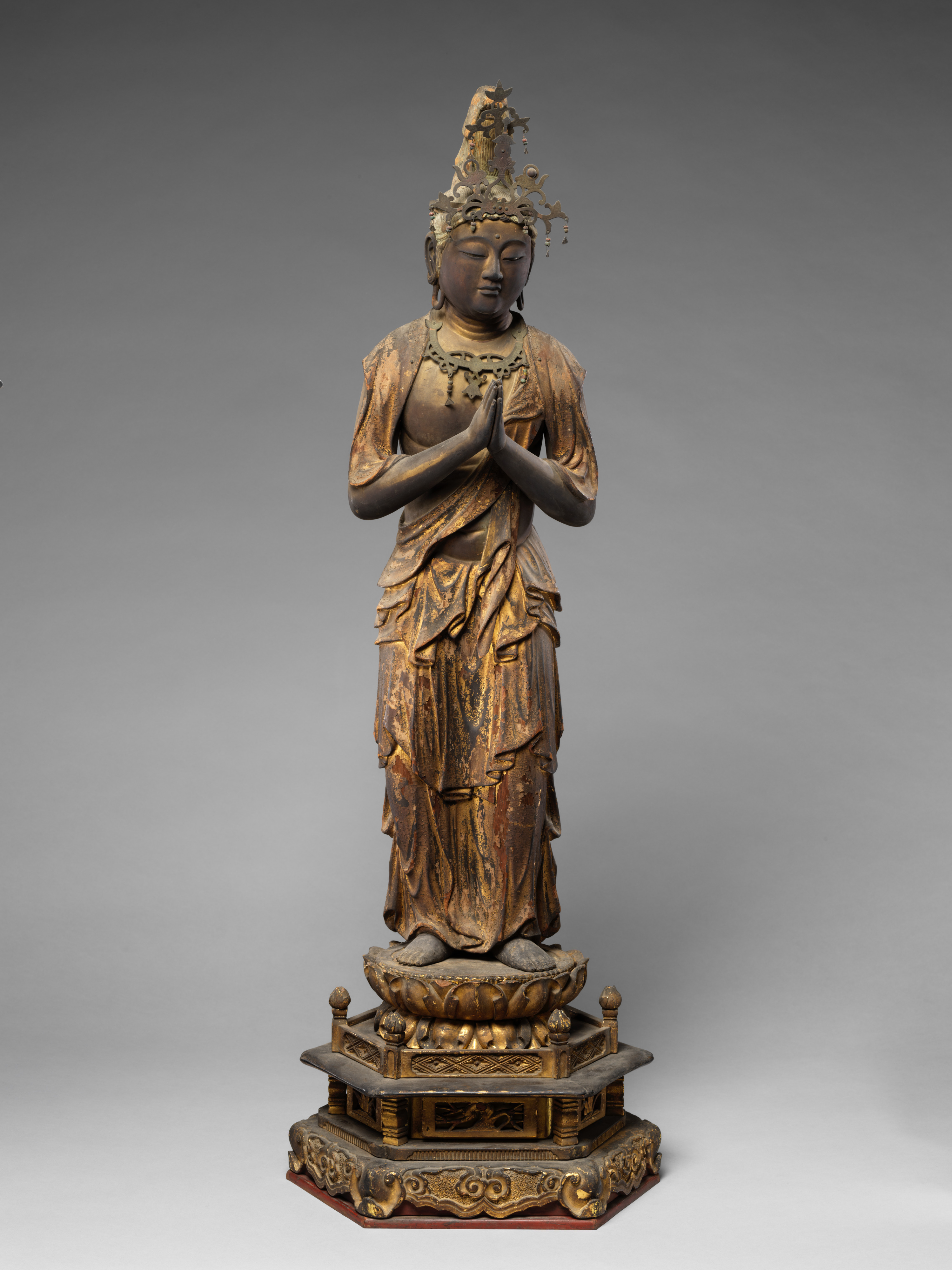
- Title
- Attendant Bodhisattva Seishi — Met 12.134.18, Kamakura, late 12th–13th c.
- Period
- Kamakura period (1185–1333), late 12th–13th century
- Region
- Japan
- Medium
- Wood with lacquer, gold paint, gold leaf, and inlaid crystal
- Dimensions
- Figure 33 × 9 3/8 × 10 3/8 in. (83.8 × 23.8 × 26.4 cm); pedestal 9 1/4 × 14 × 11 in. (23.5 × 35.6 × 27.9 cm)
- Collection
- The Metropolitan Museum of Art, New York
- Accession
-
12.134.18 - Rights
- Public Domain. The Metropolitan Museum of Art, Rogers Fund, 1912 (acc. 12.134.18). Met Open Access (OASC).
Met 12.134.18 — Attendant Bodhisattva Seishi, Kamakura late 12th–13th c. The mirror-companion to 12.134.17 in the original Amida triad.
Sources
-
[1]2026-05-13The Metropolitan Museum of Art, New York collectionapi.metmuseum.org/public/collection/v1/objects/49107Met OA API. Title *Attendant Bodhisattva Kannon*; accession 12.134.17; date late 12th–13th century (1167–1299); medium wood with lacquer, gold paint, gold leaf, and inlaid crystal; dimensions 83.8 × 24.1 × 33.0 cm (figure) with separate pedestal; classification sculpture; credit line *Rogers Fund, 1912*; public domain (CC0); gallery 224.
-
[2]2026-05-13The Metropolitan Museum of Art, New York collectionapi.metmuseum.org/public/collection/v1/objects/49108Met OA API. Title *Attendant Bodhisattva Seishi*; accession 12.134.18; date late 12th–13th century (1167–1299); medium wood with lacquer, gold paint, gold leaf, and inlaid crystal; dimensions 83.8 × 23.8 × 26.4 cm (figure); classification sculpture; credit line *Rogers Fund, 1912*; public domain (CC0).
-
Pier (1875–1943) was Assistant Curator of Decorative Arts at the Metropolitan Museum 1907–1910. He travelled in Japan, China, and 'the Orient' on Met-funded buying trips 1911–1914 and authored *Temple Treasures of Japan* (1914). The 1912 Met acquisition of 12.134.17 & .18 — Rogers Fund — sits inside Pier's 1911–14 Japan-buying period and is consistent with his focus on Buddhist sculpture in temple-dispersal markets.
-
Pier's own account of his 1911–14 buying tours through Japan, with notes on the temple-dispersal market and on individual objects acquired for American museums. The Met's late-Heian and Kamakura Buddhist sculpture acquired between 1912 and 1914 — including the 12.134.17/.18 pair — descends from Pier's documented network of contacts.
-
Standard English-language survey. Mōri treats the inlaid-crystal-eye technique (*gyokugan*) as the diagnostic Kei-school surface marker of late-Heian-to-Kamakura sculpture; the gilded-and-lacquered surface programme is the Kei-school 1180-onward production language for raigō-triad attendants. The 12.134.17/.18 pair sits inside that idiom — the crystal eyes, the gilded surface, the formal poise of the attendant figure are all Kei-school production markers.
-
Kyoto National Museum reference. Confirms the canonical Amida-sanzon (Amida-triad) configuration — Amida central, Kannon at viewer's right, Seishi at viewer's left — with Kannon holding the lotus pedestal on which the dying believer will be received, and Seishi holding the joined-hands or sutra-scroll posture. The triad as a whole is the visualisation of the *raigō* — the welcoming descent — through which Amida and his retinue meet the dying believer.
-
Jacob S. Rogers (1824–1901), New Jersey locomotive manufacturer, bequeathed approximately $5 million to the Met in 1901; the Rogers Fund became the museum's principal acquisitions endowment for the first three decades of the 20th century. The 1912 acquisition of 12.134.17 & .18 was paid from this fund, in the same window as the Met's broader Japanese-sculpture build-out under Pier and (after 1915) under the Bishop / Havemeyer / Fletcher endowments. The Rogers-Fund Japanese-sculpture acquisitions of 1912–1925 are the foundation layer of the Met's Asian Art department holdings of Buddhist sculpture.
-
Met's own Kamakura *raigō* hanging-scroll triad — the painting comparator to the 12.134.17/.18 sculptural pair. Demonstrates the canonical Amida-Kannon-Seishi composition in 2D as the sculptural pair would have stood in 3D.