A Zen chinsō of Hottō Kokushi (Shinchi Kakushin), c. 1295–1315
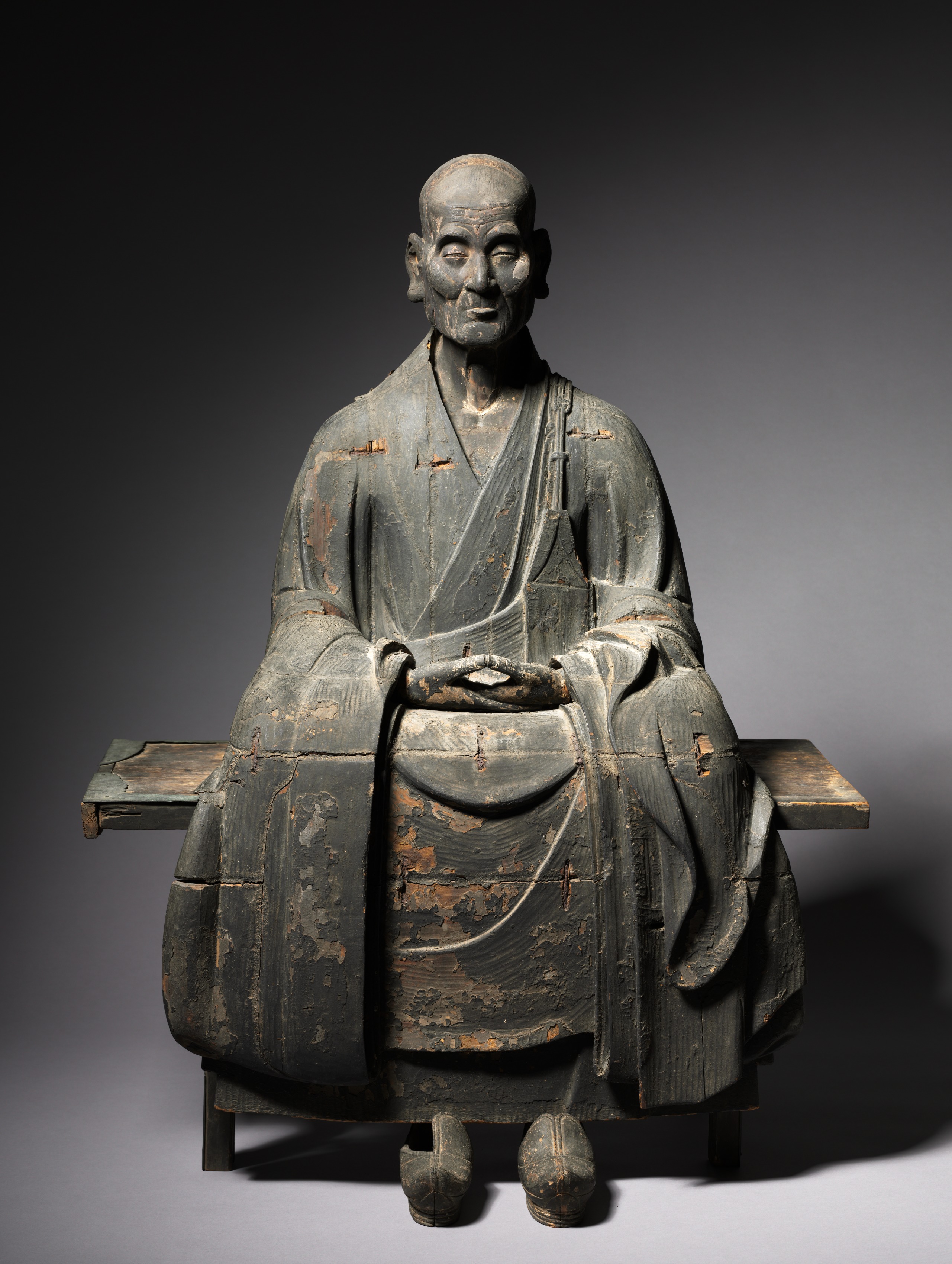
- Title
- Portrait of Hottō Enmyō Kokushi (Shinchi Kakushin) — Cleveland 1970.67, c. 1295–1315
- Period
- Kamakura period (1185–1333), c. 1295–1315
- Region
- Japan, Wakayama Prefecture (Kii Province)
- Medium
- Hinoki cypress wood with lacquer, metal staples and fittings
- Dimensions
- Overall height 91.4 cm (36 in.). Two-part accession: 1970.67.a (figure), 1970.67.b (bench).
- Collection
- The Cleveland Museum of Art
- Accession
-
1970.67 - Rights
- Public domain (CC0). The Cleveland Museum of Art, Leonard C. Hanna Jr. Fund. Open Access, Cleveland Museum of Art.
Cleveland 1970.67 — chinsō (Zen abbot portrait) of Shinchi Kakushin, the founder of Kōkokuji in Yura. The figure shows him as a much older man than the dated portraits at Ankokuji (1275) and Kōkokuji (1286); the sculpture is bracketed c. 1295–1315, straddling his death in 1298. Only the lacquer underlay survives; the original polychrome surface is lost.
The portrait in the gallery
Walk into gallery 235B at Cleveland and what you meet first, before the iconography registers, is the face. The body has been drawn back. The robes are deep, regular, slightly schematic; the kesa lies across the chest in folds that read as drapery rather than as the play of cloth on a particular man’s shoulders. The hands rest in the lap. The bench is plain. The head, by contrast, is read by the sculptor as a problem in its own right: broader and squarer than the body would prepare you for, high in the cheekbone, set with a slight downward turn at the mouth, eyes lowered with the lids low enough to read as half-closed.
That asymmetry of attention (body schematic, face specific) is the working logic of Kamakura chinsō. The genre as a whole is a portrait of a particular person against a generalised background of monastic posture. The body says this is a Zen abbot, seated in the formal pose. The face says this is Kakushin.
Kakushin in China, 1249–1254
Shinchi Kakushin (1203–1298) was the founder of Saihō-ji, later renamed Kōkoku-ji, in Yura village in Kii Province (now Wakayama Prefecture). He departed for China in 1249 with the intent of studying under the Linji master Wuzhun Shifan, and on arrival found that Wuzhun had died the year before. He took transmission instead, after six months of training, from Wumen Huikai (1183–1260), the same Wumen whose Wumenguan kōan collection had been compiled in 1228. Kakushin returned to Japan in 1254.
The 1254 return is the foundational moment of what became the Hottō line of Rinzai Zen in Japan, a parallel transmission to Eihei Dōgen’s earlier Sōtō transmission (1227) and to the contemporaneous Bukkō line traced through Mugaku Sogen (1226–1286, arrived in Japan 1279). What gives Kakushin’s lineage its distinctive coloration is the lay-disciple bracket: a group of four laymen who travelled back to Japan with him are recorded as disciples of one Zhang Can, who claimed descent from the Tang eccentric Puhua. Out of that bracket, by routes that are mostly later medieval reconstruction, emerged the Fuke sect of shakuhachi-playing wandering monks (komusō), though modern scholarship (cited in the Fuke-shū article) reads the Puhua-Zhang lineage as a Japanese invention back-projected onto Kakushin’s testimony.
Three sculptural portraits of one monk
The CMA wall text gives the bracket: two famous sculptural portraits of this monk, one at the temple Ankokuji in Hiroshima, and another at the temple Kōkokuji in Wakayama, are dated to 1275 and 1286, respectively. Both are during Kakushin’s lifetime: he was 72 in 1275 and 83 in 1286. Cleveland 1970.67 is dated by CMA to c. 1295–1315, and shows Kakushin as a much older man, old enough that the dating window can either reach back into the last years of his life (1295–1298, when he was in his nineties) or forward into the immediate posthumous decades.
That bracket matters. The Ankokuji 1275 and Kōkokuji 1286 portraits are documents of the living abbot, commissioned, plausibly, in connection with specific institutional events: a confirmation of his abbacy, the founding of a sub-temple, the visit of a senior monk. Cleveland 1970.67 is a different kind of object. It is either a portrait of the very old man in his last years, or it is a posthumous memorial portrait commissioned by his community for the dharma hall after his death in 1298.
The face is the evidence. Compared with photographs of the 1275 and 1286 portraits, the Cleveland face is markedly older: cheeks more sunken, jawline less full, eyes deeper. The standard reading in the secondary literature (Brinker–Kanazawa 1996; Mōri 1974) treats this as a deliberate posthumous portrayal in the Kamakura-realist idiom, calibrated to show Kakushin as he was remembered in old age rather than as he had been earlier sculpted.
The title that postdates the sculpture
The work’s CMA title (Portrait of Hottō Enmyō Kokushi) carries a complication worth naming clearly. Hottō Enmyō Kokushi (法燈円明国師) means Perfectly Awakened National Teacher of the Dharma Lamp; it is a posthumous imperial title bestowed on Kakushin by Emperor Go-Daigo, who reigned 1318/1319–1339. The title cannot have existed before Go-Daigo’s accession, which is at least four years after the latest end of the dating window CMA gives (c. 1295–1315).
What this means is straightforward and slightly arresting. The sculpture was originally a portrait of Shinchi Kakushin. It became a portrait of Hottō Enmyō Kokushi only after the imperial title was conferred, perhaps several decades after the wood had dried. The CMA catalog title is anachronistic with respect to the figure’s manufacture. The figure itself does not change; the institutional naming does.
This is not a CMA cataloguing error. Posthumous Zen titles slide back onto earlier portraits routinely in the institutional record: a 1286 Kōkokuji portrait of Kakushin is also today catalogued under the Hottō Kokushi name, because the community of memory has retitled the figure along with the man. The point worth making explicit is that the figure was commissioned at a moment when its subject was still Shinchi Kakushin, and that the title under which we now read it has been added on a back-current of imperial honorifics.
How the figure was built
The construction is given in plain terms in the CMA description: multiple wood blocks, with the main parts being the front, back, and the head, which is inserted into the body. The wood is hinoki cypress; the body is hollowed; the head is carved separately and slotted in from beneath; the joints are fastened with metal staples and fittings.
This is a standard chinsō construction logic in Japan in the late 13th and early 14th century. The advantages are technical and ritual at once. Technically, the three-block construction allows independent carving of the head (the load-bearing element of the work) and easier replacement or restoration if the head or body is damaged. The metal staples permit disassembly. Ritually, the hollowed cavity inside the figure could carry a naijin deposit (sutras, relics, the dead abbot’s hair or ashes, a written prayer naming the dedicators) though no published record of an interior inspection of 1970.67 exists.
The surface tells you what is no longer there. Only the lacquer remains today, the sculpture would once have been painted. The figure as we have it is a matte black ground; the original surface was a polychrome layer over that lacquer, with the face given naturalistic flesh tones, the kesa given a coloured surface (probably the dark brown of Linji-line abbots’ garments, with the brocaded patches of a senior monk’s kesa picked out), the eyes given an inlaid or painted glance, possibly with crystal-eye inserts in the Kei-school manner. We see the substrate. The polychrome that gave the figure its specific likeness has worn back to lacquer.
Memorial portrait or transmission certificate?
The dominant Western reading of chinsō through most of the 20th century (articulated in Brinker’s earlier work and rehearsed in many museum wall texts) was that chinsō functioned as evidence of dharma transmission. The portrait was given by master to disciple as a token of inheritance: the disciple held it as proof of the lineage’s passage. The figure of Kakushin would, on that reading, have been a transmission document from Wumen, or a self-portrait given to one of Kakushin’s own successors.
This reading was substantially overturned by T. Griffith Foulk and Robert H. Sharf, On the Ritual Use of Ch’an Portraiture in Medieval China, Cahiers d’Extrême-Asie 7 (1993–94), pp. 149–219. Foulk and Sharf argued, on the basis of Chinese ritual manuals and inscriptional evidence, that chinsō were funerary and memorial portraits (used at the abbot’s death, displayed at the anniversary memorial services [kaisanki], held at the founder’s hall) and that the transmission-certificate reading was a Western projection onto a quite different Chinese institutional practice. The Brinker–Kanazawa volume of 1996 incorporated the reframing.
Cleveland 1970.67 reads cleanly inside the Foulk-Sharf frame. The dating that brackets Kakushin’s death (1298) and the early-Yuan posthumous decades; the head-as-portrait, body-as-schema asymmetry; the hollowed cavity available for memorial deposits; the surviving lacquer-on-wood substrate stripped of its polychrome; the institutional location at Kōkokuji’s network: all of these read as a memorial portrait for kaisanki ritual use, not as a personal transmission token from Wumen to Kakushin or from Kakushin to a successor.
From Myōshinji to Mayuyama to Cleveland, 1970
The CMA provenance line is brief: Myōshinji, Wakayama Prefecture, Japan → Mayuyama and Company, Tokyo (sold to museum, ?–1970) → Cleveland Museum of Art, 1970–. Two notes are worth adding.
First, the Wakayama Myōshinji is not the famous Kyoto Myōshinji (the head temple of one of the Rinzai sect’s major branches); it is a smaller temple in Wakayama Prefecture, presumably within the Kōkokuji institutional orbit, where the sculpture had moved at some point between the Kōkokuji founder-hall use of the early 14th century and the mid-20th-century sale. bodhi has not located documentation of when the figure migrated from Kōkokuji proper to Myōshinji; the migration probably belongs to one of the dispersal currents that ran through Japanese temples during the haibutsu kishaku anti-Buddhist movement of the 1860s–70s and the Meiji land reforms.
Second, Mayuyama and Company is the dealership of Matsutarō Mayuyama (1882–1935) and his son Junkichi Mayuyama (1913–1999), one of the two major Tokyo firms (alongside Setsu Gatōdo) through which Sherman Lee built Cleveland’s Japanese collection in the 1950s, 60s, and 70s. The intermediary in many Mayuyama-Cleveland transactions was Howard Hollis, CMA’s Far Eastern curator 1929–46, MFAA officer in Tokyo 1946, and (from 1948) head of his own dealership Hollis & Co. The 1970 acquisition of 1970.67 sits inside that Mayuyama-Hollis-Lee triangle and was paid for from the Leonard C. Hanna Jr. Fund, the principal acquisitions endowment for Cleveland in this period.
What stays open
The dating window. CMA gives c. 1295–1315, a twenty-year bracket. Kakushin died in 1298. The portrait either belongs to his last three years or to the immediate seventeen-year posthumous bracket; bodhi reads the posthumous reading as more consistent with the very old face and the Foulk-Sharf memorial frame, but the museum’s deliberate hedge is not closeable from the public record. A dendrochronological reading of the hinoki, or an inscription found in a cavity-deposit on inspection, would resolve it.
The internal deposit. Three-block hollowed chinsō figures of this period frequently carry dedicatory deposits in the cavity. CMA has not published a study of the interior of 1970.67. If a deposit exists, it likely names the patrons, the date of commission, and the precise occasion: the most important Kakushin documentary record we do not have.
The migration from Kōkokuji to Myōshinji. Cleveland’s documented provenance starts at Myōshinji, Wakayama; the original setting must have been Kōkokuji itself. When and why the figure moved within the temple network is not known. Plausible windows: the Meiji haibutsu kishaku of the 1860s–70s; the consolidation of Wakayama temples in the early 20th century; or earlier, within the medieval institutional history of the Hottō line.
The polychrome. The original painted surface is gone. We know it existed: the lacquer underlay is a polychrome substrate. What we lose with the paint: the precise skin tone, the colour of the kesa, whether the eyes were inlaid or painted, the brocade pattern on the surplice. The CMA description registers the loss; the figure cannot be reconstructed without it.
Related
Sources
-
CMA OA API (CC0). Confirms: title *Portrait of Hottō Enmyō Kokushi* (法燈円明国師像); alternate *Portrait of Hoto Kokushi (Priest Kakushin)*; date c. 1295–1315; medium hinoki cypress wood with lacquer, metal staples and fittings; height 91.4 cm; gallery 235B Japanese; provenance Myōshinji, Wakayama → Mayuyama and Company, Tokyo → CMA 1970; credit line *Leonard C. Hanna Jr. Fund*.
-
CMA description verbatim: 'a fine example of "Kamakura realism," emphasizing facial fidelity while minimizing bodily detail … Hottō Enmyō Kokushi is a posthumous title bestowed upon the Zen Buddhist monk Shinchi Kakushin (1203–1298) by the emperor Go-Daigo. The title means "perfectly awakened national teacher of the Dharma lamp." Compared with two sculptures of the monk created during his lifetime (both in and around 1275), this sculpture portrays Kakushin as a much older man. It comprises multiple wood blocks, with the main parts being the front, back, and the head, which is inserted into the body. Although only the lacquer remains today, the sculpture would once have been painted.' CMA *did you know* note: 'Two famous sculptural portraits of this monk, one at the temple Ankokuji in Hiroshima, and another at the temple Kōkokuji in Wakayama, are dated to 1275 and 1286, respectively.'
-
Biographical compendium. Confirms: Kakushin departed Japan for China in 1249, found his original intended teacher Wuzhun Shifan no longer alive, took transmission from Wumen Huikai (1183–1260) after six months, returned to Japan 1254. Became abbot of Saihō-ji (later renamed Kōkoku-ji) in Yura, Kii Province. His Hottō line continued through Kohō Kakumyō and Bassui Tokushō. Posthumously named *Hottō Enmyō Kokushi* by Emperor Go-Daigo (r. 1318/19–1339). Note birth-date variance: terebess and many secondary sources give 1207; CMA and most institutional catalogs give 1203. bodhi uses 1203 per CMA.
-
Confirms: Kakushin's stay in Song China brought him into contact with a layman, Zhang Can, who claimed to be a sixteenth-generation successor of the Tang eccentric Puhua (a disciple of Mazu and friend of Linji). Four lay disciples of Zhang accompanied Kakushin back to Japan in 1254 and helped establish what later became the Fuke sect — the shakuhachi-playing *komusō* tradition. Modern scholarship notes that no independent Chinese record of Zhang or his Puhua school survives, so the Fuke lineage's historicity rests on Kakushin's testimony alone.
-
Landmark article reframing the chinsō tradition. Foulk and Sharf argue that chinsō (頂相) were not, contrary to a long-standing Western interpretation, dharma-transmission certificates given by master to disciple — they were funerary and memorial portraits used primarily in mortuary ritual, displayed at the founder's anniversary services. The Cleveland figure of Hottō Kokushi sits exactly within this argument: it is a posthumous (or late-life, anticipated-posthumous) memorial portrait commissioned by the Kōkokuji community, not a transmission token.
-
Standard reference on Zen portraiture across the Song / Yuan / Kamakura horizon. Brinker's earlier work read chinsō within the dharma-transmission frame; the 1996 Brinker–Kanazawa volume incorporates the Foulk-Sharf reframing and treats the genre as memorial-portrait first. The Cleveland 1970.67 figure is the standard third-pole comparison to Kōkokuji 1286 and Ankokuji 1275 in the comparative literature on Kakushin portraits.
-
Standard English-language survey. Mōri treats 'Kamakura realism' — the heightened psychological and physiognomic specificity that distinguishes Kamakura sculpture from the wayō idiom of the previous century — as concentrated most strongly in chinsō and in the Kei-school monk-portrait commissions (Mujaku and Seshin at Kōfuku-ji Hokuendō, 1212). Cleveland 1970.67 stands inside that idiom: facial fidelity heightened, bodily detail flattened.
-
Confirms: Mayuyama & Co. founded by Matsutarō Mayuyama (1882–1935); first Tokyo location 1916. After Matsutarō's 1935 death, his eldest son Junkichi (1913–1999) led the firm. In the postwar decades Junkichi developed the American business, introducing Japanese art to the Metropolitan, Seattle, and Cleveland museums. The 1970 sale of 1970.67 to Cleveland sits inside that postwar pipeline.
-
[9]2026-05-13The Cleveland Museum of Art Archives clevelandartarchives.libraryhost.com/repositories/2/archival_objects/16529CMA Archives finding aid notes Mayuyama correspondence in Lee's papers. Junkichi Mayuyama and Lee built a long working relationship through the 1950s–80s; Howard Hollis (CMA Far Eastern curator 1929–46, MFAA Tokyo 1946, Hollis & Co. dealership 1948-) was an intermediary across many transactions. The 1970 acquisition of 1970.67 sits inside that Mayuyama-Hollis-Lee triangle, the dominant institutional channel for Japanese-art acquisitions into Cleveland in the 1960s–70s.
-
Wikidata entry for CMA 1970.67.