Rokuhara-mitsu-ji Jizō: the seated Kei-school portrait of the saviour-bodhisattva
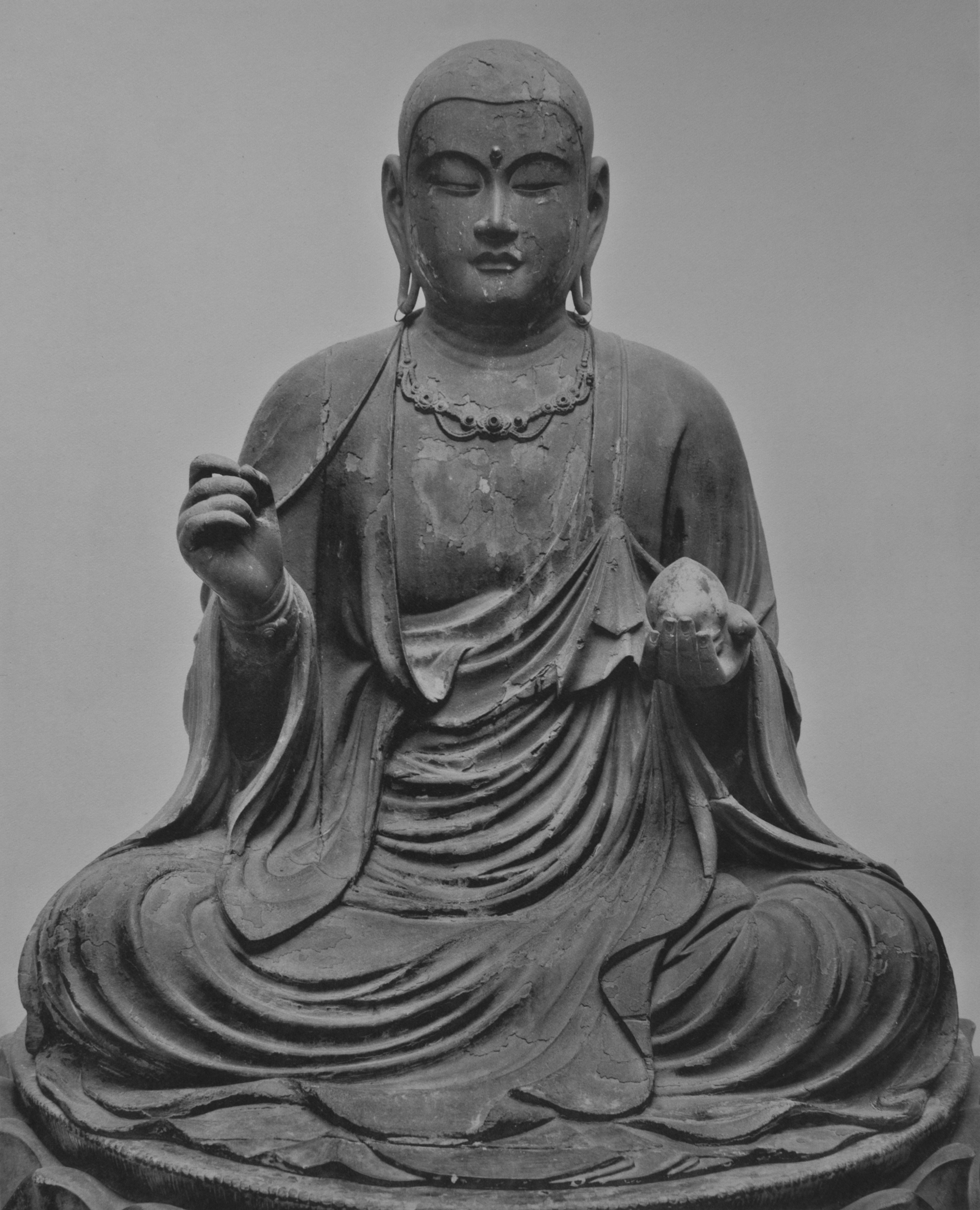
- Title
- Jizō Bosatsu, seated (地蔵菩薩坐像)
- Period
- Kamakura
- Medium
- Yosegi-zukuri (joined-block) hinoki cypress with polychromy and inlaid crystal eyes (gyokugan)
- Dimensions
- c.89.5 cm seated
- Collection
- Rokuhara-mitsu-ji (六波羅蜜寺), Kyoto
- Rights
- PD-Japan-oldphoto via Wikimedia Commons
A seated Jizō, in a Kūya temple
Rokuhara-mitsu-ji (六波羅蜜寺) is one of the smaller but most historically rich temples of central Kyoto. It was founded in 963 by the wandering Pure Land preacher Kūya (空也, 903–972), the figure conventionally treated as the first popular evangelist of Amida-faith in Japan. Kūya walked the streets of Kyoto reciting the nembutsu and gathering crowds; the temple he founded has, since 963, been one of the principal centres of popular Pure Land devotion in the capital.
The temple’s sculptural programme is exceptional. It holds the famous standing portrait of Kūya himself: Kōshō’s sculpture of c.1207 with the six tiny Amida figures emerging from the lay-monk’s open mouth, one of the most reproduced images in Japanese art history. It holds the standing portrait of Taira-no-Kiyomori. And it holds a substantial cluster of Kei-school Kamakura sculpture, of which the seated Jizō discussed here is one anchor.
The Jizō is what this article reads, not the Kūya portrait, which deserves and has received much fuller treatment elsewhere, but the seated Jizō that sits alongside the Kūya in the same Kei-school cluster, with its own claim on Unkei-workshop attribution and its own particular reading of the bodhisattva.
The seated Jizō mode
Most Jizō sculpture in the Japanese tradition is in the standing form: the bodhisattva as a young monk, robed, walking forward, holding the shakujō staff and the cintāmaṇi jewel. The standing form is the iconography of the wandering, saving Jizō: the bodhisattva who travels through the six realms of rebirth to rescue beings from each.
The seated Jizō is the less common variant. Seated, the bodhisattva is in the contemplative or enthroned mode, placed on a lotus throne, robed in the monastic kāṣāya, hands held in specific mudrās (typically the right hand raised in abhaya-mudrā or the vitarka-mudrā teaching gesture, the left hand lowered in varada-mudrā or supporting the wish-fulfilling jewel). The seated form reads less as the wandering saviour and more as the enthroned bodhisattva: the cosmic figure who saves through power rather than through movement.
The Rokuhara-mitsu-ji Jizō is in the seated mode. Stand in front of it and the figure does not seem to be in motion. The body is settled into the half-lotus posture, the proportions are balanced, the gaze is steady and slightly downward. This is Jizō as the centre of devotion rather than Jizō as the rescuer in motion.
What makes this reading specifically Kei-school is the handling of the settled body. The figure is settled but not heavy. The drapery has the deep-undercut folds that the Kei-school yosegi-zukuri technique enables, but the folds describe a body that is poised (relaxed but alert) rather than collapsed or static. The inlaid crystal gyokugan eyes catch light and produce the slight following gaze that the Kei-school workshop perfected. The figure is interior sculpture, designed for close encounter at the same level as the seated viewer, not for distant viewing or for low-angle approach.
Reading the figure
The figure measures roughly 89.5 cm seated. The proportions are slightly compressed compared with a standing Jizō at the same overall scale; the seated posture concentrates the body into the central torso, and the Kei-school workshop has handled this by giving the torso a fullness that reads as substantial without becoming heavy.
The face is youthful in the conventional Jizō register: shaven head, elongated earlobes, calm features. The mouth is slightly closed, with the faint asymmetry that gives the Kei-school faces their particular individuated quality. The eyes are inlaid crystal (a Kei-school workshop standard) and the gaze is slightly downcast, addressing a viewer seated at the same level.
The robe is yosegi-zukuri hinoki, with deep undercut folds at the cuffs and hem. The original polychromy has worn in places; gold leaf, where it survives, is mottled and patina-darkened. The lotus throne is a separate piece, slotted into the figure’s base, with multiple petal layers radiating outward.
What this figure achieves (and what places it in the Kei-school output rather than in earlier or later Japanese sculpture) is the balance of authority and accessibility. The figure is settled enough to read as authoritative, intimate enough to read as personally addressable. This is the Kei-school’s particular synthesis: the bodhisattva is both immediate and elevated, and the technical means (the gyokugan eyes, the deep-undercut drapery, the substantial-but-not-heavy torso) are calibrated to hold both qualities at once.
What the attribution rests on
The Rokuhara-mitsu-ji Jizō sits in the same complicated attribution territory as much of the Kei-school Kamakura corpus. It is firmly Kei-school, firmly early 13th century, firmly Important Cultural Property; the specific hand within the workshop is less firmly fixed.
What can be said with confidence: the figure was carved by sculptors trained in the Kei-school yosegi-zukuri technique, using the gyokugan eye-inlay method, working in the early-13th-century Kyoto context where the Kei school was active alongside the In-school and the En-school. The figure shares the technical signatures of documented Unkei-workshop output. Whether it was Unkei’s own personal handling, or one of his sons (most likely Kōshō, given the same temple’s other commission), or another workshop member, is not currently resolvable.
The Rokuhara-mitsu-ji cluster
The Jizō belongs to a cluster. Rokuhara-mitsu-ji holds, in addition to the Jizō and the standing Kūya:
- The standing portrait of Taira-no-Kiyomori (also Kamakura, Kei-school-attributed)
- A standing Yakushi Nyorai (Heian, earlier than the Kei-school cluster)
- Multiple smaller Kamakura figures and ritual objects
The Kei-school cluster (the Jizō, the Kūya, the Kiyomori, and several other figures) was probably commissioned over a relatively compressed period in the early 13th century, against the temple’s own redevelopment programme. The Pure Land devotional focus of the temple (Kūya’s founding orientation, sustained through the centuries) shaped the iconographic programme; the Kei-school’s availability in Kyoto in the early 13th century shaped the workshop choice.
Reading the Jizō in isolation slightly distorts the temple’s intent. The figure was made as part of a programme, alongside the Kūya portrait and the other commissions, in a temple whose devotional orientation gave each figure a specific place in the practice. The cluster is the unit; the Jizō is one element.
This reading bears on how the figure should be approached as an art-historical object. The Met’s signed Kaikei Jizō (2015.300.250) is a single-figure devotional commission; it can be read essentially in isolation. The Met’s 1291 Intan Jizō (2023.640) is similarly a single-figure commission. The Rokuhara-mitsu-ji Jizō is different: it is one figure in a temple programme, and the reading should retain that context.
What stays open
Three questions remain open on the Rokuhara-mitsu-ji Jizō:
- Per-figure attribution within the Kei-school cluster. The temple’s Kei-school cluster is attributed to Unkei and his workshop as a group. The specific hand on the Jizō (Unkei himself, Kōshō, another workshop member) is not resolvable on present evidence. A conservation study comparable to the 1988–1993 Nandaimon Niō programme would close this, but no such study has been published on present evidence.
- The commission context. The temple records date in part to the Kamakura period but are not contemporary with the sculpture. The patron, the specific year of commission, and the place within the temple’s wider redevelopment programme have not been comprehensively reconstructed.
- The original polychromy. The surface has worn substantially. The original colour programme (flesh tones, robe colour, gold-leaf application, eye treatment) has not been published in detail on present evidence. A targeted conservation study would close this.