A Nara Buddha hand at Cleveland: 1956.126 and the survival fragment
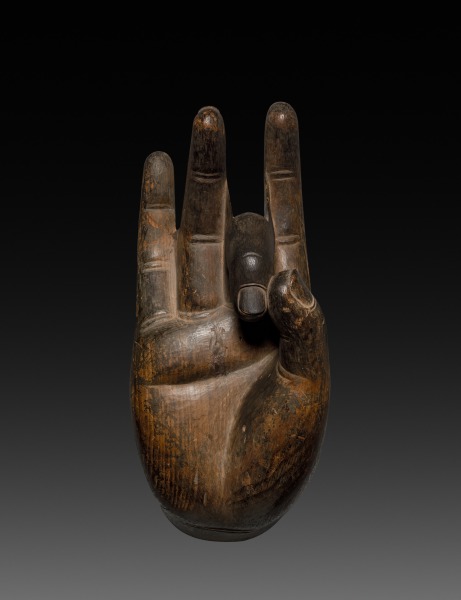
- Title
- Hand of Buddha
- Period
- Japan, Nara period (710–94), late 700s
- Region
- Japan
- Medium
- Wood
- Collection
- Cleveland Museum of Art
- Accession
-
1956.126 - Rights
- CC0 (Cleveland Open Access). The Norweb Collection.
Cleveland 1956.126: Hand of Buddha. Wood; Japan, Nara period (710–94), late 700s; overall 40 cm. The Norweb Collection. CC0 (Cleveland Open Access).
Cleveland 1956.126 is a 40-cm wood fragment of a Buddha hand, Japan, Nara period, late 700s. The hand holds the vitarka mudra: palm forward, three fingers extended, the middle finger curved to meet the thumb. The figure to which the hand belonged is lost. The fragment survives because the Nara sculptural establishment did not.
What the photograph shows
The fragment is a hand with a short surviving section of wrist below it. Cleveland records the overall as 40 cm; the hand alone, on the photograph’s proportions, reads at roughly 25–30 cm from wrist to extended fingertip. The wood is a soft, light-toned hardwood, most plausibly Japanese cypress (hinoki, 檜), the standard carving wood for Nara and post-Nara figural sculpture, though the catalog does not specify the species. The grain is prominent and runs vertically through the carved volume, with fine cracks following the grain along the back of the hand and across the palm.1
The gesture is vitarka mudra (説法印 or 安慰印, seppō-in or an’i-in, “preaching” or “reassurance”). The palm faces the viewer. Three fingers extend upward in parallel; the fourth, adjacent to the thumb, curves down and forward, its tip brought to meet the tip of the thumb in a near-circle.2
Cleveland’s catalog text reads the curving finger as the middle finger, which would place the gesture in the variant form (middle-to-thumb) documented less frequently than the canonical Indo-Tang index-to-thumb circle but well attested across the Tenpyō and post-Tenpyō Buddha and bodhisattva corpus. From the photograph alone the curving digit reads as distinctly shorter than the three extended fingers, an observation that is consistent with either reading: the index curved at its first knuckle (canonical vitarka) or the middle curved at its second (the variant). The catalog reading is followed here while the visual ambiguity is flagged.
Catalog text does not specify which hand of the figure the fragment was. Photographed in iconographic display orientation (palm out toward the viewer), the thumb sits on the photograph’s right, which on the standard mirror convention reads as the figure’s left hand rather than the right; that inference is not, however, securable without examination of the wrist break and the original installation context. The dharma-pair convention (vitarka on one hand, varada — gift-giving, palm out and downward — on the other, completing the canonical teaching-and-blessing pair) holds either way: whichever hand survives, its lost partner performed varada at the lower position.
The carving is competent and unhurried. The fingers are individuated: the joints are articulated, the nail-line is faintly readable on the index, the palm is gently cupped rather than flat. The wrist-to-palm transition is volumetric: the carver has worked the planes of the heel of the hand and the base of the thumb separately, producing a hand that reads as a hand and not as a sign for one. The surface where polychromy or a lacquer-and-gold finish would have been is worn back to bare wood. No traces of the original surface programme read at the photograph’s resolution.
The wrist base is the figure’s clearest condition note. The rounded wrist has eroded into a paler interior wood, the patina worn through to a fresh surface that postdates the fragment’s separation from the body. The break-face shape is the round, slightly hollowed end-grain section visible at the bottom of the photograph, not the angled diagonal that a simple snapped-arm fracture would leave.
The fragment was broken or unjoined from a complete figure rather than carved as an independent object. The wrist may have been a separately carved piece joined into the forearm at a tenon (in which case the break is at the joint), or continuous with the arm (in which case the break is a fracture); the catalog does not specify. The fragment’s late entry into a U.S. museum collection places its separation from the body in the medieval, early-modern, or modern period without resolving which.
If the figure stood at the jōroku class the surviving fragment estimates suggest, the hand would have read at devotional eye-level inside a large hall — the Tōdai-ji Sangatsudō or a Tōshōdai-ji-scale Kondō, where a worshipper looking up the long axis from the south door encountered the principal Buddha’s vitarka at a height that placed the gesture roughly at face-level for a figure the worshipper read at full-body. A 25–30 cm hand on a jōroku figure standing at the back of such a hall is the gesture detail the worshipper saw most clearly, before any other read of the figure resolved.
What “Nara” means and why this hand is in Cleveland
The Nara period (710–794) is the eighth-century block during which the imperial capital was at Heijō-kyō (modern Nara) and Buddhist institution-building reached the scale that defined the medieval Japanese sculptural inheritance.3 The high-Tenpyō (天平) decades under Emperor Shōmu (r. 724–749) saw the foundation of Tōdai-ji (745, the Daibutsu casting begun 747 and completed 752), the renovation of Kōfuku-ji as the Fujiwara clan-temple, the founding of Tōshōdai-ji by the Chinese monk Ganjin in 759, and the codification of the kokubunji provincial-temple system that placed a state-sponsored Buddhist establishment in every province. The figural programmes that filled the major halls set the proportional canon, the gestural vocabulary, and the technical-finish standards that the Heian and Kamakura sculptural establishments inherited.
Almost none of those Nara halls survive intact. The 1180 burning of Nara by the Taira forces under Taira no Shigehira, in the opening months of the Gempei wars, destroyed the Kōfuku-ji complex and damaged Tōdai-ji severely; the original Daibutsu’s bronze head melted in the heat, and the original Daibutsu-den hall burned around it.4
The Daibutsu-den was rebuilt under the kanjin fundraising programme directed by the monk Chōgen in the 1180s and 1190s, with Unkei and Kaikei producing the new figure programme; the original Tenpyō figures of the hall did not survive. The 1567 burning by the Miyoshi forces in the Sengoku conflict took the Daibutsu-den again, and the Meiji 1868–1873 shinbutsu bunri and haibutsu kishaku campaigns dispersed an estimated 30,000–40,000 temple holdings nationwide.5
The figures that survive in situ from the high Tenpyō are concentrated in three places: the Tōdai-ji Sangatsudō (Hokkedō, founded ca. 733), which kept its central programme intact through the 1180 sack because the hall was on the high ground east of the main complex; Tōshōdai-ji, founded 759 and never burnt; and a small number of Kōfuku-ji figures (most prominently the Ashura, dated 734) that were warehoused or were elsewhere in 1180.
Outside those concentrations, what survives of Nara sculpture is fragments. The hands, heads, drapery sections, separately carved attribute pieces, and partial torsos in U.S., European, and Japanese museum and private collections are the material residue of the catastrophic loss.
The Cleveland hand entered the museum in 1956 from the Norweb Collection, the Cleveland-area holdings of Emery May Holden Norweb and her husband R. Henry Norweb, an American diplomat. The pre-Norweb provenance is not published.
The hand may have left a temple in the Meiji haibutsu kishaku of the 1870s and entered the Western market through Yamanaka & Co., the Tokyo-and-Boston dealer that handled most of the Tenpyō and Heian fragments that crossed the Pacific in the late nineteenth and early twentieth century; without a documented chain, the inference cannot be secured. What is recoverable from the fragment itself is the figure’s likely scale, identity, workshop tradition, and the technique by which it was made.
What the figure was: scale, identity, technique
Three estimates can be committed to about the figure to which the hand belonged.
Scale. A 40-cm hand, on the standard Tenpyō figural proportions (hand approximately the height of the face, head approximately one-eighth of body), scales to a body of roughly 240–280 cm if the figure was standing or 180–220 cm if seated. The lower bound places the original figure in the jōroku class, the canonical sixteen-foot standard (one jō and six shaku, ~485 cm standing or ~242 cm seated) for a major-hall principal image. The upper bound places the figure above jōroku, in the class of the Tōdai-ji Daibutsu and the Tōshōdai-ji Birushana. The hand is, on the size evidence alone, from a figure of major-hall principal-image scale.6
Identity. The figure was a Buddha, not a bodhisattva: the hand carries no jewellery, bracelet, or banded ornament that would mark a princely bodhisattva form. The vitarka mudra in the Tenpyō and post-Tenpyō Buddha repertoire was used most often by Śākyamuni (Shaka, 釈迦, the historical Buddha), by Birushana (Vairocana, 毘盧遮那, the cosmic Buddha at the centre of the Kegon-school cosmology), and by Yakushi (Bhaiṣajyaguru, 薬師, the Buddha of medicine and healing). Without the figure’s other diagnostic markers (the ushnīṣa shape, the robe arrangement, the throne, the attendants), a more specific identification is not possible. Given the figure’s likely scale, the hand most plausibly belonged to a major-hall principal Buddha at one of the great Nara establishments; Birushana (the principal of the Tōdai-ji Daibutsu-den and the Tōshōdai-ji Kondō) and Shaka (the principal of multiple Kondō programmes across the kokubunji network) are the leading candidates.7
Technique. Cleveland records the medium as wood, single-word. The Tenpyō wood corpus divides into ichiboku-zukuri (一木造, single-block construction) and mokushin-kanshitsu (木心乾漆, wood-core dry lacquer, in which a roughly carved wood core is built up with successive layers of hemp cloth saturated in urushi lacquer, finished with a final modeled lacquer layer on which the polychromy and gilding sit; the Kōfuku-ji Ashura is the canonical Tenpyō example). Cleveland’s “wood,” without a “lacquer” or “kanshitsu” qualifier in the medium field, most plausibly identifies the fragment as ichiboku-zukuri, with the now-lost surface finish having been polychromy on a thin lacquer ground. The alternative reading, that the fragment is the wood core of a mokushin-kanshitsu figure stripped of its build-up, is possible but less plausible: the surviving surface is too uniform and too wood-grain-coherent to be a stripped lacquer core.8
These three estimates produce a working description: a major-hall principal-image Buddha, plausibly Birushana or Shaka, of jōroku or larger scale, carved in ichiboku-zukuri from a single block of cypress (or from a small number of large blocks pre-dating the late-Heian yosegi-zukuri joined-block standardization), originally finished with polychromy and gilding on a thin lacquer ground, with the now-detached vitarka hand surviving as Cleveland 1956.126.
Dakkanshitsu, mokushin-kanshitsu, and the Tenpyō technical menu
The Nara workshops worked in four principal media; each answered a different patron brief.
Gilt bronze (鍍金銅, tokin dō) was the most expensive medium, reserved for the largest single-figure commissions and the small-and-medium devotional class. The Tōdai-ji Daibutsu (Birushana, completed 752; original height ~15 m) was the high point of the Tenpyō bronze programme; the Yakushi-ji Tōindō Shō Kannon (188.9 cm) is the principal mid-scale survivor.
Dry lacquer, in two variants, was the Tenpyō technical signature. Dakkanshitsu (脱乾漆, hollow dry lacquer) built a clay core, layered hemp cloth saturated in urushi lacquer over the core to a wall thickness of roughly 5–10 mm, then dissolved the clay core through an opening in the back, leaving a hollow shell finished with a modeled lacquer surface and polychromy.9 The technique produced an extremely lightweight and dimensionally stable figure capable of fine surface modeling; the Tōdai-ji Sangatsudō Fukūkenjaku Kannon (362 cm) and the Tōshōdai-ji Kondō Birushana (339 cm) are the canonical references. Mokushin-kanshitsu (木心乾漆, wood-core dry lacquer) substituted a roughly carved wood core for the clay core, then built the same lacquer-and-cloth layers over the wood; the wood core carried the structural load and the technique was substantially cheaper to execute. The Kōfuku-ji Ashura (734, 153 cm) is the canonical reference, with the Saikondō Hachibushū and Jūdai Deshi programmes as the principal surviving cluster.
Clay (塑像, sozō) was the cheapest and least durable medium. The Tōdai-ji Sangatsudō Shitennō and the Hōryū-ji Pagoda figure groups (711) are the principal surviving clay programmes; outside those few protected hall settings, clay figures rarely survive.
Wood, the medium of the Cleveland fragment, was the late-Tenpyō and post-Tenpyō ascendant. Ichiboku-zukuri (single-block construction) carved the figure from a single trunk of Japanese cypress (hinoki) or, less often, kaya or kusunoki. The technique imposed a hard size limit (the figure could be no larger than the trunk) and required the carving to be planned around the seasonal cracking of the wood as it dried. Late-Nara wood figures are the bridge between the Tenpyō dry-lacquer corpus and the early-Heian wood ascendancy that culminated in the late-Heian yosegi-zukuri (joined-block) innovation by Jōchō (定朝, d. 1057) at the Byōdō-in Phoenix Hall in 1053. In the late Tenpyō, wood was the medium that could be commissioned at scale by the proliferating kokubunji provincial-temple network without the bronze and lacquer supply constraints that had limited the high Tenpyō. The Cleveland fragment’s late-eighth-century dating places it precisely at the inflection point.10
What the 1180 sack and the Meiji disestablishment did to the survival rate
The Cleveland fragment is a fragment because the figure did not survive intact. Two destruction events did most of the work, with a handful of smaller fires and dispersals filling out the loss curve.
The 1180 sack. The December 1180 burning of Kōfuku-ji and the partial destruction of Tōdai-ji by Taira no Shigehira’s forces was the single largest catastrophe in the institutional history of the Nara establishment. Adolphson treats the event as the opening clear-the-board action of the Gempei wars; the Taira leadership, having identified the Nara temple-warriors (sōhei) as Genji-aligned in the previous decade’s institutional politics, ordered the burning of the Nara complex to remove the temples as a strategic asset.11 The military operation took roughly twenty-four hours. Kōfuku-ji burned to the ground; the Tōdai-ji Daibutsu-den burned around the bronze Daibutsu, and the Daibutsu’s bronze head melted in the fire. The Sangatsudō (Hokkedō), east of the main complex on the high ground, was spared. The figures in the lost halls (the Daibutsu-den principal image and its attendants, the Kōfuku-ji Saikondō and Tōkondō programmes, the Kōfuku-ji Hokuendō figures) were lost in the burning, with a small number of warehoused or selectively preserved exceptions (the Kōfuku-ji Ashura and the Hachibushū / Jūdai Deshi figures most notably).
The Chōgen reconstruction. The post-1180 reconstruction was directed by the monk Chōgen (重源, 1121–1206), who organized the kanjin (勧進, fundraising-by-subscription) campaign that funded the Daibutsu-den rebuild and the new figural programme.12 Unkei and Kaikei produced the new principal images, with the Tōdai-ji Niō (1203) and the Kōfuku-ji Hokuendō Maitreya programme (1208–1212) as the surviving Kei-school anchor pieces. The reconstruction did not recover the lost Tenpyō figures. The Daibutsu-den was burned again in October 1567 by the Miyoshi forces during the Sengoku conflicts, and the Daibutsu’s head melted once more; the present hall and head date from the late seventeenth century.
The Meiji disestablishment. The 1868–1873 shinbutsu bunri and haibutsu kishaku campaigns of the early Meiji state were institutional and ideological, intended to disestablish Buddhism as the state religion and to elevate Shinto. Hardacre records that the campaign destroyed or dispersed an estimated 30,000–40,000 temples in its first five years; the figure-corpus dispersed into the secondary market is unrecorded in totals.13 Provincial temples that lost their patronage base sold or surrendered their figural holdings to clear debt or to comply with consolidation orders. The Nara fragments that entered the Western collecting market in the late nineteenth and early twentieth century, most of them through Yamanaka & Co. and through the smaller Tokyo and Kyoto dealers, most plausibly originated in the Meiji dispersal. Cleveland 1956.126’s pre-Norweb provenance is not published; the Meiji event is the most plausible single route by which a Nara fragment without temple-of-origin documentation entered the late-nineteenth-century Western market, but the inference is not securable without a documented chain.
The cumulative effect on the survival rate is severe. Of the figures recorded in the medieval Tōdai-ji yōroku and the comparable Kōfuku-ji and Tōshōdai-ji institutional inventories, less than five per cent survives intact at the original temple. Most of what survives is fragmentary: a head, a hand, a drapery section, a separately carved attribute.
The Cleveland hand is a partial witness to the lost figure, and the lost figure is a partial witness to the Tenpyō establishment that produced it. The fragment’s interest is not despite the loss; it is the loss that gives the fragment its evidentiary weight.
Reading Cleveland 1956.126 against the touchstones
The figure to which the hand belonged is lost. The hand can nonetheless be read against the surviving in-situ Tenpyō corpus.
The Tōdai-ji Sangatsudō Fukūkenjaku Kannon (mid-8th century, 362 cm including the diadem, dakkanshitsu) is the canonical reference for the high Tenpyō dakkanshitsu programme and the central anchor of the eight-figure Sangatsudō programme. The fingers of the Fukūkenjaku Kannon’s hands are individually articulated, the joints worked, the palm gently cupped: the carving discipline that the Cleveland fragment shares is the discipline that the Sangatsudō programme established.14 The Cleveland hand is wood rather than dry lacquer, and a Buddha rather than a bodhisattva; the comparison is at the level of carving discipline and gestural-vocabulary inheritance, not figure-type or medium.
The Tōshōdai-ji Kondō Birushana Butsu (late 8th century, 339 cm, dakkanshitsu) is the contemporaneous late-Tenpyō reference, the principal image of the Kondō founded by the Chinese monk Ganjin in 759 and never burnt. The Birushana’s gesture is the dharmacakra mudra (法輪印, hōrin-in, the wheel-of-the-law gesture), distinct from the Cleveland fragment’s vitarka, but the figural mode is the closest contemporaneous full-figure reference: the high-Tenpyō Tang-influenced Buddha proportions, the heavy frontal robe arrangement, the ushnīṣa topknot worked as a separate plastic volume.15 If the Cleveland fragment belonged to a major-hall Buddha of the Tōshōdai-ji generation, the in-situ Birushana is the closest surviving comparandum.
The Kōfuku-ji Ashura (734, 153 cm, mokushin-kanshitsu) is the principal Tenpyō figural-mode reference, part of the Eight Legions (Hachibushū) programme that survived the 1180 sack while most of the Kōfuku-ji Tenpyō corpus did not. The Ashura is a deva, not a Buddha; the comparison is again at the level of carving discipline. The Ashura’s six hands and three faces are the most-reproduced single Tenpyō figural element for a reason: the workshop’s capacity for finely articulated extremities, which the Cleveland fragment on its surviving evidence shares.
What the comparison commits to. The Cleveland hand is consistent with the carving discipline and the gestural vocabulary of the late-Tenpyō major-hall sculptural establishment as the Sangatsudō, Tōshōdai-ji, and Kōfuku-ji figures attest it. The figure was, on the size and the carving evidence, a major-hall Buddha at one of the great Nara establishments; most plausibly Birushana or Shaka, carved in ichiboku-zukuri from cypress with a polychromy-and-gilding finish on a thin lacquer ground (now wholly lost). The alternative reading as a stripped mokushin-kanshitsu wood core is hedged.
What the comparison cannot commit to: the specific Buddha identity, the specific temple, the workshop, and the destruction event (1180, 1567, Meiji, or another) by which the hand was separated from the body. Each could be resolved by additional evidence; none is in the published record.
What stays unverified
Three claims that future evidence would refine, organized by the kind of evidence that would resolve them.
Hand-of-figure laterality and mudra-finger reading. The catalog text describes the gesture as “the middle finger curves to touch the thumb” and does not specify which hand of the figure the fragment was. The published photograph, taken in iconographic display orientation, places the thumb on the viewer’s right of a palm-out hand — most consistent on the mirror convention with the figure’s left hand. The visible-stub length of the curving digit is consistent with either an index-curved-at-first-knuckle (canonical vitarka) or a middle-curved-at-second-knuckle (the variant the catalog records). Both questions would be settled by examination of the wrist break and the carving anatomy in person, or by a Tobunken (Tokyo National Research Institute for Cultural Properties) study of the fragment.
Figure of origin and dispersal route. The pre-Norweb provenance of 1956.126 is not in the published catalog text. Whether the fragment was dispersed in the 1180 Heike sack, in the 1567 Daibutsu fire, in the 1868–1873 Meiji haibutsu kishaku, or by another route, and through which dealer (Yamanaka & Co. is the most plausible single conduit but not the only one) cannot be secured without the Cleveland accession-records file for the 1956 Norweb cluster.
Construction technique. Cleveland’s “wood” without a kanshitsu qualifier is most plausibly read as ichiboku-zukuri, but a stripped mokushin-kanshitsu core cannot be ruled out at the published-evidence level. An X-ray cross-section, a Tobunken technical-conservation report, or a dendrochronological core would resolve the question and would also test the hinoki species inference.
Related
- An Asuka-period gilt-bronze Kannon at Cleveland
- Kirikane on a Kamakura bodhisattva: Cleveland 1983.18
- Prince Shōtoku at age two: Cleveland 1989.76
- Nikkō Bosatsu: Yakushi attendant
- Yakushi and the Twelve Generals
- Cinerary urn with Amida: a Heian bronze
Footnotes
-
Cleveland Museum of Art, accession 1956.126, “Hand of Buddha,” Japan, Nara period (710–94), late 700s; medium “wood”; classification sculpture; overall 40 cm (15 3/4 in.); credit line The Norweb Collection; CC0 (Cleveland Open Access). Catalog page accessed 2026-04-26 at clevelandart.org/art/1956.126. The published descriptive text reads in part: “palm facing forward. Three fingers extend upward while the middle finger curves to touch the thumb. The weathered wood surface displays prominent vertical grain with fine cracks and visible wear throughout. The rounded wrist base shows significant erosion, revealing lighter wood beneath the aged patina.” Status “not on view” as of the access date. The accession is single (no .a / .b component split). MANIFEST.tsv row cma-133480.jpg confirms accession, period, date, medium, classification, and credit line. ↩
-
For the vitarka mudra (説法印 / 安慰印) and its finger-position variants, see Mark Schumacher’s photographic dictionary entry on mudra in Japanese Buddhist sculpture (onmarkproductions.com/html/mudra-japan.html, accessed 2026-04-26) and the Wikidata Q-item Q1426936. The canonical vitarka brings the tip of the index finger to the tip of the thumb to form a small circle, the remaining three fingers extended; variant forms substitute the middle or the ring finger for the index. The middle-finger variant is the form recorded for Cleveland 1956.126 in the published descriptive text. The image alone does not fully secure which finger curves to the thumb: when the curving digit is bent at the second joint, its visible stub reads as significantly shorter than the three extended fingers regardless of whether it is anatomically the index or the middle. The catalog reading is preserved here. ↩
-
For the Nara-period institutional and sculptural framework, see Seiichi Mizuno, Asuka Buddhist Art: Hōryū-ji (Heibonsha / Weatherhill, 1974) and the Heibonsha Survey companion volumes; Hiromitsu Washizuka, Park Youngbok, and Kang Woo-bang, Transmitting the Forms of Divinity: Early Buddhist Art from Korea and Japan (Japan Society, 2003); and Donald F. McCallum, The Four Great Temples (University of Hawaiʻi Press, 2009) for the seventh-century institutional foundations. The principal medieval institutional chronicle is the Tōdai-ji yōroku (東大寺要録, compiled 1106 by Kanjun with later additions), which records the founding programme under Emperor Shōmu, the 752 Daibutsu eye-opening ceremony, and the figure-by-figure inventory of the major halls. ↩
-
For the 1180 Heike (Taira) sack of Nara — the December 1180 burning of Kōfuku-ji and the partial destruction of Tōdai-ji including the Daibutsu-den hall and the bronze head of the Great Buddha by the forces under Taira no Shigehira — see Mikael S. Adolphson, The Gates of Power: Monks, Courtiers, and Warriors in Premodern Japan (University of Hawaiʻi Press, 2000), chapter two, and Jeffrey P. Mass, The Development of Kamakura Rule, 1180–1250 (Stanford University Press, 1979). The post-1180 institutional aftermath, including Chōgen’s kanjin fundraising programme and the Kei-school commissions for the Tōdai-ji and Kōfuku-ji rebuilding, is treated in John M. Rosenfield, Portraits of Chōgen: The Transformation of Buddhist Art in Early Medieval Japan (Brill, 2011). ↩
-
For the Meiji 1868–1873 shinbutsu bunri (神仏分離, separation of kami and buddhas) and haibutsu kishaku (廃仏毀釈, “abolish the Buddha, destroy Śākyamuni”) campaign, see Helen Hardacre, Shinto: A History (Oxford University Press, 2017). Hardacre estimates 30,000–40,000 Buddhist temples destroyed or dispersed in the campaign’s first five years; the figure-corpus dispersed into the secondary market is unrecorded. The Wikidata Q-item Q1568468 records the campaign and the dating-window. The Cleveland hand fragment cannot be assigned to haibutsu kishaku without a documented provenance chain; the Meiji dispersal is the most plausible single event by which a Nara fragment without temple-of-origin documentation entered the late-nineteenth and early-twentieth-century Western collecting market. ↩
-
The Tenpyō hand-to-body ratio used in the present estimate is derived from in-situ measurement of the Tōdai-ji Sangatsudō Fukūkenjaku Kannon (height 362 cm including the diadem; principal image of the Sangatsudō), the Tōshōdai-ji Kondō Birushana Butsu (height 339 cm; principal image of the Kondō), and the Kōfuku-ji Ashura (height 153 cm; the Saikondō Eight Legions). The ratio is approximate; a Cleveland-published or Tobunken-published technical examination of 1956.126 with a worked-out figure-of-origin estimate would refine the bound. The standing-Buddha 240–280 cm and seated-Buddha 180–220 cm figures in the present text are the article’s working estimates, hedged accordingly. ↩
-
The identification of the figure as a Buddha rather than a bodhisattva is committed to on the basis of the unornamented hand. The further identification (Shaka, Birushana, Yakushi, or another Buddha) is hedged at the published-evidence level. The vitarka mudra in the Tang and Tang-derived Tenpyō Buddha repertoire is shared across multiple Buddha identities; the diagnostic markers that would resolve the ambiguity (the ushnīṣa shape, the robe arrangement, the throne or pedestal, the attendant configuration) are not present on the surviving fragment. A specific identification would require recovery of additional fragments from the same figure, a documented temple-of-origin record, or a stylistic-attribute argument from a specialist with access to the figure in person. ↩
-
Construction technique on Cleveland 1956.126 is committed to as ichiboku-zukuri (single-block construction) on the basis of the surviving carved-wood volume and the medium recorded by Cleveland as “wood” without a kanshitsu or lacquer qualifier. The alternative reading — that the fragment is the wood core of a mokushin-kanshitsu (wood-core dry lacquer) figure stripped of its lacquer build-up — is hedged and remains open: a Cleveland-published technical examination, a Tobunken (Tokyo National Research Institute for Cultural Properties) study, or an X-ray cross-section would resolve the question. The hinoki species inference is also hedged; the catalog records “wood” without a species qualifier. ↩
-
For the dakkanshitsu (hollow dry lacquer) and mokushin-kanshitsu (wood-core dry lacquer) techniques, see Mizuno, Asuka Buddhist Art, on the Tenpyō technical menu; Washizuka et al., Transmitting the Forms of Divinity, on the cross-institutional Nara dry-lacquer corpus; and the in-situ figures at the Tōdai-ji Sangatsudō (Fukūkenjaku Kannon, dakkanshitsu) and at Kōfuku-ji (Ashura and the Hachibushū / Jūdai Deshi programmes, mokushin-kanshitsu). Tobunken (Tokyo National Research Institute for Cultural Properties) maintains the principal recent technical-conservation literature on both variants. ↩
-
For the late-Nara wood ascendancy and the Tenpyō-to-early-Heian transition in technique, see Mizuno, Asuka Buddhist Art, and the companion Heibonsha Survey volumes on Tenpyō and early Heian; Kuno Takeshi, Catalogue of Japanese Buddhist Sculpture (Tokyo National Museum, 1956), the standard Japanese-language field-survey reference for the Nara wood corpus; and John M. Rosenfield, Japanese Arts of the Heian Period: 794–1185 (Asia Society, 1967), on the post-Nara stylistic and technical legacy. The wood ascendancy was completed under the early Heian, with the jōgan (貞観, 859–877) sculptural mode that produced the Tōji Kondō and Murō-ji programmes; the late-Heian Jōchō innovation of yosegi-zukuri (joined-block construction) at the Byōdō-in Phoenix Hall in 1053 closed the size constraint that ichiboku-zukuri imposed. ↩
-
For the Taira-Genji (Gempei) wars and the December 1180 sack of Nara, see Mikael S. Adolphson, The Gates of Power: Monks, Courtiers, and Warriors in Premodern Japan (University of Hawaiʻi Press, 2000), chapter two on the temple-court-warrior relations and the tactical reasoning behind the burning order, and Jeffrey P. Mass, The Development of Kamakura Rule, 1180–1250 (Stanford University Press, 1979), on the institutional aftermath. The medieval primary record of the destruction is in the Tōdai-ji yōroku (continuation entries) and the contemporaneous Gukanshō of Jien (慈円, 1155–1225), which treats the 1180 events from the temple-court perspective. ↩
-
For the Chōgen-directed kanjin (勧進) reconstruction of Tōdai-ji and the Kei-school commissions for the new figural programme, see John M. Rosenfield, Portraits of Chōgen: The Transformation of Buddhist Art in Early Medieval Japan (Brill, 2011). Rosenfield documents the reconstruction’s funding mechanism, the role of Chōgen as monk-administrator, and the workshop assignments to Unkei and Kaikei (the 1203 Tōdai-ji Niō, the Hokuendō programme, and the Daibutsuden refurbishment). The Hokke metsuzaiji-engi and related 12th-13th century institutional records document the figure-by-figure recovery of pre-1180 sculptural deposits where any survived. ↩
-
For the Meiji haibutsu kishaku and the figure-dispersal pattern, see Helen Hardacre, Shinto: A History (Oxford University Press, 2017), on the institutional and ideological frame of the campaign. The dealer-network through which the dispersed figures and fragments entered the Western market — Yamanaka & Co. (Osaka, Tokyo, Boston, New York), Matsuki Bunkyō (Boston), and the smaller Kyoto and Nara dealers — is documented in the recent collecting-history literature on early-twentieth-century Asian art markets. The Cleveland Norweb Collection’s pre-1956 acquisition records would resolve the route by which 1956.126 entered the Norweb holdings; those records are not in the published catalog text. ↩
-
For the Tōdai-ji Sangatsudō (Hokkedō) Fukūkenjaku Kannon and the eight-figure Sangatsudō programme as the principal in-situ Tenpyō reference, see the Tōdai-ji official cultural-properties documentation (todaiji.or.jp/en/about/cultural-properties, accessed 2026-04-26). The Sangatsudō was founded ca. 733 and survived the 1180 sack on the geographic grounds of its hilltop position east of the main Tōdai-ji complex. The principal image is dakkanshitsu (hollow dry lacquer); the surrounding programme includes the Nikkō and Gakkō Bosatsu (clay), the Bonten and Taishakuten (clay), the Shitennō (clay), and the Shukongōjin (a hibutsu wrathful guardian, kept behind the central image and shown only on the December 16 hibutsu opening). The carving discipline and the gestural vocabulary are the principal Tenpyō reference against which the Cleveland fragment’s carving is read. ↩
-
For the Tōshōdai-ji Kondō Birushana Butsu (Vairocana, 339 cm, dakkanshitsu, late 8th century) as the principal contemporaneous late-Tenpyō major-hall Buddha reference, see the Tōshōdai-ji official documentation (toshodaiji.jp/english, accessed 2026-04-26). The temple was founded by the Chinese monk Ganjin (Jianzhen, 688–763) in 759 and never burnt; the Kondō programme is the principal in-situ late-Tenpyō survival. The figural mode — the high-Tenpyō Tang-influenced Buddha proportions, the heavy frontal robe arrangement, the ushnīṣa topknot worked as a separate plastic volume — is the closest contemporaneous full-figure reference for the figure of which Cleveland 1956.126 was a fragment. ↩
Sources
-
Cleveland records the work as 'Hand of Buddha,' Japan, Nara period (710–94), late 700s; medium 'wood'; classification sculpture; overall 40 cm; credit line The Norweb Collection; CC0 (Cleveland Open Access). The published descriptive text records: 'palm facing forward. Three fingers extend upward while the middle finger curves to touch the thumb. The weathered wood surface displays prominent vertical grain with fine cracks and visible wear throughout. The rounded wrist base shows significant erosion, revealing lighter wood beneath the aged patina.' Status 'not on view' as of 2026-04-26. MANIFEST.tsv row cma-133480.jpg confirms accession, period, date, medium, classification, and credit line. The accession is single (no .a / .b component split). The figure to which the hand once belonged is unidentified at the published documentation level; no provenance chain pre-dating the Norweb Collection is published; no inscription or interior-deposit record is published.
-
Mizuno Seiichi's volume in the Heibonsha Survey covers the Asuka and early Hōryū-ji programmes; the companion volume on Tenpyō (the high-Nara sculptural era under Emperor Shōmu) treats the Tōdai-ji, Tōshōdai-ji, and Kōfuku-ji corpus. Cited for the standard mid-twentieth-century English-language framing of the Nara wood, dry-lacquer, and gilt-bronze sculptural classes, and for the dating-window distinction between the Hakuhō (645–710) and Tenpyō (710–794) phases that the Cleveland fragment's late-700s dating places at the late end of the Nara establishment.
-
The standard recent English-language catalog of the Korean-Japanese sculptural transmission from the late sixth through the eighth century. Treats the Paekche-Asuka conduit, the Tang influence on Tenpyō figures, and the small gilt-bronze and dry-lacquer corpus that bracket the wood-carved tradition the Cleveland hand fragment belongs to. Cited for the cross-institutional Nara comparanda and the workshop frame within which the late-Tenpyō wood corpus reads.
-
McCallum's monograph reconstructs the seventh-century institutional foundations (Asuka-dera, Kudara-dera, Kawara-dera, the early Hōryū-ji) on which the Nara establishment built. The companion treatment of the Hakuhō-to-Tenpyō transition is the principal English-language frame for the technical and stylistic shift that produced the late-eighth-century corpus. Cited for the institutional pipeline that produced the figure to which the Cleveland hand belonged.
-
Rosenfield's exhibition catalog from the late 1960s remains the standard English-language treatment of the post-Nara stylistic legacy and the early Heian transmission of the Tenpyō technical-finish standards. Cited for the comparative framework and for the late-Nara to early-Heian continuity that the Cleveland fragment's dating places at.
-
Rosenfield's monograph on Chōgen (重源, 1121–1206), the monk-administrator who directed the Tōdai-ji reconstruction after the 1180 Heike sack, is the standard English-language treatment of the catastrophe and its institutional aftermath. Documents the destruction of the Daibutsu (Great Buddha) head, the loss of the original Tōdai-ji halls, and the Kei-school workshop that rebuilt the figure programme. Cited for the 1180 catastrophe and its bearing on the survival rate of Nara figures.
-
Hardacre's history of Shinto includes the most-cited English-language treatment of the Meiji 1868–1873 *shinbutsu bunri* (separation of kami and buddhas) and the *haibutsu kishaku* (廃仏毀釈, 'abolish the Buddha, destroy Śākyamuni') destruction campaign that followed. The campaign destroyed an estimated 30,000 to 40,000 Buddhist temples and dispersed an unrecorded number of figures from temple holdings into the secondary market. Cited for the late-nineteenth-century dispersal-event by which many Nara fragments now in U.S. museum collections (including, plausibly, the Cleveland hand) entered Western circulation.
-
Yiengpruksawan's monograph on the Hiraizumi Fujiwara (Northern Fujiwara) Buddhist programmes (Chūson-ji, Mōtsū-ji) treats the late-Heian regional inheritance of the Nara and Heian-aristocratic technical-finish standards and the patronage-tier conditions that produced large-scale figure programmes. Cited for the comparative frame on regional Buddhist patronage and the late-Heian-to-early-medieval continuities.
-
Adolphson's institutional history of the medieval temple-court-warrior complex includes substantive treatment of the 1180 Taira-Genji (Gempei) conflict, the December 1180 destruction of Kōfuku-ji and the partial burning of Tōdai-ji by Taira no Shigehira's forces, and the institutional aftermath. Cited for the 1180 sack as the principal single catastrophe that levelled the Nara establishment and reduced its surviving figure corpus to the hibutsu-protected and the workshop-warehoused remnants.
-
Mass's institutional history of the Gempei wars and the Kamakura-shogunate consolidation. The 1180 Heike sack of Nara — the burning of Kōfuku-ji and the partial destruction of Tōdai-ji including the Daibutsu-den hall and the bronze head of the Great Buddha — is treated in chapter two. Cited as the standard Anglophone reference for the 1180 catastrophe.
-
The Tōdai-ji yōroku, compiled in 1106 by the temple priest Kanjun and continued in later additions, is the principal medieval Tōdai-ji institutional chronicle. The text records the founding programme under Emperor Shōmu (r. 724–749), the 752 Daibutsu eye-opening ceremony, the figure-by-figure inventory of the major halls, and the post-1180 reconstruction. Cited for the eighth-century institutional context within which the figure to which the Cleveland hand belonged was produced.
-
The Sangatsudō (Hokkedō, 法華堂), founded ca. 733, holds the principal surviving programme of high-Tenpyō dry-lacquer and clay sculpture: the Fukūkenjaku Kannon (dakkanshitsu, hollow dry lacquer; height 362 cm including the diadem), the Nikkō and Gakkō Bosatsu attendants, the Bonten and Taishakuten, the Shitennō, the Shukongōjin (a hibutsu wrathful guardian behind the central image), and the Kichijōten. The hall and its programme are the principal in-situ Tenpyō sculptural survival; the figures stand in the proportions, drapery convention, and Tang-influenced gestural vocabulary against which the Cleveland fragment is read. Cited as the principal in-situ Nara comparandum.
-
Tōshōdai-ji, founded by the Chinese monk Ganjin (Jianzhen, 688–763) in 759, holds the principal late-Tenpyō surviving sculptural programme: the central Birushana Butsu (Vairocana, 339 cm, dakkanshitsu hollow dry lacquer), flanking Yakushi and Senju Kannon, and the standing Tang-style figures in the Mieidō. The programme is the principal late-eighth-century reference, contemporaneous with the Cleveland fragment's late-700s dating, and is the closest stylistic comparandum for the late-Nara Tang-influenced figural mode. Cited as the principal contemporaneous in-situ comparandum.
-
The Tōindō (East Hall) at Yakushi-ji holds the standing Shō Kannon (gilt bronze, 188.9 cm), the canonical Hakuhō-to-early-Tenpyō reference for the small-and-medium gilt-bronze tradition that the Nara wood-carving establishment paralleled. Cited as a frame for the late-Hakuhō / early-Tenpyō technical-finish standards immediately preceding the Cleveland fragment's likely date.
-
The Kōfuku-ji Ashura, dated 734 by inscriptional record and produced as part of the Eight Legions (Hachibushū) and Ten Great Disciples (Jūdai Deshi) programmes for the Saikondō (Western Golden Hall), is the most-reproduced single Tenpyō dry-lacquer figure (mokushin-kanshitsu, wood-core dry lacquer; height 153 cm). The figure survived the 1180 Heike sack only because the Saikondō programme had been moved or was protected; most of the Kōfuku-ji 8th-century figure corpus was lost in the 1180 burning. Cited as the principal Tenpyō figural reference and as an explicit case of selective survival from the 1180 catastrophe.
-
The 12th-13th century Tōdai-ji and Kōfuku-ji reconstruction records (the *Hokke metsuzaiji-engi* and the rebuilding-fund subscription records associated with Chōgen's *kanjin* campaigns) document the figure-by-figure recovery of pre-1180 sculptural deposits and the casting and carving of replacement figures. Cited as the medieval institutional documentation of the post-catastrophe recovery.
-
Yiengpruksawan's article on the Byōdō-in Hōō-dō (1053) treats the late-Heian aristocratic reconstruction of Nara-derived figural and architectural programmes. Cited as a frame for the post-Nara reception of the Tenpyō technical-finish standards in the Heian Pure Land context, where the Cleveland fragment's stylistic ancestors were canonized as the model for late-Heian and Kamakura sculptural production.
-
Kuno Takeshi (久野健, 1920–2007) is the principal mid-twentieth-century Japanese cataloguer of the Nara wood corpus, with extensive field-survey work at the Tōdai-ji, Tōshōdai-ji, Kōfuku-ji, and Yakushi-ji holdings. Cited as the standard Japanese-language reference for the Nara wood sculptural class within which the Cleveland fragment sits.
-
The Norweb Collection — assembled by Emery May Holden Norweb (1895–1984) and R. Henry Norweb (1894–1983), the latter a U.S. ambassador with postings to the Dominican Republic, Panama, Portugal, Cuba, and Peru — was a major Cleveland Museum of Art donor source through the 1950s. The 1956 acquisition cluster (of which 1956.126 is one) entered the museum from the Norweb holdings. The pre-Norweb provenance of the hand fragment is not published; whether the figure of which the hand is a fragment was dispersed in the Meiji *haibutsu kishaku* of the 1870s, in a subsequent twentieth-century temple sale, or by another route is not recorded in the published catalog text.
-
Schumacher's photographic dictionary entry on mudra (印相, *insō*) in Japanese Buddhist iconography. The vitarka mudra (説法印 or 安慰印, *seppō-in* / *an'i-in*, 'preaching' or 'reassurance' gesture) is canonically described as: right hand raised at chest level, palm facing the viewer, the tips of the thumb and one of the fingers (most often the index, sometimes the middle or ring) brought together to form a small circle, the remaining fingers extended upward. The Cleveland fragment's gesture (palm forward, three fingers extended, middle finger curved to meet the thumb) corresponds to the variant form of vitarka in which the middle finger, rather than the index, is brought to the thumb. Cited as a Tier-2 institutional cross-reference. Onmark Productions site; its content dates from 2013–2022.
-
No dedicated Wikidata item for Cleveland 1956.126 has been located.
-
Wikidata Q-item for the vitarka mudra (the gesture of teaching / preaching / discussion).
-
Wikidata Q-item for the Meiji-era *haibutsu kishaku* (廃仏毀釈) anti-Buddhist destruction campaign of the 1860s-1870s. Cited as the late-nineteenth-century institutional dispersal-event by which many Nara fragments now in U.S. museum collections may have entered Western circulation.