Sanjūsangen-dō's Tankei Senju Kannon (1254): the chief image at eighty-two
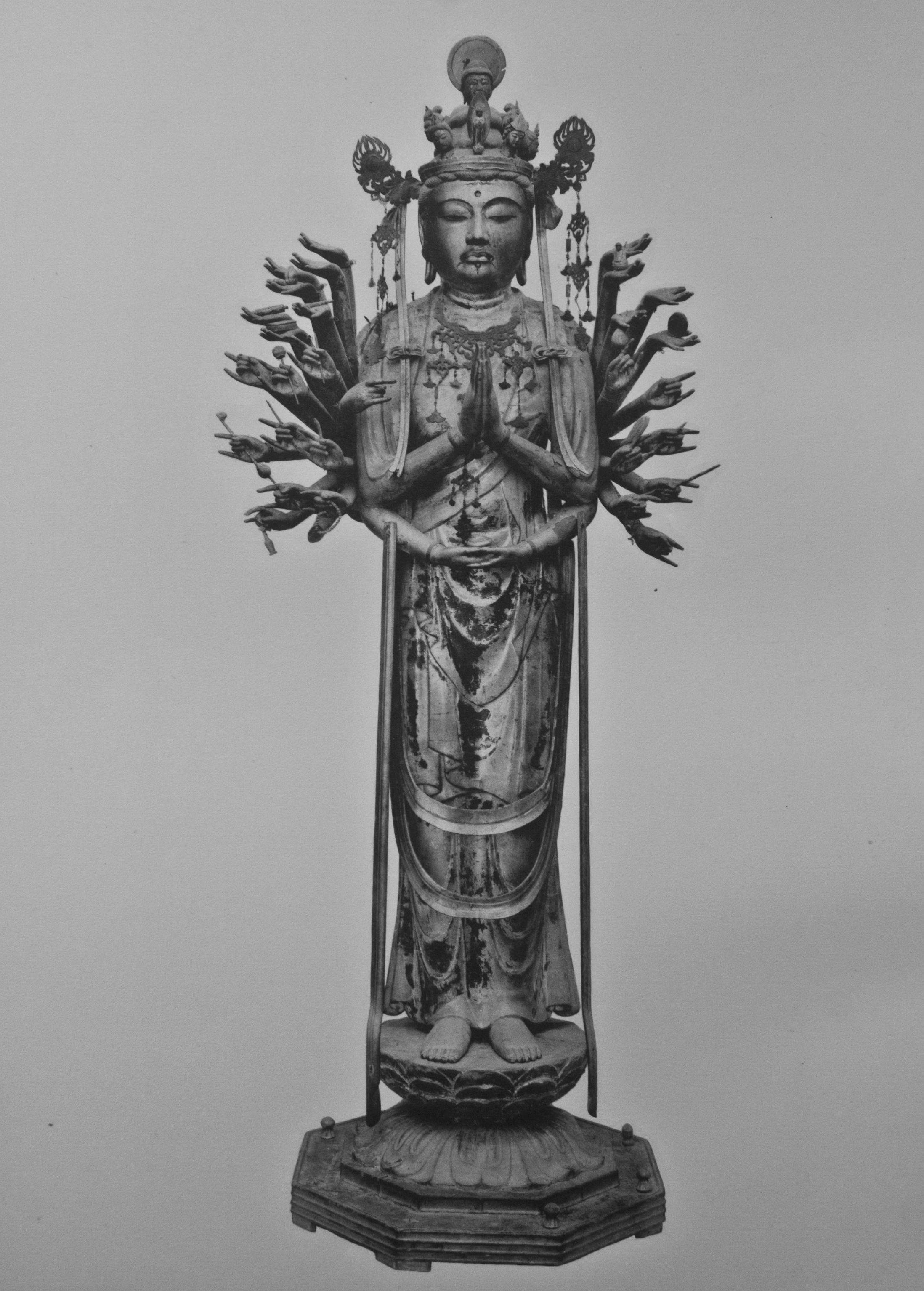
- Title
- Senju Kannon, chief image (中尊千手観音坐像)
- Period
- Kamakura
- Medium
- Hinoki cypress, yosegi-zukuri (multi-block); gold leaf over lacquer ground; inlaid crystal eyes (gyokugan)
- Dimensions
- Figure: c.335 cm (with pedestal and mandorla, the full devotional ensemble rises to c.7 m)
- Collection
- Rengeō-in (Sanjūsangen-dō), Kyoto
- Accession
-
National Treasure of Japan (国宝) - Rights
- Public domain (PD-Japan-oldphoto). Image via Wikimedia Commons.
Senju Kannon, chief image. Tankei, 1254. Hinoki cypress, yosegi-zukuri; gold leaf; c.335 cm. Rengeō-in (Sanjūsangen-dō), Kyoto. National Treasure of Japan. Image: pre-1957 photograph (PD-Japan-oldphoto), via Wikimedia Commons.
A chief image at eighty-two
Tankei (湛慶, 1173–1256) carved the chief Senju Kannon of Sanjūsangen-dō in 1254. He was eighty-two years old. Two years later, in the spring of 1256, he died. The chief image is therefore, on the inscription evidence, the last major work of his life, and the last major work of Unkei’s principal son.
The eighty-two-year-old’s hand is visible in the figure. The face is calmer than Unkei’s wrathful Niō and softer than Kaikei’s idealised Amida; the eyes are nearly closed, the brow is unfurrowed, the mouth holds a small lateral curve at the corners. The whole face reads as the face of a master in the last work of a long career, returning to the central iconographic register of Japanese Buddhism (Kannon) and rendering the figure with the spare authority of an artist who has nothing left to prove.
The institutional moment matters. The Sanjūsangen-dō had burned in 1249, in a fire that destroyed the temple’s first hall and its first programme of one thousand and one Senju Kannon figures. The pre-1249 chief image had been carved by Tankei’s grandfather generation; the post-1249 reconstruction was Tankei’s commission, and the chief image was the central object of the rebuilt hall. The 1254 completion of the chief image precedes the 1266 completion of the full hall by twelve years; the chief image’s arrival is the institutional event that the reconstruction is organised around.
The 1001-figure array
The chief image sits at the centre of a 33-bay hall (the temple’s name, sanjūsan-gen, “three-and-thirty bays,” refers to the architectural module). Flanking the chief image and ranged across the hall’s full length are 1001 standing Senju Kannon figures, in ten ranks deep along each side, each at roughly life-size (c.165 cm) on a low common platform.
The 1001 figures are not all of one date. 124 of them are Heian-period survivors from the pre-1249 hall, figures that were rescued from the 1249 fire and reinstalled in the rebuilt hall. The remaining 877 are Kamakura-period replacements made by the Kei workshop and other ateliers under the reconstruction programme, completed across the decades following the 1249 fire and the chief image’s 1254 installation. The temple’s programme is therefore layered: the chief image is 1254, the Heian survivors are 12th-century, the Kamakura replacements span the mid-to-late 13th century, and the hall as it stands today is the cumulative product of nearly a century and a half of devotional production.
What the 1001 figures do doctrinally is figure the Senju Kannon’s promise at proliferative scale. Each individual Senju Kannon is, in iconographic-doctrinal reading, the Thousand-Armed Kannon whose arms reach into the realms of suffering; one thousand and one Senju Kannons render the proliferation literal, fill the hall with the figure, and produce in the visitor’s eye the visual impression of a forest of identical bodhisattvas extending in every direction the visitor turns. The hall is not built for viewing one figure; it is built for the visual experience of many.
The chief image at the centre operates on different terms. It is larger (c.335 cm versus the c.165 cm of the standing figures), it is seated rather than standing, it is rendered with a level of sculptural detail and surface finish that the workshop replacements do not match, and it is the work of a named master (Tankei) rather than of distributed workshop teams. The viewer who enters the hall and walks the central aisle sees the 1001 standing figures peripherally and the chief image directly. The hall organises the viewer’s attention onto Tankei’s figure.
Reading the figure
The chief Senju Kannon sits in the half-lotus posture on a multi-tiered lotus pedestal. The central pair of hands is held at the chest in gasshō (the palms-pressed-together reverent gesture). The remaining forty arms (the canonical 42-arm sculptural shorthand for the Senju Kannon’s thousand arms) extend outward from the body in two arcs, twenty arms per side, each holding one of the iconographic implements the Senju Kannon programme catalogues: the lotus, the wheel, the sword, the bow and arrow, the ritual vessel, the alms-bowl, the willow branch, the vajra, the conch, the rosary, and the rest of the canonical 40-attribute set.
Above the principal head, eleven small heads are stacked in the canonical jūichimen (eleven-headed) configuration that the Senju Kannon iconographic programme takes from the Jūichimen Kannon variant. The central upper head is rendered as a small seated Buddha (Amida), the Amida-image-in-the-headdress that signs Kannon as the Amida-attendant, and the remaining ten are smaller bodhisattva heads in concentric ranks.
The drapery is rendered in the Kei-school refined Kamakura mode: distinct fold-lines, edge-broken planes across the lower body, surface preserving the rhythm of the carving. The robes are gold-leaf-surfaced over a black-lacquer ground, with the gold lifting and abraded in patches across the figure’s high-relief surfaces (the chest, the knees, the upper arms). The crystal gyokugan eyes catch the hall’s available light from the floor windows.
What the dedication says
The 1254 date and the Tankei authorship are not stylistic inferences. They are inscription evidence recovered from the figure itself: dedicatory documents stored in the interior cavity that the yosegi-zukuri assembly permitted, in the same documentary tradition as the Tōdai-ji Nandaimon Niō’s 1203 inscriptions.
The inscriptions name Tankei as the principal author and date the completion to the seventh year of Kenchō (Kenchō 7 = 1255, by the standard Japanese-era reading; some sources place the completion in Kenchō 6 = 1254 by the initial-period convention). The literature’s standard reading is 1254. The inscriptions also document the workshop assistants who worked under Tankei’s principal authorship and, less directly, the patronage history connecting the commission to the post-1249 reconstruction.
What the inscriptions establish, beyond date and authorship, is the late-career status of the work in Tankei’s biography. Tankei had been the Kei workshop’s principal continuator after Unkei’s death in 1223 and had carried the school’s institutional weight for thirty years. The Sanjūsangen-dō chief image was the largest single commission of his late period and the work the school’s institutional history would treat as his canonical masterwork.
Reading 1254 against 1203
Two Kei-school commissions bracket the school’s monumental output of the early-to-mid 13th century. The 1203 Tōdai-ji Nandaimon Niō are the school’s opening statement: collaborative four-master programme led by Unkei and Kaikei, completed in 69 days under Chōgen’s reconstruction-priest authority, the school’s first commission at the largest scale the yosegi-zukuri technique permits. The 1254 Sanjūsangen-dō chief image is the school’s closing statement of its first half-century: solo Tankei authorship at age 82, completed across a longer workshop window, the eldest son’s late-career chief image at the centre of his father’s school’s largest single-temple programme.
What the two commissions share is the yosegi-zukuri technique, the workshop-economy of distributed carving and centralised assembly, the documentary tradition of interior dedicatory inscriptions, the Kei-school anatomical-naturalist register, and the gyokugan eye-inlay technique. What they differ in is scale of authorship (four named principals vs. one), speed of execution (69 days vs. an extended workshop window), and iconographic register (wrathful Niō guardian vs. compassionate Kannon).
The shift between the two commissions is the Kei school’s internal maturation. In 1203 the school is proving its institutional capacity through speed and collaborative organisation. In 1254 the school is rendering authority through a single-master late-career signature work. The two modes are not competitors; they are sequential moments in the school’s institutional life.
What stays open
The first thing is the precise dating between Kenchō 6 (1254) and Kenchō 7 (1255). The literature carries 1254 as the standard reading but the inscription evidence is consistent with either depending on the era-conversion convention applied. A definitive resolution would require direct consultation with the Tokyo National Museum’s 2017 Unkei exhibition catalogue or with a dedicated Tankei monograph.
The second is the full per-attribute catalogue of the forty outer arms. The standard 40-attribute Senju Kannon programme is documented in the iconographic literature but the chief image’s specific per-arm rendering (which arm holds which implement, in which sequence, with what stylistic detail) has not, to current open-record knowledge, been fully transcribed in published English-language scholarship. A close-reading project against the temple’s conservation documentation would surface this.
The third is the question of the 124 Heian-survival figures. The pre-1249 Senju Kannon corpus is documented at the temple but the per-figure provenance (which 124 of the 1001 are 12th-century survivors, which sub-set of those is attributable to specific Heian workshops, what dates within the 1164–1249 founding-and-survival window each carries) is not, on current evidence, fully published in open-access form.
Sources
-
The temple is the holding institution. The chief image is the central seat of the 1001-figure devotional array.
-
Designated for the documented Tankei authorship and the 1254 inscription evidence.
-
Standard English-language source on the Kei school. The Sanjūsangen-dō Tankei reading anchors the school's late-Kamakura output in chapter 4.
-
Pre-history of the Kei school under Chōgen; background for Tankei's training and lineage position as Unkei's eldest son.
-
Major Unkei exhibition; Tankei treated as the principal Unkei-lineage continuator into the second half of the 13th century.
-
The 124 Heian-survival figures from the 1249 fire and the Kamakura replacements are catalogued in temple-internal publications.
-
Image clearance: PD-Japan-oldphoto.