Kōfuku-ji Hokuendō Mujaku (c.1212): Unkei's portrait of an Indian master
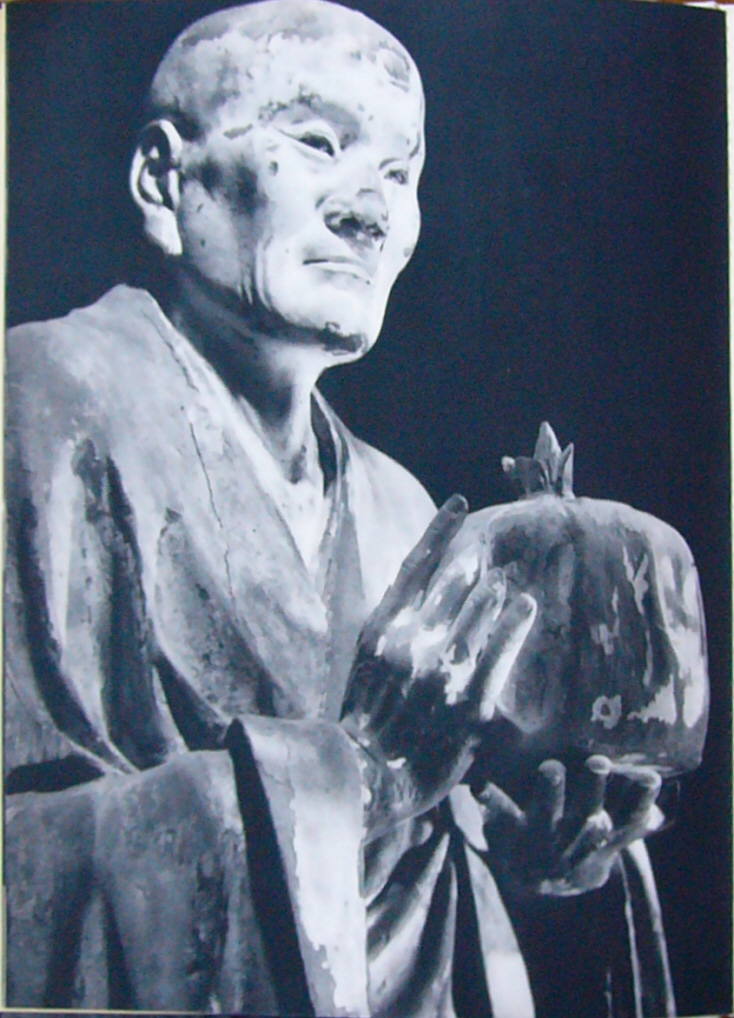
- Title
- Mujaku (無著, Asaṅga), standing
- Period
- Kamakura
- Medium
- Yosegi-zukuri (joined-block) hinoki cypress with polychromy and inlaid crystal eyes (gyokugan)
- Dimensions
- 194.7 cm tall
- Collection
- Kōfuku-ji, Hokuendō (北円堂), Nara
- Accession
-
National Treasure of Japan (国宝) - Rights
- PD-Japan-oldphoto via Wikimedia Commons
A portrait of a man no one had seen
Asaṅga (Mujaku, 無著, in Japanese) was a 4th-century Indian monk and one of the founding figures of the Yogācāra school. He lived roughly eight hundred years before Unkei. No one in Japan had seen him. No inherited portrait reached the Kamakura workshops, no contemporary description survived as ekphrasis, no relic-image circulated as a template.
What Unkei had was the Yogācārabhūmi, the Mahāyāna-saṃgraha, the doctrinal literature that gave him the idea of Asaṅga, and a commission, from Kōfuku-ji, to make a figure that would stand in the Hokuendō (the North Octagonal Hall) and represent the founding patriarch of the Hossō school, the Japanese inheritor of Yogācāra.
The figure Unkei made (completed around 1212, when Unkei himself was in his sixties) is one of the most individuated portrait sculptures in the entire Japanese tradition. He had no sitter and no inherited template, and yet what stands in the Hokuendō is unmistakably a particular man. That is the central paradox of this work, and it is what the article reads.
The Hokuendō commission
The Hokuendō at Kōfuku-ji had been destroyed in the 1180 Taira burning of Nara, the same fire that took down most of Tōdai-ji and triggered the post-1180 reconstruction programme on which the Kei school built its career. The hall was rebuilt by 1210, and the sculptural programme (the Maitreya [Miroku] Buddha as the central image, flanked by the two founding Yogācāra masters Asaṅga and Vasubandhu, Mujaku and Seshin) was awarded to Unkei’s workshop.
The commission is documented in Kōfuku-ji’s own records. The carving was led by Unkei with his sons and workshop members; the specific division of labour between Unkei himself and his workshop on the Mujaku and Seshin figures is debated (see §4), but the consensus reading is that the two patriarch portraits are Unkei’s most personally-handled work of his late period.
The Hokuendō pair stand in sharp contrast to the 1203 Nandaimon Niō: there, Unkei was leading a workshop of dozens through a 69-day completion of two 8.4-metre guardian figures, a feat of organisation. Here, the same hand is working at portrait scale (194.7 cm, close to life), at a slower pace, on a subject that demands interiority rather than ferocity. The Niō are bodies in motion; the Mujaku is a body that has been still for a very long time.
Reading the figure
The figure is 194.7 cm tall, slightly larger than life. Stand in front of it and the first thing you notice is the weight. The Mujaku is not slim; he is gaunt but solid, the body of an old man who has been a real body in a real place doing real work for a long time. The cheeks are sunken; the cheekbones stand out; the eye sockets are deep. The mouth is closed, the lips slightly compressed, with the faint asymmetry that real faces have.
The inlaid crystal gyokugan eyes (a Kei-school workshop technique perfected by Unkei) do most of the work. They catch the light differently from the matte-painted surface around them, and the result is that the gaze appears to follow you slightly as you move. The eyes are slightly down-cast, not making direct contact, but you feel them.
The robe is yosegi-zukuri (joined-block construction in hinoki cypress) with deep undercut folds at the cuffs and hem. The folds are not decorative; they describe how cloth actually hangs on a body. The surface has lost most of its original polychromy, leaving the wood grain visible in places, but enough pigment survives to indicate that the figure was originally fully painted: flesh tones for the face and hands, deep red and ochre for the robe.
What Unkei achieved in this figure is the specificity of an old man. Not generalised ascetic emaciation, not the idealised monk-type that Heian-period scholarship had been content to repeat. A particular face, with the slight asymmetries and accumulated lines that only come from being one specific person for one specific length of time. The viewer who arrives in the Hokuendō finds themselves looking at someone, not at a category.
What the commission says, and doesn’t say
The Hokuendō Mujaku is not signed in the way the Niō pair were inscribed. The Kōfuku-ji documentation places the commission with Unkei’s workshop; the per-figure authorship is inferred from style and from the late-Unkei interiority that distinguishes these two figures from the rest of the school’s output.
The Seshin (Vasubandhu) figure (Asaṅga’s younger brother and the second great Yogācāra patriarch) stands across the hall, also at 191.6 cm, also yosegi-zukuri with gyokugan eyes, also conventionally attributed to Unkei c.1212. The two figures read as a pair: brothers, both Indian, both founding masters of the same school, but distinct individuals with distinct faces. That paired-but-distinct reading is the strongest internal evidence for Unkei’s personal involvement; the unified handling of facial structure across the two figures is harder to read as workshop output.
Reading the Hokuendō pair against Unkei’s other late work
Unkei’s documented output spans roughly forty years, from the 1180s Izu commissions through the 1203 Nandaimon Niō to the 1212 Hokuendō pair and the c.1218 figures at the Tōdai-ji Daibutsuden. The Hokuendō Mujaku and Seshin sit late in this arc, after the Nandaimon Niō and before the Daibutsuden programme.
What changes across the arc is the mode. The early Izu figures are tight, controlled, almost Heian-residual. The Nandaimon Niō are explosive: bodies caught mid-motion, designed to be read at distance, formed of c.3,000 separately-carved blocks per figure under a 69-day deadline. The Hokuendō pair are something else again: slow, interior, individuated, working at near-life scale on subjects who have no surviving likeness but who are presented with the specificity of portraits from life.
The shift is not random. The Nandaimon Niō are gate-guardian figures: they exist to be seen from below and from a distance, to terrify, to mark a threshold. They are public sculpture. The Hokuendō pair are interior figures: they exist inside an octagonal hall where the viewer approaches them at close range, in low light, and stands at the same level. They are sculpture for slow looking, and Unkei’s late mode is calibrated for slow looking.
The 1254 Sanjūsangen-dō chief image, by Unkei’s son Tankei, completed when Tankei was 82, sits in this same Kei-school late-mode lineage. The school’s monumental output bookends at the 1203 Nandaimon Niō and the 1254 Sanjūsangen-dō chief image; the Hokuendō pair sit in the middle, at portrait scale, and are arguably the works in which the school’s particular synthesis of realism and devotion is most fully achieved.
The Yogācāra context
It matters who Asaṅga is. The Yogācāra school (vijñānavāda, “the consciousness-only doctrine”) holds that the perceptual world is a projection of consciousness rather than an independent external reality. Asaṅga, working in 4th-century Gandhāra, was the systematic compiler of the school’s foundational texts; his brother Vasubandhu was the philosophical synthesiser who later wrote the Abhidharmakośa-bhāṣya (the Cleveland 1916.1060 fascicle is one Heian-period survival of the Japanese reception of that text).
Hossō (the Japanese inheritor of Yogācāra) was Kōfuku-ji’s school. The Hokuendō was the architectural centre of that lineage. Putting Asaṅga and Vasubandhu in the Hokuendō was not a decorative choice; it was a doctrinal anchoring. The figures stand in the hall not as generalised patriarchs but as the founders of the specific philosophical tradition that the temple maintained.
What Unkei achieved is the visual insistence of that anchoring. The Mujaku is not a generic Indian monk; he is a specific person, with a specific face, who thought specific thoughts and wrote specific books. The realism of the portrait carries the realism of the doctrinal claim: this is not myth, the school says: this happened, this man lived, these texts were written.
What stays open
Three questions remain open on the Hokuendō Mujaku:
- The conservation report. No comprehensive published conservation study of the Hokuendō Mujaku and Seshin is currently in open distribution. The kind of internal-construction inscription evidence that the 1988-1993 Nandaimon Niō conservation produced would substantially refresh the per-figure attribution question. Until that work is published, the c.1212 date and the Unkei attribution rest on Kōfuku-ji’s own records and on stylistic reading.
- The original polychromy programme. The surviving pigment is partial. The original colour treatment (flesh tones, robe colour, eye treatment beyond the inlaid crystals) has not been comprehensively reconstructed in print. The PD-Japan-oldphoto used here captures the figure in approximately its c.1952 state; the present state may differ.
- The source material for the likeness. Unkei had no sitter and no inherited image. What he did have (textual descriptions of Asaṅga, Indian iconographic conventions arriving through Chinese mediation, the visual conventions for old monk-scholars established by the Heian period) together produced the imagined likeness. The specific recipe by which Unkei built the face has been less examined than the figure’s stylistic position in Kei-school output. A targeted iconographic study of the visual sources for the Hokuendō pair’s faces would be a substantial contribution.