The standing Amida of 1269: Kōshun, Hōkkyō, and 33 days at Shitennōji
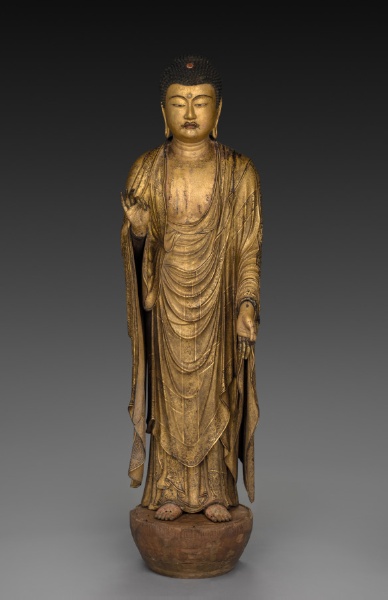
- Title
- Buddha of Infinite Life and Light (Amida Nyorai)
- Period
- Kamakura period (1185–1333), 1269
- Region
- Japan, made at Shitennōji Temple, Osaka
- Medium
- Cypress with lacquer, color, gold, cut gold (kirikane), rock-crystal inlaid eyes (gyokugan), and quartz
- Dimensions
- Overall 94.6 cm (37 1/4 in.)
- Collection
- Cleveland Museum of Art
- Accession
-
1960.197 - Rights
- Cleveland Museum of Art (Public Domain / CC0); credit line: John L. Severance Fund, 1960.197
The 1269 Amida is small (94.6 cm — sub-life-size). The honest detail is the lotus base: undecorated dark wood, much simpler than the elaborate gilt-bronze pedestals of Heian period work.
The pre-published version of this entry called the maker “unsigned.” That was wrong. The Cleveland catalog credits the work to Kōshun (康俊) as lead sculptor, at the rank of Hōkkyō (法橋), “Bridge of the Dharma,” with assistants Koshin and Joshun, completed over the course of thirty-three days in 1269 at Shitennōji Temple in Osaka.
The completion record, the Amida Sutra, and a donor register (kechien-bo) sealed inside the figure’s hollow chamber are the source. We know the names. We know the days. We know the temple.
This is much rarer than it sounds. Anonymous Kamakura Amida figures are the rule: most surviving works carry no inscription, no temple deposit, and no published provenance. A signed and dated piece with a named workshop and a specific temple-of-origin is the exception. Cleveland 1960.197 is one of the exceptions.
What you actually see
A 94.6 cm standing Amida in cypress, gilded across most of the body, on a small dark wooden lotus pedestal. The figure is sub-life-size. The head carries the usnīsa (cranial protrusion), the byakugō (urna at the brow), and tightly coiled rahotsu hair. The earlobes are long and pierced.
The robe is the standard Buddhist kasaya over a kun skirt-robe, draped asymmetrically over the left shoulder leaving the right shoulder partly bare. Its parallel-fold drapery is the Kamakura realist signature: clean, weighted, planar.
Hands form the welcoming-descent gesture: right hand raised at chest level palm forward, with thumb and forefinger joined; left hand lowered at the side, palm forward. This is raigō-in combined with the standard fearless- ness and wish-granting hand-positions (the upper hand expressing semui-in, “do not fear”; the lower expressing yogan-in, “I grant your wish”).
Standing-Amida sculpture is the freestanding equivalent of the painted raigō-zu: same descent moment, isolated as a single body.
Gilding survives across most of the body. Looking carefully, the wear is not the textbook pattern: gold has not retreated into the deep folds while abrading off the high planes. Instead, the gilding is largely intact across the prominent draped surfaces, with darker passages mostly along the lower hem of the robe and a few specific weathered zones near the right wrist and left foot.
This may indicate the piece spent most of its history under controlled altar conditions rather than being touched in routine ritual; or it may indicate a later regilding campaign. The catalog does not push on this; conservation analysis would resolve it.
The lotus pedestal is itself worth a sentence. It is small relative to the figure, undecorated, dark wood, no extensive carving or inlay. Most surviving elaborate Heian Amida figures sit or stand on tiered gilt-bronze lotus thrones; Cleveland 1960.197 sits on a comparatively austere wooden lotus. Whether this is the original 1269 base or a later-period replacement is not addressed in the published catalog.
What’s inside the body
The hollow chamber (naikū, 内空) is what gives the piece its dating-anchor. Kamakura cult sculpture routinely sealed deposits inside the figure during the dedicatory rite (shōōshiki or kuyō), not as afterthought, but as the practical condition that made the body a vessel for cult worship. The deposit transformed wood into icon.
For Cleveland 1960.197 the deposit includes:
- A copy of the Amida Sutra (Amida-kyō, 阿弥陀経): the short Pure Land sutra describing the Western Paradise.
- A donor register (kechien-bo, 結縁簿): names of those who contributed to the commission, “joined together in generating karmic merit.” This is the practice of kechien: laypeople inscribe their names to attach themselves spiritually to the icon and benefit from the merit of its existence.
- A completion record stating the image was made in thirty-three days in 1269 at Shitennōji.
The completion record is what gives us the maker. Kōshun, Hōkkyō, with Koshin and Joshun as assistants. The thirty-three-day duration is specific enough to suggest the piece was commissioned with a deadline, possibly tied to a specific kuyō date or memorial service.
On the rank
Hōkkyō (法橋), “Bridge of the Dharma,” is the third and lowest of three honorary ranks granted to Buddhist artisans by imperial authority during the Heian and Kamakura periods. The full ladder, in ascending order:
- Hōkkyō (法橋): Bridge of the Dharma. Third rank.
- Hōgen (法眼): Eye of the Dharma. Second rank.
- Hōin (法印): Seal of the Dharma. First and highest rank.
The ranks were originally clerical titles for ordained Buddhist priests, extended to Buddhist sculptors (busshi) starting in the eleventh century when Jōchō received Hōkkyō in 1022 and Hōgen later.
By Kōshun’s time the ranks were standard recognition for senior workshop heads. Unkei ended his career at Hōin. Kaikei advanced to Hōin late in life. A sculptor holding Hōkkyō in 1269 (fifty-six years after Unkei’s death) was a respected workshop master, neither a beginner nor at the absolute summit.
The rank-ladder matters here for one reason: the Cleveland catalog notes, and several non-specialist sources repeat, that Kōshun (康俊) is also the name of a sculptor active at Kōfukuji from c. 1315 to 1328 at Hōgen rank, who signed himself “descendant of Unkei.” Whether the 1269 Hōkkyō Kōshun and the 1315–1328 Hōgen Kōshun are the same person is an open question.
A forty-six-year career advancing from Hōkkyō to Hōgen is plausible; a master passing his name to a son or pupil is equally plausible. The Cleveland catalog does not commit; the secondary literature is unsettled. Honest practice is to keep them as two records and note the link, not collapse them.
On the school
The pre-elevation version of this entry called the piece “every technique on it is identifiably Kei.” That assertion needs hedging. The Kei school (慶派, Keiha), also called the Nara busshi, was founded by Kakujo (覚助, d. 1077) and headquartered at Kōfukuji in Nara. Its lineage runs through Kōkei → Unkei → Tankei, Kaikei, and others into the late thirteenth century.
The Kei school’s signature contribution is precisely the construction-and- finish vocabulary on display here: yosegi-zukuri joined blocks, gyokugan rock-crystal inlay, kirikane cut-gold patterning, naturalistic anatomical proportions, individuated faces.
But Cleveland 1960.197 was made at Shitennōji in Osaka, not at Kōfukuji. Shitennōji had its own resident Buddhist sculptors. The 1315–1328 Kōshun who signed as “descendant of Unkei” is one basis for tying the 1269 maker to the Kei lineage, if the two are in fact the same person.
The catalog’s choice not to assign the piece to a specific school is appropriate caution. The most defensible statement: the construction and finish techniques on Cleveland 1960.197 are Kei-school techniques, but whether the maker belongs to the Kei lineage proper or to a Shitennōji-based atelier trained in those techniques is not settled.
The distinction matters because the Kei school is sometimes spoken of as the Kamakura sculptural mode. It was the dominant lineage but not the only one. The In school (Inha, 院派) and En school (Enha, 円派), both Kyoto-headquartered, continued through the Kamakura period in parallel. Some Kamakura sculpture is none of the three.
How the figure was built
The construction vocabulary, as far as Mori (1974) and Morse (1985) articulate it for Kamakura figures of this scale and date:
Yosegi-zukuri (寄木造り): joined-block construction. The body is assembled from multiple hollowed cypress blocks pegged and lacquered together rather than carved from a single log (ichiboku-zukuri, the Heian-and-earlier method).
The advantages are decisive: parallel work by multiple hands, much larger possible figures, thinner walls, and the hollow chamber that holds the deposit. Yosegi is the Jōchō-school innovation of the eleventh century (Morse 1985 traces it specifically to Jōchō’s workshop at Hōjōji); the Kei school inherited and refined it.
Gyokugan (玉眼): rock-crystal inlaid eyes. Convex polished crystals are inlaid from inside the hollow head, backed with painted irises and cotton. The inlay is anchored from inside the cranial chamber. Gyokugan is a Kamakura innovation; you do not see it in Heian or earlier figures.
On Cleveland 1960.197 the gyokugan are visible as the slight light-catching quality of the eyes; the inlay was accessed during construction, before the front and back halves of the head were joined.
Kirikane (切金): cut-gold-leaf patterning. Squares, hexagons, or strips of gold leaf are cut to size with a bamboo knife and applied with diluted glue along robe edges, halo bands, and ornamental panels. The technique requires near-microscopic dexterity. It is the most demanding finish technique in the Kei vocabulary; it identifies a piece as high-grade workshop work.
On Cleveland 1960.197 the kirikane runs along robe edges and ornamental bands, visible at close range though faint at this image resolution.
Urushi-cloth-and-gold polychromy. The surface preparation is the standard Japanese Buddhist scheme: a coarse cloth (moshi) layer applied to the wood, sealed with urushi (lacquer), then gold leaf laid over the lacquer ground. This sequence has been standard since the Asuka period (seventh century) and is what makes the gilding durable across centuries.
What stays unverified
Three substantive questions remain open about Cleveland 1960.197:
The two-Kōshuns question. Whether the 1269 Hōkkyō Kōshun and the 1315–1328 Hōgen Kōshun at Kōfukuji are the same person, a father-son pair, or a master-pupil with name inheritance is unsettled. A 46-year career is plausible (Kōshun in 1269 might be in his thirties or forties; in 1315 he would be in his late seventies or eighties).
But the late Kōshun’s signature as “descendant of Unkei” is also consistent with a younger sculptor inheriting the name and lineage claim. Resolving this would require comparing the calligraphy of the 1269 completion record with the late Kōshun’s signed works at Kōfukuji.
The school attribution. The Kei-school construction-and-finish vocabulary is on the figure. Whether the workshop itself was a Kei branch operating at Shitennōji, a Shitennōji-resident atelier trained in Kei methods, or a hybrid is not settled. The secondary literature treats the piece variously as “Kōshun atelier” (Asia Society 2016), “Kei school” (several non-specialist sources), and “Kamakura, late thirteenth century” (the Cleveland catalog itself, neutrally).
The lotus pedestal. Whether the dark undecorated wooden lotus base is original to 1269 or a later replacement is not addressed in the published catalog. The simplicity of the base relative to the elaboration of the figure is unusual; Heian-period and high-Kamakura figures of this rank typically sit on more ornate gilt-bronze or carved-and-gilded lotus thrones.
Either the original base was simpler than the figure (consistent with a regional commission at Shitennōji where Pure Land iconography emphasised the figure rather than its furniture), or the original base has been replaced.
How to read it next time
Look at the eyes: Kamakura. Look at the gilding pattern: see where it has worn and where it has held; that is the figure’s life history written in surface. Look at the robe edges: the kirikane, where it survives, is the workshop’s signature. Look at the lotus base: its plainness, if you notice it, is part of the reading.
And know that the 1269 Amida is not anonymous: it was made in thirty-three days, by Kōshun at the rank of Hōkkyō, with two named assistants, at Shitennōji in Osaka, by an atelier working in techniques the Kei school perfected. The names matter. The deposit matters. The rank matters.
Sources
-
[2]— Hisashi Mori, Sculpture of the Kamakura Period, trans. Katherine Eickmann (New York: Weatherhill, 1974) print referenceFoundational English-language study of Kei-school construction and finish technique; pp. 27–58 on the Kei lineage and pp. 138–162 on yosegi-zukuri and kirikane.
-
[3]— Samuel Morse, Jōchō and the Yosegi-zukuri Technique in Archives of Asian Art 38 (1985): 60–78 print referenceOrigin of joined-block construction in Heian and its Kamakura refinement.
-
Kei-school workshop organization in late 12th–13th century Nara.
-
[5]— Onmark Productions Glossary of Japanese Sculptors (Busshi) onmarkproductions.com/html/busshi-glossary.htmlReference for honorary ranks (Hōin, Hōgen, Hōkkyō) and the Kei / In / En school lineages.
-
[6]— Asia Society, Kamakura: Realism and Spirituality in the Sculpture of Japan (exhibition catalogue, 2016) print referenceDiscusses the 1269 Amida as 'a product of the atelier of Kōshun.' The Asia Society catalog is the most accessible English-language treatment of the Cleveland 1269 piece in its workshop context.