Prince Shōtoku at age two: the Namu Busshi image-type at Cleveland (1989.76)
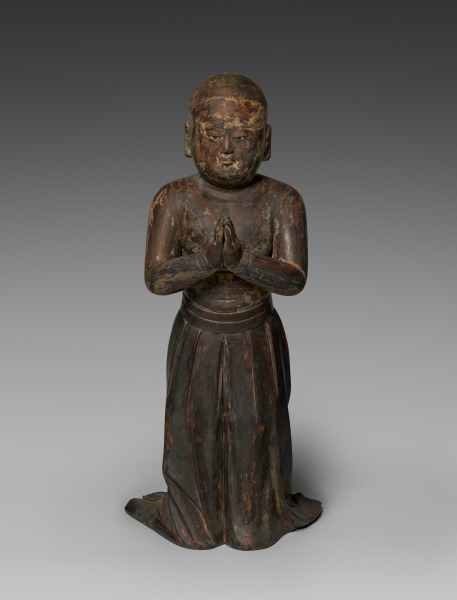
- Title
- Prince Shōtoku at Age Two — 聖徳太子立像(二歳像)
- Period
- Kamakura period (1185–1333), early 1300s
- Region
- Japan
- Medium
- Wood with lacquer, color, and rock-crystal inlaid eyes
- Dimensions
- Height 68.6 cm (27 in.)
- Collection
- Cleveland Museum of Art
- Accession
-
1989.76 - Rights
- Cleveland Museum of Art (CC0). Gift of Mr. and Mrs. James Campbell Weir in memory of Dr. and Mrs. William Hawksley Weir.
Cleveland 1989.76: Prince Shōtoku at Age Two (Shōtoku Taishi Nisai-zō, 聖徳太子立像(二歳像)). Standing figure, 68.6 cm. Wood with lacquer, color, and rock-crystal inlaid eyes; Kamakura period, early 1300s. Gift of Mr. and Mrs. James Campbell Weir in memory of Dr. and Mrs. William Hawksley Weir, 1989. CC0.
Cleveland 1989.76 is an early-1300s Kamakura wood Shōtoku Taishi Nisai-zō, 68.6 cm: a small standing figure, naked from the waist up, palms joined in gasshō, with rock-crystal inlaid eyes and traces of red lacquer pigment. The image-type commemorates the Namu Busshi legend and is a standardized form of the post-Hōnen Shōtoku revival cult.
What the photograph shows
The figure stands. Cleveland’s Japanese-language catalog title reads Shōtoku Taishi ryūzō (nisai-zō) (聖徳太子立像(二歳像)), “standing image (age-two image)” — and the title accurately describes the work.
The body is upright; the long pleated skirt drops to the floor in vertical folds with no behind-the-knee gathering; small feet are just visible at the centre-bottom of the skirt’s hem. The standing form is also the canonical Nisai-zō iconography: the Sedgwick Shōtoku at Harvard (1991.500) and the Princeton y1984-76 are both standing figures in the same image-type, and the published Kamakura-period Shōtoku Nisai-zō corpus is uniformly standing.
Palms are pressed together at the chest in gasshō (合掌, palms-joined gesture).1 The torso rises bare from the long lower garment, the elbows pull in close to the body, the hands meet flat against the chest at sternum height with the fingers extended together rather than interlaced.
The body is that of a small child. The head is large in proportion to the torso, a deliberate iconographic choice that reads the figure as a toddler rather than a small adult.
The face is full and round, the cheeks slightly bulging, the chin small and recessed. The mouth is closed in repose, the lips not parted into the “Namu Butsu” speech-act that the legend records but composed afterward, the moment of utterance held quiet.
The hair is gathered into the canonical child’s hair-style of two short topknots, one on each side of the head, with the front of the scalp shaved in the agemaki (or mizura) Asuka-archaizing aristocratic-child convention that the iconography preserves as a marker of Shōtoku’s seventh-century-prince identity.
The eyes are the technical signature. They are inlaid in carved rock-crystal, gyokugan (玉眼), a Kamakura-period innovation in which polished translucent crystal is set into the eye-socket from the interior of a hollow figure, with the iris and pupil painted on the back of the crystal in lacquer or pigment so that the eye reads as a refractive optical body rather than a carved-and-painted surface.
The technique was a Kei-school workshop development of the late twelfth century that became the canonical Kamakura realist convention. Cleveland’s eyes are downcast, set into a slight forward tilt, and read at the photograph’s resolution as the most fully-preserved single passage of the figure’s surface programme. Where the polychromy elsewhere has been worn or lost, the crystal inserts have held.
The polychromy programme survives in fragments. The skirt was originally red, and the colour survives in the recesses of the carved fold-pattern, particularly behind the knees and along the inner edges of the hem.
The skin was originally pale, of a pale-flesh pigmentation that has weathered to a matte unmodulated wood-tone over the visible surfaces. The hair colour is unrecovered: the surviving pigment traces do not resolve to either of the two standard conventions (lacquer-black or pigment-blue-black) that the comparable Harvard and Princeton figures in the same image-type carry.2
The lacquer ground that bound the original colour is peeling on the upper back and across the right shoulder.
What the photograph cannot resolve at the published scale: the construction technique (whether the figure is yosegi-zukuri joined-block or carved from a single block), the state of the interior cavity (whether it is hollow and whether dedicatory deposits survive), and the per-figure assignment of any inscription on a base or interior surface.
The Sanjūsangen-dō Senju Kannon programme resolves comparable questions through the surviving inscriptional record; the Sedgwick Shōtoku at Harvard resolves them through a 1937 conservation cavity-deposit removal that supplies the dating-floor of 1292; no equivalent technical record has surfaced for Cleveland 1989.76 in the sources consulted for this article.3
The Namu Busshi legend and the Denryaku
The episode that the figure depicts is the Namu Busshi (南無仏, “homage to the Buddha”) legend, the most-circulated of the hagiographic miracle-narratives attached to the historical Prince Shōtoku (Shōtoku Taishi, 574–622, Wikidata Q263972), the Asuka-period regent under Empress Suiko traditionally credited with the official establishment of Buddhism as a state religion in Japan.
The story is preserved in the Shōtoku Taishi Denryaku (聖徳太子伝暦), the early-tenth-century hagiographic biography that became the principal narrative source for the post-Heian Shōtoku cult.4
In the Denryaku version, the toddler prince at age two (on the second-month fifteenth-day anniversary of the Buddha’s parinirvāṇa) turned to the east, joined his hands in gasshō, and uttered the words “Namu Buddha” without instruction.
The legend specifies that a small relic of the historical Buddha (most commonly named as the shari of the Buddha’s left eye) materialized between his joined palms at the moment of utterance, supplying both the immediate miracle and the relic-deposit logic that the medieval cult later attached to the image-type.5
The Denryaku itself is a hagiographic compilation, not a documentary record.
Michael Como’s Shōtoku: Ethnicity, Ritual, and Violence in the Japanese Buddhist Tradition (Oxford, 2008) traces the construction of the Shōtoku cult across the two centuries between the Nihon Shoki (720) and the Denryaku, in which the historical figure of the Asuka regent was elaborated by an institutional cluster of Buddhist lineages, many of immigrant Korean (Silla) descent, into the foundational hero-figure of Japanese Buddhism.6
The Denryaku is the consolidated late-stage form of that elaboration. The Namu Butsu episode is one of the legend-cycle’s signature miracles, alongside the prince’s reported posthumous identification with the bodhisattva Avalokiteśvara (Kannon) and the foundation legends of Hōryū-ji, Shitennō-ji, and the other Shōtoku-affiliated monasteries.
The legend’s iconographic activation came late. The cult was institutionally vigorous through the Heian period: Hōryū-ji’s Shōryōin (Hall of the Prince’s Spirit) was renovated in Hōan 1 (1121) to house a seated adult-regent Shōtoku image as its principal hibutsu, designated National Treasure and unveiled annually on 22 March, the eve of the prince’s death anniversary.7
The Heian sculptural Shōtoku corpus is dominated by this adult-regent type. The age-two image-type, by contrast, is a Kamakura-period innovation.
The earliest dated examples surface in the early thirteenth century, well after Hōnen’s foundation of the Jōdo-shū (1175) and at the threshold of Shinran’s Jōdo-Shinshū formation, and it is in this Pure Land–revivalist context that the Nisai-zō becomes a standardized commission for installation at Shōtoku-affiliated halls and at the new Pure Land sects’ liturgical sites.
The post-Hōnen revival and the Pure Land identification
The Kamakura proliferation of Shōtoku image-types is inseparable from the Pure Land sects’ adoption of Shōtoku as the spiritual founder-figure of Pure Land Buddhism in Japan. The institutional history runs through Hōnen (法然, 1133–1212) and Shinran (親鸞, 1173–1263), the two figures around whom the Jōdo-shū (1175) and the Jōdo-Shinshū (mid-thirteenth century) crystallized as the dominant new sectarian formations of the early Kamakura.
Kenneth Doo Young Lee’s The Prince and the Monk: Shōtoku Worship in Shinran’s Buddhism (SUNY, 2007) is the standard English-language treatment of the link.8 Lee documents Shinran’s reported dream-visions in which Shōtoku appeared as the bodhisattva Kannon (Avalokiteśvara), supplied liturgical instruction, and confirmed Shinran’s Pure Land mission.
The honji-suijaku (本地垂迹, “original ground and trace manifestation”) logic that the medieval Japanese theological synthesis used to align Buddhist deities with local kami is here applied in reverse: Shōtoku, the historical Asuka regent, is read as a suijaku (trace manifestation) of Kannon, the honji (original ground).
The Kamakura Pure Land sects therefore had institutional reason to commission Shōtoku images at scale, particularly images that compressed the prince’s biography into iconographic-shorthand single-figure forms. The Nisai-zō supplied the founder-as-toddler form; the age-sixteen Kōyō (孝養) image-type supplied the filial-piety form; the adult-regent and the ascetic-warrior types supplied the others.9
The doctrinal logic of the Nisai-zō within this revivalist context is specific. The age-two utterance “Namu Buddha” is read as the historical-Japanese precedent for the Pure Land nenbutsu (念仏, “Buddha-recollection”) — the recitative invocation that Hōnen and Shinran made the ritual centre of their Pure Land practice.
Shōtoku’s untaught toddler-utterance establishes that the nenbutsu-form invocation is innate to Japanese Buddhist devotion at its origin: the practice the new Pure Land sects propagated in the thirteenth century is recoverable from the cult’s foundational figure in the seventh. The Nisai-zō is therefore not a generic devotional image but a polemical iconographic claim: the founder of Buddhism in Japan was, at age two, already a Pure Land practitioner.
The geographic distribution of surviving Nisai-zō figures supports this institutional reading. Carr’s Plotting the Prince (Hawai’i, 2012) maps the medieval Shōtoku image corpus across Hōryū-ji, Shitennō-ji, Tachibana-dera, and the network of affiliated sub-temples, with the densest Kamakura sculptural production at the institutional sites of the post-Hōnen Shōtoku revival.10
Hundreds of Nisai-zō survive across the Kamakura, Nanbokuchō, Muromachi, and Edo centuries; the iconography crystallized rapidly in the early Kamakura and remained essentially stable across the next four centuries.
The standard image-types of Shōtoku
The Kamakura cult standardized roughly four sculptural image-types of Shōtoku, each anchored to a specific episode in the Denryaku-derived hagiographic biography. Cleveland 1989.76 belongs to the first; Cleveland’s own collection holds an example of the second; Met holdings illustrate the chronological persistence into the Nanbokuchō and Muromachi.
The Nisai-zō (二歳像, “age-two image”) is the standing Namu Busshi form to which the Cleveland figure belongs: small standing toddler, naked from the waist up, palms joined in gasshō at the chest, the head-and-body proportions exaggerated to read as a child. The episode is the Namu Butsu utterance at age two on the parinirvāṇa anniversary.
The earliest dated examples surface in the early thirteenth century; the standard quality-benchmark and dating-anchor for the type is the Sedgwick Shōtoku at Harvard (1991.500), dated to ca. 1292 by an inscribed manuscript among the more than seventy interior dedicatory deposits sealed within its hollow body cavity.11
Princeton y1984-76 supplies a second closely-comparable late-thirteenth-century witness; Cleveland 1989.76 supplies the early-fourteenth-century continuation. Hundreds of Nisai-zō survive across the Kamakura, Nanbokuchō, Muromachi, and Edo centuries.
The Kōyō (孝養, “filial-piety”) or age-sixteen image is a standing figure of the prince at sixteen in Buddhist vestments, holding a long-handled incense burner. The episode is the prince’s prayer for the recovery of his ailing father Emperor Yōmei.
Cleveland 1964.278 is the in-collection example: the sixteen-year-old garbed in Buddhist vestments with the long-handled censer, accompanied by attendants holding religious texts and a nyoi ceremonial scepter.12 The Met holds the Nanbokuchō (1336–92) continuation of the type at accession 13.71. The Kōyō and Nisai-zō are the two most commonly produced Kamakura Shōtoku sculptural types.
The adult-regent image is a seated Shōtoku in court-attire, typically holding a shaku (笏, court-scepter), in the cult’s institutional-administrator pose. The Hōryū-ji Shōryōin’s Heian (1121) National Treasure is the canonical pre-Kamakura example. The Kamakura cult continued the type but did not develop it as innovatively as the child-figure types.
The ascetic-warrior image depicts Shōtoku in armor on horseback, typically subduing the Mononobe clan (the historical anti-Buddhist faction defeated in the 587 Asuka power-struggle that secured the prince’s institutional Buddhist patronage). The type is rare in surviving sculpture and more common in painted formats; the Met’s Kamakura Shōtoku Taishi e-den (Illustrated Biography, accession 29.100.471) supplies the painted-narrative context.13
The four image-types are not exhaustive. The medieval cult produced occasional images of the prince at age seven (the Uma-yado / “Stable-door” prodigy episode), at age forty-nine (preaching the Lotus Sūtra at Hōryū-ji), and in posthumous-Kannon form. But the four canonical types account for the great majority of surviving sculptural commissions, with the Nisai-zō and the Kōyō dominating the Kamakura sculptural corpus by a wide margin.
What the Cleveland figure attests, and what remains open
The iconographic identification is secure. The standing toddler in gasshō with the rock-crystal eyes and the surviving red-pigment skirt is a Nisai-zō, the Kamakura cult’s standardized age-two image of Prince Shōtoku at the moment of the Namu Butsu utterance.
The Harvard Sedgwick Shōtoku (1991.500, ca. 1292) and the Princeton y1984-76 (late thirteenth century) supply the principal Kamakura-Nisai-zō comparanda; Cleveland 1989.76 reads as the early-fourteenth-century continuation of a fully-standardized image-type.
The doctrinal context is also secure: the Nisai-zō is a product of the post-Hōnen Pure Land–revivalist Shōtoku cult, which adopted the prince as the spiritual lineage-founder of Pure Land in Japan and read his age-two utterance as the historical-Japanese precedent for the Pure Land nenbutsu practice.
The institutional context is documentary: hundreds of Nisai-zō figures were commissioned for installation at Hōryū-ji’s Shōryōin and at the network of Shōtoku-affiliated and Pure Land–affiliated halls across the Kamakura through Edo centuries.14
Three things remain open.15 First, no specific workshop, sculptor, or temple-of-origin attribution is published for Cleveland 1989.76.
The figure’s stylistic features are consistent with early-fourteenth-century Kei-derived sculptural practice broadly, and the rock-crystal gyokugan convention places it within the post-late-twelfth-century Kei-school technical inheritance, but no finer attribution has surfaced in the sources consulted for this article. The 1989 Weir-family gift carries no published pre-1989 provenance chain that would resolve the temple-of-origin question.
Second, the construction technique is not specified in Cleveland’s published catalog. The figure is recorded as “wood with lacquer, color, and rock-crystal inlaid eyes”; the yosegi-zukuri (joined-block) versus ichiboku-zukuri (single-block) question is not resolved at the published documentation level.
The contemporaneous Sedgwick and Princeton figures are both yosegi-zukuri; Cleveland 1989.76 is most plausibly the same, on stylistic and chronological grounds, but the question would be settled by a Cleveland-published condition report.
Third, the interior-deposit state is unknown. The Sedgwick Shōtoku’s dating-anchor came from the manuscript-inscribed materials sealed within its hollow body cavity; if Cleveland 1989.76 is hollow and was never opened, it may carry a comparable cache that would supply a precise dating, donor-network reconstruction, and institutional-provenance pathway.
If it has been opened and the deposits documented, the documentation has not been published in the catalog text accessible at the time of writing.
What the Cleveland wood offers is the iconographic programme complete and intact: the standing Namu Butsu posture, the gasshō gesture, the rock-crystal eyes that survive the loss of much of the polychromy, the surviving red-pigment evidence of the original colour scheme, at a scale (68.6 cm) that the Sedgwick figure (the Harvard standard) approaches but the Princeton figure (53.0 cm) does not.
The figure carries the standardized iconography of the post-Hōnen Shōtoku revival cult into a U.S. museum collection that has held it on public view in its Japanese gallery since the Weir-family gift in 1989. What it cannot offer at the published state is the workshop, the construction technique, the interior-deposit state, or the pre-1989 institutional history.
Related
- Zaō Gongen and the Kinpusen mountain cult: Cleveland 1973.105
- Asuka Kannon: gilt-bronze of the mid-600s
- Yūzū Nenbutsu Engi: the illuminated handscroll
- The White Path between Two Rivers: a Pure Land parable
- Nanbokuchō raigō: the twenty-five bodhisattvas
Footnotes
-
Cleveland Museum of Art, accession 1989.76, “Prince Shōtoku at Age Two (Shōtoku Taishi)” (聖徳太子立像(二歳像)), Japan, Kamakura period (1185–1333), early 1300s; wood with lacquer, color, and rock-crystal inlaid eyes; classified as sculpture; height 68.6 cm (27 in.); credit line “Gift of Mr. and Mrs. James Campbell Weir in memory of Dr. and Mrs. William Hawksley Weir”; CC0 (Cleveland Open Access); on view in Gallery 235B (Japanese). Catalog page accessed 2026-05-07 at clevelandart.org/art/1989.76. The descriptive text reads the figure as commemorating the Namu Busshi episode: “depicts him chanting Buddha’s name at age two, a legendary occurrence that preceded his significant religious contributions,” with the prince’s palms held together in gasshō gesture. The standing posture is in the Japanese-language title (立像, ryūzō, “standing image”) and was confirmed by visual inspection of the museum’s published photograph (2026-05-07). The accession is single (no .a / .b component split). Wikidata Q60758587 records the same metadata with public-domain image rights. ↩
-
Cleveland’s published descriptive text identifies “fragmentary paint layers” indicating that the garment was red, the skin was a pale colour, and the hair was painted “a different, as-yet unknown color.” The hair-colour conventions at the Harvard Sedgwick Shōtoku (1991.500) and Princeton y1984-76 are documented in those museums’ technical records but the Cleveland hair-colour reconstruction remains an open question pending a Cleveland-published condition report. ↩
-
For the Harvard Sedgwick Shōtoku (1991.500): yosegi-zukuri (assembled-block) Japanese cypress (hinoki) construction with rock-crystal inlaid eyes set before assembly; the hollow body cavity contained more than seventy dedicatory deposits removed in 1937 by a visiting Japanese conservator at the Museum of Fine Arts, Boston; the deposits include relic grains (shari), miniature sutras, miniature devotional sculptures, a twill-weave silk bag, Sanskrit dhāraṇī charm sheets, and individually-named donor inscriptions; the latest dated item is a manuscript inscribed in 1292, which supplies the dating-floor for the entire deposit and (by curatorial inference) for the figure itself. See the Harvard Art Museums catalog entry for accession 1991.500 (harvardartmuseums.org/collections/object/209642, accessed 2026-04-26) and the Harvard exhibition record for “Prince Shōtoku: The Secrets Within” (harvardartmuseums.org/exhibitions/5756, accessed 2026-04-26). For Princeton y1984-76: yosegi-zukuri construction in two pieces for the head, two for the body, plus additional pieces for the skirt base, with crystal eyes set before assembly and the arms as modern reconstructions (artmuseum.princeton.edu/art/collections/objects/32872, accessed 2026-04-26). No equivalent technical-study record has surfaced for Cleveland 1989.76 in the sources consulted for this article. ↩
-
The Shōtoku Taishi Denryaku (聖徳太子伝暦), traditionally attributed to Fujiwara no Kanesuke (藤原兼輔, 877–933) and probably compiled in the early tenth century, is the first sustained chronological hagiography of Shōtoku and the principal narrative source for the Namu Butsu age-two episode. Kenneth Doo Young Lee, The Prince and the Monk: Shōtoku Worship in Shinran’s Buddhism (SUNY Press, 2007), notes that more than a hundred biographical accounts of Shōtoku were produced through the Tokugawa period, most based on or influenced by the Denryaku. The Denryaku consolidates the cult’s transformation of Shōtoku from political hero (the Nihon Shoki figure) into religious savior-figure (the medieval-cult figure). ↩
-
The relic-materialization variant of the legend — in which a small vessel containing a shari (relic) of the historical Buddha, named most commonly as the left eye of Śākyamuni, appeared between Shōtoku’s joined palms at the Namu Butsu utterance — is preserved in the Denryaku and reproduced in the museum-catalog narratives at Princeton (y1984-76, artmuseum.princeton.edu/art/collections/objects/32872, accessed 2026-04-26) and at Cleveland (1989.76 catalog descriptive text). The relic-materialization element is the doctrinal hinge that licenses the Kamakura-period devotional practice of installing actual Buddhist relics within the hollow body cavities of Nisai-zō figures, of which the Harvard Sedgwick Shōtoku is the principal documented example. ↩
-
Michael I. Como, Shōtoku: Ethnicity, Ritual, and Violence in the Japanese Buddhist Tradition (Oxford University Press, 2008), traces the institutional construction of the Shōtoku cult across the two centuries between the Nihon Shoki (720) and the Shōtoku Taishi Denryaku (early tenth century). Como argues that immigrant kinship groups of Silla-Korean descent were central agents in elaborating the cult, attaching the Shōtoku name to hagiographic miracles that established a foundational charter for one specific reading of Japanese Buddhism. The Namu Butsu age-two episode belongs to this elaborated layer rather than to the documentary record of the historical regent. Cited for the cult’s textual prehistory; the Kamakura sculptural crystallization is a downstream development. ↩
-
For the Hōryū-ji Shōryōin (聖霊院, Hall of the Prince’s Spirit) and its Heian (1121, Hōan 1) seated adult-regent Shōtoku image, designated National Treasure and unveiled annually on 22 March as a hibutsu, see Hōryū-ji’s official institutional documentation (horyuji.or.jp/en/garan/syoryoin/, accessed 2026-04-26). The Shōryōin is the institutional centre of the Hōryū-ji Shōtoku-cult tradition; its principal Heian sculpture is in the adult-regent image-type that dominates the Heian sculptural corpus, in contrast to the Kamakura-period Nisai-zō (age-two) and Kōyō (age-sixteen, censer-bearing filial-piety) types that proliferate after the late twelfth century. ↩
-
Kenneth Doo Young Lee, The Prince and the Monk: Shōtoku Worship in Shinran’s Buddhism (SUNY Press, 2007), is the standard English-language treatment of the institutional link between the Kamakura Shōtoku cult and the Pure Land sects. Lee documents Shinran’s reported dream-visions of Shōtoku as Kannon, the honji-suijaku logic by which Shōtoku was identified as the suijaku (trace manifestation) of the bodhisattva Kannon, and the institutional consequences for Jōdo-Shinshū’s adoption of Shōtoku as a foundational charter-figure. Lee places the Shōtoku-as-Kannon identification within the broader medieval Japanese theological synthesis rather than reading it as a Shinran-personal eccentricity. Cited for the doctrinal context of the Nisai-zō Pure Land–polemical reading; the iconographic application is downstream of Lee’s textual-historical argument. ↩
-
For the canonical Shōtoku image-typology — Nisai-zō (age two, Namu Butsu, standing with gasshō); Kōyō (age sixteen, censer-bearing filial-piety, standing); the adult-regent type (seated, court-attire, scepter); the ascetic-warrior type — see Kevin Gray Carr, Plotting the Prince: Shōtoku Cults and the Mapping of Medieval Japanese Buddhism (University of Hawai’i Press, 2012). Carr treats the typology as standardized visual narratives that mapped Shōtoku’s hagiographic biography onto sacred geography across the Shōtoku-affiliated monastic network. Cited as the principal scholarly reference for the iconographic-typology framing applied here. ↩
-
For the geographic distribution and institutional embedding of the medieval Shōtoku image corpus across Hōryū-ji, Shitennō-ji, Tachibana-dera, and affiliated sub-temples, with the densest Kamakura production at the institutional sites of the post-Hōnen revival, see Carr, Plotting the Prince, the chapter on visual-narrative geography. Carr argues that the Shōtoku image-types functioned as components in larger institutional projects of religious legitimation, communal-history-building, and sacred-geography elaboration — not as standalone devotional commissions. Cited for the institutional-distribution context against which Cleveland 1989.76 reads as one of hundreds of Kamakura sculptural Nisai-zō produced for installation in this network. ↩
-
For the Sedgwick Shōtoku (Harvard 1991.500) as the world’s earliest fully-documented surviving Nisai-zō, dated to ca. 1292 by an inscribed manuscript among the seventy-plus interior dedicatory deposits, see the Harvard Art Museums catalog entry (harvardartmuseums.org/collections/object/209642, accessed 2026-04-26), the exhibition record for “Prince Shōtoku: The Secrets Within” (harvardartmuseums.org/exhibitions/5756, accessed 2026-04-26), and the Smarthistory essay on the work with curatorial commentary by Rachel Saunders, Angela Chang, and Steven Zucker (smarthistory.org/shotoku/, accessed 2026-04-26). Harvard’s catalog frames the figure as “widely acknowledged to be the world’s oldest and finest surviving sculpture of the prince at this age.” The 1937 conservation-removal of the deposits at the Museum of Fine Arts, Boston, supplies the dating-anchor and the principal evidentiary record for the image-type’s devotional-deposit practice. ↩
-
Cleveland Museum of Art, accession 1964.278, “Shōtoku Taishi at Sixteen,” Japan, Kamakura period (1185–1333); CC0 (Cleveland Open Access). Catalog accessed 2026-04-26 at clevelandart.org/art/1964.278. The descriptive text identifies the iconographic episode: the sixteen-year-old prince in Buddhist vestments, holding a long-handled incense burner, praying day and night for the recovery of his ailing father Emperor Yōmei. The figure is flanked by two attendants — one carrying religious texts in a box, the other holding a nyoi ceremonial Buddhist scepter. Cited as the in-Cleveland-collection comparandum for the canonical Shōtoku age-typology. ↩
-
For the Kamakura-period Met Shōtoku Taishi e-den (Illustrated Biography of Prince Shōtoku, accession 29.100.471, Met object ID 45371; one of two hanging scrolls, H. O. Havemeyer Collection) as the painted-narrative context for the standardized sculptural image-types, see the Met catalog page (metmuseum.org/art/collection/search/45371, accessed 2026-04-26). The e-den hanging-scroll format crystallizes alongside the sculptural Nisai-zō and Kōyō types and supplies the visual reference for the episodes that the single-figure sculptural images compress into iconographic shorthand. Met Open Access. The Met also holds a Nanbokuchō (1336–92) Shōtoku Taishi at age sixteen at accession 13.71 (Met object ID 49122; Rogers Fund, 1913), demonstrating the typology’s continuation past the Kamakura crystallization into the Nanbokuchō and Muromachi centuries. ↩
-
The standing small-child figure, naked from the waist up, palms joined in gasshō, with rock-crystal inlaid eyes and surviving red-pigment skirt traces, is iconographically secure as a Kamakura-period Shōtoku Taishi Nisai-zō (age-two image, Namu Busshi type) per the cross-institutional comparanda at Harvard (1991.500), Princeton (y1984-76), and Cleveland (1989.76) and the typological framework in Kevin Gray Carr, Plotting the Prince (University of Hawai’i Press, 2012). The doctrinal reading of the image-type as a Pure Land–revivalist polemical claim — Shōtoku as a Pure Land nenbutsu practitioner from age two — follows Kenneth Doo Young Lee, The Prince and the Monk: Shōtoku Worship in Shinran’s Buddhism (SUNY Press, 2007), with reference to the Denryaku-textual basis of the Namu Butsu episode and the Como (Oxford, 2008) account of the cult’s pre-Kamakura textual prehistory. ↩
-
What would resolve the article’s open uncertainties: (1) a Cleveland-curatorial or technical-study attribution of 1989.76 identifying the workshop and probable temple-of-origin; (2) a Cleveland-published construction-technique report (yosegi-zukuri versus ichiboku-zukuri) and condition record; (3) the interior-deposit state — whether the figure is hollow, whether dedicatory materials survive, and whether any have been removed and documented; (4) a high-resolution IIIF reproduction or condition record sufficient to resolve the original polychromy programme, particularly the unrecovered hair colour. ↩
Sources
-
Cleveland's catalog records the work as 'Prince Shōtoku at Age Two (Shōtoku Taishi)' (聖徳太子立像(二歳像)). The Japanese title 立像 (ryūzō, 'standing image') accurately describes the work's posture — visual inspection (2026-05-07) confirms the figure is standing, not kneeling, consistent with the catalog title and with the canonical standing-form Nisai-zō iconography across Harvard 1991.500, Princeton y1984-76, and the dated Kamakura-period corpus. Japan, Kamakura period (1185–1333), early 1300s; wood with lacquer, color, and rock-crystal inlaid eyes; classified as sculpture; height 68.6 cm (27 in.); credit line 'Gift of Mr. and Mrs. James Campbell Weir in memory of Dr. and Mrs. William Hawksley Weir'; CC0 (Cleveland Open Access); on view in Gallery 235B (Japanese). The catalog descriptive text reads the figure as commemorating the Namu Busshi episode: 'depicts him chanting Buddha's name at age two, a legendary occurrence that preceded his significant religious contributions,' with the prince's palms held together in gasshō gesture. Wikidata Q60758587. The accession is single (no .a / .b component split).
-
[2]2026-04-26Harvard Art Museums / Arthur M. Sackler Museum harvardartmuseums.org/collections/object/209642Harvard's 'Sedgwick Shōtoku' is the standard scholarly comparandum for the age-two image-type. Acquired 1991 with the Walter C. Sedgwick Collection of Japanese Buddhist Sculpture. Dated to ca. 1292 on the basis of an inscribed manuscript among the more than seventy interior deposits sealed within the figure's hollow body cavity (relic grains, miniature sutras, miniature devotional sculptures, twill-weave silk bag, Sanskrit dhāraṇī charms, and inscribed prayers and poems naming individual donors). The interior cache was removed in 1937 by a visiting Japanese conservator at the Museum of Fine Arts, Boston. Harvard scholarship (Saunders, Chang, et al.) treats the Sedgwick Shōtoku as the world's earliest surviving fully documented Nisai-zō and the iconographic-quality benchmark for the type. Cited as the principal sculptural and conservation-historical comparandum to Cleveland 1989.76.
-
[3]2026-04-26Princeton University Art Museum artmuseum.princeton.edu/art/collections/objects/32872Princeton y1984-76: a late-13th-century Nisai-zō, standing, hands joined in gasshō, yosegi-zukuri (assembled wood-block) construction with crystal eyes set before assembly and the head and body each in two pieces plus additional pieces for the skirt base. The arms are modern reconstructions. Acquired 1984 from Sugimoto Works of Art, New York, with the Fowler McCormick (Class of 1921) Fund. Princeton's catalog elaborates the legend: at age two, Shōtoku faced east, joined his hands, and uttered words in reverence of the Buddha, after which a small vessel containing a relic — the left eye of the Buddha Śākyamuni — appeared in his hands. Cited as a closely-comparable Princeton-collection witness to the same image-type as Cleveland 1989.76; demonstrates the standardization of the standing-with-gasshō Nisai-zō across the late Kamakura.
-
Cleveland's parallel Shōtoku Taishi sculpture in the age-sixteen (Kōyō, 'filial-piety' or 'censer-bearing') type, in which the prince is shown as a sixteen-year-old in Buddhist vestments holding a long-handled incense burner, praying for the recovery of his ailing father Emperor Yōmei. Cited as the in-collection comparandum for the canonical age-typology of Shōtoku image-types within Cleveland's Japanese sculpture holdings. The age-two and age-sixteen sculptures are the two most commonly produced Shōtoku image-types of the Kamakura cult.
-
Met's Nanbokuchō (1336–92) Shōtoku Taishi at age sixteen, in the censer-bearing filial-piety pose. Cited as a Met-collection cross-period comparandum demonstrating the continuation of the standardized Shōtoku image-types into the Nanbokuchō and Muromachi centuries after the Kamakura crystallization.
-
Met's Kamakura-period Shōtoku Taishi e-den (Illustrated Biography of Prince Shōtoku) hanging-scroll set, the painted-narrative cycle that supplies the visual context for the sculptural single-figure image-types. Cited for the painted-biography genre that crystallizes alongside the sculptural Nisai-zō and Kōyō types in the Kamakura Shōtoku cult.
-
Lee's monograph on the Shōtoku cult as an institutional foundation for Shinran's Jōdo-Shinshū. Lee tracks the development of the Shōtoku cult from the Nihon Shoki and the early-tenth-century Shōtoku Taishi Denryaku through Shinran's identification of Shōtoku with Kannon and the Pure Land sects' adoption of Shōtoku as the spiritual lineage-founder of Pure Land in Japan. The standard English-language treatment of why Shōtoku iconography multiplied in the Kamakura period under the new Pure Land sects' patronage. Cited for the doctrinal-institutional context against which the Cleveland Nisai-zō reads as a product of the post-Hōnen Shōtoku revival cult.
-
Como's monograph on the construction of the Shōtoku cult in the centuries following the prince's death (622), with attention to the role of immigrant kinship groups of Korean (Silla) descent in the cult's elaboration. Como argues that the cult was not a spontaneous popular devotion to a historical figure but an institutional construction in which a specific set of immigrant lineages made Shōtoku into the foundational figure of a particular reading of Japanese Buddhism. Cited for the cult's textual prehistory before the Kamakura sculptural crystallization, especially the corpus of hagiographic legends from which the Nisai-zō Namu Butsu episode is drawn.
-
Carr's monograph on the medieval (10th–14th c.) Shōtoku cult and its visual culture, the closest scholarly fit for the iconographic and institutional context of Cleveland 1989.76. Carr treats the Shōtoku image-types — the age-two Nisai-zō, the age-seven and age-sixteen filial-piety types, the adult-regent type, the ascetic-warrior type — as standardized visual narratives that mapped Shōtoku's hagiographic biography onto sacred geography across Hōryū-ji, Shitennō-ji, Tachibana-dera, and other Shōtoku-affiliated sites. The book is the standard English-language treatment of the visual culture of the medieval cult. Cited as the principal scholarly anchor for the iconographic-typology framing of the Cleveland figure.
-
[10]2026-04-26Harvard Art Museums (Arthur M. Sackler Museum) harvardartmuseums.org/exhibitions/5756/prince-shotoku-the-s…Harvard exhibition centered on the Sedgwick Shōtoku (1991.500) and the more than seventy dedicatory deposits removed from its hollow body cavity in 1937. The exhibition documented the manuscript dating evidence (an inscribed item of 1292 supplies the floor-date for the entire deposit and the figure itself), the relic-grain (shari) deposits, the miniature votive sculptures, the Sanskrit dhāraṇī sheets, and the inscribed donor-prayers. Curated with Rachel Saunders (Abby Aldrich Rockefeller Associate Curator of Asian Art) and Angela Chang (Conservator of Objects and Sculpture). Cited as the principal recent museum-exhibition treatment of the Nisai-zō image-type and its devotional-deposit practice.
-
[11]2026-04-26Harvard Art Museums / Index Magazine harvardartmuseums.org/article/the-mysteries-of-prince-shotokuHarvard Index Magazine feature on the Sedgwick Shōtoku and the Secrets Within exhibition. Documents the 1937 conservation removal of the deposits at the MFA Boston, the manuscript dating to 1292, and the curatorial reading of the figure as the world's earliest fully-documented surviving Nisai-zō. Cited for the conservation history and the dating evidence.
-
Smarthistory essay on the Sedgwick Shōtoku (Harvard 1991.500), with curatorial commentary by Rachel Saunders, Angela Chang, and Steven Zucker. The essay frames the figure as the iconographic anchor for the Nisai-zō type and treats the interior dedicatory deposits as evidence of the devotional practice surrounding the image. Cited as the principal publicly accessible scholarly reading of the figure. This article instead foregrounds the Cleveland figure (rather than the Harvard figure that Smarthistory anchors) and by giving the iconographic-typology and the Pure Land cult-context that the Smarthistory essay does not.
-
Schumacher's photographic dictionary entry for Shōtoku Taishi: institutional photographs of major Shōtoku image-sites (Hōryū-ji Shōryōin, Shitennō-ji), the canonical iconographic vocabulary across the age-typology of image-types, the Denryaku-derived Namu Butsu legend, and the Tier-2 secondary-literature synthesis. Cited as a Tier-2 institutional cross-reference. Onmark Productions site; its content dates from 2013–2022.
-
Hōryū-ji's Shōryōin is the cultic centre of the Shōtoku worship tradition at Hōryū-ji and the institutional anchor of the Kamakura-period Shōtoku revival. The hall enshrines a Heian-period (1121, Hōan 1) seated Shōtoku Taishi in adult-regent form, designated National Treasure, hidden as a hibutsu and unveiled annually on 22 March (the eve of the prince's death anniversary). The Kamakura-period Shōtoku revival commissioned the standardized sculptural image-types — including the standing Nisai-zō to which Cleveland 1989.76 belongs — for installation at the Shōryōin and at affiliated sub-temples. Cited for the institutional centre of the cult.
-
Wikidata Q-item for Prince Shōtoku himself. The item identifies the historical figure (574–622), Asuka-period regent under Empress Suiko, traditional patron of Buddhism in Japan.
-
Wikidata Q-item for the Cleveland 1989.76 sculpture. Properties: instance of sculpture; depicts Prince Shōtoku (Q263972); creator unknown; location Cleveland Museum of Art; inventory number 1989.76; copyright status public domain.
-
Japanese Wiki Corpus entry for Shōtoku Taishi: the Nihon Shoki and Shōtoku Taishi Denryaku textual sources, the Namu Butsu age-two legend, the cult's institutional history, the Pure Land sects' identification of Shōtoku with Kannon. Cross-reference for the canonical secondary-source narrative.