Tōdai-ji Niō, 1203: the Unkei-Kaikei collaboration in 69 days
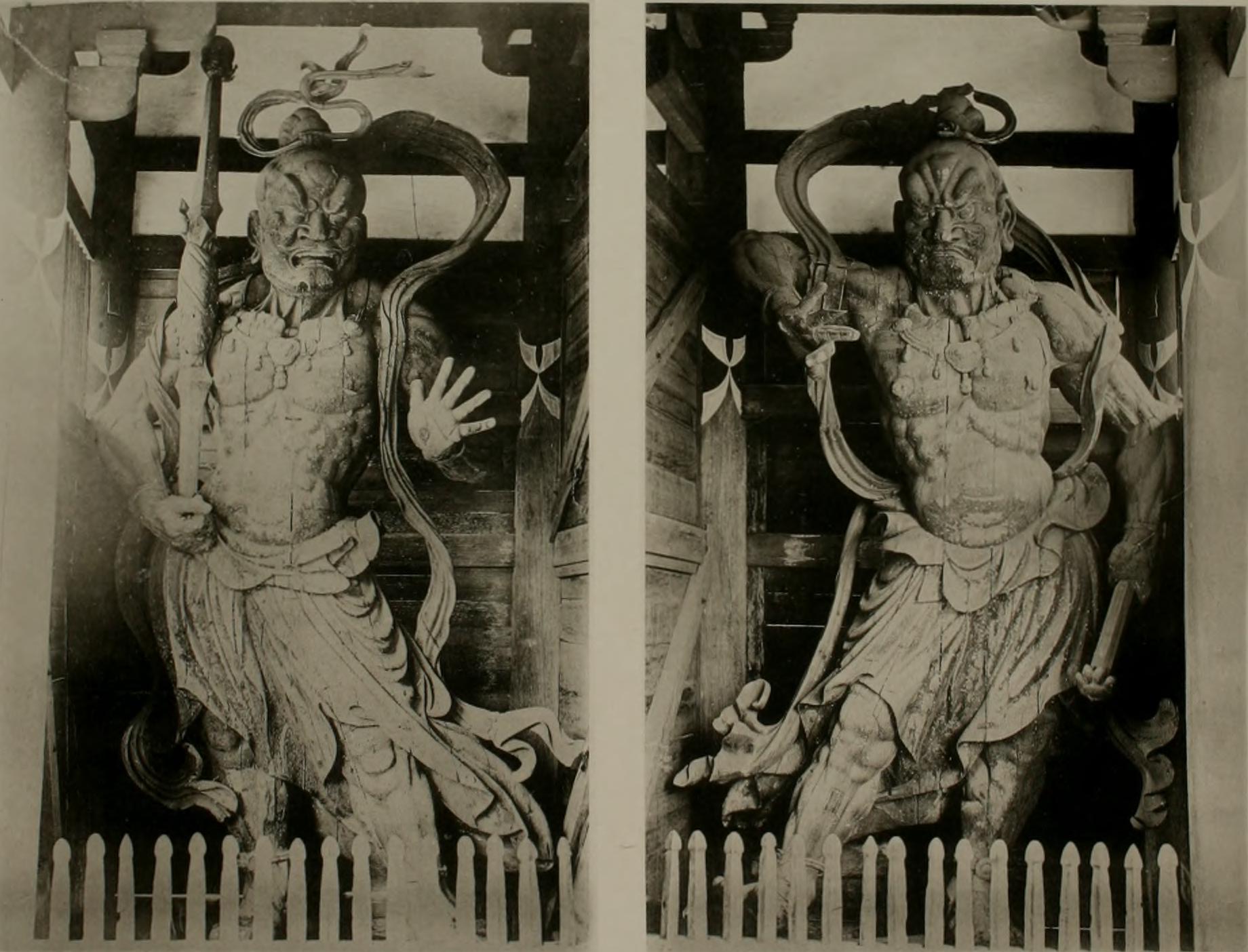
- Title
- Niō (金剛力士) — Tōdai-ji Nandaimon, Agyō and Ungyō, 1203
- Period
- Kamakura period (1185–1333), Kennin 3 (1203)
- Region
- Japan
- Medium
- Cypress (*hinoki*) *yosegi-zukuri* (joined-block construction); originally polychromed; lost-pigment surface today
- Dimensions
- Each figure approximately 8.4 m in height; Agyō (open-mouth) on the east, Ungyō (closed-mouth) on the west of the gate's interior
- Collection
- Tōdai-ji Nandaimon (東大寺南大門), Nara — Japanese National Treasure (国宝)
- Rights
- Engraved plate from *Histoire de l'art du Japon*, ouvrage publié par la Commission impériale du Japon à l'Exposition universelle de Paris, 1900 — public domain in Japan (PD-Japan-oldphoto, pre-1957) and public domain in source country (life of authors + 70 years; 1900 publication). Subject: Tōdai-ji Nandaimon Niō (Agyō), 1203 — Japanese National Treasure (国宝).
1900 engraved plate from the Imperial Commission's *Histoire de l'art du Japon* — the first official Japanese art-history compilation, prepared for the Paris Universal Exposition. The plate depicts the Agyō (open-mouth) Niō at the Tōdai-ji Nandaimon, then a quarter-millennium into its second life since the 1203 Kennin commission. The French caption mis-identifies the figures as 'Brama et Indra' — period-typical Western misreading; modern scholarship reads the pair as the *kongōrikishi* (vajra-bearer) guardian pair, an iconographic register distinct from Brahma and Indra. The 1900 plate is the earliest widely-circulated Western reproduction of the figure.
The Tōdai-ji Nandaimon Niō (東大寺南大門金剛力士像), 1203: the documented Kamakura sculptural anchor — 8.4 m, yosegi-zukuri, A-un pair carved in 69 days (July 24 – October 3) under Unkei and Kaikei with Tankei, Jōkaku, and 16 artisans. The 1988 restoration recovered a Hōkyōin darani-kyō naming Chōgen as supervising priest and the sculptors explicitly. They replace the originals lost in the 1180 Heike War.
The 69 days
The dating is documented to the day. Work began on the 24th day of the 7th month of Kennin 3 (建仁三年七月二十四日, July 24 1203) and was completed on October 3, 1203. The total: 69 days.
Two figures, each 8.4 metres tall, in yosegi-zukuri joined-block cypress construction, polychromed, glass-eye-fitted (gyokugan, 玉眼), positioned at the interior flanks of the Tōdai-ji south gate. Done in 69 days.
The number is not legend. It comes from the documentary record found inside the Agyō figure during the 1988 restoration — a Hōkyōin darani-kyō sutra (宝篋印陀羅尼経) placed inside the body cavity at consecration, with an inscription naming the supervising priest Chōgen (重源, 1121–1206) and the sculptors who worked on the project. Unkei and Kaikei are named jointly, with Tankei (Unkei’s eldest son) and Jōkaku, and the 16 other workshop artisans (the busshi shōnin).
The 69-day claim should be read with care, however. The documentary phrase records the period during which carving and assembly of the figures occurred at the gate; preparatory work (the cypress sourcing, the rough-shaping of the principal blocks, the workshop coordination, the iconographic studies) almost certainly occurred earlier. What the 69 days names is the on-site assembly-and-finishing phase. The full project — from commission to consecration — runs longer.
What it nevertheless means: a workshop of more than twenty hands, working under direct documentation, produced two of the largest pre-modern wooden statues in Japan in slightly over two months on-site. This is the Kamakura sculptural workshop in its operational peak.
What the figures show
The Niō (仁王, “two kings”) are the kongōrikishi (金剛力士, “vajra-bearers”) — the wrathful guardian pair stationed at the gates of Buddhist halls and temples. They are an A-un pair: Agyō (阿形) with mouth open in the a utterance — the first sound, the beginning syllable; Ungyō (吽形) with mouth closed in the un utterance — the last sound, the terminal syllable. The pair together render the seed-sound aum (अोम्) — the cosmological sound from beginning to end.
At the Tōdai-ji Nandaimon the placement is reversed from the iconographic norm. Agyō stands on the east interior of the gate, Ungyō on the west — the conventional placement is Agyō on the west, Ungyō on the east. Mōri Hisashi treats this reversal as a deliberate Kei-school workshop choice; other scholars read it as a function of the Nandaimon’s specific entry-procession geometry.
The figures are stripped to the waist. The chests are bared, muscular, articulated with anatomically pronounced abdominal and pectoral details. The arms are raised high in active gestures; Agyō holds the kongō-sho (金剛杵, vajra-pestle); Ungyō stands with arms raised and clenched fists, no implement.
The bodies are twisted in dynamic three-quarter postures (sansoku register), one knee raised, the weight on one hip, the chest counter-rotated against the lower body. This is the high-Kei-school sculptural realism programme: the body in active motion rather than static contemplation, the iconographic register fully kinetic.
The eyes are gyokugan — glass insets behind the carved socket-rims, giving the figures the lifelike illumination that becomes the Kei-school technical signature. The Tōdai-ji Niō are among the earliest documented large-scale gyokugan installations in Japanese sculpture; the technique appears in earlier Heian carved works at smaller scale, but the 8.4 m Niō are where it becomes a Kamakura institutional standard.
The Hōkyōin darani-kyō and the documentary record
The 1988 restoration is the substantive scholarly anchor. Conservation work on the Agyō figure during the late-20th-century campaign opened the body cavity and recovered, among other ritual deposits, a copy of the Hōkyōin darani-kyō (宝篋印陀羅尼経, Sūtra of the Jewel-Box-Seal Dhāraṇī) — a Mahāyāna text widely deposited inside Buddhist images during medieval Japanese consecration.
The deposit’s value is not the text itself but the inscription on the deposited copy. The inscription names:
- Chōgen (重源) as the Daikanjin (大勧進, supervising priest of the reconstruction)
- Unkei (運慶) as a principal sculptor
- Kaikei (快慶) as a principal sculptor
- Tankei (湛慶), Unkei’s eldest son, as a participant sculptor
- Jōkaku (定覚) as a participant sculptor
- The 16 other workshop artisans (busshi shōnin) by name in the Hōkyōin darani-kyō manuscript record
This is the single most-cited documentary anchor for Kamakura sculptural attribution. Most Japanese Buddhist sculpture from the period is attributed via stylistic analysis or temple tradition; the Tōdai-ji Niō are attributed in writing, by sculptor name, with the supervising priest’s authorisation. The deposit transforms the Niō from “attributed” to “documented” — a much narrower category in Japanese art-history scholarship.
The Nabunken (Nara National Research Institute for Cultural Properties) 1954 Unkei kenkyū (Study on the Life and Works of Unkei) is the foundational scholarly synthesis of Unkei attribution; the 1988 deposit recovery confirms the Tōdai-ji Niō as one of the secure Unkei works against which the broader corpus is read.
The 1180 Heike War as inflection point
The 1203 commission is a reconstruction. The original Tōdai-ji Niō pair was destroyed in December 1180 during Taira no Shigehira’s Nanto Yakiuchi (南都焼討, “burning of the southern capital”) — the Heike-War retaliation against the Nara monastic establishment that had supported the Genji cause.
The destruction was comprehensive. Tōdai-ji’s Daibutsu-den, the Vairocana inside, the south gate, the Niō pair, and most of the temple complex burned. The Tōdai-ji Hokke-dō survived only because it stood at the temple’s eastern edge, distant from the main destruction; the rest of the institutional Buddhist precinct was effectively rebuilt from the ground up over the next two decades.
Chōgen (重源, 1121–1206) was appointed Daikanjin of the Tōdai-ji reconstruction in 1181. Chōgen had visited Song China multiple times (the conventional historiography has three visits, though specific dating is debated) and had studied Chinese Song construction directly. The Tōdai-ji reconstruction proceeded under his direction; the Nandaimon itself, completed 1199, is built in the Daibutsu-yō (大仏様, “Great Buddha style”) Song-influenced architectural register that Chōgen brought back from China.
The 1203 Niō commission is set inside this institutional context. The Kei-school workshop — Unkei’s family lineage, with Kaikei as the senior allied master — was the natural choice for a project at this institutional scale. Chōgen’s selection of the workshop is documentary; the actual division of labour between Unkei and Kaikei within the project is debated.
The Unkei-vs-Kaikei attribution debate
Both sculptors are documented as principals. What the inscription does not specify is which figure each carved. The conventional historiography reads:
Unkei as the principal hand for Agyō (with Tankei and Jōkaku as primary collaborators). The argument: the dynamic muscular bodily register, the open-mouth expression, the chest-twisted posture all match the broader Unkei stylistic profile better than Kaikei’s more measured-and-contained sculptural register elsewhere.
Kaikei as the principal hand for Ungyō (with the workshop assist). The argument: Ungyō’s slightly more contained-and-stable posture, the closed-mouth restraint, the proportionally calmer surface read closer to Kaikei’s other documented works (the Tōdai-ji Sōgyō Hachimanzō of 1201, the Hossō Hachimanzō of 1207, the Kōfukuji Eshin-bō Sōzu portrait of c. 1185–1198).
The reading is not universally adopted. Mōri 1974 cautions that the Kei-school workshop method made strict authorial attribution problematic — the principals trained on each other’s hands, the workshop produced a coordinated Kei-school style across the project, and individual hand-attribution within a single 69-day intensive collaboration is difficult to establish stylistically. The documentary record names both as principals; the iconographic register reads as a coordinated workshop product rather than as two distinguishable single-hand works.
The honest reading: both Unkei and Kaikei are documented as principals on both figures; the Agyō-Unkei / Ungyō-Kaikei attribution is conventional but not certain.
Where these figures sit
The Niō stand at the Tōdai-ji Nandaimon, on the temple’s southern entrance. The gate itself is a National Treasure (the 1199 Chōgen reconstruction in Daibutsu-yō style). The Niō inside are individually National Treasures.
The figures are visible during all standard temple visiting hours. The Nandaimon is open passage rather than a closed hall; the visitor walks through the gate on the path between the temple’s outer precinct and the Daibutsu-den approach. The Niō are mounted at floor level inside the gate’s flanking interior bays, glass-eyes fixed in dynamic three-quarter pose, the muscular bodily register fully visible at moderate viewing distance.
For the visitor walking the central path, the figures’ scale is the first encounter. At 8.4 metres they are larger than the Daibutsu in any human-readable sense; the Vairocana is enthroned at distance, the Niō are at the path’s edge. The visitor passes between them.
Where this work sits
The Tōdai-ji Niō are the anchor of Kamakura sculpture studies: the documented Unkei-Kaikei joint commission, the institutional Kei-school workshop’s operational peak, the Heike-War-reconstruction programme’s most-cited sculptural product. Every later Kei-school attribution is read against this work; every Anglophone Kamakura-sculpture syllabus opens with the 1203 Niō.
The figures matter beyond Kei-school attribution debates. They are the institutional anchor for yosegi-zukuri at the largest pre-modern scale (companion to the Byōdō-in Amida at the Heian-period scale); they are the documentary anchor for busshi workshop attribution (against which the broader Kamakura sculptural record is read); and they are the Heike-War-reconstruction monument that closes the Heian-to-Kamakura sculptural transition.
For the reader looking at any later Japanese guardian-figure sculpture, the Tōdai-ji Niō are the iconographic-and-stylistic reference. The Kei-school sculptural realism programme that defines Kamakura Buddhist art begins, institutionally, at this gate.
Related
- Articles: Yosegi-zukuri multi-block construction, Byōdō-in’s Amida by Jōchō
- Entities: future cross-links to dedicated entity primers for Unkei, Kaikei, Tankei, Chōgen, and the Niō / Agyō / Ungyō figures
Sources
-
Temple-authoritative source for the Nandaimon and its Niō. The Nandaimon itself is a Kamakura reconstruction (1199), commissioned under Chōgen during the post-Heike-War rebuilding. The current gate is the second on the site
-
1988 conservation work on Agyō recovered a *Hōkyōin darani-kyō* sutra placed inside the figure with an inscription naming **Chōgen** (重源, 1121–1206) as the supervising priest of the Tōdai-ji Kamakura reconstruction, and naming the sculptors **Unkei**, **Kaikei**, **Tankei**, **Jōkaku**, and 16 additional workshop artisans. The single most-cited documentary anchor for Kamakura sculptural attribution; gives both Unkei and Kaikei joint credit in writing
-
The foundational scholarly investigation of Unkei's life and works. Cited at work level; specific pages not verified.
-
The standard English-language reading of the Kei-school sculptural programme. Treats the Tōdai-ji Niō as the principal Unkei-Kaikei joint commission and the documentary record of the 69-day workshop. Cited at work level.
-
Cross-cluster reading of Kamakura institutional sculpture and the Kei-school workshop model. Cited at work level.
-
The Tōdai-ji Daikanjin (大勧進, supervising priest) of the post-1180 reconstruction. Chōgen is named as the patron of the 1199 Nandaimon and the 1203 Niō pair. He visited Song China three times (sources vary: probably one major journey 1167; documented studies of Song architecture and engineering); the Daibutsu-yō (大仏様) Song-influenced architectural style of the Nandaimon is conventionally credited to his observation of Chinese Song construction
-
Taira no Shigehira's December 1180 attack on Nara destroys both the Tōdai-ji Daibutsu-den (with the Vairocana inside) and the original Niō pair at the south gate. The Kennin 3 (1203) Unkei-Kaikei reconstruction is the response
-
The first official Japanese art-history compilation, prepared by the Imperial Commission for the Paris Universal Exposition. The 1900 publication is in the public domain. Source for the bodhi cleared engraved plate of the Agyō Niō. Pre-1957 (PD-Japan-oldphoto eligible) and pre-1929 (US public domain)