Intan's Jizō Bosatsu, 1291 — the Met's first signed In-school work
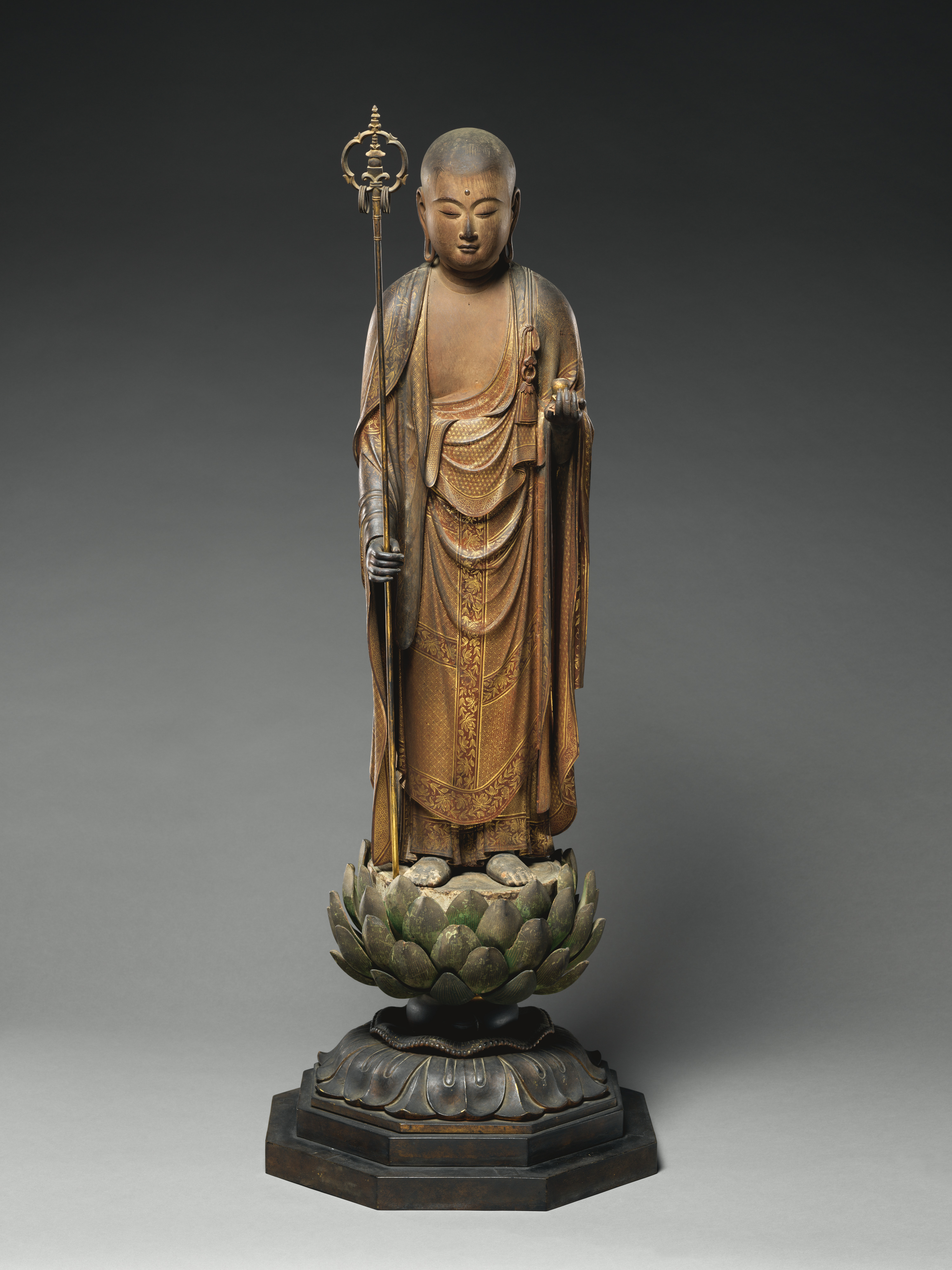
- Title
- The Bodhisattva Jizō — signed Intan (院湛), dated 1291 — Met 2023.640a–c
- Period
- Kamakura period (1185–1333), dated 1291 (Shōō era year 4, 9th month, 24th day)
- Region
- Japan, Nara — originally Kōfuku-ji
- Medium
- Japanese cypress wood (hinoki) with polychrome pigments, gold paint (kindei), cut gold leaf (kirikane), and rock-crystal eyes
- Dimensions
- Height with pedestal 135.9 cm (53 1/2 in.); width 27.9 cm (11 in.)
- Collection
- The Metropolitan Museum of Art, New York
- Accession
-
2023.640a–c - Rights
- The Metropolitan Museum of Art, New York. Purchase, Florence and Herbert Irving Acquisitions Fund for Asian Art, Florence and Herbert Irving Acquisitions Fund, by exchange, The Miriam and Ira D. Wallach Foundation Fund, Brooke Russell Astor Bequest, and Fletcher Fund, 2023 (acc. 2023.640a–c). Image from Met Open Access (OASC).
Met 2023.640 — Intan's Jizō Bosatsu, 1291. Signed and dated at the foot, in the joint to the lotus pedestal. One of only three documented surviving Intan works.
The signature at the foot, 1291
The figure carries its own date and its own maker’s name. At the foot of the standing Jizō, in the joint where the figure meets its lotus pedestal, the busshi has inscribed the Shōō era, year 4, 9th month, 24th day (the equivalent of 1291), together with the name Intan (院湛). The placement is workshop-standard for the period: the inscription sits where the figure was last worked, where the carving was finished, where the busshi could sign off the commission as completed; it is also the place where the inscription is least visible to a worshipper, which is the point.
Signed-and-dated Kamakura sculpture is rare. The major surviving signed works of the Kei-school (Unkei’s Hokuendō Miroku of 1212, Tankei’s Sanjūsangen-dō Senju Kannon of 1254, Kaikei’s many Amida and Jizō figures) have established the workshop chronology of the late 12th and 13th centuries. The In-school equivalent corpus is much smaller. Intan himself, on the current scholarly count, has only three documented surviving works: this Jizō at the Met, a seated Jizō at Jōki-in on Mount Kōya, and a Kannon at Akishino-dera. The Met figure is the most complete of the three. Full height, full polychrome stack still partially intact, surviving lotus pedestal, and it is the only one of the three not now in a Japanese temple holding.
Intan, In-school, and the Kei synthesis
The name Intan (院湛) is itself a piece of workshop information. The first character, 院 (in), is the lineage name of the In-school (院派, Inpa), the Kyoto-based busshi tradition with close ties to the Imperial Household, distinct from the Kei-school (慶派, Keiha) based in Nara and from the En-school (円派, Enpa) as the third major Kamakura lineage. Most In-school busshi names begin with 院 (Inkaku, Inson, Inkō, etc.); Intan’s 院 marks him as a member of the In-school. The second character, 湛 (tan), is more pointed. It is the same character used by Tankei (湛慶, 1173–1256), the son of Unkei and second-generation leader of the Kei-school after his father’s death in 1223.
The combination 院湛 is therefore a name with a thesis. The busshi is declaring himself a member of the In-school and a borrower from the Kei-school’s leading name: a workshop synthesis in two characters. The late 13th century is the period when the strict In / Kei / En distinctions had begun to soften. The Kei-school had built its institutional weight through the post-1180 Kōfuku-ji and Tōdai-ji rebuilds; the In-school continued to hold the Kyoto imperial-court commissions; by the 1280s and 1290s, individual busshi could move between workshops, and a name-character synthesis like Intan’s was no longer transgressive.
What this means for the Met figure is that it is both an In-school work and a work that wears its Kei-school inheritance on its surface. The yosegi construction is shared across the workshops by this period; the inlaid rock-crystal eyes (gyokugan) are the Kei-school’s diagnostic surface technique adopted by the In-school here; the kirikane cut-gold-leaf surface treatment is shared. What is distinctively In-school is harder to specify in a single signal. The secondary literature reads it as a calmer, more measured posture, less dynamic than the Kei-school’s monumental commissions, more attuned to the small-scale and the personal-devotional register.
The figure: youthful monk with the wish-granting jewel
Jizō Bosatsu (Sanskrit Kṣitigarbha) is the bodhisattva of the Earth Store, the saviour of beings in the six realms, the protector of children, the figure who travels to hell to rescue the lost. In Japan from the late Heian period onward, Jizō is depicted not in princely bodhisattva attire (the crown-and-jewellery of Kannon or Seishi) but in the youthful monk register: shaven head, no crown, simple monastic robes, and the two diagnostic attributes, the nyoi-hōju (wish-granting jewel) and the shakujō (the staff with metal rings that announce his arrival).
The Met figure follows the canonical iconographic programme. The proper right hand is raised at chest height in the abhaya / sermon-giving register, the calm welcoming gesture that the worshipper reads first. The proper left hand is held lower, palm up, supporting the nyoi-hōju. The staff is not present in the current display; whether it was lost in the dispersal period or whether the figure was originally configured without a staff (some Jizō figures hold only the jewel) is not documented in the Met catalog.
The kesa (Buddhist surplice) is rendered in kirikane: cut gold leaf applied in small geometric units to build up a patterned surface. The technique is technically demanding. Thin sheets of gold leaf are cut into precise small pieces with a bamboo knife and laid down with lacquer adhesive in patterns that build into the brocade-imitating surface that gives late-Kamakura sculpture its characteristic shimmer. The kirikane is more intact on the Met Jizō than on most surviving late-Kamakura figures; patches across the kesa, the lower garment, and the cuffs are still legible in the period’s intended register.
Hinoki and the late-Kamakura surface programme
The Met catalog records the medium precisely: Japanese cypress wood (hinoki) with polychrome pigments, gold paint (kindei), cut gold leaf (kirikane), and rock-crystal eyes. Each layer of that stack is doing specific work.
The hinoki is yosegi-zukuri: joined blocks of dry cypress, hollowed before joining, with the joints fastened by metal staples and dowels. The construction has been workshop-standard since Jōchō in the mid-11th century; by 1291 it is universal for figures of this scale across both the Kei- and In-schools.
Over the carved wood, polychrome pigments lay in the flesh tones, the face, the under-painting of the robes. Over the polychrome, kindei (gold paint, made by binding gold leaf into a paint medium with animal-glue) fills the recesses and the more weathered surfaces. Over the kindei, kirikane (the cut gold leaf) builds the surface patterns of the kesa and the brocaded elements. The rock-crystal eyes (gyokugan) are inserted from behind the carved eye cavity with the back of the crystal painted to give the iris-and-pupil; this is the Kei-school technique that the In-school had adopted as standard by the 1290s.
What makes the Met figure exceptional in the corpus is that this entire stack is partially intact. Most surviving late-Kamakura sculpture has lost the kirikane and the polychrome, leaving only the gilded base or the bare wood. Met 2023.640 retains substantial kirikane patches across the kesa and the lower garments. The sculpture as it was meant to be seen in 1291 is still partially legible on the figure today.
Kōfuku-ji, 1906
The work was originally a Kōfuku-ji image. The Met press release of February 2024 names the temple of origin directly: originally commissioned for Kōfukuji temple in Nara, where it remained until 1906.
The 1906 Kōfuku-ji sale is a load-bearing moment in the institutional history of Japanese Buddhist art in American collections. The temple, having lost its land endowments to the Meiji-era haibutsu kishaku (anti-Buddhist disestablishment) of the 1860s and 1870s, and facing reconstruction needs across its precinct, sold a substantial portion of its sculpture and painting holdings in 1906 to raise funds. The 1906 sale dispersed dozens of major works through the Tokyo dealer network into private collections and, decades later, into American institutional holdings.
The 1906 dispersal touches at least three works that this corpus has already covered. The Met’s Kaikei Jizō (Met 2015.300.250) traces back to the 1906 sale via Galerie Janette Ostier in Paris. Cleveland’s Heian seated Buddha (Cleveland 1973.85) was photographed at Kōfuku-ji in 1906, presumably in the same survey programme that preceded the sale, and was dispersed at some point between 1906 and 1973. And now Met 2023.640: the third major Kōfuku-ji 1906 work in this corpus, traceable through a longer chain of private collections.
The Tokyo market, Masuda Takashi, and Samuel Josefowitz
The post-1906 provenance is documented. The figure entered the Tokyo dealer market; the industrialist Masuda Takashi (1848–1938), one of the great early-20th-century Japanese collectors of Buddhist art, acquired it in the post-1906 dispersal window. After Masuda’s death (1938), the figure returned to the dealer market through Setsu Gatōdo, the Tokyo dealership that would, a generation later, also supply Cleveland’s 1973.85 to Sherman Lee.
The Lausanne-based Polish-French collector Samuel Josefowitz purchased the figure in Japan on 8 January 1962. It remained in the Josefowitz collection for sixty years.
In 2012, the Josefowitz family loaned the figure to the Metropolitan Museum on long-term loan. The Met displayed it as part of its Asian Art galleries from 2012 to 2022. The loan was conventional in form. The family retained title; the Met retained physical custody and display rights. What was unconventional was the duration: ten years is a long loan window, long enough that the figure became publicly associated with the Met before any sale was contemplated.
The 2023 Christie’s sale and the Irving Acquisitions Fund
On 13 October 2023, Christie’s in London auctioned the Josefowitz collection. The Intan Jizō sold for £3.67 million (approximately $4.57 million USD), and was acquired by the Metropolitan Museum into the permanent collection. The credit line names five funding lines: Florence and Herbert Irving Acquisitions Fund for Asian Art, Florence and Herbert Irving Acquisitions Fund (by exchange), The Miriam and Ira D. Wallach Foundation Fund, Brooke Russell Astor Bequest, and Fletcher Fund. The principal fund is the Irving, the $80 million Asian-art endowment given by Florence and Herbert Irving to the Met in 2017 as part of the largest single gift the museum had received for its Asian collections.
The Met press release of February 2024 frames the acquisition as one of the Asian Art department’s most significant purchases of the 2020s. Curator John T. Carpenter is quoted on the research opportunity that ten years of physical custody under loan had given the museum: conservation studies, dating verification, and the comparative work against the Met’s existing Jizō corpus had been done before the permanent-acquisition decision.
Where this Jizō sits in the Met’s corpus
The Met holds five Kamakura Jizō figures. Met 53175, the Kaikei Jizō (2015.300.250), is the canonical reference point. Met 42589 is a 13th-century standing Jizō from the Rogers Fund; Met 44891 is another standing Jizō; Met 18.93 is the Jizō with staff acquired through the Rogers Fund in 1918. The Intan Jizō (2023.640) is the only one of the five with both a documented sculptor’s signature and a precise date inscription.
Reading the Met’s Kamakura Jizō corpus as a coherent group: Kaikei’s early-Kei-school commission (c. 1192–1209) → the unnamed Rogers Fund Jizō figures of the 1910s acquisitions (12.134.17/.18 era) → Intan’s late-In-school commission (1291). The Met’s holdings span the full century of the cult’s institutional weight. The 2023 acquisition closed the corpus: the only major signed-and-dated Kamakura Jizō not yet in the Met collection at the time of the Christie’s auction.
What stays open
The two other Intan works. Jōki-in on Mount Kōya and Akishino-dera in Nara both hold Intan works; bodhi has not opened the Japanese-language scholarship on either. Action when reviewed: comparison against the Met figure on style, attribution evidence, and dating.
The dedicatory cavity. Late-Kamakura yosegi figures of this scale routinely carry interior deposits. The Met conservation studies of 2012–2022 may have inspected the cavity but the contents (if any) are not in the public record. Action if Met conservation publishes: record the contents.
The Masuda Takashi collection inventory. Masuda was one of the major early-20th-century Japanese collectors; his collection inventory would name when he acquired the figure and from whom. Action when located: name the immediate post-1906 dealer.
The full Kōfuku-ji 1906 dispersal corpus. We know three works from this dispersal (Kaikei Jizō, Intan Jizō, Heian Buddha) in American collections. The full 1906 sale inventory has not been reconstructed publicly. Action if a temple-archive list surfaces: identify other works in the dispersal corpus.
Related
- Met 2015.300.250: Kaikei Jizō, signed Amida Butsu
- Cleveland 1973.85: Heian seated Buddha in the Jōchō style
- Met 12.134.17 & .18: Kamakura Kannon-Seishi attendant pair
- Hokuendō Miroku, 1212: Unkei’s solo Kōfuku-ji programme
- Tōdai-ji Niō, 1203: Unkei and Kaikei
- Yosegi-zukuri: multi-block construction
- Jizō Bosatsu: saviour of the six realms
Sources
-
[1]2026-05-13The Metropolitan Museum of Art, New York collectionapi.metmuseum.org/public/collection/v1/objects/76084Met OA API. Title *The Bodhisattva Jizō*; artist Intan (Japanese, active 13th c.); date 1291; medium Japanese cypress wood (hinoki) with polychrome pigments, gold paint (kindei), cut gold leaf (kirikane), and rock-crystal eyes; height with pedestal 135.9 cm; width 27.9 cm; classification sculpture; credit line *Purchase, Florence and Herbert Irving Acquisitions Fund for Asian Art, Florence and Herbert Irving Acquisitions Fund, by exchange, The Miriam and Ira D. Wallach Foundation Fund, Brooke Russell Astor Bequest, and Fletcher Fund, 2023*; public domain (CC0).
-
Wikipedia entry on the work. Confirms: signed at the foot of the figure, in the joint connecting to the lotus pedestal; dated *Shōō 4, 9th month, 24th day* (1291); signature *Intan* (院湛) — combining the In-school 院 name-character with the *tan* (湛) used by Tankei of the Kei-school, signalling a workshop-synthesis declaration. One of only three documented Intan works (the other two are the seated Jizō at Jōki-in on Mount Kōya and a Kannon at Akishino-dera). Originally Kōfuku-ji; dispersed in the 1906 Kōfuku-ji sale; passed through Setsu Gatōdo (1938), the Masuda Takashi collection, and the Josefowitz collection (1962); loaned to the Met 2012–2022; sold at Christie's London 13 October 2023 for £3.67M (~$4.57M USD); Met permanent collection 2023.
-
Met press release on the 2023 Jizō acquisition (and a paired Shintō deity acquisition). Curator John T. Carpenter quoted on the research opportunity. Jizō first displayed in the exhibition *Anxiety and Hope in Japanese Art* (Met, 2024).
-
The Florence and Herbert Irving Acquisitions Fund was endowed by the Irvings' 2017 gift to the Met of $80 million (the largest single gift the Met had received for Asian art). The 2023 Intan Jizō acquisition is one of the fund's most significant single purchases.
-
Foundational Japanese-language scholarly monograph on Unkei. The In-school / Kei-school / En-school distinction is the standard classification of the Kamakura busshi tradition: the In-school (院派, Inpa) was based primarily in Kyoto with imperial-household ties; the Kei-school (慶派, Keiha) was based in Nara and led the Kōfuku-ji rebuild after the 1180 Taira raid; the En-school (円派, Enpa) was a third lineage.
-
Standard English-language survey. Mōri reads the In-school as the working idiom of the Kyoto-based imperial-household busshi tradition through the 12th and 13th centuries, distinct from the Kei-school's Nara monastic-workshop tradition. Intan's name-character choice — 院湛 — is read in the secondary literature as a deliberate workshop-synthesis declaration.
-
In 1906, Kōfuku-ji sold a substantial portion of its sculpture holdings to raise funds in the aftermath of the Meiji-era *haibutsu kishaku* (anti-Buddhist disestablishment, 1860s–70s), which had stripped the temple of its land endowments, and against the Taishō-era reconstruction programmes. The 1906 dispersal touched several major holdings now in American collections: the Met's Kaikei Jizō (2015.300.250) traces back to the 1906 sale via Galerie Janette Ostier; the Met's Intan Jizō (2023.640) also traces back to the 1906 sale via Masuda Takashi and the Setsu Gatōdo dealership; and the conservation photograph of Cleveland 1973.85 — the Heian seated Buddha — was taken at Kōfuku-ji *in* 1906, plausibly in the survey programme that preceded the sale. The Met press release (2024) names Kōfuku-ji 1906 as the origin for the Intan Jizō's provenance.
-
Met holdings of Kamakura Jizō Bosatsu sculpture: Met 53175 (Kaikei Jizō, 2015.300.250, Burke bequest); Met 42589 (Jizō, Kamakura, Rogers Fund); Met 44891 (Jizō, Kamakura); Met 18.93 (Jizō with staff, Rogers Fund 1918). The Intan Jizō (2023.640) is the only signed-and-dated work in the corpus; the Kaikei Jizō (2015.300.250) is also signed, but with an *Amida Butsu* dedication-name signature rather than a busshi name. The 2023.640/2015.300.250 pair frames the Met's Kamakura Jizō holdings — both are signed Kōfuku-ji works dispersed in the 1906 sale.