Raijin in pine, separated from his Fūjin: reading Cleveland 1972.64
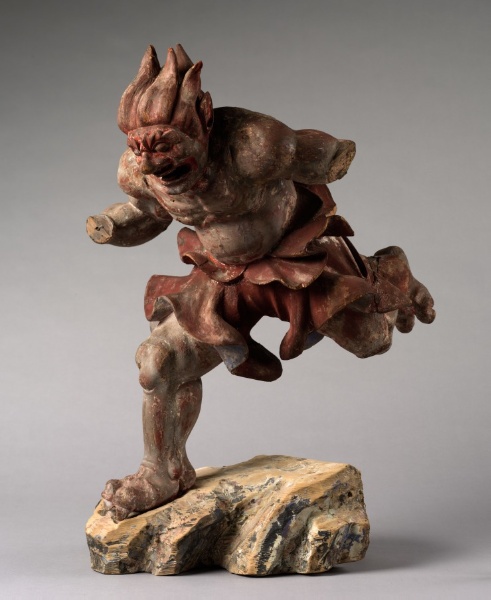
- Title
- Thunder God (Raijin)
- Period
- Kamakura period (1185–1333), 1300s (14th century)
- Region
- Japan
- Medium
- Wood with traces of gesso and red and black pigment
- Dimensions
- Overall 66.7 cm (26 1/4 in.)
- Collection
- Cleveland Museum of Art
- Accession
-
1972.64 - Rights
- Cleveland Museum of Art (Public Domain / CC0); credit line: Purchase from the J. H. Wade Fund, 1972.64
Half of a separated pair. The metal clasp on the back marks where the drum-ring once attached. The matching Fūjin is at the Fukuoka Art Museum, 5,300 miles away. The two have not been displayed together in living memory.
This is half of a pair. The other half is in Fukuoka, on the western coast of Kyushu, 1,000 km from Kyoto and about 8,500 km from Cleveland. For roughly a century the Raijin in Cleveland and the Fūjin in Fukuoka have not been in the same room. They were carved together; they belong together; they are not together.
A metal clasp on the back of the Cleveland Raijin marks where the ring of taiko drums once attached. The drums are missing. The Fūjin in Fukuoka has lost its wind-bag in the same way: the cloth sack the running figure once shouldered behind him is gone. What survives is the running posture and the mid-stride dynamism — and, on Cleveland’s piece, more red and dark-brown pigment than published catalog notes suggest.
What you actually see
A small wooden figure (66.7 cm, sub-life-size), mid-stride on a carved rocky base. The right leg planted on the rock with toe down; the left leg lifted behind, foot pointed back. The body leans forward into the running stride.
Both arms extend forward — the right hand forward and slightly above the left — with the palms now apparently broken or empty rather than holding the drum-beaters (bachi) the iconography prescribes. Whether the beaters were broken off and lost or whether they were carved separately and stored, removed, or simply lost is not addressed in the catalog.
The clasp on the back is the load-bearing evidence: this figure was made to carry attributes that are no longer attached.
The face is preserved in three-dimensional detail: open mouth showing fangs, brow ridges raised, eyes round and intent (no rock-crystal gyokugan inlay — this is a sub-life-size piece without the high-grade Kei-workshop construction we see in the 1269 Amida at the same museum).
The hair is modeled as carved flame-like tongues sweeping upward in three high cone-shapes, characteristic of the oni/demon iconography Raijin inherits from indigenous folk imagery.
The polychromy is much more intact than the catalog’s “traces of gesso and red and black pigment” suggests. Red survives across the loincloth (a knee-length skirt, painted in dark red), the chest, the brow, the lower face, and along the leg muscles. Dark brown-black survives on the hair-tongues, the eyes, and the deep folds of the loincloth.
The figure was conceived to be vividly polychromed — unnaturally red-skinned, in the conventional Raijin/oni colour scheme — and a substantial fraction of that scheme remains. What the catalog characterises as faded is, in person, more vivid than published.
The base is a single carved rock-form, integral to the original construction. The piece stands on this base by means of a single contact point — the planted right foot — with the second foot lifted free of the surface. The balance is achieved through the wooden construction: the figure is hollow, with a low centre of gravity, and the rock-form base anchors it.
The separated pair
The fact most consequential for reading Cleveland 1972.64 is that it is not a single figure. The Cleveland Museum of Art’s catalog notes, in one short sentence, that “a metal clasp protruding from the Cleveland Raijin’s back indicates that a ring of drums was once attached.” It does not name the matching Fūjin.
The matching Fūjin is at the Fukuoka Art Museum (福岡市美術館), accession unknown to me without further research, and Google Arts & Culture publishes its specifications: 13th century Kamakura, 69 cm, hinoki wood, yosegi-zukuri construction (the body assembled from two left-and-right wood blocks with the head, arms, and legs joined as additional pieces).
The matching dimensions (Cleveland 66.7 cm, Fukuoka 69 cm) and the matching dating (both 13th century, both sub-life-size, both running-figure mid-stride) and the matching attribute-clasp loss (Cleveland’s drum-ring; Fukuoka’s wind-bag) make the matched-pair attribution as secure as such attributions get without published provenance documentation linking the two acquisitions.
Both pieces record a single workshop’s production of a single Raijin/Fūjin pair, made for a temple programme that has not been identified, and at some point in the modern collection-history cleaved into two halves now separated by an ocean.
The Cleveland piece was acquired through the J. H. Wade Fund in 1972. Pre-acquisition provenance is not published. The Fukuoka piece’s acquisition history is also not in the publicly searchable record I have access to.
A focused study of Japanese-language art-market records of the 1960s and early 1970s would likely identify the dealer who handled the split — sub-life-size Kamakura sculptural pairs were the kind of object that could be cleaved by a dealer between domestic Japanese and international clients. This is conjecture; documenting it would require Japanese-language archival work.
Iconographic context: the Sanjūsangen-dō anchor
The single most-cited Raijin/Fūjin pair in Japanese sculpture is at Sanjūsangen-dō (三十三間堂, also called Rengeō-in 蓮華王院) in Kyoto, founded 1164, rebuilt after fire in 1266.
The 13th-century Sanjūsangen-dō Raijin and Fūjin stand at either end of the temple hall flanking the 1,001 Senju Kannon statues and the central seated thousand-armed Senju Kannon by Tankei (湛慶, completed 1254 when Tankei was 82). They are part of the Nijūhachibushū (二十八部衆), the 28 guardian-deity programme of Senju Kannon.
Onmark Productions’ summary of the Nijūhachibushū iconography (citing Tang-period Chinese translations of Senju Kannon scriptures) notes that Raijin and Fūjin were “later added” to the original 28 — they are extra-canonical iconographic guests at the Senju Kannon’s 28- legion court.
The Sanjūsangen-dō Raijin/Fūjin pair is at approximately one meter in height (life-size for the iconographic scheme), is wood with lacquer, gold leaf, paint, and crystal-inlaid eyes (rock-crystal gyokugan), and is designated National Treasure of Japan.
The pair is the thirteenth-century stylistic anchor for every later painted and sculpted Raijin/Fūjin in the Japanese tradition, including the Cleveland-Fukuoka pair.
Cleveland’s Raijin is sub-life-size (66.7 cm vs. ~100 cm at Sanjūsangen-dō). It does not have the high-grade Kei-workshop construction signatures that the National Treasure piece has. It is not, then, a Sanjūsangen-dō product or a Sanjūsangen-dō workshop spinoff.
It is a sub-life-size pair likely made for a smaller Kannon hall or a regional Senju Kannon programme — perhaps for a sub-temple of one of the major Kyoto-Nara monastic complexes, perhaps for a provincial Tendai or Shingon temple where the 28-legion programme was adopted in reduced form. The size, the construction, and the iconographic vocabulary all point this way; the absence of provenance keeps the specifics open.
What the carving tells you about the workshop
The piece is more skilled than a generic temple-guard. The weight distribution between the planted leg and the lifted leg is correct — the body’s centre of gravity is over the planted foot, not floating abstractly.
The pectoral and abdominal muscles are anatomically observed in the way that Kei-school post-1180 sculpture is observed: not symbolic shorthand, but an actual run of muscle groups under strain. The mouth is open in a real shout — lips drawn back, fangs visible, throat tense — not the schematic open-mouth of pre-Kamakura guard-figures.
This places Cleveland 1972.64 in the broader Kei-school sculptural sphere, even though the workshop itself is not identified.
The Sanjūsangen-dō Raijin/Fūjin (1266 rebuild, Tankei era) is the central example of the Kei mode applied to Raijin/Fūjin iconography; sub-life-size pieces in the same vocabulary were produced through the thirteenth and fourteenth centuries by workshop branches and trained peripheral ateliers. Cleveland 1972.64 is one of those.
The carving lacks one Kei marker: rock-crystal eye inlay (gyokugan). The eyes are carved and painted rather than inlaid. This is consistent with a sub-life-size piece where the cost and labour of crystal inlay were not justified, and consistent with a workshop branch operating below the high-end Kei standard.
The Sōtatsu inheritance
In the early seventeenth century the Rinpa painter Tawaraya Sōtatsu painted a folding-screen pair of Raijin and Fūjin (Kennin-ji 建仁寺, Kyoto) that became — and remains — one of the most famous images in all of Japanese art. The Cleveland sculpture and the Fukuoka Fūjin are two centuries older.
What Sōtatsu inherited, painted, and amplified was already the iconographic and postural vocabulary on display here: the running figures, the wild hair, the demonic colour scheme, the balance of guardian and oni. The vocabulary the Edo Rinpa workshop re-mediated into ink-and-gold painting was carved in pine in the thirteenth century. Cleveland 1972.64 is part of the source matter the Sōtatsu screen is reading.
Christine Guth’s Japanese Art of the Edo Period treats the Sōtatsu Raijin/Fūjin as a hinge in the popular reception of the iconography: by the seventeenth century the figures have crossed from strict Buddhist guardian-iconography into broadly cultural-emblematic status.
Cleveland’s piece, late Kamakura / early Nanbokuchō, is on the earlier side of that hinge — still primarily a temple-guard figure within a Senju Kannon iconographic programme, not yet a Sōtatsu icon in popular circulation.
What stays unverified
Three substantive questions remain open about Cleveland 1972.64:
The pair’s original temple of installation. No provenance is published for either Cleveland 1972.64 or the matching Fukuoka Fūjin prior to twentieth-century museum acquisition.
The pair was made for a specific temple programme — almost certainly a Senju Kannon iconographic environment with an abridged 28-legion guardian set — but which temple, where, and under whose patronage are not on the record. Identifying the original installation would require Japanese art-market records and possibly post-Meiji temple-deposit documentation.
The pair may have been ejected from a temple during the haibutsu kishaku (廃仏毀釈) Buddhist-suppression episodes of the early Meiji period and entered the secular art market then.
The hand attributes. Both Cleveland’s Raijin (drum-beaters) and Fukuoka’s Fūjin (wind-bag) show evidence of attribute-loss. Were the bachi originally carved separately in wood and pegged in (plausible at this scale)? Were they cast in metal and screwed onto the metal clasps that survive (plausible if the drum-ring itself was a metal armature)? The catalog does not address. A close conservation inspection of the wrist sockets and the back-clasp could resolve.
The polychromy programme. The Cleveland catalog characterises the surface as “wood with traces of gesso and red and black pigment.” In person — and even in the 491×600 publicly available image — the preservation is markedly stronger than the term “traces” suggests.
Whether the figure has undergone modern restoration (likely; the red on the loincloth and chest is too consistent to be all original medieval pigment) or whether the original polychromy survives more fully than the standard catalog summary admits is a question for conservation analysis. The honest claim is “polychromy substantially preserved with at least some restoration”; the published catalog text under-describes.
How to read this Raijin
Look at the running posture — the planted-and-lifted legs, the forward-leaning torso, the muscles drawn tight. Look at the hair, the mouth, the colour. Look at the empty hands and the back-clasp and imagine the drum-ring restored above the head.
Then think west: 8,500 kilometres west, in a museum on the coast of Kyushu, the running Fūjin partner has its hands empty in the same way, its wind-bag similarly absent, its scale 69 cm to Cleveland’s 66.7 cm.
They were made to run together in the same temple hall, on either side of a Senju Kannon, sometime in the thirteenth century. They are at present running alone, on opposite sides of the world.
Sources
-
[2]— Fukuoka Art Museum — Fūjin (Wind God), 13th c., 69 cm, hinoki wood, yosegi construction artsandculture.google.com/asset/fujin-god-of-wind-unknown/hwEIy…The matching Fūjin half of the Cleveland Raijin pair. Both pieces are mid- to late-13th-century sub-life-size temple-guardian figures.
-
[3]— Tanabe Saburōsuke, Nihon chōkokushi kiso shiryō shūsei: Heian jidai (Tokyo: Chūōkōron Bijutsu Shuppan, 1995) print referenceFoundational Heian-Kamakura sculpture catalog including Raijin/Fūjin pair sculptures.
-
Kei-school workshop organisation late 12th–13th c.; broader context for sub-life-size Kamakura guardian figures produced in workshop branches.
-
[5]— Hisashi Mori, Sculpture of the Kamakura Period, trans. Katherine Eickmann (New York: Weatherhill, 1974) print referenceFoundational English-language study; treats Sanjūsangen-dō Raijin/Fūjin (life-size, National Treasure) as the iconographic anchor for the Kamakura type.
-
[6]— Onmark Productions, Nijuhachibushu — 28 Legions of Senju Kannon, plus Raijin & Fūjin onmarkproductions.com/html/28-bushu-kannon.shtmlOn the integration of Raijin and Fūjin into the 28-legion guardian programme of Senju Kannon halls.
-
[7]— Christine Guth, Japanese Art of the Edo Period (London: Weidenfeld & Nicolson, 1996) print referenceTawaraya Sōtatsu's painted Raijin/Fūjin (Kennin-ji) and the Edo-period popular reception of the iconography.