Bishamonten: the northern guardian as armored warrior
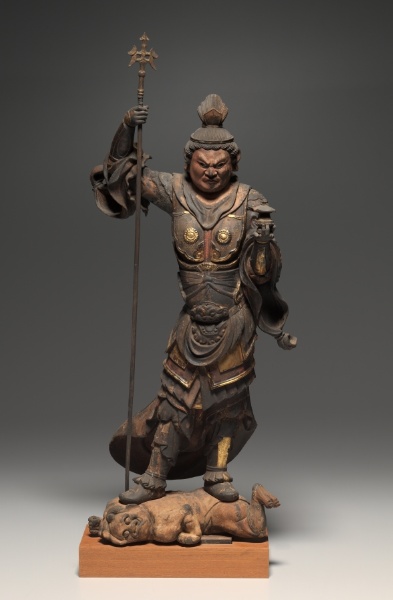
- Title
- Guardian King of the North (Bishamonten) / 毘沙門天像
- Period
- Kamakura period (1185–1333)
- Region
- Japan
- Medium
- Wood with gold polychromy
- Collection
- Cleveland Museum of Art
- Accession
-
1959.135 - Rights
- Cleveland Museum of Art (CC0). James Parmelee and Cornelia Blakemore Warner Funds, 1959.135.
Overall 76.8 × 28.6 cm. Catalog text: stupa in left hand, spear in right hand, demon underfoot. The visible weapon-head reads as a multi-pronged form (sankoshō / sansageki family) rather than a plain spear point — see iconography section.
The diagnostic is the stupa. Of the Four Heavenly Kings, only Bishamonten carries one: cradled in the open left palm at chest height, weapon shaft rising vertical in the right hand, both feet planted on the back of a prone demon.
The Cleveland figure (acc. 1959.135) is a working temple-guardian in domestic Japanese collection terms: gold leaf mostly gone from the legs, the wood grain showing through the lower body, the upper body still carrying enough polychromy to read the cuirass as armor and not just carved relief.
What you’re looking at
Bishamonten (毘沙門天) is the Japanese form of Vaiśravaṇa, the warrior-king of the north and the most-copied of the Shitennō, the Four Heavenly Kings posted at the cardinal directions of the Buddhist cosmos. In any temple’s main hall the four are typically deployed at the corners of the central altar, each turned outward to defend a direction.
Bishamonten alone broke off and developed an independent cult, and from the Heian period on appears as a freestanding single figure as often as in the Shitennō group.
| Direction | Guardian | Color | Diagnostic attribute |
|---|---|---|---|
| North | Bishamonten (Vaiśravaṇa) | yellow-gold | stupa + weapon |
| East | Jikokuten (Dhṛtarāṣṭra) | white | sword |
| South | Zōchōten (Virūḍhaka) | blue | sword or staff |
| West | Kōmokuten (Virūpākṣa) | red | brush + scroll |
The colour assignments are textual (from the Konkōmyō-kyō / Sutra of Golden Light and related sources) rather than visible: most surviving figures have lost their original polychromy or never carried the canonical pigments at all. The diagnostic that holds across sets is the attribute: stupa for north, brush-and-scroll for west, sword for east. Find the stupa and you have found Bishamonten.
Reading the iconography of this figure
The Cleveland catalog text is brief and specific: “He stands with a stupa symbolizing the Buddhist teachings and relics of the Buddha in the palm of his left hand, and a spear to foil the enemies of Buddhism in his right. He crushes a demon beneath his feet.”
A few details that survive looking longer:
- The stupa, left hand. Cradled, not gripped, held in the open palm at chest height, shaft tilted forward. The stupa references Vaiśravaṇa’s pre-Buddhist Indic role as guardian of the Buddha’s relics, which is why he gets the reliquary and the others do not.
- The staff, right hand. Catalog calls it a spear. The visible head reads as multi-pronged rather than a single point: closer to a sansageki (三叉戟, three-pronged staff) or a long- shafted sankoshō form than a plain hoko spear. Bishamonten’s weapon attribute is genuinely variable across the iconographic literature: hoko (halberd), sansageki (three-pronged spear), and hōbō (treasure baton) all appear in the textual sources, and the workshops chose. We follow the catalog reading and note the visual ambiguity.
- The demon underfoot. A single supine figure, lying on its back, the guardian’s feet planted on its torso. Not crushed into a rocky base: the demon is the base. The plinth beneath is a modern museum wood mount, plain and rectangular. The Heian and Nara Shitennō convention of an irregular rocky outcrop under the guardian’s feet has dropped out by the Kamakura period in this type; the demon stands in for the rock.
- The cuirass. Two large round bosses survive in gold leaf at the chest, the lamellar skirt-flaps below the waist still carry patches of gilt, and the laminated breastplate retains enough surface to read as armored construction rather than carved drapery.
- The crown. Tall and pointed, topped with a flame-shaped or jewel-shaped finial at the apex, not the broad lobed helmet with side neck-flaps that some Heian Bishamonten wear. Closer to the pointed crowns of the Kei-school Tōdai-ji Bishamonten than to earlier types.
- The face. Wrathful but contained: brows knotted, mouth open in a low snarl rather than a roar, the lower jaw firm. This is protective wrath, the guardian’s mode, distinct from the apocalyptic rage of the Wisdom Kings (Fudō, Daiitoku), which is doctrinally wrathful-compassion and sits in a different iconographic register.
What the surface tells you
The most legible thing about the Cleveland figure is what it has lost. The Cleveland catalog flags this directly: gold leaf wear on the legs and lower figure, exposing the textured wood beneath. Read across the figure top-to-bottom and the polychromy decays in a predictable gradient: chest bosses still bright, abdomen patchy, thighs mostly stripped, calves and feet down to bare wood.
This is the wear pattern of a temple object that was lit from above (oil lamps, candles, eventually electric uplights) and approached from below by worshippers; the protected upper body keeps its surface and the exposed lower body loses it.
The colour now reading as warm grey-brown with gold patches is not the Kamakura intent. Originally this would have been a saturated yellow-gold figure on a polychromed demon, with red, green, and black detailing on the armor straps and skirt borders.
Mōri Hisashi treats this kind of palette in Sculpture of the Kamakura Period (Weatherhill, 1974), and Kei-school workshops in particular were working at the high end of the polychromy program: gold leaf over lacquer ground (kindei), with finely cut gold-foil pattern (kirikane) on the textile portions. None of that is now legible on 1959.135 at the resolution the museum publishes, but the underlying construction logic is visible enough to extrapolate from.
The Kei-school inheritance
This figure dates from the Kamakura period (1185–1333), the era of the Kei-school sculptural revolution led by Unkei, Kaikei, and the following generation of Kei masters.
The Kei program is famous for two things: anatomical realism (bodies that have weight, muscles that engage, faces that read as portrait-specific rather than typologically generic) and the systematic recovery of Tang-dynasty Chinese costume, especially military costume, in armored guardian figures.
The recovery is one of the curious facts of Buddhist sculpture history. The Kei workshops, working in the late twelfth and thirteenth centuries, were copying figure types that had stabilised in Japan around the seventh and eighth centuries from Tang Chinese models, and by the Kamakura period the Tang originals had been gone for three hundred years, supplanted in China by Song military fashion. Japan kept copying the older type.
Rosenfield’s Portraits of Chōgen (Brill, 2011) traces this through the Tōdai-ji rebuilding campaign that brought the Kei masters into prominence. The result is that Kamakura armored guardians preserve Tang military costume more completely than the Chinese sculptural record itself does.
The Cleveland figure sits inside this lineage but does not announce itself as a named master’s work. The catalog gives no attribution, “Japan, Kamakura period (1185–1333),” and we have not found published scholarship that places 1959.135 in a specific workshop.
The body shows the Kei concern with weight and stance: feet planted wide on the demon, hips squared, shoulders rotated slightly to balance the raised right arm gripping the staff. Compare a Heian Bishamonten at this scale, where the armor reads as flat decorative surface and the body inside it is largely notional. By Kamakura the armor is a container around something that has volume.
The face in particular is in the Kei mode: frown lines clearly worked, the jowls and cheek planes structured, the open mouth modeled rather than incised. Whether this rises to the level of the named Kei figures or sits in the broader workshop circle is the kind of attribution question the Cleveland catalog declines to make.
Comparanda
- Tōdai-ji Hokkedō Shitennō (Nara, 8th c., dry-lacquer over wood-core). The earliest surviving major Shitennō set in Japan. Useful for seeing the type before Kei-school realism: the bodies are blocky, the armor decorative, the wrath stylised.
- Tōdai-ji Standing Bishamonten (Kamakura, early 13th c.). One of the canonical Kei-period freestanding Bishamonten. The frontal weight and the staff-stupa arrangement are directly comparable to Cleveland 1959.135.
- Tō-ji Lecture Hall Shitennō (Heian, 9th c., wood). Kūkai’s esoteric mandala arrangement: the Shitennō here are at the outer ring of a sculpted mandala. Different deployment context; same type.
- Kuramadera Bishamonten (Kyoto, Heian period). The major independent-cult site for Bishamonten in Japan; founded under the premise that the temple’s mountain is itself Bishamonten’s Northern Heavenly residence.
- Toledo Museum 1939.30 Bishamonten (Kamakura). Comparable freestanding US holding; the Toledo figure preserves more of its polychromy and is useful as a reference for how the Cleveland figure once looked.
The independent cult
Bishamonten is the only Heavenly King who broke out of the four-king group into autonomous worship. Kuramadera in northern Kyoto is the canonical centre; the temple’s founding legend places Bishamonten as the deity of the mountain itself, which is treated as an extension of the cosmological north.
Warrior patrons through the Heian and Kamakura periods built personal devotion programs around Bishamonten specifically: he was the deity to invoke before battle, both for his martial competence and for his guarantee of the dharma’s protection.
By the Edo period the cult had broadened again: Bishamonten enters the Seven Lucky Gods (Shichi-fukujin) as the warrior-deity in a group otherwise made up of ageing-scholar and merchant types, and is worshipped in that context for worldly wealth and military success.
The Cleveland figure pre-dates the Seven Lucky Gods program by several centuries, but the warrior-patron cult that fed it would have been the most plausible commission context for a figure of this scale and finish.
What stays unverified
- Workshop / attribution. Cleveland catalog is silent. We have not found a published placement of 1959.135 inside a specific Kei-school sub-workshop, and we are not making one.
- Original deployment. Whether this figure stood as one of a Shitennō set (corner of a temple altar) or as an independent Bishamonten cult image is not stated in the catalog. The scale (76.8 cm) and the finish are consistent with either.
- Weapon-head form. Catalog says spear; the visible head reads as multi-pronged. Whether this was originally a sansageki (three-pronged), a sankoshō-finialed staff, or a hoko halberd with a damaged blade cannot be securely determined at the publication resolution. We follow the catalog as the published- evidence baseline and flag the visual disagreement.
- Belt and shoulder ornament. Tang-style armored guardian figures often carry shoulder masks (sometimes lion-faced) and scalloped belt panels. Whether the Cleveland figure originally carried these in pigment or attached metalwork is not directly observable from the museum’s published image; better-resolution inspection would settle it.
How to read it next time
You are in a temple. You see four armored figures standing at the corners of the central altar, each glaring outward. Look for the stupa. The figure cradling a small reliquary is north, and that figure is Bishamonten.
If the four become one and you find a single armored guardian standing alone in his own hall, with a stupa in the left hand and a weapon in the right and a demon under his feet, you are in front of a Bishamonten dedication, and there is probably a warrior patron’s name in the temple’s records.
Sources
-
Catalog entry, accessed 2026-05-07. Wood with gold polychromy; James Parmelee and Cornelia Blakemore Warner Funds.
-
[2]— Mōri Hisashi, Sculpture of the Kamakura Period (New York: Weatherhill / Heibonsha, 1974) print referenceStandard English reference for Kei-school sculpture and Kamakura armored guardian type.
-
[3]— John Rosenfield, Portraits of Chōgen: The Transformation of Buddhist Art in Early Medieval Japan (Leiden: Brill, 2011) print referenceKamakura sculptural revival and the recovery of Tang-style armored figure types.
-
[4]— Samuel C. Morse, Kamakura: Realism and Spirituality in the Sculpture of Japan (Asia Society catalog, 2016) print referenceKei-school context; Higo Busshi Jōkei circle and the Kamakura realism program.
-
[5]— Buddhistdoor Global, 'King of Kings: The Propagation of Bishamonten Iconography' buddhistdoor.net/features/king-of-kings-the-propagatio…Iconographic survey covering the multi-pronged staff (sansageki) and Bishamonten's independent cult.