Kōfuku-ji Hokuendō Miroku, 1212: Unkei working alone
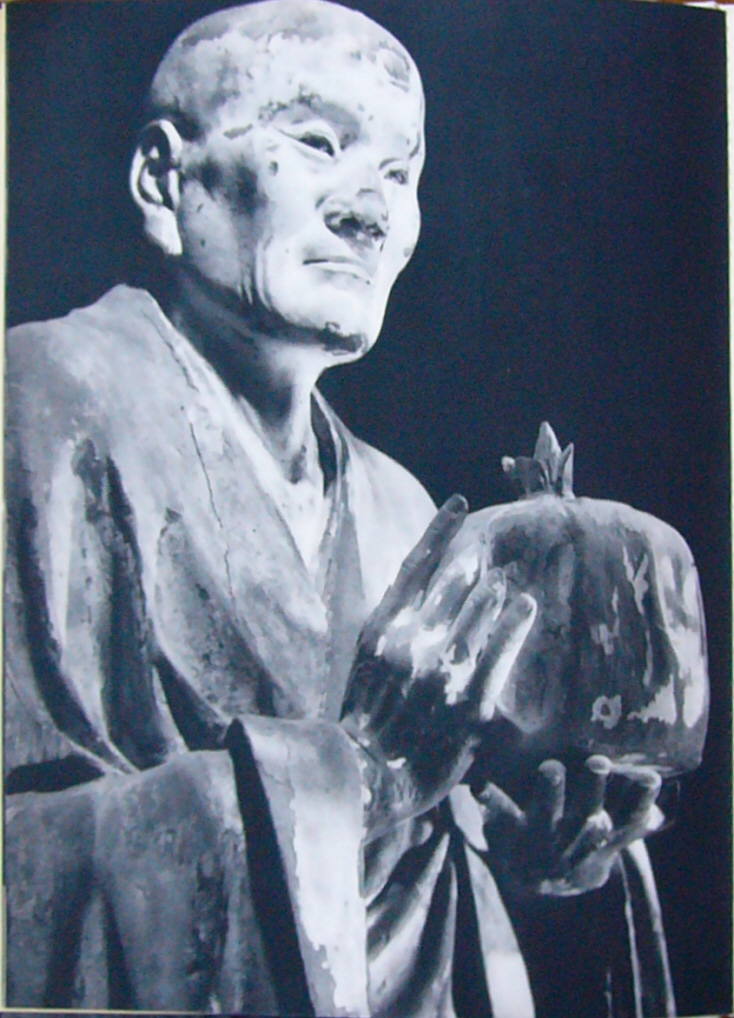
- Title
- Mujaku (無著, Asanga) — Kōfuku-ji Hokuendō, the late-Unkei solo-attributed Yogācāra patriarch
- Period
- Kamakura period, completed 1212
- Region
- Yamato / Nara
- Medium
- Wood (cypress) with polychromy and *gyokugan* (rock-crystal eyes); *yosegi-zukuri* construction; body-cavity dedications recovered during 20th-c. restoration confirm Unkei attribution and the 1212 completion
- Dimensions
- 193 cm standing
- Collection
- Kōfuku-ji Hokuendō (北円堂), Nara — Japanese National Treasure (国宝)
- Accession
-
Hokuendō Mujaku-zō - Rights
- Public domain (PD-Japan-oldphoto). Photograph by Shihachi Fujimoto (藤本四八, 1911–2006), published April 15, 1952 in *NIHON NO TYOKOKU (Japanese Sculptures), No.6, Kamakura Period* (Bijutsu Shuppan, Tokyo) — pre-1957 PD-Japan-oldphoto eligible. Source: Wikimedia Commons.
The signature Hokuendō figure: Mujaku (Asanga), 1212, Unkei solo-attributed. The late-Unkei *idealised characterisation study* — not a portrait from life of a 4th-c. Indian patriarch, but the Hossō Kōfuku-ji confession of doctrinal lineage in carved cypress. Shihachi Fujimoto plate, 1952.
The Kōfuku-ji Hokuendō programme (1208–1212) is Unkei working alone. The Miroku Buddha and the paired Mujaku and Seshin disciple-portraits are completed 1212 per body-cavity dedications. Together with the 1203 Tōdai-ji Niō (workshop-coordinated with Kaikei), they bracket Unkei’s late period: 1203 as workshop director at age ~53, 1212 as solo author at ~62. The two together ground the workshop-vs-solo division-of-hand reading that the popular Unkei-Kaikei attribution narrative tends to flatten.
The 1203/1212 bracket
The two best-documented Unkei attributions sit nine years apart and at opposite ends of the workshop-coordination spectrum.
1203 — Tōdai-ji Niō. 8.4 metre A-un pair at the Nandaimon. Workshop-coordinated with Kaikei. Tankei, Jōkaku, and 16 busshi shōnin in the production team. Documented by the 1988 Hōkyōin darani-kyō recovery from inside the Agyō body cavity. The workshop-coordinated Kei-school production-system at its operational peak.
1212 — Kōfuku-ji Hokuendō. Miroku Buddha + Mujaku + Seshin. Solo-attributed to Unkei per body-cavity recoveries. The hall (Northern Octagonal Hall, Hokuendō) was rebuilt 1208-1210 after Heike-War destruction; the principal images were completed in 1212.
Reading the two together is the substantive Unkei-attribution exercise. The 1203 Niō are unmistakably workshop production — the documented sculptor list is Unkei + Kaikei + Tankei + Jōkaku + 16 named-but-not-individually-tracked artisans. Even within the workshop-coordinated frame, the popular “Unkei did the Agyō, Kaikei did the Ungyō” division is not documented and does not align with the production reality.
The 1212 Hokuendō programme is different. The body-cavity dedications name Unkei specifically. The figures’ carving registers in the technical-stylistic literature as a single hand’s work — the modelling consistency across Miroku, Mujaku, and Seshin reads as one master sculptor working through three figures with assistants on subsidiary work, not as a parallel-coordinated workshop production.
The two together establish what “Unkei attribution” actually means for the corpus: workshop director on monumental commissions (1203), solo author on the late doctrinal-portrait commissions (1212). The workshop-vs-solo division.
The Hokuendō programme
The Kōfuku-ji Hokuendō (北円堂) is the temple’s Northern Octagonal Hall — one of the four octagonal halls in the Kōfuku-ji precinct, with the Nan’endō (Southern Octagonal) as its formal counterpart. The hall was originally founded in 721 as a memorial for Fujiwara no Fuhito; it burned with the rest of Kōfuku-ji in the 1180/12/28 Heike-War destruction (the same fire that burned Tōdai-ji); the present hall is the 1208-1210 rebuild.
The 1212 image programme has three principal figures:
-
Miroku (弥勒, Skt. Maitreya) — the future Buddha. The hall’s honzon (principal image). Seated in the padmāsana (lotus) posture on a high lotus throne; right hand raised in vitarka-mudrā (teaching gesture); Buddha-form (Buddha-clad with usnīsa, urna, elongated earlobes) rather than bodhisattva-clad.
-
Mujaku (無著, Skt. Asaṅga, c.4th-5th c.) — the Indian founder of the Yogācāra school. Standing figure in monk’s robes, holding a sūtra scroll. Mature middle-age modelling.
-
Seshin (世親, Skt. Vasubandhu, c.4th-5th c.) — Asaṅga’s half-brother, the principal philosophical systematiser of Yogācāra. Standing figure in monk’s robes, with hands in gasshō (palms together at chest). Younger / more austere modelling than Mujaku.
The pairing is doctrinal. Kōfuku-ji is the principal Hossō (法相) school institutional centre in Japan; Hossō is the Japanese reception of Indian Yogācāra; Mujaku-Seshin are the canonical Indian Yogācāra patriarchs. The Hokuendō programme reads, institutionally, as Kōfuku-ji’s confession of faith — Maitreya as the future Buddha to whom Yogācāra revelations were transmitted, with the Indian transmitter-pair attended on his throne.
Mujaku and Seshin as portraits
The two disciple-figures are the most-cited works in the Hokuendō programme, and the substantive Unkei-realism claim rests on them.
The Indian patriarchs lived roughly eight hundred years before Unkei carved them. There are no surviving portraits of either; there is no biographical-physical record. Unkei is producing imagined likenesses — what the popular framing calls “portraits” but which are, technically, retrospective characterisation portraits of figures the sculptor never saw and could not have seen.
What Unkei achieves is a degree of physical-psychological individuation that distinguishes the figures decisively. Mujaku reads as the older of the two — the seasoned doctrinal teacher, holding the sūtra-scroll, mature jaw and cheekbones, the modelled musculature of an aged but vigorous body. Seshin reads as the younger, more contemplative — gasshō-holding, austere lower face, the body modelling implying a more ascetic temperament. The two are not merely “two monks” but specifically these two, distinguished by physical type.
The realism is, however, idealised. Unkei is not painting from life; he is constructing imagined Indian patriarchs with the physical-psychological vocabulary of Kamakura-period realist sculpture. The figures wear standard Kōfuku-ji-Hossō monastic robes (not period-Indian robes); they sit in standard Kamakura sculptural rendering (not authentic Indian sculptural conventions); the faces use Mōri’s “modelled musculature” register rather than continental-Indian sculpture’s flatter modelling.
What this means: Mujaku and Seshin are not “portraits of historical figures” but rather idealised characterisation studies using Kamakura-period realist sculptural vocabulary to render Indian doctrinal patriarchs. The realism-claim is genuine within the Kamakura sculpture tradition; reading it as “Unkei made portraits from life” is the popular over-reach that the Mōri-Rosenfield scholarship explicitly retires.
What the body-cavity dedications anchor
The 1212 dating and the Unkei attribution rest on body-cavity recoveries. During Meiji-era and early-20c restoration of the figures, dedications were recovered from inside the figures naming Unkei as sculptor and dating the work to Kennin 2 / 1212. The recovered objects parallel the 1988 Tōdai-ji Niō Hōkyōin darani-kyō recovery in evidentiary weight — internal-cavity dedications surviving 800 years inside hollow yosegi-zukuri figures, recovered during modern conservation, and providing the documentary anchor for the attribution.
The Hokuendō dedications were recovered earlier (Meiji and early-20c restoration cycles) than the 1988 Niō recovery, and they have been longer in the scholarship. Nabunken’s 1954 Study on the Life and Works of Unkei draws on the Hokuendō dedications as the foundational evidence for the solo-Unkei reading of the 1212 programme. Mōri 1974 builds on Nabunken; Rosenfield’s later realism scholarship reads the figures against the broader Kamakura realist-portrait corpus.
The substantive claim that the body-cavity recoveries support: Unkei is the documented author of these figures. The “solo” reading is honest — the modelling is consistent across the three figures and reads as one hand with workshop subordinates on subsidiary work, not as workshop-parallel production.
Where this work sits
The Hokuendō Miroku-Mujaku-Seshin programme sits at the late-Unkei mature register. The sculptor was approximately 62 in 1212, having directed the 1203 Tōdai-ji Niō workshop nine years earlier and having worked through commissions at Kōen-ji, Ganjōju-in, and other smaller projects in the intervening years.
What 1212 represents is the late-career working frame. The Niō workshop commission demanded scale, speed, and coordinated workshop output; the Hokuendō commission allowed Unkei to work at smaller scale (the figures are sub-life-size and life-size respectively, not 8.4 m), with longer time per figure, on a doctrinally-load-bearing programme that mattered to the institutional Kōfuku-ji-Hossō identity.
The two commissions together — 1203 and 1212 — bracket the working frame for Unkei’s late period and provide the documented basis for the workshop-vs-solo division. Reading them together is reading Unkei honestly, neither as the supposed “Agyō Niō solo carver” of popular over-reach nor as the merely-administrative workshop director that the workshop-only framing would imply.
Related
- Tōdai-ji Niō, 1203 — the Unkei-Kaikei collaboration — the workshop-coordinated commission that brackets the other end of Unkei’s late period.
- Yosegi-zukuri: the multi-block construction that scales — the construction technique that enables the body-cavity dedications recovered from the Hokuendō figures.
- Senju Kannon: reading the thousand arms — the Sanjūsangen-dō programme led by Tankei (Unkei’s eldest son) provides the natural Kei-school continuation.
Sources
-
The Northern Octagonal Hall (Hokuendō) was rebuilt 1208-1210 and the principal images were completed 1212. Miroku Buddha (the Hokuendō honzon), Mujaku (Asanga), Seshin (Vasubandhu). All three figures by Unkei or under his direct hand. Body-cavity dedications recovered during 20th-c restoration confirm the 1212 completion and Unkei attribution
-
The body-cavity recoveries name Unkei as sculptor and date the figures to 1212. Documentary anchor for the solo attribution. Comparable in evidentiary weight to the 1988 Tōdai-ji Hōkyōin darani-kyō recovery, but recovered earlier (Meiji-era and early-20c restoration work)
-
[3]— Nara National Research Institute for Cultural Properties nabunken.go.jp/english/monograph/1.htmlFoundational mid-20c attribution scholarship. Reads the Hokuendō programme as Unkei's solo-attributed late masterpiece; contrasts with the workshop-coordinated 1203 Tōdai-ji Niō. Establishes the workshop-vs-solo division that informs all subsequent Unkei attribution scholarship
-
English-language Kamakura sculpture reference. Reads the Hokuendō Mujaku and Seshin as the most psychologically realised disciple-portrait pair in Japanese Buddhist sculpture. Cited at work level.
-
Anchors the Kamakura realism question — Mujaku and Seshin as part of the broader Kamakura-period turn toward physical-psychological realism in disciple portraiture. The Tōdai-ji Chōgen portrait (also early-13c) is the natural comparandum
-
Cross-checked the 1210 hall reconstruction date, the 1212 image-completion date, the National Treasure designations for Miroku, Mujaku, Seshin
-
Cross-checked the c.1150-1223 lifespan, the Hokuendō dating, the body-cavity-recovery documentary record, the workshop-vs-solo distinction
-
Cross-checked the Mujaku = Asanga (4th-c. Indian Yogācāra founder) and Seshin = Vasubandhu (his half-brother, also Yogācāra) identifications. The pair as the Hossō-school Indian patriarchs was foundational to Kōfuku-ji's institutional identity
-
Cross-checked Kōfuku-ji as the principal Hossō (Yogācāra) institutional centre in Japan, with Mujaku and Seshin as the canonical patriarch-pair. The Hokuendō Miroku-Mujaku-Seshin programme is institutionally the Hossō Yogācāra confession of faith — Maitreya as the future Buddha to whom Yogācāra revelations were transmitted, with the Indian transmitters represented