Pure Land & Raigōzu
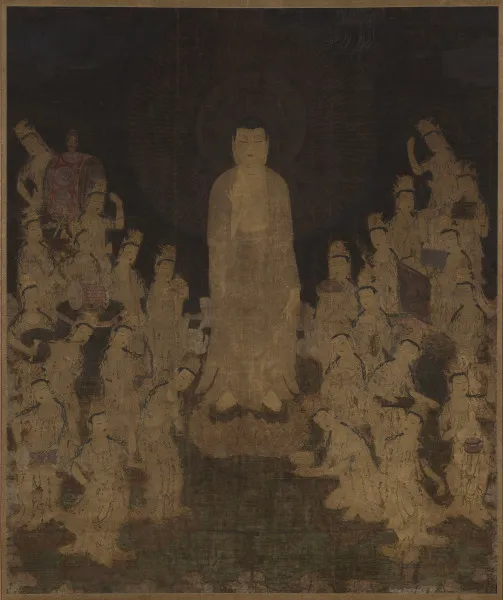
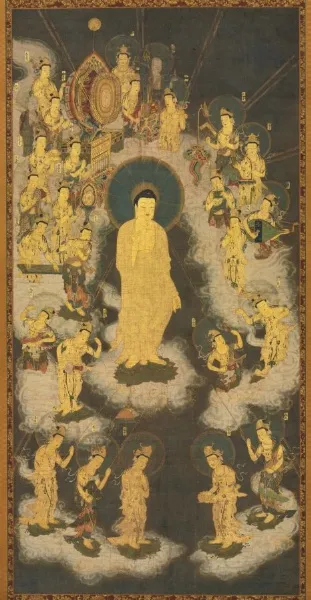
The descending procession of Amida and twenty-five bodhisattvas, the merit-economy of gold-on-indigo sutra-copying, the Heian elite-patronage origins and the post-Heian mass-devotional turn. The cluster reads Pure Land devotion through its surviving objects.
What the cluster reads
Pure Land Buddhism in Japan is, in the simplest reading, the devotional tradition centred on Amida Nyorai (Amitābha) and on the practitioner’s rebirth in his western Pure Land (Sukhāvatī, Saihō Jōdo). The visual record of the tradition is unusually rich and unusually well-dated, because the central iconographic programmes — the descending-procession raigōzu paintings, the Taima Mandala recensions, the gold-on-indigo sutra-copying tradition — were sustained continuously from the late tenth century through the Edo period and produced both elite-patron and popular-devotional witnesses across the period.
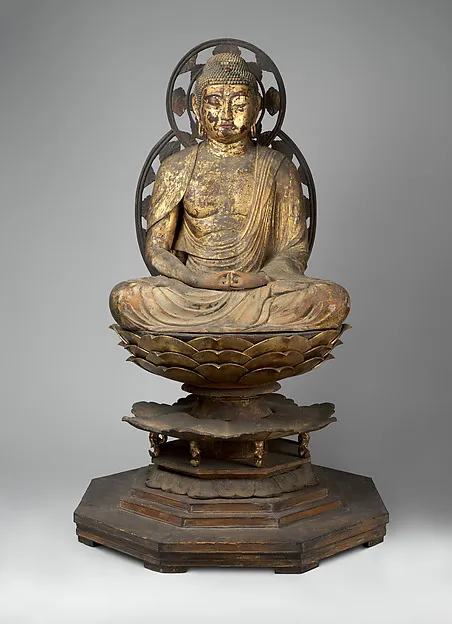
The cluster gathers fourteen articles. They cover three iconographic programmes (raigōzu, Taima Mandala, gold-on-indigo sutra) and one canonical sculptural anchor (the Byōdō-in Amida by Jōchō, 1053). The articles read across silk painting, gold-and-silver text on indigo paper, gilded-bronze sculpture, embroidered hanging scroll, and the late-Kamakura illustrated handscroll tradition. The objects are mostly small-and-portable scale, made for individual or small-group devotional practice rather than for public monumental display.
What changes across the period
The Pure Land visual tradition does not stand still across six centuries. The cluster traces three shifts that recur in the surviving objects:
The shift in patronage. Late Heian Pure Land production (the Heike Nōkyō, the Byōdō-in Amida by Jōchō (1053), the gold-on-indigo sutra-copying tradition) is elite-patron work: court-aristocrat commissions executed by the highest-skill workshops at extraordinary expense. Post-Heian production opens out. The thirteenth and fourteenth-century raigōzu corpus includes substantial commissions by mid-rank temple congregations and provincial-warrior houses; the late-Kamakura Yūzū Nenbutsu Engi is a handscroll built around mass-devotional practice rather than around individual elite devotion. The shift in patronage shows in the surface programme: late-Heian gold-on-indigo work is finished to a level of refinement that the post-Heian successors do not maintain.
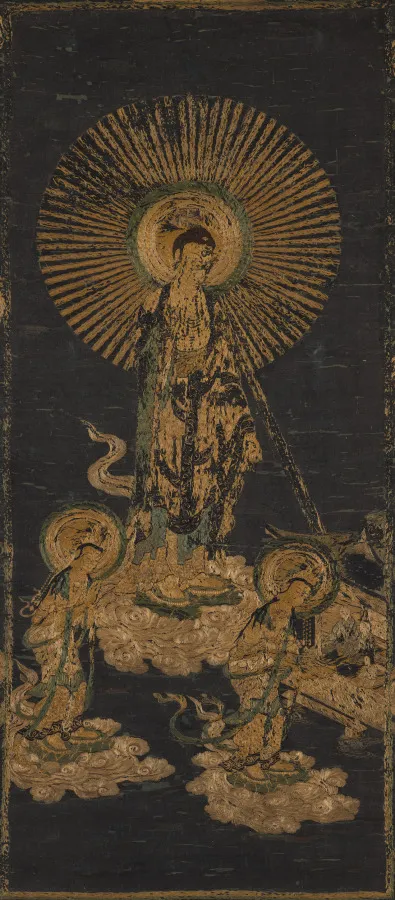
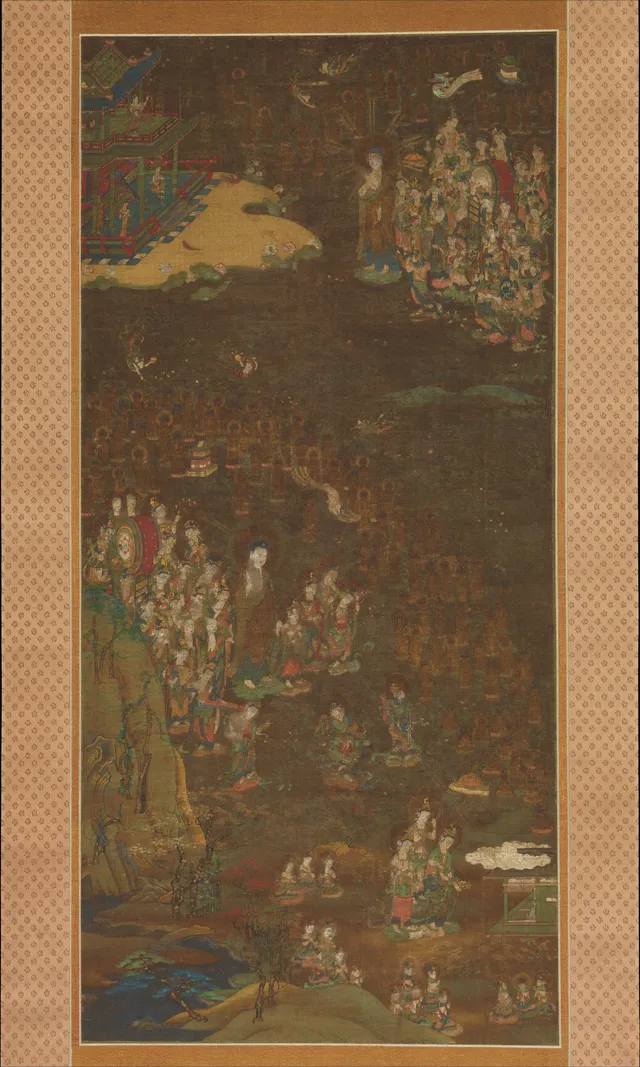
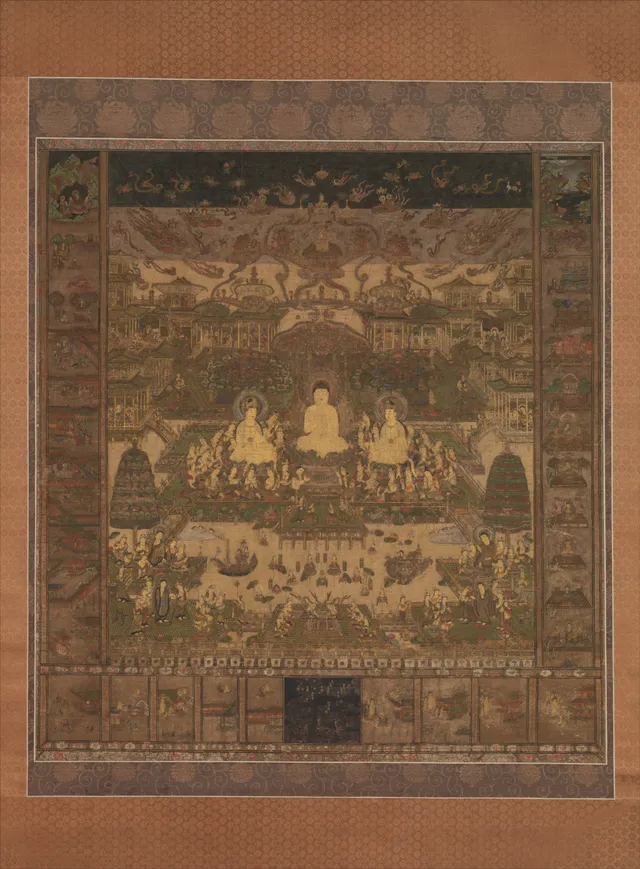
The shift in compositional scale. Late Heian Pure Land painting (the Yamagoshi Amida type, the early raigōzu compositions) tends toward the central, formal, frontal Amida triad. The Kamakura hayaraigō (“rapid raigō”) tradition introduces the diagonal-descent composition in which Amida and the twenty-five attendant bodhisattvas sweep across the silk on a sharply-tilted cloud, addressed directly to a dying viewer placed at the lower right. The compositional shift is functional: the hayaraigō is hung at the deathbed of the practitioner, who lies turned toward the painting; the diagonal composition is calibrated to that viewing posture. The Nanbokuchō twenty-five-bodhisattva raigō and the Met 27.176.2 Nanbokuchō Taima Mandala are the cluster’s Nanbokuchō witnesses to this compositional standardisation.
The shift in mediation. Early Pure Land practice is mediated by extended ritual specification — the kanmuryōjukyō sixteen contemplations, the multi-day nenbutsu zanmai retreat, the elaborate temple-architectural Pure Land programmes (Byōdō-in’s Hōō-dō, c.1053). Post-Hōnen and post-Shinran Pure Land practice is mediated by single-phrase recitation: the nenbutsu alone, repeated. The visual programme follows: the late-Kamakura and Nanbokuchō raigōzu compose the practitioner’s death-bed encounter with Amida as the single-image anchor for the single-phrase practice. The painting absorbs the ritual specification that the contemplative literature once carried in elaborated form.
What to read first
Three entry points:
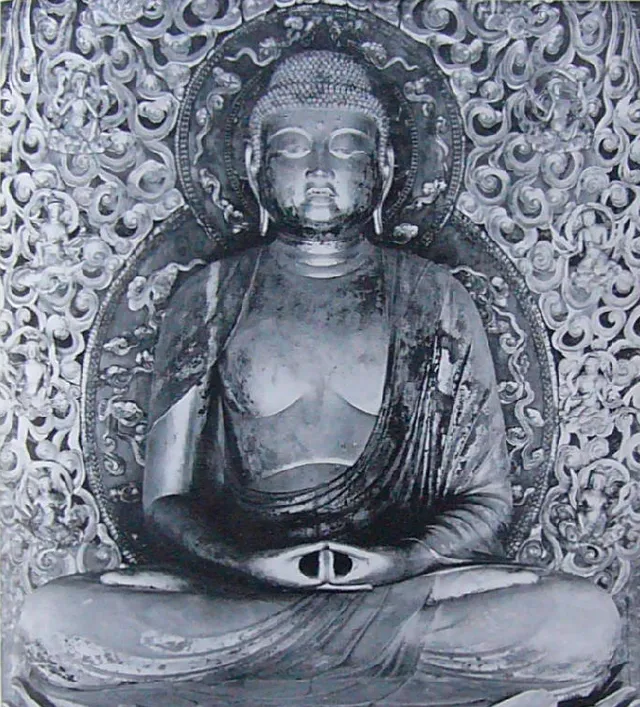
The reader looking for the canonical anchor should start with the Byōdō-in Amida by Jōchō (1053). Jōchō’s seated Amida is the single most-reproduced image in the Japanese Pure Land sculptural record; everything later in the cluster sits in some relation to it.
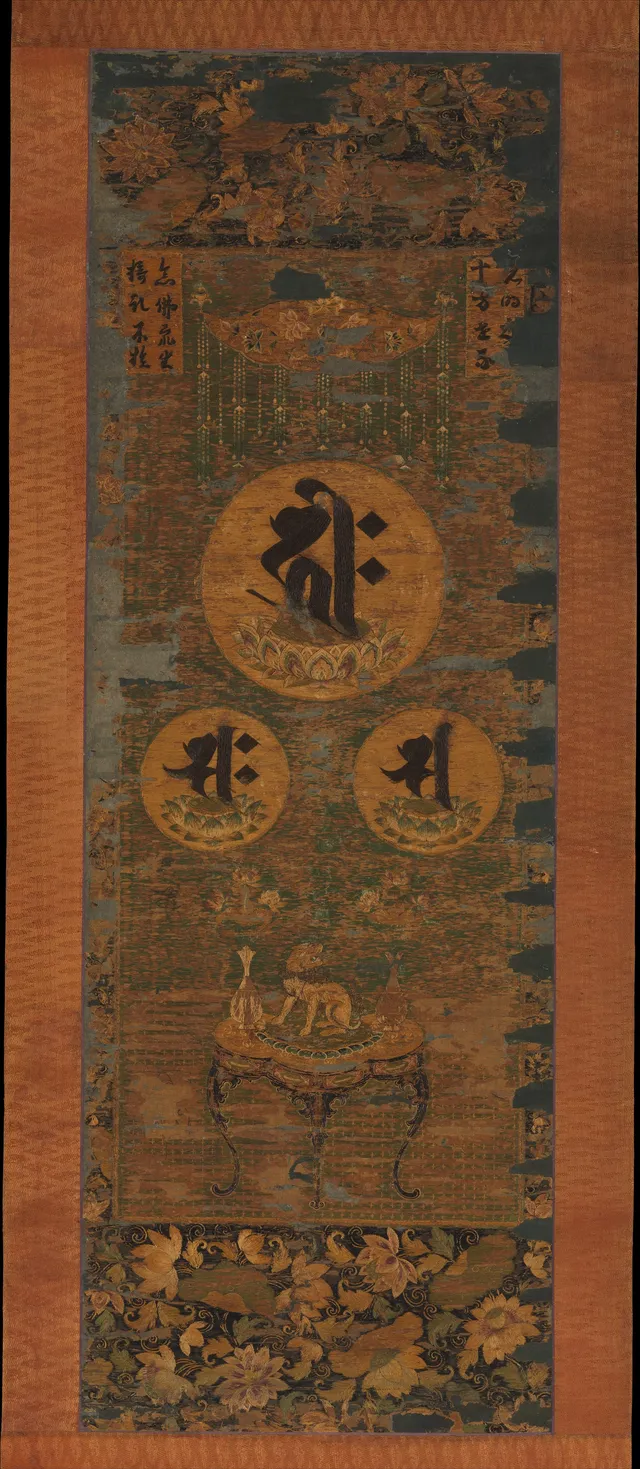
The reader looking for the compositional structure of raigōzu should start with the Nanbokuchō twenty-five-bodhisattva raigō and the Cleveland 1966.513 embroidered Amida raigō with hair-embroidery. The two together cover the standard painted and the variant embroidered modes; the disambiguation table below carries the twenty-five-bodhisattva attribute grid that both compositions use.
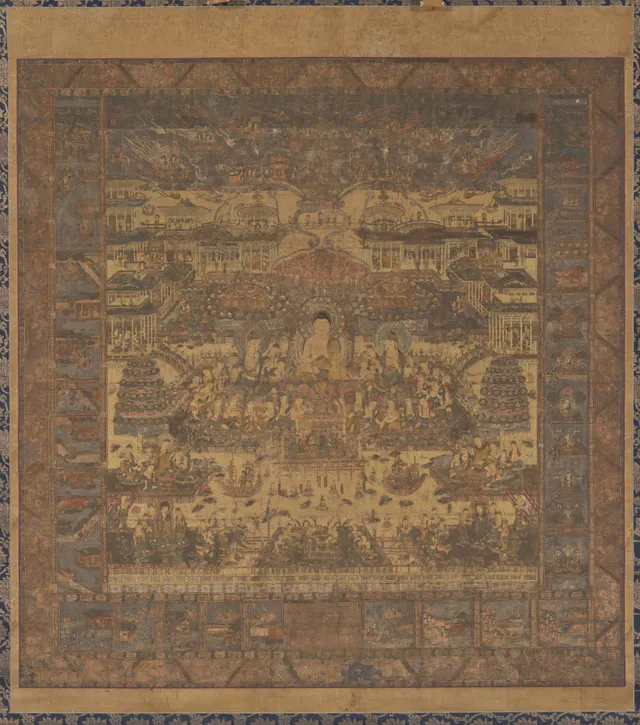
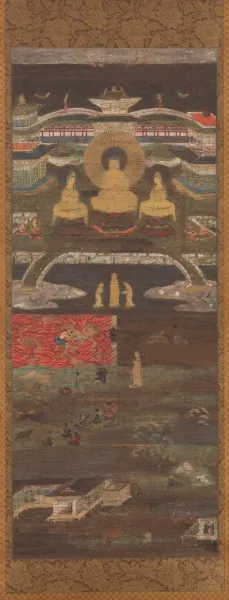
The reader looking for the Taima Mandala tradition — the central Japanese Pure Land textual-pictorial programme, derived from the eighth-century original at Taima-dera in Nara — should start with the Taima Mandala Heian recension reading and the Met 27.176.2 Nanbokuchō recension. The Taima Mandala is a complex multi-register composition that takes time to read; the two articles together cover the iconographic programme at two distinct period-witnesses.
The Heian gold-on-indigo programme
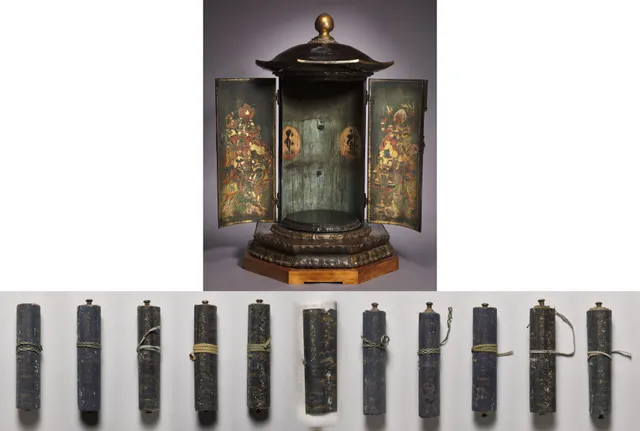
Sutra-copying as a Pure Land practice generates a distinctive material-record. The Heian elite copied the principal Pure Land texts — the three Pure Land sutras, the Lotus Sutra, in many cases the larger Mahāprajñāpāramitā corpus — on indigo-dyed paper in gold and silver ink, with frontispiece paintings of corresponding paradise scenes. The Heian gold-silver-indigo sutra tradition article reads the material programme at the level of paper, pigment, and binding; the Cleveland 1916.1060 Abhidharmakośa fascicle is a single-fascicle witness to the tradition.
The material economy is unusual. Each fascicle of gold-on-indigo sutra-copying represents an investment of paper (each sheet hand-dyed), pigment (gold-leaf ground to powder and suspended in glue), labour (a single fascicle requires weeks of high-skill calligraphic work), and pictorial-frontispiece commissioning (the frontispiece painted by a workshop painter, the sutra-text written by a separate calligrapher-priest). A complete copy of the Lotus Sutra on indigo represents months to years of full workshop output; a complete Mahāprajñāpāramitā (six hundred fascicles) represents decade-scale workshop programmes. The merit-economy claim is the reason: each fascicle is itself a merit-bearing object, and the production effort is the offering.
The cluster carries this thread because the gold-on-indigo programme is one of the principal material-record witnesses to Pure Land elite-patron Heian devotion. The textual content (Pure Land sutras) and the visual content (frontispiece paradise scenes) align; the surviving fragments are read both for the iconographic programme they once anchored and for the merit-economy practice they once enabled.
What the cluster does not cover
Three things sit at the edge of the Pure Land cluster and are not here:
- Practice / devotional manuals. Articles on nenbutsu recitation, the kanmuryōjukyō contemplations, Pure Land doctrinal exegesis, Hōnen’s Senchakushū, Shinran’s Kyōgyōshinshō — the Pure Land textual and ritual tradition outside the visual record — are out of scope. The cluster reads Pure Land objects, not Pure Land practice.
- Chinese Pure Land precedents. Tan-luan, Tao-ch’o, Shan-tao, and the Chinese Pure Land patriarchal tradition; the Dunhuang Pure Land paradise paintings; the Song-dynasty Amitābha sculptural tradition — all the Chinese antecedents that the Japanese tradition inherits — are not in scope.
- Modern (post-Meiji) Pure Land. The post-1868 Pure Land institutional history, the Higashi/Nishi Honganji sectarian programmes of the late nineteenth and twentieth centuries, the modern Jōdo Shinshū in diaspora — out of scope. The cluster’s terminus is roughly the end of the Edo period.
What stays open
Two systemic gaps in the cluster as it currently stands:
The Byōdō-in Amida by Jōchō is the cluster’s only Heian sculptural anchor. The Heian Pure Land sculptural tradition is much broader — the Sanjūsangen-dō original 1164 hall held a different Heian-late sculptural programme that the 1249 fire destroyed; the Kōfuku-ji and Tōdai-ji Heian Pure Land programmes are partial survivors; multiple regional temples hold Heian Amida figures that the corpus has not yet absorbed. A future second Heian Amida article would close part of this.
The Pure Land cluster’s coverage of kōsō-zu — patriarch-portraits of the Pure Land lineage (Hōnen, Shinran, Genshin, Ippen) — is currently nil. The post-Hōnen Pure Land tradition produced an extensive patriarch-portrait corpus, both as sculpture and as painting, which the bodhi corpus has not yet entered. A dedicated kōsō-zu article would be a high-leverage addition.
The cluster’s Heike Nōkyō (1164) reference appears as comparandum across multiple articles but does not have its own dedicated entry. The Heike Nōkyō is the single best-dated and most-completely-surviving Heian gold-on-indigo sutra-set; a dedicated article would refresh the Heian gold-silver-indigo sutra reading and serve as the cluster’s load-bearing dated Heian witness.
Reading the table
The disambiguation table below carries the twenty-five-bodhisattva grid for the standard raigōzu descending-procession composition. Each attendant carries a specific attribute that distinguishes them within the procession; the grid makes the attributes legible across the principal painted, embroidered, and sculptural witnesses to the programme.
Disambiguation
In this cluster
25 articles




No articles match that filter.