Datsueba: the old woman of the Sanzu River
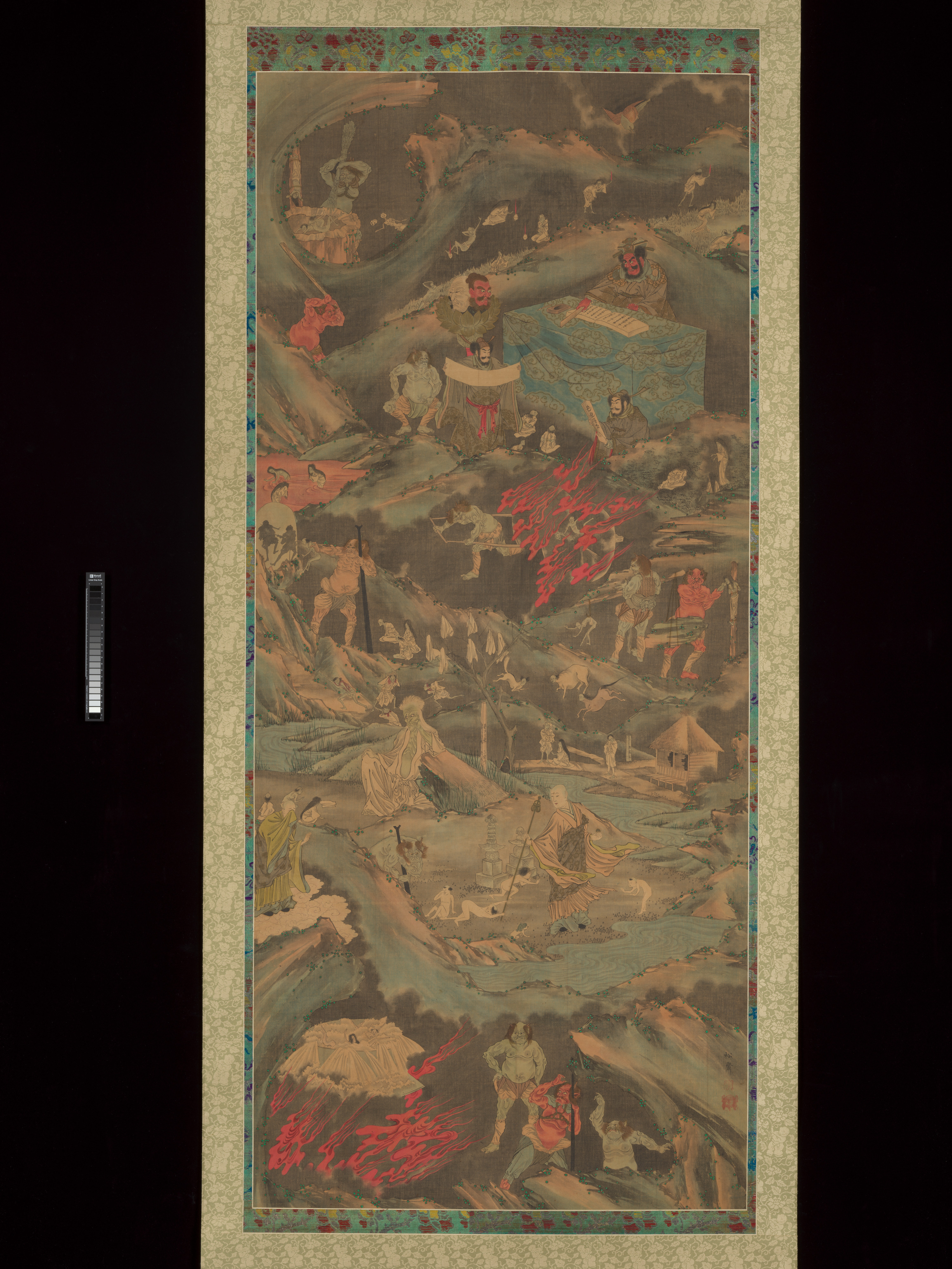
- Title
- Scenes of the Buddhist Hell
- Period
- Edo period (1615–1868), second half of the 19th century
- Region
- Japan
- Medium
- Hanging scroll; ink and color on silk
- Dimensions
- Image: 195.4 × 84.4 cm
- Collection
- The Metropolitan Museum of Art
- Accession
-
2020.170 - Rights
- The Metropolitan Museum of Art, Open Access (CC0 / public domain). Acc. 2020.170.
Datsueba sits at the lower left of the river band, the clothes-hanging tree above her — one vignette inside a full Ten Kings tableau.
Datsueba (奪衣婆) is the old woman who strips the dead at the Sanzu River. Saka’s monograph shows she is the seam where Japan added a body to an imported bureaucracy: she is named in the Japanese Jizō Jūō-kyō, not the Chinese Ten Kings scripture it copies. The Met’s Shōsai hell scroll (acc. 2020.170) holds her at the conservative end of a long transformation: still the terror, not yet the saviour.
Where she sits on the Met scroll
The scroll is tall, nearly two metres of silk, so the king of hell at the top sits well above standing eye level, and the eye climbs to him first, which is where the composition wants it. He is behind a draped blue desk with a scribe, the karma mirror, the sword-leaf mountain in red. Datsueba is not up there with the judgment. She is two-thirds of the way down, at the left margin of the river band, where a viewer of average height reads her at roughly chest level rather than by looking up. The painter has given her almost no stage: a strip of bank, a bent tree, a turn of green water.
She is unmissable once found. Among a tableau of small, pale, interchangeable sinners she is the one body the painter individuated: a large seated figure, knees up, the loose robe slid off both shoulders so the chest is bare and the breasts hang flat against the ribs. The hair is a white shock, not coiffed but blown back as if by the heat of the place. The face is the unexpected part. It is not snarling. The brush has set the jaw forward and the eyes deep, and the expression that results is clerical rather than furious, the look of someone who has done this work a long time and is not going to be hurried through it. Above and to her right, pale garments hang over the bare branches of a leafless tree. A robed male figure stands by it, attending to a kneeling, long-haired sinner at the water’s edge. That second figure is Ken’eō, and the tree is the eryōju.
The whole river crossing is compressed into a panel perhaps a tenth of the painting’s height. That is the first thing the object teaches that a text does not: Datsueba is central to how Japan imagined the entrance to hell, and pictorially marginal on the silk that carries her. The Met records the work as Scenes of the Buddhist Hell, by the thinly documented painter Shōsai (松斎), Japan, second half of the 19th century, ink and color on silk, 195.4 × 84.4 cm, acquired 2020 (acc. 2020.170).1 One hanging scroll does here what earlier centuries spread across a ten-scroll Ten Kings set.
The seam the Chinese scripture did not have
This figure earns a study rather than a line in a Ten Kings survey because of a textual seam. The scholar who has worked it hardest is Chihiro Saka (Nichibunken), whose Datsueba the Clothes Snatcher (Brill, 2022) is the only English-language monograph on her.2 Saka states the seam flatly. The Jizō Jūō-kyō (fully the Bussetsu Jizō Bosatsu hosshin innen jūō-kyō) was composed in Japan in the twelfth century on the frame of a Chinese apocryphon, the Scripture on the Ten Kings (the Foshuo Yanluo wang… jing); and “one of the differences between the Jizō jūō kyō and the Chinese apocrypha is that in the Japanese scripture, the female ogre Datsueba appears by the river.”3 She takes the clothes; she passes them to Ken’eō (懸衣翁); he hangs them on tree branches. The Chinese text, in Teiser’s standard edition, has the ten courts and the fixed intervals but no riverbank pair.4
That absence is not a philological footnote. It changes what the figure is for. The Chinese system is a registry; you are processed by clerks. The Japanese addition installs, at the very threshold, a body that is old, female, and physical, taking your robe with her hands. Hank Glassman’s study of the Jizō cult reads this as the broader medieval-Japanese move to give the imported hell faces and kin-relations rather than leave it administrative.5 The Sanzu pair are the clearest case of it.
The other thing Saka establishes is that this figure was not born fully grown. In the eleventh- and twelfth-century texts she is brief and minor. She is in the Hokke genki (c. 1040–44), in the tale of the priest Renshū, who dies, meets an old woman at the river who moves to take his clothing, and is saved from her by divine boys and revived for his devotion to the Lotus Sutra. A walk-on, not a fixture.3 Only by the thirteenth century, Saka argues, had she “increased in status and become a distinctive element of Japanese hell imagery,” the form the Shōsai scroll inherits six centuries later.3 The Met silk is late in a long curve, not a snapshot of a fixed type.
What she does at the river
Her function is administrative. She is stationed on the far bank of the Sanzu River, the river of three crossings the dead reach before the court of the second of the ten kings, Shokō-ō, and she takes the clothes off those who come over.3 She does not judge. She processes. Ken’eō hangs the stripped garments on the eryōju, and the branch bends. How far it bends is the reading: heavy, water-logged clothing drags the branch down, and the degree of that bend stands as evidence.
Two details of that machinery are exactly what the Met scroll shows in miniature. The weighing is done by water and gravity, not a scale. The river itself is the instrument. The crossing point assigned to a soul (a bridge for the light, a ford for the middling, a deep snake-channel for the worst) fixes how soaked the clothes come out. The sorting has happened in the water before Datsueba touches anyone; she and Ken’eō only register its result. And the pair are genuinely a pair. The stripping and the hanging are two hands of one operation, which is why this painting, like any competent hell scroll, keeps the seated woman and the standing man within one glance of each other across the bank.
One narrative wrinkle is easy to miss and worth holding, because it is the hinge the whole later transformation turns on. Saka notes that some religious texts let the dead keep their clothes if they made a cloth offering while living.3 The river apparatus, in other words, already had an exemption written into it. The figure who strips you was, from fairly early, also a figure you could deal with in advance.
The figure who grew, and the salvation she came to bridge
That exemption is what made the later Datsueba possible, and it is the part the popular accounts and the museum captions usually miss. By the Edo period, Saka shows, Datsueba “came to be worshipped as a border-marker, a saviour of women, and a miraculous deity who grants various worldly benefits.”3 The cloth she takes from the dead is the same cloth a living worshipper offers her to be spared, so the iconography of punishment carried, folded inside it, the iconography of rescue.
The sharpest case is gendered, and here the scholarship will commit. The reading is not the loose “she is female because medieval Japan feared for women’s salvation”; it is documented ritual. At the Tateyama cult, Saka and Caroline Hirasawa describe the Nunobashi Kanjō-e, the Cloth Bridge Consecration: women confessed at an Enma Hall, walked a path of white cloth across the river-line to the Uba Hall, and received kechimyaku talismans that “save women from the Blood Pond Hell, transform them into the male body, and promise their rebirth in the Pure Land.”36 Datsueba, the aged female body at the river, the keeper of cloth, is the figure that ritual is built around. The connection between her sex and women’s hell-soteriology is not bodhi reconstructing a doctrine the texts leave silent; it is the explicit logic of a documented Edo rite. The residual uncertainty is narrower: how far back before the Edo documentation that logic runs, which the surviving record does not fix.
Saka’s other study draws the bridge out fully. In the Zenkōji pilgrimage mandara she reads Datsueba pulled clean out of the hell scene and placed at the middle gate, where pilgrims expected ritual death and rebirth and a karmic bond with Amida. Her death-and-hell charge is repurposed there to mark the threshold of salvation, not the threshold of punishment.7 The clothes-stripper became the gate-keeper of the Pure Land. That is the long arc the Met scroll sits inside, and pointedly does not depict.
The two Datsuebas, and which one this scroll is
By the time Shōsai painted, the figure had a double life, and the Met silk takes a side. The hell-scroll Datsueba on this silk is the old terror: bare-chested, at the river, doing the grim arithmetic of the clothes. The other Datsueba was, by the same decades, almost her own opposite. In the early Kaei era (1848–54) the Datsueba statue at Shōjuin, a Pure Land temple in Shinjuku, became a hayarigami (a faddish deity granting worldly benefits) and crowds came to wish; Utagawa Kuniyoshi and other ukiyo-e artists printed the craze and fed it.3 The Shōjuin image wears a mound of donated floss silk piled over its head. Saka reconstructs the logic from a late-Edo gossip text, Jinsaiō’s Kōgai zeisetsu. The statue was held to cure coughs, plausibly through a pun: seki 咳 “cough” against seki 関 “barrier,” Datsueba being the woman who stands at the barrier between the living and the dead.3
The Met scroll sits on the conservative side of that split and does the older work: the deterrent hell of the Ten Kings, the river, the frightening administrator, not the Shōjuin benefactress. It belongs to the program-of-fear lineage Genshin’s Ōjōyōshū fixed for Japanese painting, and to the Ten Kings hell-scroll tradition more broadly. The divergence is worth naming because captions collapse it. “Datsueba who strips the dead” and “Datsueba the wish-granting grandmother of a Tokyo temple” are one name on two iconographies an Edo viewer told apart at a glance. This scroll is unambiguously the first, painted while the second was at its loudest a few wards away.
What the painter left out
The leave-out is the tell. Shōsai had room, on a scroll this size, for the full Sanzu apparatus: the three crossings, the snake-water, the six-coin toll, the children heaping stones at Sai no Kawara, Jizō hiding them in his sleeves. Most of it is absent or barely indicated. What survives the compression is the irreducible core — the seated woman, the tree, the man reading the branch, the river. A painter deep in the popular-print era knew this minimum was enough, because the iconography was fixed enough that four elements at a tenth scale would read correctly to anyone standing in front of the silk. The economy is itself the evidence of how thoroughly the figure had been internalised by the 1850s.
It is the loud parts that are generic. The red flames, the sword-leaf mountain, the small pale bodies herded by ox-headed wardens are the furniture the genre shares with its Chinese source. The quiet panel, the seated woman and the bending branch, is the specifically Japanese part, and Shōsai’s decision to individuate exactly that figure and leave the torturers interchangeable is a reading of where the weight sits. He put the brush where the tradition put its invention.
What is still unpinned
The object is honest about its own limits and so is this reading. The painter Shōsai is barely documented; the scroll’s temple or workshop context is not in the Met record, and no fuller curatorial note from the museum has been consulted. Nothing on the silk dates it tighter than the museum’s “second half of the 19th century.” The figure identifications here are made from the image and the iconographic literature, not from a catalogue essay, and the article says so rather than supplying a provenance the sources do not.
The scholarship is now carried by Saka, read in full where open access allowed: the 2024 Hualin article is pinned to its pages, and Teiser and Hirasawa are pinned through Saka’s own citations rather than from the physical volumes. Saka’s 2017 Zenkōji article and the 2022 monograph are cited at argument level — the Nanzan open-access PDF and the Brill book were not consulted directly. What is settled is the seam: Datsueba is the body Japan added to an imported bureaucracy, and the Met scroll holds her at the conservative end of the long change Saka traces, before the cloth she takes became the cloth that saves.
Sources
| Source | Type | Citation |
|---|---|---|
| The Metropolitan Museum of Art, Scenes of the Buddhist Hell, acc. 2020.170 | museum record | Shōsai, Japan, 2nd half 19th c.; CC0; Met Collection API, 2026-05-18 |
| Chihiro Saka, “Embedding Prayers in Cotton, Ramie, and Silk” | article | Hualin Int. J. Buddhist Studies 7.2 (2024): 333–359; open access |
| Chihiro Saka, Datsueba the Clothes Snatcher | book | Brill (Brill’s Japanese Studies Library 71), 2022 |
| Chihiro Saka, “Bridging the Realms of Underworld and Pure Land” | article | Japanese J. Religious Studies 44/2 (2017): 191–223 |
| Stephen F. Teiser, The Scripture on the Ten Kings | book | University of Hawai‘i Press, 1994 (cited via Saka 2024) |
| Hank Glassman, The Face of Jizō | book | University of Hawai‘i Press, 2012 |
| Caroline Hirasawa, Hell-bent for Heaven in Tateyama Mandara | book | Brill, 2013 (Nunobashi Kanjō-e, pp. 148–59; via Saka 2024) |
Related
- The hell-scroll tradition — the Ten Kings on silk
- Genshin’s Ōjōyōshū — the deterrent hell as program
- Rokudō — the six paths of rebirth
- Jizō — the saviour who walks the six realms
- Datsueba (entity)
- Jizō (entity)
- Sanzu River (entity)
- Jizō Jūō-kyō (entity)
Footnotes
-
The Metropolitan Museum of Art, Scenes of the Buddhist Hell, painter Shōsai (松斎, Japanese, active second half of the 19th century), accession 2020.170, objectID 826900; Purchase, Friends of Asian Art Gifts, 2020; “Hanging scroll; ink and color on silk,” image 195.4 × 84.4 cm. Met Open Access, public domain (CC0), object-level Wikidata Q126119559, re-confirmed via the Met Collection API on 2026-05-18. The museum’s full curatorial prose (if any) was not consulted; the figure identifications here are made from the image and the iconographic literature, not from a Met catalogue essay. ↩
-
Chihiro Saka, Datsueba the Clothes Snatcher: The Evolution of a Japanese Folk Deity from Hell Figure to Popular Savior (Leiden: Brill, Brill’s Japanese Studies Library 71, 2022; xvi + 265 pp.; ISBN 978-90-04-51441-6; DOI 10.1163/9789004517677; Japan Art History Forum First Book Subvention Prize 2020). The only English-language monograph on Datsueba; Saka is Project Research Fellow at the International Research Center for Japanese Studies (Nichibunken). Bibliographic detail and chapter structure verified via Brill and Nichibunken; the hell-figure→popular-savior thesis is summarised from the verified Brill abstract and from Saka 2024, which condenses and cites the book (nn. 5, 34). Book body not consulted directly; argument-level citation. ↩
-
Chihiro Saka, “Embedding Prayers in Cotton, Ramie, and Silk: The Symbolism of Textiles in Datsueba Worship,” Hualin International Journal of Buddhist Studies 7.2 (2024): 333–359 (DOI 10.15239/hijbs.07.02.10; open-access CC PDF, read in full, accessed 2026-05-18). Pinned: the Jizō jūō kyō composed in Japan in the 12th c. on the Chinese Scripture on the Ten Kings, and “one of the differences between the Jizō jūō kyō and the Chinese apocrypha is that in the Japanese scripture, the female ogre Datsueba appears by the river” — she crosses before the court of the second king Shokō-ō (p. 334, with Teiser, “The Scripture on the Ten Kings,” 57–60, 212; Bussetsu Jizō bosatsu hosshin innen jūō kyō, 301); the Hokke genki Renshū tale, divine-boys rescue, brief/minor early appearance (pp. 334–35, citing Hokke genki, 138–39); status increase to “a distinctive element of Japanese hell imagery” by the 13th c. (p. 335); the cloth-offering exemption — texts that let the dead keep their clothes if a cloth offering was made while living (p. 336 n. 6); the Edo-period evolution to “a border-marker, a saviour of women, and a miraculous deity who grants various worldly benefits” (p. 335); the Shōjuin (Shinjuku) Kaei-era (1848–54) hayarigami cult, Kuniyoshi prints, floss-silk mound, and the seki 咳 cough / seki 関 barrier homophone behind the cough cure (pp. 348–50, citing Jinsaiō, Kōgai zeisetsu, 299–300); the Tateyama Nunobashi Kanjō-e and kechimyaku talismans that “save women from the Blood Pond Hell, transform them into the male body, and promise their rebirth in the Pure Land” (p. 343). ↩ ↩2 ↩3 ↩4 ↩5 ↩6 ↩7 ↩8 ↩9
-
Stephen F. Teiser, The Scripture on the Ten Kings and the Making of Purgatory in Medieval Chinese Buddhism (Honolulu: University of Hawai‘i Press, 1994), pp. 57–60 and 212. The standard edition and study of the Chinese Shiwang jing and its bureaucratic model of purgatory; the claim borrowed here — that the Chinese scripture has the ten courts and fixed intervals but no riverbank clothes-stripping pair — is the content Saka 2024 (p. 334 nn. 1–2) cites Teiser pp. 57–60, 212 for. Cited second-hand (Teiser via Saka), not from a direct reading of Teiser. ↩
-
Hank Glassman, The Face of Jizō: Image and Cult in Medieval Japanese Buddhism (Honolulu: University of Hawai‘i Press, 2012). Glassman’s iconological study of the medieval Jizō cult treats the Japanese reworking of the imported underworld — the identification of Jizō with Enma and the personalisation of the hell bureaucracy; cited here at the level of that overall argument; page numbers not verified. ↩
-
Caroline Hirasawa, Hell-bent for Heaven in Tateyama Mandara: Painting and Religious Practice at a Japanese Mountain (Leiden: Brill, 2013), the Tateyama religious landscape (pp. 19–22) and the Nunobashi Kanjō-e / Cloth Bridge Consecration ritual (pp. 148–59). Cited for the documented Tateyama rite in which women receive kechimyaku talismans against the Blood Pond Hell; pages cited via Saka 2024 nn. 24–25 (Saka pp. 343–44), not from a direct reading of Hirasawa. ↩
-
Chihiro Saka, “Bridging the Realms of Underworld and Pure Land: An Examination of Datsueba’s Roles in the Zenkōji Pilgrimage Mandala,” Japanese Journal of Religious Studies 44/2 (2017): 191–223 (JSTOR 90017696). Saka argues that in the Zenkōji pilgrimage mandara Datsueba is removed from the hell scene and placed at the middle gate, where her death-and-hell association is repurposed to signal the ritual death-and-rebirth and the karmic bond with Amida that the pilgrimage offers. Bibliographic record verified across Brill, Nichibunken, JSTOR, CiNii, and the Nanzan IRC author page; the JSTOR/Gale full text and the Nanzan open-access back-issue PDF were not consulted, so cited at article/argument level; page numbers not verified. ↩
Sources
-
[2]2026-05-18Hualin International Journal of Buddhist Studies glorisunglobalnetwork.org/wp-content/uploads/2025/03/hualin7.2_…Open-access (CC) PDF read in full. Saka (Nichibunken) is the author of the only English-language monograph on Datsueba. Pinned here: Jizō jūō-kyō composed in Japan in the 12th c. on the Chinese Scripture on the Ten Kings, and 'one of the differences between the Jizō jūō kyō and the Chinese apocrypha is that in the Japanese scripture, the female ogre Datsueba appears by the river' (p. 334); Hokke genki Renshū tale, divine-boys rescue, pp. 138–39 of the text, Saka p. 334–35 nn. 1–4; Datsueba brief/minor in the 11th–12th-c. texts and a 'distinctive element of Japanese hell imagery' only by the 13th c. (p. 335); cloth-reciprocity — some texts let the dead keep their clothes if a cloth offering was made while living (p. 336 n. 6); Shōjuin (Shinjuku) Kaei-era (1848–54) hayarigami cult, Kuniyoshi prints, floss-silk mound, and the seki 咳 cough / seki 関 border homophone explaining the cough cure (pp. 348–50, citing Jinsaiō, Kōgai zeisetsu, 299–300); Tateyama Nunobashi Kanjō-e and kechimyaku talismans that 'save women from the Blood Pond Hell, transform them into the male body, and promise their rebirth in the Pure Land' (p. 343, with Hirasawa, Hell-bent for Heaven, 148–59).
-
[3]2026-05-18Japanese Journal of Religious Studies (Nanzan Institute for Religion and Culture) jstor.org/stable/90017696Bibliographic record verified across Brill, Nichibunken staff page, JSTOR stable 90017696, CiNii, Nanzan IRC author page; full text JSTOR/Gale 403 and Nanzan back-issue PDF not consulted, so cited at article/argument level: Saka argues Datsueba in the Zenkōji pilgrimage mandara is moved out of the hell scene to the middle gate, where her death-and-hell association is repurposed to signal the ritual death-and-rebirth and Amida karmic connection the pilgrimage offers — the underworld figure made to do Pure Land work. Page numbers not verified.
-
Standard study + edition of the Chinese Shiwang jing. Pages 57–60 and 212 are the passages Saka 2024 (p. 334 nn. 1–2) cites for the scripture's content and the absence of the riverbank clothes-stripping pair; cited here second-hand (Teiser via Saka), not from a direct reading of Teiser.
-
Pages 148–59 = the Nunobashi Kanjō-e (Cloth Bridge Consecration) ritual; pp. 19–22 = the Tateyama religious landscape. Pinned via Saka 2024 nn. 24–25 (Saka pp. 343–44), not from a direct reading of Hirasawa.
-
The only English-language monograph on Datsueba; ISBN 978-90-04-51441-6, DOI 10.1163/9789004517677, Japan Art History Forum First Book Subvention Prize 2020. Bibliographic detail + chapter structure verified via Brill and Nichibunken; the book's argument (hell figure → border-marker / saviour of women / worldly-benefit deity) is summarised here from the verified Brill abstract and from Saka 2024, which condenses and cites it (Saka 2024 nn. 5, 34). Book body not consulted directly; cited at record/argument level.
-
Late-Heian Japanese apocryphal scripture, after the Chinese Scripture on the Ten Kings; the text in which Datsueba and Ken'eō are named at the Sanzu crossing.
-
c. 1040–1044; the tale of the monk Renshū carries the earliest Japanese description of a clothes-stripping hag at the river of the dead.