The White Path Between Two Rivers: reading Shandao's parable as visual program
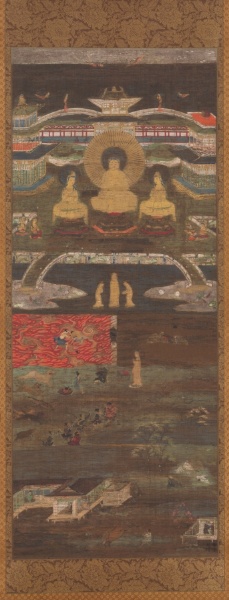
- Title
- The White Path Between Two Rivers (Niga byakudō-zu)
- Period
- Kamakura period (1185–1333), 1200s
- Region
- Japan
- Medium
- Hanging scroll; ink, color, gold, silver, and cut gold on silk
- Dimensions
- Painting 124.7 × 50.8 cm; mounted 215.1 × 67.7 cm
- Collection
- Cleveland Museum of Art
- Accession
-
1955.44 - Rights
- Cleveland Museum of Art, Gift of The Norweb Foundation, 1955.44. CC0 (public domain).
The path is the spine of the composition. Everything else is what is being walked away from or walked toward.
The Cleveland Kamakura scroll Niga byakudō-zu (acc. 1955.44) renders Shandao’s Two Rivers and a White Path parable as a vertical iconographic stack: Amida at the apex of the Western Paradise, Shaka behind the devotee on the eastern shore, the river of fire (anger) and river of water (greed) flanking the four-inch white path, and the six realms of transmigration arrayed at the base.
The scroll is read top-down, but it is built bottom-up. The lower third holds the world the devotee is leaving: the six realms of transmigration with their hells, hungry ghosts, beasts, contending titans, humans, and devas. The middle holds the obstacle and the route across it: two rivers, a path between them, a small standing figure of the devotee, and Shaka at his back. The upper third holds the destination, Amida in his Pure Land, framed by an architectural pavilion of the Western Paradise. The path between the rivers is the only feature that crosses two of these three zones. Everything else stays in its register.
The parable, in Shandao’s words
The Niga byakudō (二河白道) parable, “the two rivers and the white path,” is the only extended parable in Shandao’s Commentary on the Contemplation Sutra (Guan Wuliangshou jing shu 観無量寿経疏, completed in the late 7th century in Tang Chang’an).[^1] It appears in the fourth fascicle, the Sanzengi section, and is told once. Shandao gives the picture, then immediately keys each element to a doctrinal claim about Pure Land practice.
A traveler walks westward through an empty plain. Bandits and wild beasts close in from behind. The traveler comes upon two rivers running north and south: a river of fire on the south side, a river of water on the north. Between them runs a white path four or five inches wide, a hundred paces long, leading from the eastern bank to the western. The fire scorches the path; the waves wash over it.
The traveler hesitates. Behind him the bandits call out, false counsel urging him back. From the eastern shore, a voice tells him to go forward: “With singleness of mind and right attention, go now.” From the western shore, a voice calls across: “Come straight ahead. I will protect you.” Inagaki’s translation of the passage, working from the Taishō text, is the standard English point of reference for both the parable and Shandao’s allegorical key that follows.[^2]
Shandao’s allegorical key is severe and precise. The eastern shore is the burning house of saṃsāra. The western shore is the Pure Land. The bandits and beasts are the senses, the elements, and the false views that keep the unawakened in the burning house. The river of fire is anger and hatred (chen 瞋); the river of water is greed and craving (tan 貪). The white path between them is the pure aspiration for birth in Amida’s Pure Land that arises from within the unawakened mind, narrow because the passions threaten it on both sides.
The voice from behind is Shakyamuni, the historical Buddha, sending the practitioner forward with the teaching. The voice from across is Amida, calling and promising to receive. The traveler is the practitioner. The crossing is birth in the Pure Land at the moment of death.
The parable is doctrinally compact. It encodes the three minds (sanjin 三心) of Pure Land practice (sincere mind, deep mind, and the mind that aspires to birth and transfers merit) into a spatial arrangement that a sculpted hall, a deathbed scroll, or a painting program can stage in a single image. That compactness is what made the parable iconographically viable in a way that most sutra metaphors are not.
The transmission to Japan
Shandao’s Commentary circulated in Japan from the early Heian period as part of the broader Pure Land textual import. The parable’s afterlife in Japanese doctrinal writing runs through two specific quotations that any Niga byakudō scroll’s Kamakura readers would have known:
Hōnen (1133–1212) quotes the parable in the Senchaku hongan nembutsu shū (選択本願念仏集, completed 1198), the founding text of Jōdo-shū, where Shandao’s Commentary is cited as the central exegetical authority for nembutsu practice.[^3] Shinran (1173–1263) quotes the parable in the Kyōgyōshinshō (教行信証), in the chapter on Faith (Shinkan 信巻), where the Two Rivers passage anchors his account of shinjin, the entrusting heart that the parable’s white path represents in spatial form.[^4] Both citations treat the parable not as one figure among many but as a privileged image: the picture that organizes the doctrine.
The visual program follows the textual one with a lag. Okazaki, in Pure Land Buddhist Painting, places the earliest surviving Japanese Niga byakudō paintings in the late 12th and 13th centuries: that is, in the immediate Hōnen and post-Hōnen generation, when Pure Land practice as a distinct school had institutional patronage for the first time and a use for a deathbed-side image that was not the more elaborate raigō.[^5] The Cleveland scroll sits inside that first century of the Japanese visual codification.
What the Cleveland scroll actually shows
The scroll measures 124.7 × 50.8 cm in painted area, mounted to 215.1 × 67.7 cm. The support is silk; the medium is ink, color, gold, silver, and cut gold (kirikane 切金). The Norweb Foundation gave it to Cleveland in 1955; the museum dates it to the 1200s, within the Kamakura period (1185–1333). The catalog credits the iconographic program to a teaching ascribed to Shandao.[^6]
The composition is a vertical stack: three registers stacked along the scroll’s long axis, with a near-vertical white path running up the central spine and connecting the lower world to the upper one.
At the apex, Amida sits frontal in a pavilion of the Western Paradise, with the architectural enclosure rendered in gold-leaf and kirikane: geometric cut-gold patterns on the roof tiles, the railings, and the lotus pond at his feet. Two small attendant bodhisattva figures, conventionally Kannon and Seishi (Mahāsthāmaprāpta), are placed within the pavilion to either side of Amida; the catalog’s general identification of the upper register as Amida in his Pure Land is securely Pure Land iconographic standard, and the attendant pair is the standard Amida triad.
Just below the pavilion, in the lotus pond at the western shore, two further small standing bodhisattva figures wait — bodhi reads these as the receiving pair (again Kannon and Seishi, here in their welcoming role at the water’s edge, not their seated attendant role inside the pavilion). The doubling of the attendants is one of the iconographic choices that signals this scroll’s deathbed function: the practitioner who reaches the western shore is met at the water by the receiving bodhisattvas, not only at the throne above.
The middle register is where the parable is staged. The two rivers occupy the broad central band as side-by-side vertical ribbons rather than stacked horizontal layers: the river of fire (Shandao’s chen, anger) on the left, rendered in vermillion and gold tongues of flame, and the river of water (his tan, greed) on the right, laid in darker teal and silver wash. The four-or-five-inch white path runs vertically up the gap between them, with only the gentlest leftward lean as it rises toward the lotus pond and Amida’s pavilion above. (Some recensions tilt the path to a strong diagonal; the Cleveland painter does not.)
At the eastern end of the path stands the small standing figure of the practitioner. Behind him stands Shaka, the figure sending him forward, and behind Shaka, in the lower portion of this band, the threats: small figures of bandits with weapons drawn, and the wild beasts of the parable. The textual record in Shandao gives the bandits a speaking part (the false counsel), and the Cleveland painter renders them as a pictorial group rather than as text-banner inscriptions, which is the Japanese convention; the Tang and Song Chinese antecedents that survive in fragmentary form at Dunhuang sometimes use cartouche text instead.
At the base, the six realms of transmigration (rokudō 六道) are arrayed in a register of small-scale figural groups. The Cleveland catalog identifies the six as the heavens, the hells, the human realm, the animal realm, the realm of hungry ghosts, and the realm of fierce beings (ashura). The hells are the most readable to a modern viewer: small armoured demon-figures at work on tiny human bodies, in the lower-left corner of the composition. This is what the practitioner is leaving. The lower register is the burning house Shandao names; the upper register is the Pure Land he is being called toward; the white path is the only crossing.
The cut-gold work concentrates on Amida’s pavilion and on the lotus pond at the path’s western terminus. The painter’s choice to lavish kirikane on the destination and to render the rivers in flatter pigment puts the visual weight of the composition exactly where the doctrine needs it: on what is being walked toward, not on what is being walked between.
What is unusual about this recension
Niga byakudō paintings survive in a small group of Kamakura and Nanbokuchō Japanese examples (perhaps two dozen in named institutional holdings), and the iconographic core is conservative across the corpus. Variations that the Cleveland scroll rewards close looking on:
-
The path’s axis. Niga byakudō paintings vary in how strongly the painter tilts the path off vertical. The Cleveland scroll runs the path nearly straight up the central axis with only a gentle leftward lean, and terminates the path into the lotus pond at Amida’s feet rather than at a separate compositional plane. This is the more nearly vertical variant of the iconographic choice; the Manpuku-ji scroll in Masuda (Shimane) and the Nara National Museum’s Important Cultural Property example (acc. 948) both use a comparable near-vertical path. Other Kamakura recensions push the path to a stronger diagonal across the picture plane.
-
The six-realm base. Not every Niga byakudō includes the rokudō register at the base. Some examples (the British Museum scroll, for instance) give the practitioner alone on the eastern shore with no schematic depiction of what he is leaving. The Cleveland scroll’s inclusion of the six realms makes the parable’s framing claim explicit: this is a soteriological cosmology, not just a path-crossing image. Szostak’s 2007 study of the Niga byakudō theme in Archives of Asian Art notes that the inclusion or omission of the rokudō register is one of the principal axes of variation in the Japanese corpus, and that the inclusive variant (the Cleveland choice) tracks more closely with Hōnen-school institutional use, where the parable is read as a comprehensive map of the unawakened condition rather than as a focused crossing scene.[^7]
-
The bandits and beasts as figural group. The pictorial rendering of the bandits and beasts as a small figural assembly behind the practitioner, rather than as cartouche text, is the standard Japanese choice and is also the choice at the Nara NM example. Where Tang Chinese antecedents at Dunhuang preserve fragments of the parable in mural form, the textual cartouches are present alongside the figures; the Japanese transmission drops the cartouches and lets the figures carry the parable. The Cleveland painter follows this convention.
The recension is, in short, a mid-range Kamakura standard, neither the most elaborated nor the most schematic, and is iconographically continuous with Okazaki’s account of the form’s stabilization in the post-Hōnen generation.[^8]
Reading the parable as visual program
The parable’s transposition into the painted vertical scroll is iconographically efficient. Shandao’s text is built on a spatial metaphor (east shore, west shore, two rivers, a path between), and the hanging-scroll format is itself a vertical spatial axis that hangs at viewer-eye level. The painter is given the parable as a ready-made composition. The choice that has to be made is which parts of Shandao’s allegorical key to render visually and which to leave to the iconography itself to do.
The Cleveland choice is to leave the allegorical key implicit. The river of fire is fire; the painter does not label it anger. The river of water is water; the painter does not label it greed. The bandits are bandits; they do not carry banners that say false views. The viewer who knows the parable reads the doctrine; the viewer who does not still reads the image as a man crossing between two rivers toward a paradise above. This is the patient choice. It assumes the parable’s Japanese reception is widespread enough, through Hōnen’s Senchaku-shū citation, through Shinran’s Kyōgyōshinshō citation, through nembutsu practice in temple and household, that the painted image does not have to teach the parable from scratch. It only has to stage it.
The deathbed function follows from this. Niga byakudō scrolls, like raigōzu, were used in Pure Land deathbed rites: hung above or beside the dying person so that the last thing the eye rested on was the painted image of the path being walked. The parable’s spatial metaphor and the deathbed scene’s spatial use coincide. The dying person is on the eastern shore, looking west, hearing the nembutsu chanted at his back (Shaka’s voice, in the parable’s allegory), and being received by the painted Amida at the apex (Amida’s voice, calling). The function is what made the parable worth painting at all in the first generation of Japanese Pure Land institutional practice.
Where this scroll sits in the corpus
Beyond the Cleveland 1955.44 scroll, the principal Japanese institutional Niga byakudō holdings include:
- Nara National Museum, ICP painting acc. 948, Kamakura period. The single most-cited Japanese example in the scholarly literature; designated Important Cultural Property; treated as the canonical reference image in the Japanese curatorial tradition.[^9]
- Manpuku-ji, Masuda (Shimane), Kamakura period. Silk hanging scroll, designated Important Cultural Property; the Shimane example is the principal regional Kamakura survival outside the Nara/Kyoto axis.
- Kōsetsu Museum, Kobe. A Kamakura recension cited by Okazaki and by Szostak, with the rokudō register elaborated.
- British Museum, acc. 1881,1210,0.54, hanging scroll. A later Japanese example without the rokudō base; cited here for comparative purposes via the museum’s published catalog rather than reproduced.
- Chion-in, Kyoto. The head temple of Hōnen’s Jōdo-shū holds a Niga byakudō scroll in the temple collection; documented in the temple’s own publications and treated as iconographically continuous with the Cleveland and Nara NM standards.
The Cleveland scroll’s specific contribution to the Western institutional record is that it is openly licensed (CC0) at high resolution. The Nara NM, Manpuku-ji, Kōsetsu, and Chion-in holdings are documented through Japanese-language scholarly publications and remain rights-reserved; the Cleveland scroll is what an English-language reader can study at full image fidelity.
A note on what the iconography does not do
The Niga byakudō is not a raigō, the welcoming-descent scene, where Amida and his entourage descend from the Pure Land at the moment of death to receive the practitioner. The two genres share the deathbed-rite function and overlap in the Japanese institutional record, but they are doctrinally and iconographically distinct: the raigō stages the receiving, the Niga byakudō stages the crossing. The raigō’s compositional emphasis is on the descending procession; the Niga byakudō’s is on the path itself. Where a raigō puts Amida and the twenty-five bodhisattvas in motion across the diagonal, the Niga byakudō puts the practitioner in motion and Amida at the apex, still.
The two were used in the same death-rite contexts and sometimes at the same temples; they are the two principal Japanese visual idioms of late-medieval Pure Land deathbed practice, and they read most clearly when read together.[^10]
Related
Sources
-
[3]— Taishō Tripitaka no. 1980; trans. Hisao Inagaki, Liturgy for Birth (Ōjō raisan), 2002 print reference