The Welcoming Descent of Jizō: a raigō for the wrong bodhisattva
- Title
- Welcoming Descent of Jizō (地蔵菩薩来迎図)
- Period
- Kamakura
- Medium
- Hanging scroll; ink, color, gold, and cut gold (kirikane) on silk
- Dimensions
- Image: 59 × 33.2 cm. Overall: 120.7 × 51.4 cm.
- Collection
- The Cleveland Museum of Art
- Accession
-
1983.75 - Rights
- Public domain (Cleveland Museum of Art Open Access, CC0). Accession 1983.75. John L. Severance Fund, 1983.
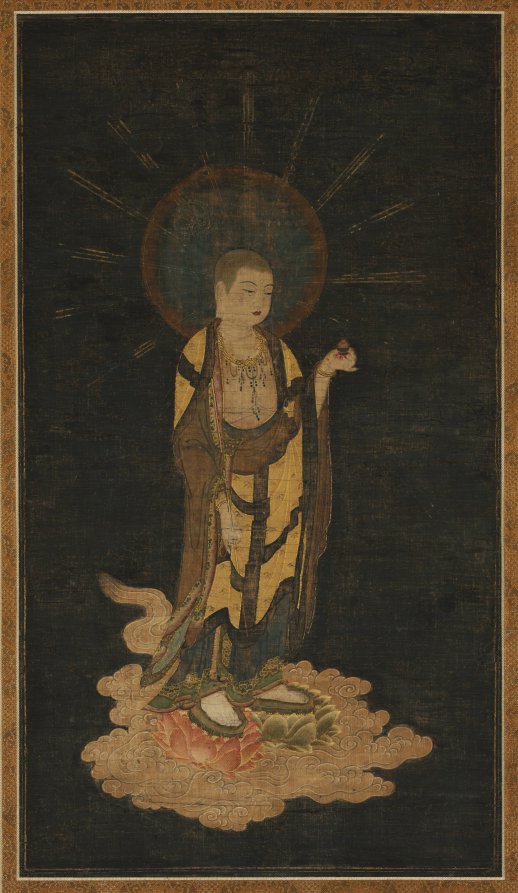
Welcoming Descent of Jizō. Japan, Kamakura period (1185–1333), 1200s. Hanging scroll, ink, color, gold and cut gold (kirikane) on silk; 59 × 33.2 cm (image). The Cleveland Museum of Art, John L. Severance Fund, accession 1983.75. Public domain (CC0).
The wrong bodhisattva for the moment
The welcoming-descent, raigō, is an Amida moment in the Pure Land iconographic programme as it consolidated through the Heian and Kamakura centuries. Amida Nyorai descends through cloud-cover toward the dying believer to receive their soul up into the western paradise. Kannon and Seishi attend. The welcoming-descent mudra (raigō-in) identifies the central buddha, and the lotus dais carries the soul. The programme is built around Amida, and canonically reserved for him.
Cleveland 1983.75 substitutes Jizō into that Amida-shaped slot. The composition is the raigō composition: descent on lotus blossoms, a single principal figure at near-full canvas height, the descending posture signed by angled feet and inclined head, the cloud-bands and gold-leaf register-organisation that the painted Pure Land tradition had established as canonical. But the descending figure is not Amida. He is shaven-headed and monk-formed, carrying the wish-fulfilling jewel (cintāmaṇi) in one hand and the ringed monastic staff (shakujō) in the other. He is, unambiguously, Jizō: the Earth-Store Bodhisattva, Kṣitigarbha, in his canonical form.
The substitution is not a workshop error. It is a doctrinally specific move. Kamakura-period devotion built around Jizō includes the explicit claim that Jizō, like Amida, descends to the dying believer to receive and save the suffering soul. Jizō’s reach, though, extends to a class of beings the Amida raigō doctrine treats as outside Amida’s salvific economy. Specifically, Jizō intervenes in the six paths of rebirth (the hot hells, the cold hells, the hungry-ghost realm, the animal realm, the asura realm, the human realm). The Kamakura devotional tradition reads his raigō moment as the rescue of beings already in lower-realm rebirth, not the collection of dying-but-faithful believers at the threshold of paradise.
The Cleveland record’s description articulates this: “the bodhisattva of compassion — described as an enlightened being who refuses to become a Buddha in order to aid other beings in their quest for enlightenment — descends… to rescue suffering believers who call for help.”
Reading the figure
Jizō stands at the centre of the composition, slightly off the vertical axis toward the viewer’s right. He stands on a cluster of three open lotus blossoms, pale pink against the gold-grounded sky, themselves rendered as if descending through cloud. His robe is the monastic-robe pattern with the body bared at the right shoulder. The robe is densely worked in kirikane (cut-gold leaf): narrow gold strips applied to the silk to produce woven-pattern textile ornamentation that no painted-pigment technique can produce. The gold lifts the figure into the gold-grounded sky around it.
The face is round and soft. The eyes are nearly closed, the mouth is small, the eyebrows arch lightly. The figure’s head is shaven (the bhikṣu monastic crown), unlike the high-coiled headdress that the bodhisattva-form Kannon and the lesser-attendant bodhisattvas of the Pure Land programme carry. The lack of headdress is the load-bearing iconographic detail that, alongside the staff and the jewel, identifies the figure as Jizō and only Jizō.
In his left hand he carries the cintāmaṇi, the wish-fulfilling jewel, rendered as a softly luminous orb held against the chest. In his right he carries the shakujō, the ringed monastic staff, held vertically along the figure’s right side. There are six rings at its head, one for each of the six paths. In monastic-walking practice the rings would chime softly as the monk walked; the iconographic detail signs Jizō as the bodhisattva who walks through the realms of rebirth.
The descent moment is signed by the angle of the feet and by the lotus blossoms. The figure does not stand still. The lotuses below the feet are positioned at an angle, suggesting movement-down-through-the-air rather than stable-on-the-ground, and the cloud-bands rise around the lower body to indicate the air-passage. The head inclines slightly downward to the viewer’s left, the direction toward which the descent is moving.
What the substitution does
The Jizō raigō, by substituting Jizō into the Amida-shaped iconographic slot, addresses a problem internal to the Pure Land programme. The Amida raigō promises Amida’s descent to the believer at the threshold of death: the dying person who has practised the nembutsu, who has accumulated faith, who calls Amida’s name with sincere mind. The promise is conditional on the believer’s act and on the believer’s status as a dying-but-faithful person at the moment of death. In its strictest reading it does not extend to beings already in lower-realm rebirth, nor to beings who never had access to nembutsu practice, nor to beings whose lives ended without the threshold-of-death moment the iconographic programme depicts.
Jizō’s salvific economy is wider. The Jizō Bosatsu Hongan-kyō (the Jizō Original Vow Sutra) records his vow to refuse buddhahood until all beings in the six paths have been saved. Jizō descends not at the threshold of death but at any moment when a being in any of the six realms calls for help. His raigō is therefore not the soul-collection of the dying believer but the rescue of the suffering being from where they already are. The iconographic programme is the same (a bodhisattva descending on lotus toward a believer), but the doctrinal load it carries is different.
What the Kamakura devotional tradition did with this is the load-bearing argument of Hank Glassman’s The Face of Jizō (2012). The tradition expanded the raigō programme’s pictorial reach from the Amida-only canonical configuration to a sub-genre in which Jizō (and, in some 14th–15th century works, Kannon-alone, Miroku, or Yakushi) occupies the central descent slot. The expansion was driven by the doctrinal need to figure salvation as available outside the strict Amida-nembutsu economy. The Jizō raigō is one of the principal pictorial moves the Kamakura tradition made in this direction.
Reading 1983.75 against the standing-Jizō tradition
Across most of the Kamakura devotional corpus the figure inhabits the iconic register: the canonical Kamakura wood sculpture as a freestanding devotional image, of which the Met’s 18.93 standing Jizō is the bodhi corpus’s principal worked example. The figure stands on a lotus pedestal, in monastic robes, with the same staff-and-jewel attribute pair, but rendered as static. It is the figure of contemplation and worship, positioned for incense and offering and gasshō at the temple-shrine.
What 1983.75 does is animate the same iconographic figure into a narrative moment. The static standing-Jizō becomes the descending-Jizō. The figure of contemplation becomes the figure of rescue. The temple-shrine devotional posture becomes the cloud-borne mid-descent posture. Iconographic attributes are conserved (staff, jewel, shaven head, kirikane robe); the temporality shifts from the always-already-present worship-form to the in-the-moment-of-descent narrative-form.
The two registers, iconic and narrative, operate together within the Kamakura Jizō cult. A temple might hold a standing Jizō as its principal honzon and commission a raigō painting of the same figure for use in a sub-hall or for processional display on appropriate liturgical occasions. Cleveland 1983.75 (the painted raigō) and Met 18.93 (the sculpted standing figure) model this pairing across two American collections.
What stays open
The first thing is the inscription. The work, in the photographic record visible through Cleveland Open Access, does not carry a visible inscription on its painted surface. Whether the original mounting (now likely replaced) carried an inscription with donor, date, or temple-of-origin is unknown from the open record. Cleveland’s curatorial entry may have more.
The second is the temple of origin. The provenance line traces back through Shogoro Yabumoto, the major Kansai-region dealer in Amagasaki, Hyōgo Prefecture, but does not extend beyond. Yabumoto’s dealer records, if extant and accessible, would be the path to recovering the pre-1983 temple history.
The third is the dating window’s precision. Cleveland carries “1200s”, the full century. The stylistic vocabulary (the kirikane ornamentation, the figure’s facial type, the compositional armature) is consistent with the early-to-mid thirteenth century, but the open record does not narrow this further. Glassman (2012) or the CMA Bulletin entry are the likely sources for a tighter date.
Sources
-
Cleveland Open Access CC0. Provenance: Shogoro Yabumoto, Amagasaki, Hyōgo → CMA 1983.
-
Scriptural source for the Amida-centred raigō programme that this work substitutes Jizō into. Taishō T.0365.
-
The Jizō Original Vow Sutra. Scriptural source for the Jizō devotional cult; the source of the doctrine that Jizō refuses to enter buddhahood until all beings are saved. Taishō T.0412.
-
Standard English-language source on the medieval Japanese Jizō cult; treats the Jizō raigō sub-genre and the substitution doctrine.
-
Likely first detailed publication of the work after the 1983 acquisition; volume and page not confirmed.
-
Pre-1983 provenance source. Yabumoto was a major Kansai-region dealer; the records, if extant, may carry pre-Yabumoto temple-of-origin information.