The standing Amida that completes the Met's Kamakura raigō triad
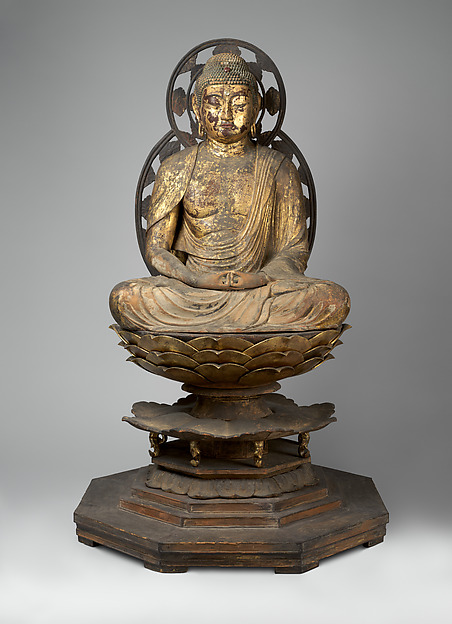
- Title
- Amida, the Buddha of Limitless Light (阿弥陀如来立像)
- Period
- Kamakura period (1185–1333), ca. 1250
- Region
- Japan
- Medium
- Wood with lacquer, gold leaf, and color
- Dimensions
- Figure H. 87.9 × W. 73 × D. 57.8 cm (34 5/8 × 28 3/4 × 22 3/4 in.); overall with pedestal H. 154.9 × W. 99.1 × D. 99.1 cm (61 × 39 × 39 in.)
- Collection
- The Metropolitan Museum of Art
- Accession
-
19.140a-c - Rights
- The Metropolitan Museum of Art (Public Domain / OASC). Rogers Fund, 1919 (19.140a-c).
Met 19.140a-c. Standing Amida in wood with lacquer, gold leaf, and color, c. 1250 — middle Kamakura. The figure performs the raigō-in welcoming-descent mudra (right hand raised, left lowered) and stands on a multi-tier carved lotus pedestal. Acquired through the Rogers Fund in 1919, more than half a century before the Harry G. C. Packard 1975 transformative gift, and one of the earliest Kamakura Pure Land sculptures in any American museum. CC0 / public domain.
A standing Buddha at three-quarter life
The figure stands at eighty-eight centimetres without its pedestal, about the height of a child of seven, set at a height that asks the museum visitor to stand close. The pedestal, when the figure is shown on it, lifts the head to roughly the eye-level of an adult, and the whole installation reads at one hundred and fifty-five centimetres total. The proportion is the Kamakura compromise: sub-life-size for the carved body, life-size for the assembled icon-on-pedestal as the viewer encounters it.
The 87.9 cm figure-height is the smaller of the two principal Kamakura standing-Amida scales. The other is full life-size (roughly 165 cm carved body), used for temple-honzon installations where the figure is the central icon of a Pure Land hall. The sub-life-size scale of Met 19.140 places it in the private-devotion or sub-shrine register rather than the temple-honzon one, close enough that the figure could be a miei (personal devotional image), a side-altar icon, or the central image of a smaller Pure Land hall where the architecture does not call for a temple-honzon-scale work.
The figure’s date (c. 1250, middle Kamakura) sits in the densest decade of Kamakura Pure Land sculptural production. The Jōchō workshop convention had matured into the standing-Amida format roughly two generations earlier; the Kei-school revolution in Kamakura sculpture under Unkei (d. 1223), Kaikei (d. c. 1236), and Tankei (d. 1256) was at its institutional height. The figure does not carry a Kei-school workshop attribution. The Met catalog does not assign one. What it carries is the iconographic and stylistic register of mid-13th-century Pure Land sculpture, which the period’s anonymous output sustains alongside the signed Kei-school masterworks.
The welcoming-descent mudra
The hand-pair is the load-bearing iconographic feature of any standing Amida. Met 19.140’s hands perform the raigō-in (来迎印), the welcoming-descent mudra, in its standard Kamakura configuration: the right hand raised at shoulder level palm-forward, thumb touching index finger; the left hand lowered at hip level palm-forward, thumb touching index finger. The two hands together perform the jōbon-jōshō (上品上生) variant of the Amida mudra system, the highest-grade rebirth gesture from the Nine Grades of Pure Land rebirth taxonomy.
The raigō-in’s iconographic content is precise. Pure Land devotion in late-Heian and Kamakura Japan was anchored doctrinally on the Ōjōyōshū (往生要集) of Genshin (985) and on the Senchaku hongan nenbutsu shū (選択本願念仏集) of Hōnen (1198), and the canonical scene around which the iconography organised itself was the raigō, the descent of Amida and his retinue to welcome the dying person at the moment of death.
A standing Amida performing the raigō-in is not a representation of Amida in his Pure Land seat. It is a representation of Amida in the moment of motion toward the deathbed. The figure is depicted at the instant when the dying person, performing the nenbutsu chant, would be expected to perceive the Buddha’s descent. The hand gesture is the visual equivalent of the moment in which the soul is collected.
This is why the standing-Amida convention emerged in the late-Heian period and dominated Pure Land sculpture from then through the Kamakura: the seated Amida register inherited from the Byōdō-in 1053 Jōchō tradition reads as Amida in the Pure Land; the standing register reads as Amida coming toward the viewer. The shift is doctrinal as well as compositional.
The Met’s three Kamakura Pure Land sculptures
The Met holds three Kamakura sculptures that together form an iconographically complete Amida raigō triad: 19.140 (the standing Amida treated here), 12.134.17 (Kannon Bosatsu, the proper-right attendant), and 12.134.18 (Seishi Bosatsu, the proper-left attendant). The three works do not have a documented temple-installation relationship. They entered the Met across two acquisitions seven years apart, presumably from separate sources, and there is no evidence in the public record that they were originally made for a single hall. They are three Kamakura Pure Land sculptures that happen, when placed together, to perform the triad.
The institutional fact is the more interesting one. The Met currently displays the works separately. The standing Amida is installed in one gallery; the Kannon and Seishi attendants are installed in another. The notional triad is a curatorial reconstruction, not a recovered installation. A visitor walking the Met’s Asian Art floor would meet each of the three works without obvious reference to the others.
The bodhi article on the Met 12.134.17 and 12.134.18 attendant pair treats the two attendants at single-work depth as a pair. The standing Amida treated here is the third element of the iconographic triad the Met holds in pieces. The reader who works through both articles in sequence has the institutional triad in view.
Rogers Fund 1919: pre-Packard Japanese sculpture at the Met
The Rogers Fund accession of 19.140 in 1919 is the larger institutional fact. Rogers (Jacob Rogers, the railroad president who left the Met a major bequest in 1901) funded a substantial fraction of the Met’s early-20th-century Asian Art acquisitions, and the 1919 accession of a Kamakura standing Amida is one of the earlier instances of a Japanese Pure Land sculpture at temple-icon scale entering an American institutional collection.
The acquisition predates the Harry G. C. Packard 1975 gift-and-purchase by more than half a century. Before 1975, the Met’s Japanese sculpture collection was strong but uneven: concentrated in early-Asuka and Hakuhō bronzes (the Pier-era purchases of 1911–1914), Kamakura raigō paintings, and a smaller number of sculpture works of which Met 19.140 was one. The Packard gift, in 1975, brought the Kamakura sculpture register up to the strength of the painting register. The fact that 19.140 was already there in 1919 means that the Met had been working with a Kamakura standing Amida for fifty-six years before it had the Packard sculpture corpus to read it against.
This dating matters for the work’s reception history. The Met catalog text on 19.140 in the pre-Packard period had to construct its readings against a thinner comparandum field than the catalog text of any work that entered after 1975 has had to do. A reader looking at the figure in a 1925 Met gallery would be reading without the surrounding density of Kamakura sculpture that a reader in 1985 had at hand. The work is the same work; the institutional frame around it changed substantially with the Packard accessions.
Reading 19.140 against the Cleveland 1269 standing Amida
The principal named-maker comparandum for Met 19.140 is the Cleveland 1960.197 standing Amida by Kōshun, signed and dated 1269 at Shitennō-ji, Osaka, completed in thirty-three days by a sculptor holding the Hōkkyō rank (the third of the three Buddhist artisanal ranks). The Cleveland work is the same iconographic register as Met 19.140 (standing, raigō-in, sub-life-size) and is dated to within twenty years of the Met’s c. 1250 attribution. Reading the two figures against each other tracks the standing-Amida convention at its mature mid-to-late-Kamakura phase.
The Cleveland work carries its workshop attribution on the figure itself: Kōshun’s inscription, dated and signed inside the hollow body. The Met figure does not. The c. 1250 dating of 19.140 is therefore a stylistic dating, anchored against the Cleveland 1269 as the calibrating signed-and-dated work for the form’s mid-century chronology. Mōri 1974 (on Kei-school Kamakura sculpture chronology) treats the standing-Amida convention as having stabilised by roughly 1240; the Met work sits inside that established convention.
The two works are different at the body-attitude level. The Cleveland figure has a slightly more pronounced contrapposto, and the robe falls in a more sculpturally-articulated drape; the Met figure is more squarely grounded, with the robe falling in a flatter register. Whether this difference is workshop variation, regional difference, or chronological progression across the twenty years between the two works is not resolvable from the available comparanda. The Met catalog has not assigned 19.140 a workshop, and bodhi does not assign one.
What the comparanda do establish: Met 19.140 is the type-piece, not the masterwork. It is a competent mid-Kamakura standing Amida: the production register that filled the side chapels and sub-shrines of Pure Land devotion during the period in which raigō painting reached its mature Kamakura phase and the Kei-school sculptors produced their named-maker temple commissions. The masterworks survive because they are signed; the type-pieces survive because they were durable. Met 19.140 is a survival of the second kind.
What stays open
Four questions sit unresolved in the open record on Met 19.140.
The provenance line back from the Rogers Fund 1919 acquisition to a Japanese temple or family holding is not in the public Met record. The Met catalogue page, which may record it, could not be retrieved when checked on 2026-05-13.
The original installation context (temple-honzon, sub-shrine, private devotional, miei) is not documented. The sub-life-size scale rules out the largest temple-honzon installations and is consistent with sub-shrine and private-devotional contexts. Beyond that, the record is silent.
The workshop attribution is not assigned by the Met catalog and is not assigned here. The figure is stylistically consistent with mid-13th-century Kamakura production. Whether it is Kei-school workshop, In-school workshop, En-school workshop, or unaffiliated provincial workshop is not resolvable from the public catalog text.
The relationship to 12.134.17-18 is not claimed by the Met as a historical installation pairing. The three works form a notional iconographic triad when read together at the Met’s holdings level; reading them as a single original installation is a curatorial reconstruction the Met has not endorsed. The bodhi article reads the three as a notional triad in the institutional sense (Met holdings of the same iconographic programme) and does not extend the claim past that.
What is firm is the figure itself: standing, eighty-eight centimetres, c. 1250, wood with lacquer and gold, the raigō-in performed in its canonical Kamakura form, the figure stepping toward the viewer at the moment of welcoming descent. The institutional history surrounds the work and partly conditions how the work has been read. The iconographic register is its own.
Related
- The 1269 standing Amida by Kōshun (Cleveland 1960.197): the signed and dated comparandum
- Met 12.134.17 & .18: the Kannon and Seishi attendant pair: the iconographic pendant inside the Met holdings
- Amida raigō: the welcoming descent: the iconographic context in the painted register
- Byōdō-in Amida by Jōchō (1053): the canonical Heian image: the seated late-Heian source of the standing Kamakura convention
- Nanbokuchō raigō and the twenty-five bodhisattvas: the next register of raigō iconography, in painting
- Cinerary urn with Amida (Heian, bronze): the Heian Pure Land devotional register in metal
- Kuhon ōjō: the nine grades of rebirth as a diagram
Sources
-
OA API record verified 2026-05-13. The catalogue page could not be retrieved, so no descriptive text from it is used. The provenance line is not given in the public record.
-
The foundational English-language treatment of Kei-school construction, finish technique, and chronological development. pp. 27–58 on the Kei lineage, pp. 138–162 on yosegi-zukuri and kirikane. Cited for the dating logic of mid-13th-century standing Amida figures and the relation to the Jōchō workshop conventions of the late Heian.
-
Origin of joined-block construction in the Heian period and its Kamakura refinement. Cited for the technical scaffolding behind the standing-Amida convention.
-
Kei-school workshop organisation in late 12th–13th century Nara. Provides the chronology of Kei-school standing-Amida iconography against which mid-century Pure Land sculpture without explicit workshop attribution is read.
-
The Met's Kannon-and-Seishi attendant pair, acquired 1912 via the Rogers Fund. Treated at single-work depth in the bodhi article on the 12.134.17-18 pair; the iconographic and institutional pendant to 19.140.
-
The signed and dated 1269 standing Amida at Cleveland — the named-maker comparandum for the Met's c. 1250 anonymous standing Amida. Treated at single-work depth in the bodhi article on Cleveland 1960.197.
-
The canonical late-Heian seated Amida that anchors the iconographic tradition Met 19.140 stands inside. The bodhi article on the Byōdō-in 1053 Amida treats the Jōchō workshop at length; the standing-Amida convention is the Kamakura-period adaptation of the Jōchō register to upright posture.