Cleveland's Nanbokuchō raigō: reading the twenty-five-bodhisattva descent figure by figure
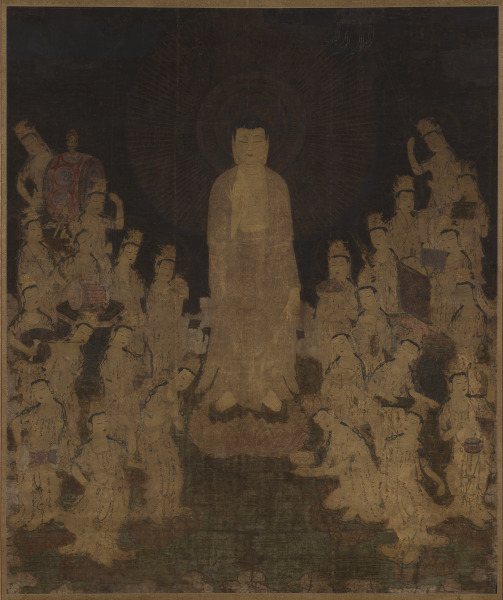
- Title
- Welcoming Descent of Amida with Twenty-Five Bodhisattvas (阿弥陀二十五菩薩来迎図)
- Period
- Nanbokuchō period (1336–92), mid-1300s
- Region
- Japan
- Medium
- Hanging scroll; ink, color, gold, silver, and cut gold on silk
- Dimensions
- Painting 164.5 × 137.7 cm; mounted 255 × 166.6 cm
- Collection
- Cleveland Museum of Art
- Accession
-
2025.138 - Rights
- Cleveland Museum of Art (Public Domain / CC0); Leonard C. Hanna Jr. Fund, 2025.138.
*Welcoming Descent of Amida with Twenty-Five Bodhisattvas* (阿弥陀二十五菩薩来迎図), Japan, Nanbokuchō period (1336–92), mid-1300s. Hanging scroll; ink, color, gold, silver, and cut gold on silk. Painting 164.5 × 137.7 cm; mounted 255 × 166.6 cm. Cleveland Museum of Art, accession 2025.138, Leonard C. Hanna Jr. Fund. Public domain (Cleveland Open Access). Source: clevelandart.org/art/2025.138.
Cleveland’s recently acquired Welcoming Descent of Amida with Twenty-Five Bodhisattvas (acc. 2025.138, mid-1300s) lets every figure in the canonical Nijūgo Bosatsu retinue be read against a single high-resolution Nanbokuchō scroll. The named bodhisattvas, the music they play, the lotus throne Kannon carries, and the deathbed-ritual function the painting served are all here in one frame.
The work
The Cleveland scroll entered the museum’s collection in 2025.1 It is a hanging silk scroll of the Amida Nijūgo Bosatsu Raigōzu (阿弥陀二十五菩薩来迎図) type, the welcoming descent of Amida Nyorai accompanied by the twenty-five bodhisattvas (nijūgo bosatsu) who, by the late Heian period, had been canonised as the named retinue for Pure Land deathbed rites. The painting measures 164.5 × 137.7 cm; mounted, it stands 255 × 166.6 cm. A scroll this height was hung at the head of a bed.
Amida stands at the painting’s centre, full-frontal, body painted in gold over a stable horizontal cloud bank, with concentric red-and-dark radiating rays surrounding his halo. The twenty-five bodhisattvas distribute in a roughly symmetrical mandorla disposition around and below him: the foreground court at the bottom of the silk, the principal flanking attendants at the level of Amida’s body, the rear-band figures stacked above on cloud-tongues. This is the symmetric-iconic (Genshin-mode) descent (frontal, hierarchic, balanced), not the diagonal hayaraigō whose photograph is the genre’s most-travelled image; that distinction is taken up in the comparanda section.
The silk ground is dark and broadly uniform; centuries of incense and altar smoke have darkened the support, with darker passages now most evident along the lower edge. The kirikane (cut-gold) patterning across Amida’s robes and the principal bodhisattvas’ costumes survives in places: narrow gold-leaf strips laid in geometric and floral motifs over the painted ground. Cleveland’s catalog gives the medium as ink, color, gold, silver, and cut gold on silk;1 the silver, oxidised in places, survives in the haloes and in the diaper patterning behind several of the secondary figures.
One bodhisattva at the upper-left carries a small tiered tabernacle structure: the painting’s most idiosyncratic iconographic detail, possibly identifying that figure with one of the “treasury” (蔵) bodhisattvas. No signature, temple seal, or pre-acquisition provenance is published; the dating to mid-1300s rests on the kirikane treatment, the silk weave, and the descent typology discussed below. The work was acquired through the Leonard C. Hanna Jr. Fund and is on view in Gallery 235B.1
A note on count. The catalog title names twenty-five bodhisattvas, and the Jūōjō Amida Bukkokukyō fixes the count at twenty-five. Counting figures on the silk at the resolution publicly available, I distinguish eighteen to twenty distinct attendants, with several smaller bodhisattvas plausibly tucked among the cloud-banks of the upper register or behind the tightly-grouped foreground court. The catalog’s count is the textual reading; whether the painter was canonically faithful or produced a reduced “twenty-five-by-name-twenty-by-figure” composition is not retrievable from the silk alone.
The twenty-five names, and where they come from
The named twenty-five-bodhisattva retinue is not a Genshin invention. The textual source is the Jūōjō Amida Bukkokukyō (十往生阿弥陀仏国経; Sutra on the Ten Forms of Birth in Amida’s Buddha-Land), an apocryphal Chinese sutra that the Heian Pure Land tradition received as canonical and that names the twenty-five bodhisattvas Amida sends to protect the practitioner who calls Amida’s name.2 The Jōdoshū dictionary entry for Nijūgo Bosatsu gives the canonical list in sutra order; the Tendai canon preserves the same list with minor romanisation variants.3 In Hepburn romanisation:
| # | Name | Kanji | Note |
|---|---|---|---|
| 1 | Kanzeon (Kannon) | 観世音 | lotus-throne bearer; Amida’s principal attendant |
| 2 | Daiseishi (Seishi) | 大勢至 | hands in gasshō; Amida’s right attendant |
| 3 | Yakuō | 薬王 | ”Medicine King” |
| 4 | Yakushō | 薬上 | ”Medicine Superior”; brother of Yakuō |
| 5 | Fugen | 普賢 | ”Universal Worthy”; bodhisattva of practice |
| 6 | Hōjizai-ō | 法自在王 | ”Sovereign of the Dharma” |
| 7 | Shishikū | 獅子吼 | ”Lion’s Roar” |
| 8 | Darani | 陀羅尼 | ”Dhāraṇī” |
| 9 | Kokūzō | 虚空蔵 | ”Space-Treasury” |
| 10 | Tokuzō | 徳蔵 | ”Treasury of Virtue” |
| 11 | Hōzō | 宝蔵 | ”Treasury of Jewels”; not Amida’s pre-buddhahood Hōzō (法蔵) |
| 12 | Konzō | 金蔵 | ”Treasury of Gold” |
| 13 | Kongōzō | 金剛蔵 | ”Vajra-Treasury” |
| 14 | Kōmyō-ō | 光明王 | ”Sovereign of Light” |
| 15 | Sankai-e | 山海慧 | ”Wisdom of Mountains and Seas” |
| 16 | Kegon-ō | 華厳王 | ”Sovereign of the Flower Garland” |
| 17 | Shuhō-ō | 衆宝王 | ”Sovereign of Many Jewels” |
| 18 | Gakkō-ō | 月光王 | ”Sovereign of Moonlight” |
| 19 | Nisshō-ō | 日照王 | ”Sovereign of Sunlight” |
| 20 | Sanmai-ō | 三昧王 | ”Sovereign of Samādhi” |
| 21 | Jōjizai-ō | 定自在王 | ”Sovereign of Concentration” |
| 22 | Daijizai-ō | 大自在王 | ”Great Sovereign” |
| 23 | Byakuzō-ō | 白象王 | ”White Elephant King” |
| 24 | Daiitokutoku-ō | 大威徳王 | ”Great Awesome Virtue” |
| 25 | Muhenshin | 無辺身 | ”Boundless Body” |
Three structural patterns hold across the list: the medical pair (Yakuō and Yakushō, borrowed from the Lotus Sutra); the four “treasury” bodhisattvas (Tokuzō, Hōzō, Konzō, Kongōzō, with Kokūzō at one remove); and the run of “sovereign” (王) bodhisattvas, accounting for nine of the twenty-five. Most have no individuating attribute outside this retinue. Within the raigō genre they are distinguished almost entirely by what they are holding: instrument, banner, scarf, lotus, or jewelled platform.
Reading the figures, group by group
The Cleveland painting reads in four functional groups: the same groups that organise every canonical twenty-five-bodhisattva descent.4
The central Amida. Standing, never seated. A standing Amida is a descending Amida; the seated form belongs to sutra-illustration. His hands form the raigō-in (welcoming mudra): the right raised and the left lowered, thumb and forefinger joined on each.
Cleveland’s Amida is in the late-medieval gold-flesh convention, the body painted in yellow-gold pigment over the kirikane robe; by the Nanbokuchō period this had hardened into a workshop standard. The frontal posture, the central placement, and the radiating-ray halo together encode the iconic descent: the descent shown as cosmological event, not as moment in narrative time.
The lotus-throne pair. Kannon and Seishi attend Amida at the principal-flanking level. Kannon holds the lotus platform (renge-za) on which the dying soul will be received; on Cleveland 2025.138 the platform appears in the foreground court rather than carried at Amida’s chest level, a Nanbokuchō re-arrangement consistent with the symmetric-iconic register, where ritual objects are foregrounded for the deathbed viewer. Seishi is the figure with hands in gasshō.
The empty platform is the painting’s most ritual-loaded passage: it awaits the soul the painting was hung to receive. The empty seat is for the viewer.
The musicians. A canonical late-Heian or Kamakura raigō shows a substantial subset of the bodhisattvas playing the biwa (four-stringed lute), the shō (mouth-organ), the yokobue (transverse flute), the taiko (drum), and small cymbals. Okazaki and ten Grotenhuis count this as the iconographic feature that distinguishes Pure Land painting from every other Japanese Buddhist genre: this is the only canonical surface on which named bodhisattvas play instruments.5
On Cleveland 2025.138 the music-makers cluster in the middle and rear bands of the symmetrical assembly rather than streaming forward in two flanking columns the way they do on the Chion-in hayaraigō. The biwa-player is identifiable by the tilted lute and the visible plectrum-arm; a shō appears as a cluster of vertical pipes. By the Nanbokuchō period the instruments are drawn smaller and more emblematically than in their Heian originals, but the canonical inventory is preserved.
Bo Lawergren’s survey of medieval raigō counts fourteen instruments at Chion-in and fifteen at the Kōyasan Reihōkan triptych; Cleveland 2025.138 sits within that range, though precise counting at the publicly available image resolution is not possible.
The court at the cloud edge. The foreground bodhisattvas at the lower edge of the assembly are the welcomers proper, in the canonical ordering closest to the deathbed viewer. The rear-band figures (painted slightly higher in the picture plane and slightly smaller) fill the assembly’s depth.
The upper-left bodhisattva carrying the small tiered tabernacle structure is the painting’s idiosyncratic figure; the iconographic literature on attribute identifications across raigō scrolls (Lawergren on the Met cartouche raigō, where bodhisattvas are explicitly labeled) suggests this attribute most likely belongs to one of the “treasury” (蔵) bodhisattvas: Hōzō (宝蔵, “Treasury of Jewels”), Konzō (金蔵, “Treasury of Gold”), or Kongōzō (金剛蔵, “Vajra-Treasury”). Without cartouches the assignment is conjectural.
What hung above the bed: the deathbed function
The raigō-zu was not in the first instance a meditation aid. It was a piece of ritual equipment.
Genshin (源信, 942–1017) is the author of the Ōjōyōshū (往生要集; Essentials of Birth in the Pure Land, 985), the foundational Japanese Pure Land manual.6 In 986, the year after he completed it, Genshin and twenty-four fellow monks at Yokawa on Mt. Hiei founded the Nijūgo Zanmai-e, the Twenty-five Samādhi Society: a fellowship that bound its members to nenbutsu practice and to attending one another at death.7 The fellowship is named after the twenty-five samādhis enumerated in the Nirvana Sutra, but the resonance with the twenty-five bodhisattvas of the Jūōjō sutra is structural to the Heian Pure Land imagination of how a person dies well.
The deathbed protocol the Ōjōyōshū and the Nijūgo Zanmai-e helped fix, the rinjū gyōgi (臨終行儀; “deathbed comportment”), is the practical context for the raigō-zu. Stone, in Death and the Afterlife in Japanese Buddhism, reconstructs it from the surviving rinjū gyōgi manuals: the dying person was placed facing west; a raigō-zu was hung above the bed so Amida’s descent met them at the right angle of view; a five-coloured thread was tied between the painted hand of Amida and the hand of the dying devotee, so that “the practitioner could be drawn into the Pure Land along the thread.”8 The thread was the literal mechanism. The painting was the topology that made the thread make sense.
The Cleveland scroll’s height (164.5 cm in the painting field, 255 cm mounted) is the deathbed height. From the floor of a tatami room, a scroll at this size hangs Amida’s face at the eye level of a person lying flat with their head propped, and Kannon’s empty lotus platform at the level of the chest. The painting was made for one viewer in one position. The position was the deathbed.
Comparanda: standard vs. rapid descent, and three Cleveland sister works
The single most-cited canonical example of the genre is the Amida Nijūgo Bosatsu Raigōzu held jointly by Chion-in and the Kyoto National Museum, conventionally called the haya-raigō (早来迎; “rapid descent”).9 National Treasure (designated 1955-02-02, no. 113), late Kamakura, 14th century, on silk, 145.1 × 154.5 cm: slightly smaller than Cleveland’s painting and nearly square in format. The Chion-in cloud bank rushes diagonally from upper-left to lower-right across steep Yamato-e mountains, with cherry blossoms and a tiny figure of the dying nenbutsu-chanter in the lower-right corner; the figures lean forward and the clouds drag tails of wind behind them.
Cleveland’s painting is the standard (not rapid) descent. The figures are arrayed in a more frontal, hierarchically composed group; the cloud bank descends but does not rush; the mountain landscape is largely absent.
Okazaki argues that the rapid-descent type is a 13th-century formal innovation specifically of Kamakura-period Yamato-e workshop circles, while the standard descent is the older Heian inheritance preserving Amida frontal and the bodhisattvas symmetrically grouped.4 The Cleveland scroll, mid-1300s, sits in the Nanbokuchō continuation of the standard type: late, but conservative.
The standard-type painting most often compared with Cleveland 2025.138 in the secondary literature is the Konkai-Kōmyō-ji (金戒光明寺) raigō at Kyoto, an early Kamakura silk; the Kōya-san painted set, Heian rather than Kamakura, sits behind both as the older textual ancestor. Mōri’s Sculpture of the Kamakura Period treats raigō painting only at the margins of his sculpture-focused argument, but the post-Tōdai-ji-fire workshop chronology he sets out for sculpture is the same chronology the painting record traces.10
Three other Pure Land descent paintings in Cleveland’s collection read informatively against 2025.138:
- Cleveland 1953.123, Welcoming Descent of Amida (Amida Raigō), Kamakura period, c. 1300–1333; hanging scroll, ink, color and gold on silk, 171.8 × 84.5 cm.11 The older Cleveland raigō. Its Japanese title (阿弥陀二十五菩薩来迎図) names the same canonical twenty-five-bodhisattva configuration, but the visible figure count at publicly available image resolution is closer to seventeen-to-eighteen: the same count-vs-figures-visible question as 2025.138, which is endemic to small-scale published images of 25-bodhisattva paintings rather than evidence of a reduced-court variant. Format is taller (single-column hanging scroll) where 2025.138 is broader.
- Cleveland 1993.42, Welcoming Descent of Amida Buddha (Raigō), Kamakura period, c. 1270–1333; hanging scroll, ink, color, gold and cut gold on silk, 95.3 × 46.6 cm.12 A single-Amida descent on a dark blue ground, with no bodhisattva retinue at all: the welcoming mudra and the standing pose preserved, the named retinue (and the deathbed-ritual structure it carries) lost. The portable late-medieval form.
- Cleveland 1966.513, Embroidered Welcoming Descent of Amida Triad, Muromachi period, 1400s; hanging scroll, silk and human-hair embroidery, 109.1 × 37.2 cm.13 The triad form: Amida and two attendants only (Kannon and Seishi). The use of human hair in the embroidery places the work in the devotional tradition where a relative’s hair was incorporated into the image of the figure who would receive the dying soul. What the painted raigō handles iconographically, the embroidered raigō handles materially.
Read across the four sheets, the late-medieval Pure Land descent contracts: from the full canonical twenty-five-bodhisattva court (2025.138), to the abbreviated-court raigō (1953.123), to the single-figure Amida (1993.42), to the embroidered triad (1966.513). The 2025.138 scroll is the one in which the full court is named, even where (as on the silk at the resolution publicly available) some of those names are hidden in cloud-banks.
What stays unverified
Three substantive questions remain open:
The painter, the workshop, and the temple of origin. No signature, no temple seal, no pre-acquisition provenance is published. The mid-1300s dating rests on internal evidence (kirikane patterning, silk weave, descent typology). A high-resolution conservation analysis would tighten the dating window and might yield workshop indicators; the underdrawing visible in the Chion-in hayaraigō after the Tsumugu Project (2019–2022) is the kind of evidence Cleveland 2025.138 would benefit from but which has not been publicly released.
The figure count. The catalog title and the Jūōjō sutra both fix twenty-five. Counting figures on the silk at publicly available resolution yields eighteen-to-twenty distinct attendants. The most likely reading is that smaller bodhisattvas are tucked among the cloud-banks of the upper register or behind the foreground court; resolving this requires a higher-resolution scan or in-person inspection in Gallery 235B.
The upper-left tabernacle-bearer. The most idiosyncratic figure on the painting carries a small tiered tabernacle structure. Without cartouches, the assignment to a specific named bodhisattva is conjectural. The “treasury” (蔵) bodhisattvas (Hōzō, Konzō, Kongōzō, Tokuzō, Kokūzō) are the most likely candidates iconographically, but no two surviving raigō scrolls assign attributes the same way. The Met cartouche raigō (acc. 45249, late 14th c.), where bodhisattvas are explicitly labeled, gives a comparison set; a cross-comparison of attributes across the Met, Chion-in, Kōyasan, and Cleveland scrolls is the project that would settle this.
Related
- The solo Amida raigō — the welcoming descent reduced to one figure
- A Kamakura Amida triad in Sanskrit syllables, embroidered in human hair
- Gōshō mandara — Amida receives a warrior’s soul, c. 1300
- Amida raigō: the welcoming descent, read panel-by-panel
Footnotes
-
Cleveland Museum of Art, accession 2025.138 catalog page (clevelandart.org/art/2025.138); credit line, dimensions, materials, gallery, and license terms taken verbatim (accessed 2026-04-26). ↩ ↩2 ↩3
-
Jūōjō Amida Bukkokukyō (十往生阿弥陀仏国経): apocryphal Chinese sutra in which the named twenty-five bodhisattvas are dispatched by Amida to protect the nenbutsu practitioner at death; the source the Jōdoshū dictionary cites for the canonical list. ↩
-
Shinsan Jōdoshū Daijiten, entry 二十五菩薩 (Nijūgo Bosatsu): the twenty-five bodhisattvas, drawn from the Jūōjō Amida Bukkokukyō, sent by Amida to protect the practitioner at the moment of death. The Tendai canonical list (tendai.or.jp houwashū entry 136) gives the same names with one variant: Yakushō (薬上) rather than the Jōdoshū Yakujō in the fourth slot. ↩
-
Jōji Okazaki, Pure Land Buddhist Painting, trans. Elizabeth ten Grotenhuis (Tokyo: Kodansha International / Shibundō, 1977), pp. 92–145 on the chronology and the standard-vs-rapid descent recensions; pp. 117–122 specifically on the named twenty-five-bodhisattva paintings as a sub-genre. ↩ ↩2
-
Okazaki / ten Grotenhuis (1977), pp. 124–128, treating the bodhisattva-as-musician iconography as the diagnostic feature of the genre, tracing it back to the Mt. Kōya 11th-century Heian raigō set. ↩
-
Robert F. Rhodes, Genshin’s Ōjōyōshū and the Construction of Pure Land Discourse in Heian Japan (Honolulu: University of Hawai’i Press, 2017): the standard modern English-language monograph on the Ōjōyōshū and on Genshin’s Yokawa context. ↩
-
Jacqueline I. Stone, “With the Help of ‘Good Friends’: Deathbed Ritual Practices in Early Medieval Japan,” in Stone and Mariko Namba Walter, eds., Death and the Afterlife in Japanese Buddhism (Honolulu: University of Hawai’i Press, 2008), pp. 61–101: on the founding of the Nijūgo Zanmai-e in 986 and on the rinjū gyōgi deathbed protocol the fellowship helped fix. ↩
-
Stone, “With the Help of ‘Good Friends’,” pp. 84–87, on the five-coloured thread tied between the painted hand of Amida and the hand of the dying devotee; the protocol is also reproduced in Genshin’s Ōjōyōshū. ↩
-
Kyoto National Museum masterpieces page, Amida Nijūgo Bosatsu Raigōzu (haya-raigō) held jointly by Chion-in and KNM. National Treasure designation 1955-02-02, no. 113; conservation Spring 2019 to March 2022 (Tsumugu Project) revealed the underdrawing and the kirikane programme. ↩
-
Mōri Hisashi, Sculpture of the Kamakura Period, trans. Katherine Eickmann (Heibonsha Survey of Japanese Art, vol. 11; New York: Weatherhill, 1974); the post-Tōdai-ji-fire workshop chronology Mōri sets out for sculpture parallels the late-Kamakura-into-Nanbokuchō painting record. ↩
-
Cleveland Museum of Art, accession 1953.123, Welcoming Descent of Amida (Amida Raigō), Kamakura period, c. 1300–1333; ink, color and gold on silk; 171.8 × 84.5 cm. John L. Severance Fund. Public domain. ↩
-
Cleveland Museum of Art, accession 1993.42, Welcoming Descent of Amida Buddha (Raigō), Kamakura period, c. 1270–1333; ink, color, gold and cut gold on silk; 95.3 × 46.6 cm. Mr. and Mrs. William H. Marlatt Fund. Public domain. ↩
-
Cleveland Museum of Art, accession 1966.513, Embroidered Welcoming Descent of Amida Triad, Muromachi period, 1400s; silk and human-hair embroidery; 109.1 × 37.2 cm. Public domain. ↩
Sources
-
Apocryphal Chinese sutra; the textual locus for the named twenty-five-bodhisattva retinue assigned to protect the Amida-devotee at the moment of death.
-
[13]— in Medieval Sacred Chant: from Japan to Portugal (open-access PDF, Hunter College CUNY) print referenceStanding taxonomy of symmetric-iconic (Genshin-mode) vs. rapid-descent (hayaraigō) modes; instrument-counts at Kōyasan triptych (15), Byōdōin Phoenix Hall (28 of 52 figures), Chion-in (14), and the Met cartouche raigō (acc. 45249, late 14th c., labeled bodhisattvas).