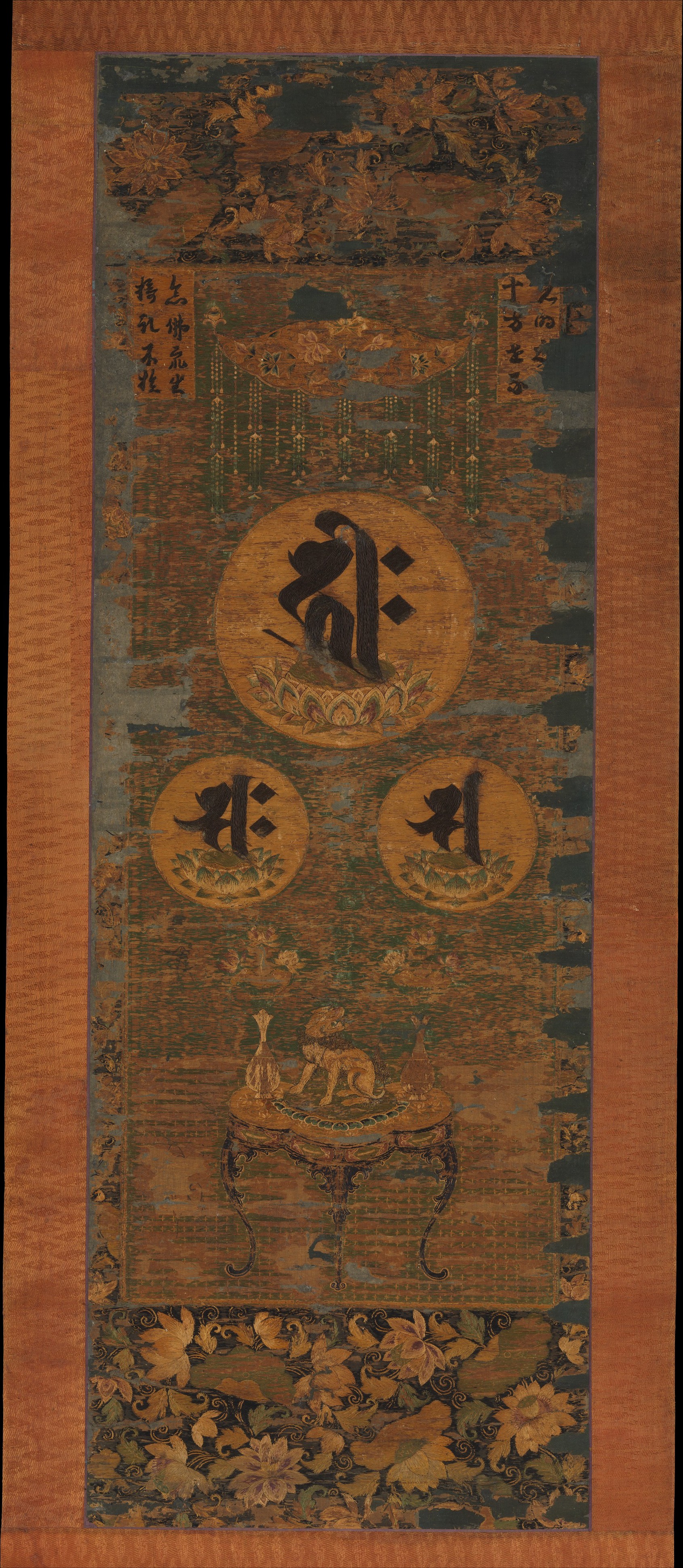
A Kamakura Amida triad in Sanskrit syllables, embroidered with human hair
- Title
- Amida Triad in the Form of Sacred Sanskrit Syllables
- Period
- Kamakura period (1185–1333), 13th century
- Region
- Japan
- Medium
- Hanging scroll; silk embroidery, gold-wrapped thread, and human hair
- Dimensions
- Image 114 × 38.7 cm; overall with mounting 165.7 × 52.1 cm
- Collection
- The Metropolitan Museum of Art
- Accession
-
1975.268.22 - Rights
- The Metropolitan Museum of Art, OASC (CC0 public domain). The Harry G. C. Packard Collection of Asian Art, Gift of Harry G. C. Packard, and Purchase, Fletcher, Rogers, Harris Brisbane Dick, and Louis V. Bell Funds, Joseph Pulitzer Bequest, and The Annenberg Fund Inc. Gift, 1975 (acc. 1975.268.22)
Amida Triad in the Form of Sacred Sanskrit Syllables. Japan, Kamakura period, 13th century. Hanging scroll; silk embroidery, gold-wrapped thread, and human hair. Image 114 × 38.7 cm; overall with mounting 165.7 × 52.1 cm. The Metropolitan Museum of Art, The Harry G. C. Packard Collection of Asian Art, Gift of Harry G. C. Packard, and Purchase, Fletcher, Rogers, Harris Brisbane Dick, and Louis V. Bell Funds, Joseph Pulitzer Bequest, and The Annenberg Fund Inc. Gift, 1975, acc. 1975.268.22. CC0 / public domain.
A small embroidery, on the deathbed
The figure of Amida is not in this scroll. Neither is Kannon. Neither is Seishi. What is here are three Sanskrit seed-syllables (bonji 梵字) stitched in human hair and gold-wrapped thread onto a dark silk ground, each riding a lotus pedestal, arranged in the triad register of an Amida raigōzu. Below them: a small altar, a flower vase, an incense burner in the shape of a crouching lion.
The scale is intimate. Image dimensions are 114 × 38.7 cm, about the height of a chair, the width of a hand-span. This is not a temple banner. It is an object for one person at one moment, and the moment is the deathbed.
In Kamakura Pure Land devotion the dying lay person held a five-coloured cord tied to the hand of an Amida image, and the raigō (the welcoming descent of the Buddha to the deathbed) was visualised in the final hours. A standard raigō painting needed a wall and a stand. An embroidery this size could be unrolled at the bedside and rolled away again. The bonji form compresses further: three syllables and an altar, complete iconography, portable.
The triad in syllables: hríh, sa, saḥ
The substitution is doctrinal, not aesthetic. In the esoteric Buddhist mantra system imported from Tang China, every Buddha and bodhisattva has a shuji 種子 (seed-syllable) that is held to be the deity, not depict it. Visualising the syllable, or chanting the syllable, is held to be soteriologically equivalent to visualising or invoking the figure.
In Met 1975.268.22, hríh sits at top centre, on a larger pedestal: this is Amida. Below and flanking, sa and saḥ ride two smaller pedestals: Kannon to the proper right, Seishi to the proper left. The compositional logic is the standard frontal triad. What has been removed is anthropomorphic representation. What is left is the syllable that is the figure.
This is not a Pure-Land idiosyncrasy. It is the visual grammar of esoteric Buddhism: the Shingon and Tendai schools, which by the late Heian period had absorbed Pure Land thought into their ritual system. Bonji substitute for figures throughout this register: in Godai Myōō mandalas, in stūpa inscriptions, in Ninnōkyō ritual diagrams. By the 13th century the syllable-as-deity convention was old, widely understood, and ritually authorised.
Why human hair, not silk
The third material in this scroll is what makes it strange.
The Met catalog names it: silk embroidery, gold-wrapped thread, and human hair. The hair is stitched into the bonji themselves (into the strokes of hríh, sa, saḥ) using a basic backstitch on the silk ground. Looked at closely, the syllables are not gold alone; they are gold-and-hair, the hair giving texture and a slight darker tone alongside the metallic thread.
The practice has a documented origin in late-Heian and early-Kamakura mourning ritual. In the Gyokuyō 玉葉, the diary of the regent Kujō Kanezane (1149–1207), there are two entries from spring 1188 that record what may be the earliest textual references to hair embroidery. Kanezane’s first-born son Fujiwara no Yoshimichi (1167–1188) collapsed and died on the nineteenth day of the second month, aged twenty-one. The monks attending his deathbed performed the tonsure (teihatsu 剃髪) and shaved his head, a step in preparing the body for the funeral and an inscription of his renunciation. The hair from that tonsure was kept.
Forty-one days later, on the second day of the fourth month, the Gyokuyō records that Yoshimichi’s hair was stitched into the lotus pedestal of the central figure of an embroidered Shaka sanzon (Śākyamuni triad). Fifty-six days after that, on the twenty-ninth day of the fifth month, Yoshimichi’s aunt Hachijōin (1137–1211) stitched another portion of his hair into a freestanding hríh seed-syllable: the syllable of Amida. The dates are not arbitrary. The forty-ninth-day and one-hundredth-day memorial services were the two ritual hinges of the Buddhist mortuary calendar, the moments at which the rebirth-fate of the deceased was held to be decided. The hair was prepared, deliberately, for those two services.
Hōjō Masako (1157–1225), widow of Minamoto no Yoritomo, did the same thing twelve years later. On the thirteenth day of the first month of 1200, Azuma kagami records that Masako stitched her own ritually trimmed hair into a seed-syllable embroidery, dedicated for the one-year memorial of her husband. The practice is documented across imperial-court, monastic, and warrior elites in the late-12th and 13th centuries, then runs into the Nanbokuchō and Muromachi periods as a continuing genre.
Met 1975.268.22 belongs to this register. It is not a pious abstraction. It is a portable mortuary technology in which the hair of the deceased, or of the bereaved, has been worked into the very strokes of the syllables that name Amida and his escorts.
Hair embroidery as a Kamakura mortuary register
The medium does something specific that paint cannot do. Hair carries the identity of the body it came from: its somatic signature, in Halle O’Neal’s reading of palimpsest mourning practice. By stitching that hair into a Sanskrit seed-syllable, the bereaved performed a material identification between the body of the deceased and the body of the Buddha. The syllable was not a memorial picture of Amida. It was Amida, partly made of the deceased.
The Cleveland Museum holds a 15th-century figural counterpart in the same medium: Cleveland 1966.513, Embroidered Welcoming Descent of Amida Triad, 109.1 × 37.2 cm, hanging scroll, silk and human hair embroidery. The Cleveland scroll depicts the triad figurally (Amida flanked by Kannon and Seishi descending on clouds, with a monk-woman-child donor group below) but uses the same human-hair register. Together with Met 1975.268.22 the two objects bracket a long genre: bonji substitution at the 13th-century end, figural raigō at the 15th-century end, hair embroidery as the continuous technical thread.
Mujū Ichien on bonji kudoku
The doctrinal text that most directly supports the practice is in the Zōtanshū 雑談集 (Casual Digressions), completed in 1305 by Mujū Ichien (1226–1312). Mujū was a Rinzai-affiliated monk who had also studied Ritsu, Pure Land, and Shingon, and who preached across sectarian lines from his rural temple in Owari Province.
Fascicle ten of the Zōtanshū is titled Bonji kudoku no koto 梵字功徳ノ事 — Concerning the Merit of Sanskrit Seed-Syllables. In it Mujū writes that bonji are the language of the heavenly realm, that contemplating the seed-syllable A (the ajikan practice central to Tendai esoteric meditation) reveals “true forms as they are” (jissō 實相), and, explicitly, that chanting the hríh seed-syllable of Amida allows one to attain rebirth in the Pure Land. He further argues, in language that Wargula 2024 reads as the doctrinal frame for hair embroidery, that stitching one’s hair into a Sanskrit syllable destabilises and transforms personal identity in this life and the next, enabling the practitioner to realise sokushin jōbutsu 即身成仏: Buddhahood in this very body.
The Met scroll predates the Zōtanshū by perhaps fifty to a hundred years, depending on where in the 13th century one places it. But Mujū is not inventing the doctrine. He is documenting a practice that the Gyokuyō shows already in force a hundred and seventeen years earlier, in 1188.
Embroidery, painting, sculpture: the substitution chain
Bonji substitution moves across media in the Kamakura period. The Met itself holds a companion: 12.134.15, Monju Bosatsu with Eight Sacred Sanskrit Syllables, a Nanbokuchō (14th-c.) hanging scroll, ink and colour on silk, in which Monju rides a lion surrounded by the eight syllables of the Hachiji Monju mantra. There the syllables and the figure coexist: anthropomorphic representation has not been suppressed, only supplemented.
In Met 1975.268.22 the suppression is complete. The bonji are the iconography. The reason this is doable, ritually, is that by the 13th century the doctrinal equivalence (syllable is deity) was secure enough to bear the load. The reason it is desirable is that the bonji form, especially in the hair-embroidered medium, performed mortuary work the figural form could not.
Harry G. C. Packard and the 1975 acquisition
The Met acquired the scroll from Harry G. C. Packard (1914–1991) in 1975, as one element of a transformative gift-and-purchase agreement that brought more than four hundred Japanese objects into the collection. Packard was an American collector-dealer based in Kyoto, active from the 1950s through the 1970s. He moved repeatedly between Japan and the United States, selling works in New York to fund further acquisition in Japan, and built a collection that, unusually, spanned the full chronological range of Japanese art, from Neolithic earthenware through 19th-century painting.
The 1975 acquisition is the moment the Met’s Japanese collection becomes encyclopedic. Before Packard, the Met had a strong but uneven set of holdings dominated by Pier-era buying (1911–14) and Rogers Fund purchases. After 1975, the Met held a collection of the kind that until then existed only in Tokyo and Kyoto institutional contexts. The Packard Collection Charitable Trust later (1977) endowed the Metropolitan Center for Far Eastern Art Studies in Kyoto, which still operates.
Met 1975.268.22 is one of the smaller, quieter objects in the 1975 group. It does not carry the visual force of the Amida 1269 standing sculpture corpus or the great Packard-era handscrolls. But within the corpus of 13th-century mortuary embroideries (a small surviving body, concentrated in Japanese temple holdings) it is one of the strongest objects in any Western museum.
Where this scroll sits in the corpus
The Met’s Kamakura Pure Land holdings are concentrated, after the 1975 Packard influx, in three registers:
- Sculpture: the Amida 1269 standing figure, and the workshop-anonymous attendant pairs (Met 12.134.17 & .18).
- Painting: the figural raigōzu corpus, especially the Burke-collection works that entered in 2015.
- Textile / embroidery: Met 1975.268.22, the only bonji hair-embroidery of its date in the collection, and a small cluster of 14th- and 15th-century figural embroideries.
Each register handles the Pure Land deathbed scenario differently. The standing Amida is the visualised welcoming figure made object. The figural raigōzu is the welcoming scene made image. The bonji hair-embroidery is the welcoming-by-name made portable, with the body of the deceased stitched into the name.
What stays open
-
The maker. Whether the needleworker was a temple nun, a family member, or a commissioned secular embroiderer is not in the Met record. The basic backstitch is achievable by a novice; the design is workshop-conventional. The question of who-stitched-what is unresolved for this scroll.
-
The specific commission. Whose hair is in these syllables, for whose death, in which year between 1200 and 1299, is not in the public record. The Packard acquisition file may carry partial information.
-
The hair attribution itself. Wargula notes that no scientific testing has been conducted on hair-embroidered images of this type (including the Tokugawa Art Museum’s 14th-century triad) to confirm whether the dark thread is in fact human hair rather than darkened silk. The Met catalog reads it as hair; the reading is consistent with the documented genre.
-
The pre-Packard provenance. The scroll was in Packard’s Kyoto holdings before 1975. The chain back from Packard to a Japanese temple or family is not in the public record.
-
The bonji-versus-figural ratio. What fraction of surviving 13th-century Kamakura hair embroideries are bonji versus figural is not, to bodhi’s knowledge, quantified in the secondary literature. Tokugawa, Cleveland 1966.513, and the Chion-in / Zenrin-ji holdings are figural; Met 1975.268.22 and the Hachijōin 1188 hríh syllable are bonji. The genre may be bifurcated by region or by patron-class in ways not yet read.
Related
- Amida raigō: the welcoming descent
- Nanbokuchō raigō and the twenty-five bodhisattvas
- The Two Rivers and the White Path: a Pure Land parable
- Met 19.140a-c: the 1269 standing Amida
- Cinerary urn with Amida: Heian Pure Land bronze
- Met 2019.418.1: a Hachiji Monju in gilt bronze
- Cleveland 1987.39: a Heian Ninnōkyō zuzō
- The Thirteen Buddhas memorial mandala