A late-Heian bosatsu-men at Cleveland: 1950.581 and the procession across the bridge
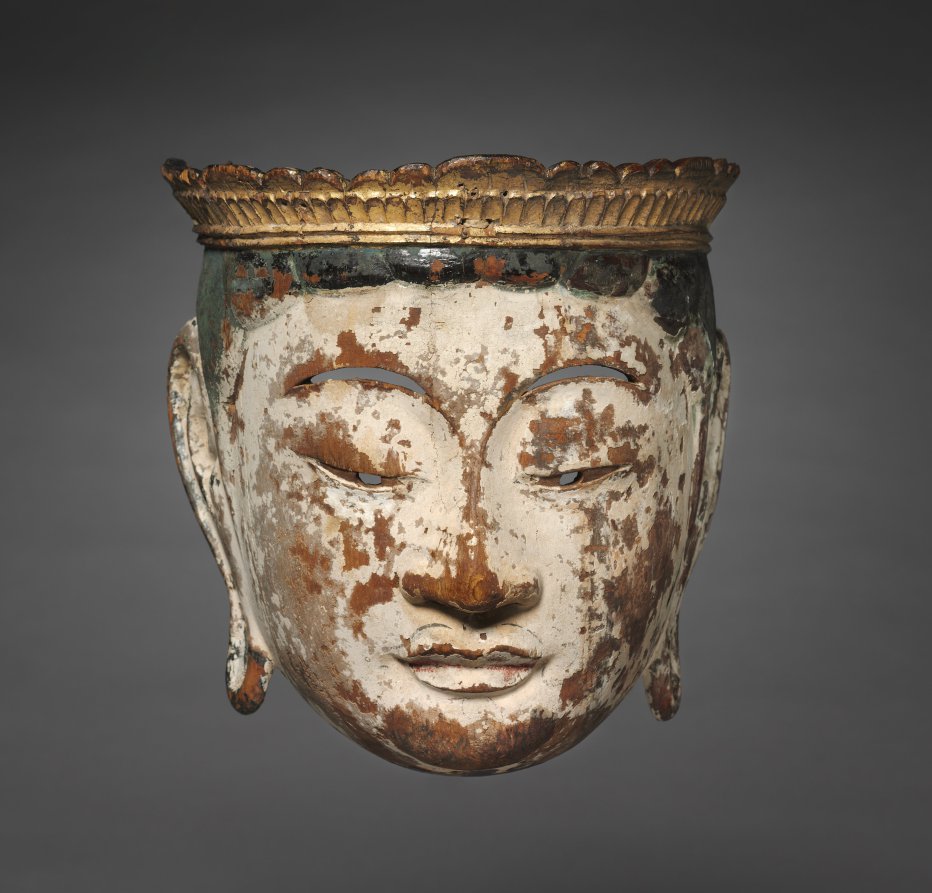
- Title
- Processional Mask of a Bodhisattva (行道面・菩薩)
- Period
- Japan, Heian period (794–1185), late 1100s
- Region
- Japan
- Medium
- Wood, lacquered and painted
- Collection
- Cleveland Museum of Art
- Accession
-
1950.581 - Rights
- CC0 (Cleveland Open Access). John L. Severance Fund.
Cleveland 1950.581: Processional Mask of a Bodhisattva (行道面・菩薩). Wood, lacquered and painted; Japan, Heian period (794–1185), late 1100s; 22 × 16 cm. John L. Severance Fund. CC0 (Cleveland Open Access).
Cleveland 1950.581 is a 22 by 16 cm late-Heian face-mask of a bodhisattva, carved in wood, lacquered, and painted: white skin, narrow downcast eyes, golden petaled crown, dark scalloped hair. The mask was worn by a priest in the nijūgo bosatsu raigō-e, a procession across an elevated bridge that re-enacts Amida’s descent to receive a dying soul. The ceremony continues annually at Taima-dera and Sokujō-in.
What the photograph shows
The mask is a face-only piece, 22 cm tall and 16 cm wide, carved to cover the priest’s face from hairline to chin without extending over the crown of the skull or down to the collarbone. The proportions are head-to-life-scale: a face roughly the size of an adult’s, fitted at the perimeter to a silk hood that, in use, would have covered the back of the head, the neck, and the costume below.1
The carving is a single block of wood on the photograph’s evidence; whether it is the standard hinoki (Japanese cypress) of the Heian sculptural establishment or an alternative cannot be confirmed from the catalog text. The medium field reads “wood, lacquered and painted,” which records the surface programme without specifying the species or the construction.
The face is oval, narrowing slightly toward the chin. The skin is painted white over the reddish-brown wood ground beneath; the white pigment is most plausibly gofun (胡粉, calcium-carbonate from crushed shell suspended in animal-glue binder), the canonical white ground of the Heian and post-Heian polychromy menu.
The white surface has worn through across the forehead and the cheeks to the wood beneath, and the wood grain reads through the residual paint. The forehead is high and clear; the brows arch in two long, painted strokes that begin near the bridge of the nose and extend outward; the nose is straight and narrow.
The eyes are the iconographic centre of the mask, and their treatment is the type’s signature. They are narrow horizontal apertures cut through the wood: open slits, not painted closed ones. The lid above each aperture is modelled in low relief into the carving so that the rim of the opening reads as a half-closed bodhisattva eye, but the aperture itself is the priest’s sight-hole.
This is the working economy of a mask in use — the iconographic register the audience reads (downcast, almost-closed, inward-turned) is achieved through carving and angle, while the priest behind the mask sees out through the same opening. The downcast effect comes from the angle of the slit and the relief above it, addressed to a viewer seated below the bridge or standing at ground level beneath a procession-platform.
A bosatsu-mask reads the priest’s face as serene and inward-turned, distinct from the wide-eyed wrathful or animated registers of the gigaku and bugaku mask traditions that the same period also produced.2 The mouth is small and slightly parted, with red lip-pigment surviving on the modelled lips, and a faint lift at the corners that approaches but does not reach a smile.
The crown is the second iconographic marker. A golden band sits at the hairline, shaped at the upper edge into a row of small petals or leaf-tips, the canonical short-form of the bodhisattva hōkan (宝冠, jewelled crown) reduced to a face-mask’s available surface.
The hair behind the crown is painted dark, scalloped at the lower edge into the wave-pattern that bodhisattva iconography uses for the strands falling behind the ear. The earlobes are elongated, modelled in low relief and angling downward toward the rounded chin: the short-form of the canonical Buddha and bodhisattva long-ear convention, accommodated to the smaller scale of the procession mask.
Two condition notes read at the photograph’s resolution. The white paint surface is worn back across the forehead and the cheeks, exposing the reddish-brown ground; the wear is even, suggesting long use rather than a single damaging event. A faint dark green-grey band reads at the brow-line beneath the crown, where the hair-pigment and the skin-pigment originally met; whether this is residual original paint or a later darkening of the lacquer ground is not specified by the catalog.
The perimeter of the mask is intact at the resolution available; the cord-mounting hardware that, in use, would have secured the mask to a silk hood (typically small holes drilled at temple, jaw, and crown points) is not visible at the front-facing photograph’s angle. A back-of-mask photograph or a Cleveland conservation report would resolve the mounting question.
Genshin, the Twenty-Five Samadhis, and the descent that the mask enacts
The mask was made for a ceremony, and the ceremony has a textual ground. The conceptual seed is in the Ōjōyōshū (往生要集, “Collection of the Essentials for Birth in the Pure Land”), completed by the Tendai monk Genshin (源信, also Eshin Sōzu, 942–1017) in 985 at Yokawa on Mount Hiei.3 The text systematizes the doctrinal and practical foundation for nenbutsu-based devotion to Amida.
The “Ten Joys” (Jūraku, 十楽) chapter describes the welcoming descent (raigō, 来迎) of Amida and his attendant bodhisattvas to receive the soul of the dying nenbutsu practitioner: the cloud-borne procession enters the room, Kannon carries a lotus throne to receive the soul, Seishi attends, and the larger bodhisattva retinue accompanies the descent.
The institutional seed is in the Nijūgo Zanmaie (二十五三昧会, “Twenty-Five Samadhis Society”), a fellowship Genshin organized in 986 with twenty-four other Yokawa monks for coordinated nenbutsu practice and mutual deathbed care.4 The fellowship’s vow committed each member to attend the others at the moment of death, sustain the nenbutsu chant through the dying transition, and read the welcoming-descent passages aloud as the raigō arrived.
The number twenty-five carried the canonical weight of the vow’s signatories; in the iconographic genealogy that the next century elaborated, the twenty-five became the twenty-five bodhisattvas that accompany Amida in the descent (the Nijūgo Bosatsu, 二十五菩薩), with the canonical roster fixed by the late Heian and post-Heian ritual literature.
The pictorial form developed first. The late-Heian raigōzu painting tradition produced the high-prestige court Pure Land works: the standard Amida and bodhisattva-retinue descent (the principal subject of the Cleveland 1953.123 raigō and a long surviving cluster at the Met, the Cleveland holdings, the Princeton collection, the Mt. Kōya Reihōkan, the Konkai-Kōmyō-ji, and the Chion-in), and the haya-raigō (早来迎, “swift descent”) sub-type developed in the Kamakura period.
The procession reenactment is a parallel development: the live performance of the same descent that the painting freezes, with the priests masked and costumed as the figures of the painted retinue and the procession route built across an elevated bridge between two halls representing the present world and the Pure Land.5
The textual genealogy is straightforward to summarize and harder to date precisely. The Ōjōyōshū describes the descent. The Nijūgo Zanmaie institutionalizes the twenty-five-fellowship. The eleventh- and twelfth-century court Pure Land programmes elaborate the iconography in painting.
By the late eleventh and twelfth centuries the procession reenactment is documented at the major Pure Land-aligned temples; the Tōdai-ji 1086 mask is the earliest dated bosatsu-men in the surviving corpus, and the Hōryū-ji set of ten dated 1138 is the earliest dated programmatic survival. The Cleveland mask’s late-1100s dating places it in the second half of the twelfth century, in the period when the procession ceremony had become an established institutional fixture at the principal Pure Land temples.
The surviving mask corpus: Tōdai-ji, Hōryū-ji, Sokujō-in, Taima-dera
The bosatsu-men corpus survives in two registers: the dated examples held at named temples, and the undocumented examples now in museum collections. Both registers bracket the Cleveland mask’s late-1100s dating window.
Tōdai-ji holds the earliest dated bosatsu-men in the surviving corpus, an Important-Cultural-Properties pair dated to 1086 and 1334 respectively.6 The 1086 mask sits at the leading edge of the type-dating; the 1334 mask brackets the type at the Nanbokuchō end.
The pair indicates that the type was institutionally settled at Tōdai-ji from the late eleventh century forward, across the 1180 sack of Nara that destroyed most of the temple’s pre-1180 sculptural establishment. The bosatsu-men, like the Sangatsudō hibutsu programme, were among the small surviving classes of Tōdai-ji ritual objects from the period.
Hōryū-ji holds a set of ten bosatsu-men dated 1138, used in the shōryō-e (聖霊会) memorial-ceremony programme for Prince Shōtoku and the temple’s other founding figures.7 The set is the principal Heian-period programmatic survival of the type and the closest dated mid-Heian comparandum to the Cleveland mask.
That ten masks survive together as a programmatic set, rather than as scattered single examples, indicates that the procession ceremony at Hōryū-ji was a settled institutional event by the early twelfth century. The Hōryū-ji shōryō-e is a memorial procession rather than a Pure Land welcoming-descent in the strict Taima-dera or Sokujō-in sense, but the mask-and-costume class is shared.
Sokujō-in (即成院) in Higashiyama-ku, Kyoto, founded in 1087 as a private Buddha hall at the mountain villa of Tachibana no Toshitsuna in Fushimi, holds the principal Heian sculptural realization of the descent that the Cleveland mask enacts.8 The Amida and twenty-five-bodhisattvas group in the main hall comprises eleven Heian figures dated approximately 1094 (around the time of Toshitsuna’s death) and fifteen later figures added in the Edo period in the Heian style, completing the canonical twenty-six-figure programme on a four-tiered Buddha platform.
The group is the principal three-dimensional realization of the welcoming-descent iconography in surviving Japanese sculpture; where the Taima Mandala renders the descent in painted silk, the Sokujō-in programme renders it as carved wood. The annual Nijūgo Bosatsu Oneri Kuyō procession on the third Sunday in October crosses an elevated bridge built between two halls, the priest-bodhisattvas arriving at the soul-receiving hall in the mask-and-costume corpus that Cleveland 1950.581 belongs to.
Taima-dera (当麻寺) in Katsuragi, Nara, holds the most-cited contemporary continuation of the procession.9 The annual Nerikuyō Eshiki on May 14 (formerly April 14 in the lunar calendar; Cleveland’s catalog text retains the older date) sends twenty-five priests masked and costumed as bodhisattvas across the raigō-bashi (来迎橋, “welcoming-descent bridge”) between the Mandara-dō (曼荼羅堂, “mandala hall,” housing the Taima Mandala) and the Shaba-dō (娑婆堂, “present-world hall”).
The Mandara-dō represents the Pure Land (jōdo, 浄土); the Shaba-dō represents the present world (shaba, 娑婆). Kannon, leading the procession, carries a lotus-throne to receive the soul of a stand-in for the dying; Seishi attends; the larger retinue follows in the canonical order.
The temple’s mask corpus, stored at the Gonen-in sub-temple, spans the Heian, Kamakura, and Edo periods; the older masks have been retired into protected display and the procession is now performed with later-period replacements.
A third Pure Land continuation operates at Jōdo-ji in Onomichi, Hiroshima, the principal western-Japan continuation of the ceremony. Smaller annual or periodic observances continue at Pure Land-aligned temples elsewhere; the three named here (Sokujō-in, Taima-dera, Jōdo-ji) are the principal canonical sites.
Reading Cleveland 1950.581 against the corpus
The Cleveland mask is undated and unattributed at the published-evidence level. Cleveland’s late-1100s dating is the institutional consensus; whether the assignment rests on a comparative-stylistic argument against the Tōdai-ji 1086 and Hōryū-ji 1138 dated examples, on a technical-finish argument from the lacquer-and-pigment programme, or on the pre-acquisition documentation, is not stated in the published catalog text. The dating window is plausible against the surviving dated corpus and consistent with the iconographic vocabulary of the mask itself.
What can be committed to. The mask is a bosatsu-men of the late-Heian Pure Land procession class. The figure represented is a generic bodhisattva of the Amida retinue rather than a named principal: there is no Kannon-specific lotus-throne attribute, no Seishi-specific water-jar attribute, no horse-headed Bato or eleven-headed Jūichimen marker that would identify a specific named figure within the twenty-five.
The mask is one of the supporting bodhisattvas of the retinue; the principal-figure masks (Kannon, Seishi, Amida himself in the painted-mask tradition) carry diagnostic iconographic markers that this mask does not.
What the mask cannot commit to without further evidence: the specific temple of origin, the workshop or carver, the destruction or dispersal event by which it left a temple, and the route by which it entered the Western collecting market.
Cleveland acquired the mask in 1950 with the John L. Severance Fund; the pre-acquisition provenance is not published in the catalog page accessed 2026-04-26. The Meiji haibutsu kishaku dispersals of the 1860s and 1870s are the most plausible single route by which a Heian ritual object without temple-of-origin documentation entered the late-nineteenth- and early-twentieth-century market, but the inference cannot be secured without a documented chain.10
The mask’s interest is not despite the missing provenance; it is what the surviving evidence does carry. The face is one of twenty-five that crossed a bridge between two halls in a procession that staged Genshin’s textual welcoming-descent as a public event. The figure represented is a member of a retinue that has been in continuous performance at three named Pure Land sites for roughly a millennium.
The mask’s downcast eyes are the type’s signature: a bodhisattva looks at the dying soul beneath the procession-platform, and the mask is positioned to address that gaze. The wear-pattern across the forehead and cheeks, where the white pigment has come back to the wood beneath, is the residue of long use. The face was worn by priests over what may be a hundred or more procession events before it left service; the wear is not a damage but a record.
The bridge, the mandala, and the present continuation
The procession’s spatial diagram is exact and unusual. At Taima-dera and Sokujō-in, an elevated wooden bridge (in the Taima-dera case, the raigō-bashi) is built between two halls for the duration of the ceremony. One hall represents the Pure Land; the other represents the present world.
The procession of priest-bodhisattvas departs the Pure Land hall, crosses the bridge above the heads of the gathered observers, arrives at the present-world hall, receives the soul (in the canonical performance, a stand-in figure or a child-pilgrim representing the dying), and crosses back to the Pure Land hall.
The bridge is the temporary architectural realization of the iconographic device the raigōzu painting renders as Amida’s cloud descending the diagonal of the silk: the moment of crossing between worlds.
At Taima-dera the bridge connects to the Mandara-dō, the hall housing the eighth-century Taima Mandala that depicts the Pure Land in painted silk. The mandala is the iconographic referent the procession dramatizes; the priest-bodhisattvas are the mandala’s figures rendered in mask-and-costume and walked into the present world.11
At Sokujō-in the bridge connects to the main hall housing the eleven Heian and fifteen Edo Amida-and-twenty-five-bodhisattvas sculptures; the priest-bodhisattvas are the sculptures’ three-dimensional analogues, walked into the present world from the figural programme they share.
The Cleveland mask was made for this kind of crossing. Whether it crossed at Taima-dera, at Sokujō-in, at one of the Tōdai-ji or Hōryū-ji or Kōfuku-ji programmes, or at a smaller temple whose ceremony has not survived, the published evidence does not record.
The mask survives because the procession survived; the procession survives because the textual ground (Genshin’s Ōjōyōshū), the institutional ground (the Pure Land-aligned temples), the iconographic ground (the raigōzu painting and the Sokujō-in sculptural programme), and the architectural ground (the bridge, rebuilt each year for the ceremony) all remained continuous from the late Heian to the present. Cleveland 1950.581 is the procession’s residue at one institutional remove.
Related
- Cleveland’s Nanbokuchō raigō: the twenty-five-bodhisattva descent figure by figure
- A Heian cinerary urn engraved with Amida’s Pure Land
- The white path between two rivers: a Pure Land parable
- The Yūzū Nenbutsu engi: an illuminated handscroll
- Kakebotoke of Kannon: a hanging plaque
- Kirikane on a Kamakura bodhisattva: Cleveland 1983.18
Footnotes
-
Cleveland Museum of Art, accession 1950.581, “Processional Mask of a Bodhisattva” (行道面・菩薩), Japan, Heian period (794–1185), late 1100s; medium “wood, lacquered and painted”; classification sculpture; 22 × 16 cm (8 11/16 × 6 5/16 in.); credit line John L. Severance Fund; CC0 (Cleveland Open Access). Catalog page accessed 2026-04-26 at clevelandart.org/art/1950.581. Status “not on view” as of the access date. The accession is single (no .a / .b component split). MANIFEST.tsv row cma-127952.jpg confirms accession, period, date, medium, classification, and credit line. The pre-acquisition provenance is not published in the catalog page accessed 2026-04-26. ↩
-
For the typological distinction between the bosatsu-men (Pure Land procession masks, serene closed-mouth expression with downcast eyes) and the gigaku and bugaku mask classes (court-and-temple performance masks, often grotesque or heroic), see Mark Schumacher’s photographic dictionary entry on Japanese Buddhist masks (onmarkproductions.com/html/masks.html, accessed 2026-04-26) and the Wikipedia gyōdō entry (en.wikipedia.org/wiki/Gyōdō). The bosatsu-men are a sub-class of gyōdō-men (procession masks); the iconographic register is set by the figure they represent (a serene bodhisattva of the Amida retinue) rather than by the dramatic register of the performance medium. ↩
-
For Genshin (源信, Eshin Sōzu, 942–1017) and the Ōjōyōshū (往生要集, “Collection of the Essentials for Birth in the Pure Land”, 985), see Robert F. Rhodes, Genshin’s Ōjōyōshū and the Construction of Pure Land Discourse in Heian Japan (University of Hawaiʻi Press, 2017), the standard recent English-language treatment. Rhodes’s chapter on the “Ten Joys” (Jūraku, 十楽) treats the welcoming-descent (raigō) passages as the iconographic seed from which the later raigōzu painting and the bosatsu-mask procession traditions both grew. The text is anthological in form, integrating nearly a thousand passages from over 160 sources, with Genshin’s commentary organizing the doctrinal and practical material. ↩
-
For the Nijūgo Zanmaie (二十五三昧会, “Twenty-Five Samadhis Society”) founded by Genshin and twenty-four fellow Yokawa monks on Mount Hiei in 986, see Rhodes, Genshin’s Ōjōyōshū, on the fellowship’s organization and its coordinated deathbed practice; and the Wikipedia entry on Genshin for a summary of the institutional history. The vow committed each of the twenty-five members to attend the others at the moment of death, with hospice care, nenbutsu chant, and the reading of welcoming-descent passages as the principal ritual acts. The twenty-five-fellowship’s number-symbolism is the principal candidate for the conceptual ancestor of the later iconographic Nijūgo Bosatsu (二十五菩薩) retinue, though the precise textual chain by which the fellowship’s twenty-five practitioners become the iconographic twenty-five bodhisattvas is treated by Rhodes as elaboration over the eleventh and twelfth centuries rather than as a single attested moment. ↩
-
For the relation between the static raigōzu painting tradition and the live procession reenactment, see Elizabeth ten Grotenhuis, Japanese Mandalas: Representations of Sacred Geography (University of Hawaiʻi Press, 1999), on the Taima Mandala and its lineage of recensions; Ikumi Kaminishi, Explaining Pictures: Buddhist Propaganda and Etoki Storytelling in Japan (University of Hawaiʻi Press, 2006), on the performance frame surrounding the static images; and Hank Glassman, The Face of Jizō: Image and Cult in Medieval Japanese Buddhism (University of Hawaiʻi Press, 2012), on the medieval Pure Land deathbed-ritual context within which the procession ceremonies operated. The procession reenactment treats the static raigōzu as a score: the figures, the order, the attributes, and the lotus-throne receipt are the same; the medium is changed from painted silk to live priest-and-mask. ↩
-
For the Tōdai-ji bosatsu-men pair (Important Cultural Properties; the 1086 mask is among the earliest dated examples of the type, the 1334 mask brackets the type at the Nanbokuchō end), see the Tōdai-ji official cultural-properties documentation (todaiji.or.jp/en/about/cultural-properties, accessed 2026-04-26) and the Wikipedia gyōdō entry, which summarizes the dated corpus. The Tōdai-ji holdings cross the 1180 sack of Nara; the bosatsu-men, like the Sangatsudō hibutsu programme, were among the small surviving ritual-object classes from the pre-Kamakura institutional period. ↩
-
For the Hōryū-ji set of ten bosatsu-men dated 1138, used in the shōryō-e (聖霊会) memorial-ceremony programme for Prince Shōtoku, see the Hōryū-ji official documentation (horyuji.or.jp/en, accessed 2026-04-26) and the Wikipedia gyōdō entry. The shōryō-e is a memorial-procession ceremony rather than a Pure Land welcoming-descent in the strict Taima-dera or Sokujō-in sense; the iconographic class of the masks (bodhisattva-faces in the serene closed-mouth register) is shared with the Pure Land procession corpus. ↩
-
For Sokujō-in (即成院, Wikidata Q11409172), founded 1087 by Tachibana no Toshitsuna at his Fushimi mountain villa, and the Amida and twenty-five-bodhisattvas group (eleven Heian figures ca. 1094, fifteen Edo-period figures completing the programme in the Heian style on a four-tiered Buddha platform), see the temple’s institutional documentation and the Japanese Wiki Corpus entry on the temple (japanesewiki.com/shrines/Sokujo-in Temple.html, accessed 2026-04-26). The group is the principal three-dimensional sculptural realization of the welcoming-descent iconography. The annual Nijūgo Bosatsu Oneri Kuyō procession on the third Sunday in October re-enacts the descent the sculptures depict. ↩
-
For Taima-dera (当麻寺) in Katsuragi, Nara, and the annual Nerikuyō Eshiki on May 14, see Elizabeth ten Grotenhuis, Japanese Mandalas (University of Hawaiʻi Press, 1999), on the Taima Mandala and the temple’s mandala-anchored programme; the temple’s official site (taimadera.org, accessed 2026-04-26); and the Wikipedia entries on Taima-dera and gyōdō. Cleveland’s catalog text records “April 14 annually,” which retains the older lunar-calendar date; the Meiji-era calendar reform shifted the observance to May 14 in the solar calendar at most sites, with the older date preserved in some institutional documentation. The procession crosses the raigō-bashi (来迎橋) between the Mandara-dō (曼荼羅堂) and the Shaba-dō (娑婆堂), the spatial diagram of the Pure Land–to–present-world descent. ↩
-
The pre-acquisition provenance of Cleveland 1950.581 is not published in the catalog page accessed 2026-04-26. The mask was acquired with the John L. Severance Fund. For the Meiji haibutsu kishaku (廃仏毀釈, “abolish the Buddha, destroy Śākyamuni”) dispersal context, the 1868–1873 institutional and ideological campaign that destroyed or dispersed an estimated 30,000–40,000 Buddhist temples and an unrecorded number of figures and ritual objects, see Helen Hardacre, Shinto: A History (Oxford University Press, 2017). The Wikidata Q-item Q1568468 records the campaign. The Meiji event is the most plausible single route by which a Heian ritual object without temple-of-origin documentation entered the late-nineteenth- and early-twentieth-century Western collecting market via the Yamanaka & Co. and smaller Tokyo-and-Kyoto dealer networks; the inference is not securable for this object without a documented chain. ↩
-
For the spatial diagram of the Taima-dera Nerikuyō Eshiki — the elevated wooden bridge (raigō-bashi, 来迎橋) between the Mandara-dō (曼荼羅堂, housing the Taima Mandala) and the Shaba-dō (娑婆堂, “present-world hall”), the procession of twenty-five masked priest-bodhisattvas, and the symbolic crossing between Pure Land and present world — see Elizabeth ten Grotenhuis, Japanese Mandalas: Representations of Sacred Geography (University of Hawaiʻi Press, 1999) on the Taima Mandala and its ceremonial frame, and the temple’s official documentation (taimadera.org, accessed 2026-04-26). The bridge is the temporary architectural realization of the iconographic device that the raigōzu painting renders as Amida’s cloud descending the diagonal of the silk; the procession is the live reenactment of the painting’s frozen moment of descent. ↩
Sources
-
Cleveland records the work as 'Processional Mask of a Bodhisattva' (行道面・菩薩), Japan, Heian period (794–1185), late 1100s; medium 'wood, lacquered and painted'; classification sculpture; 22 × 16 cm. Credit line John L. Severance Fund 1950.581. CC0 (Cleveland Open Access). Status 'not on view' as of 2026-04-26. Cleveland's published descriptive text reads in part: 'oval face with white paint over reddish-brown wood. The facial features include narrow, downcast eyes with horizontal slits and arched brows; a straight nose; and a small mouth with full lips. A golden crown with petaled rim sits atop dark, scalloped hair. Elongated earlobes extend downward toward a rounded chin. The weathered surface reveals visible wood grain across the forehead and cheeks.' Cleveland's curatorial text identifies the function: 'This ceremonial mask was used in a dramatic enactment of the descent of the Buddha Amida and his entourage to welcome the dying to his Pure Land. Such performances, known as welcoming descent processions, began by the early 11th century and continue at some temples today, notably at Taimadera in Nara on April 14 annually.' MANIFEST.tsv row cma-127952.jpg confirms accession, period, date, medium, classification, and credit line. The accession is single (no .a / .b component split). The pre-acquisition provenance is not published in the catalog page accessed 2026-04-26.
-
Rhodes's monograph is the standard recent English-language treatment of Genshin (源信, 942–1017, also known as Eshin Sōzu) and the Ōjōyōshū (往生要集, 'Collection of the Essentials for Birth in the Pure Land', 985), the formative text of Japanese Pure Land Buddhism. Rhodes treats the Mount Hiei Yokawa context, the Nijūgo Zanmaie (二十五三昧会, Twenty-Five Samadhi Society) founded 986 with twenty-five nenbutsu practitioners pledged to coordinated deathbed care, and the iconographic genealogy from the text's 'Ten Joys' descriptions of Amida's welcoming descent to the later raigōzu painting and procession traditions. Cited for the Heian Pure Land conceptual frame within which the bosatsu-men corpus emerges.
-
Ten Grotenhuis's monograph treats the Taima Mandala (当麻曼荼羅) and its lineage of recensions across the late Heian, Kamakura, and Muromachi periods, the Pure Land visualization programmes that the mandala anchors, and the relation between mandala visualization, raigōzu painting, and the procession reenactment in which the Cleveland bosatsu-men was used. Cited for the Pure Land visualization framework and the Taima-dera tradition's iconographic anchoring in the mandala.
-
Glassman's monograph on medieval Jizō image-and-cult treats the related Pure Land deathbed-ritual context, the iconographic vocabulary of the bodhisattva descent, and the institutional history of the welcoming-descent rituals at the temples that practised them. Cited as the principal recent English-language frame for the medieval Japanese Buddhist ritual-object class within which the bosatsu-men corpus belongs.
-
Rosenfield's exhibition catalog from the late 1960s remains the standard English-language treatment of the Heian period and the post-Nara stylistic legacy. Cited for the late-Heian sculptural and ceremonial-object frame within which Cleveland 1950.581 sits.
-
Kaminishi's monograph on etoki (絵解き, picture-explanation) and the Heian-Kamakura performance traditions that surrounded raigōzu, mandala displays, and Pure Land-related visual culture treats the public-ritual reception of the iconographic programmes that the procession ceremonies dramatized. Cited for the performance frame that connects the static raigōzu painting to the live-procession ceremony.
-
The Ōjōyōshū, completed by Genshin in 985 at Yokawa on Mount Hiei, is the formative text of Japanese Pure Land Buddhism. The text systematizes the doctrinal and practical foundation for nenbutsu-based devotion to Amida and for the deathbed ritual practice that Genshin and his twenty-five-member Nijūgo Zanmaie fellowship organized in 986. The 'Ten Joys' (Jūraku, 十楽) chapter describes the welcoming descent (raigō, 来迎) of Amida and his attendant bodhisattvas, the iconographic seed from which the later raigōzu painting and the bosatsu-mask procession traditions both grew. Cited for the canonical Pure Land textual ground for the welcoming-descent ceremony.
-
Tōdai-ji holds an Important-Cultural-Properties pair of bosatsu-men dated by inscription or institutional record to 1086 and 1334, bracketing the Heian-to-Nanbokuchō range of the surviving corpus. Cited as the principal dated late-Heian and Nanbokuchō reference points for the Cleveland mask's late-1100s dating window. The 1086 mask is among the earliest dated examples of the type.
-
Hōryū-ji holds a set of ten bosatsu-men dated 1138, used in the shōryō-e (聖霊会) memorial ceremonies for Prince Shōtoku and the temple's other founding figures. The set is the principal Heian-period programmatic survival of the type and a near-contemporary reference for the Cleveland mask's dating. Cited as the closest dated mid-Heian comparandum for the Cleveland fragment.
-
Sokujō-in (即成院), now a sub-temple of the Sennyū-ji (泉涌寺) complex in Higashiyama-ku, Kyoto, was founded in 1087 as a private Buddha hall at the mountain villa of Tachibana no Toshitsuna (橘俊綱) in Fushimi. The eleven Heian-period figures of the Amida and twenty-five bodhisattvas group are dated approximately 1094, around the time of Toshitsuna's death; the remaining fifteen Edo-period figures complete the canonical twenty-six-figure programme in the Heian style on a four-tiered Buddha platform within the main hall. The group is the principal three-dimensional sculptural realization of the raigō descent and the institutional anchor of the Nijūgo Bosatsu Oneri Kuyō (二十五菩薩お練り供養) procession held annually on the third Sunday in October, in which the masked bodhisattva-priests cross an elevated bridge built between two halls. Cited as the principal Heian sculptural-and-ceremonial reference for the bosatsu-men's institutional context.
-
Taima-dera (当麻寺) in Katsuragi, Nara, holds the most-cited annual nijūgo bosatsu raigō-e procession in Japan, performed each year on May 14 (formerly April 14 in the lunar calendar; Cleveland's catalog text retains the older date). Twenty-five priests masked and costumed as bodhisattvas, led by Kannon carrying a lotus-throne for the dying soul and Seishi attending, cross a long elevated bridge (the raigō-bashi, 来迎橋) built between the Mandara-dō (曼荼羅堂) and the Shaba-dō (娑婆堂), the two halls representing the Pure Land (jōdo) and the present world (shaba). The Mandara-dō houses the Taima Mandala, the eighth-century raigōzu visualization on which the procession's iconography is anchored. The mask-and-costume corpus stored at the temple's Gonen-in spans the Heian, Kamakura, and Edo periods. Cited as the principal in-situ ceremonial reference for the function of the Cleveland bosatsu-men.
-
Jōdo-ji at Onomichi in Hiroshima Prefecture is the third major institutional site at which the nijūgo bosatsu raigō-e procession continues annually. The temple's Pure Land-tradition ceremony is the principal western-Japan continuation of the Taima-dera and Sokujō-in observances. Cited as the third canonical contemporary site of the procession.
-
Wikipedia's gyōdō (行道) entry summarizes three categories of Japanese Buddhist procession ceremony: ritual circumambulation of temple buildings or images while chanting sutras; masked memorial-service processions; and Pure Land reenactments of Amida's welcoming descent. The entry confirms the Tōdai-ji 1086 and 1334 mask dates, the Hōryū-ji 1138 set of ten masks, and the May 14 Taima-dera continuation. Cited as a Tier-2 cross-reference for the type-corpus. The classification of bosatsu-men as a sub-class of gyōdō-men is institutional-standard.
-
The V&A's Muromachi-period bosatsu-men is constructed of four sections of wood (possibly Japanese cypress, hinoki) covered with gofun (a gesso-like ground), then painted, lacquered, and gilded; height 29.3 cm, width 18.5 cm. The catalog text records use in gyōdō ceremonies, particularly the raigō and nerikuyō forms, with priests wearing the masks enacting Amida and his retinue. Internal inscriptions reference cyclical dates for 'New Year processions.' Cited as a later-period (Muromachi) institutional comparandum for the construction-and-finish standards that Cleveland 1950.581 anticipates.
-
[15]2026-04-26Nelson-Atkins Museum of Art art.nelson-atkins.org/objects/22726/ceremonial-mask-of-a-bo…Nelson-Atkins holds a comparable ceremonial bosatsu mask, cited as a North-American institutional comparandum to the Cleveland holding. The published catalog page treats the iconographic class and the procession context.
-
Schumacher's photographic dictionary entry on Japanese Buddhist mask traditions distinguishes the bosatsu-men (Pure Land procession masks, serene closed-mouth expression) from the gigaku and bugaku mask classes (court-and-temple performance masks, often grotesque or heroic). Cited as a Tier-2 institutional cross-reference. Onmark Productions site; its content dates from 2013–2022.
-
No dedicated Wikidata item for Cleveland 1950.581 has been located.
-
Wikidata Q-item for Sokujō-in (即成院) in Higashiyama-ku, Kyoto. Cited as the institutional Q-item for the canonical Heian sculptural realization of the twenty-five-bodhisattva descent.