The Amida raigō embroidered in human hair
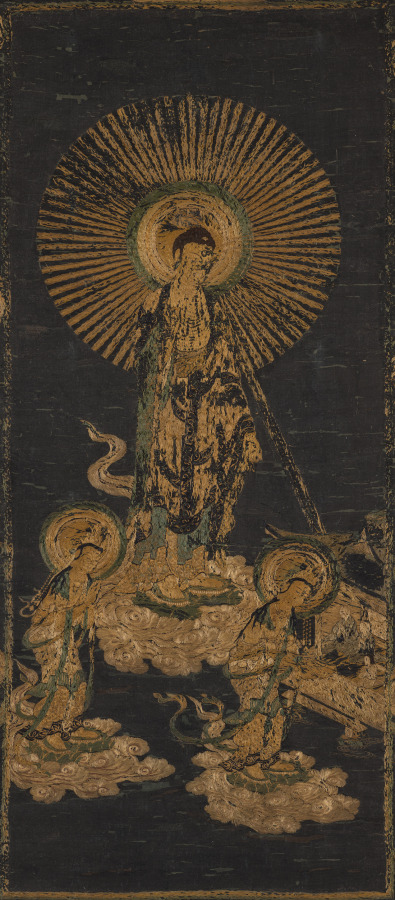
- Title
- Embroidered Welcoming Descent of Amida Triad (繡仏阿弥陀三尊来迎図)
- Period
- Muromachi
- Medium
- Hanging scroll; silk and human hair embroidery
- Dimensions
- Embroidery: 109.1 × 37.2 cm. Mounted: 173.1 × 49.4 cm.
- Collection
- The Cleveland Museum of Art
- Accession
-
1966.513 - Rights
- Public domain (Cleveland Museum of Art Open Access, CC0). Accession 1966.513. Gift of the American Foundation for the Maud E. and Warren H. Corning Botanical Collection, 1966.
Embroidered Welcoming Descent of Amida Triad. Japan, Muromachi period (1392–1573), 1400s. Hanging scroll, silk and human hair embroidery; 109.1 × 37.2 cm (embroidery). The Cleveland Museum of Art, accession 1966.513. Public domain (CC0).
Sixteen characters in a pale cartouche
Above the figure field of Cleveland 1966.513 sits a small rectangle of pale ground with four columns of four characters, read right to left:
光明遍照 十方世界 念佛衆生 攝取不捨
The museum’s record describes the inscription as a quotation from the Contemplation Sutra to the effect that Amida’s compassion flows impartially to all who recite his name. The characters can be matched exactly. They are the second half of a sentence in the sutra’s ninth visualization, the contemplation of Amida’s body (T 365, vol. 12, 343b26): each light shines throughout the worlds of the ten directions, and beings mindful of the Buddha are gathered in and never abandoned. The last four characters, sesshu fusha, became a Pure Land formula of their own.
The cartouche does not appear in the museum’s main photograph, which crops to the figure field. It shows in the two alternate photographs of the scroll in its mounting, set in a band of scrolling flowers that frames the field above and below. The characters are dark on the pale ground, written in a plain, unhurried regular script.
A few lines before this sentence, the sutra describes the Buddha’s round halo as wide as a hundred billion world-systems. The embroidery’s answer is a disc of spoke-like rays around the head, wider than the body beneath it.
One beam, one house
Read downward from the cartouche, the composition is a diagonal. Amida stands on a cloud in three-quarter view, head inclined toward the lower right. From his body a single beam, stitched as two parallel lines, runs down to the eave of a building at the right edge of the field. That beam is the verse above it, made visible.
Inside the building three small figures sit facing out. The tonsured monk is the most legible, stitched in pale floss against a darker interior. The woman and the child sit lower and nearer the edge, and a tasselled pendant hangs from the eave beside them. The museum’s description names the three and says only that they pray. Nobody in the house is shown lying down, so the scroll does not say which of them is dying, if any one of them is.
Both attendants stand on their own clouds below Amida and turn toward the house. The nearer one bows from the waist. The farther one stands upright, a beaded strand hanging from its hands. The photographs don’t resolve whether either holds the lotus pedestal on which, in the standard welcoming-descent programme, Kannon receives the dying.
Scale matters here. The figure field is only 37.2 cm wide, roughly a forearm. The house with its three worshippers occupies a patch about the size of a palm. Below the attendants’ clouds the lowest fifth of the field is empty dark ground.
Wargula 2024 distinguishes the three-quarter raigō from the rarer frontal type, which gained ground only in the fourteenth century (p. 295). 1966.513 is the three-quarter type, and the house explains why. A frontal Amida faces the viewer, who can then imagine being the one welcomed (p. 295). Here Amida faces someone else.
Where the hair might be
The collection record gives the medium as “silk and human hair embroidery”. It does not say which threads are hair.
The closest published account of a comparable object is Wargula’s study of the fourteenth-century triad at the Tokugawa Art Museum. There, she writes, the snail-shell curls of the Buddha, the cascading locks of the bodhisattvas and the inscription are all worked in human hair, and each seed-syllable is backstitched in bundles of two or three strands (pp. 297–298). The hair goes where hair would be, and into the words.
On 1966.513 the darkest and glossiest stitching sits in comparable places. Amida’s head is a smooth dark cap, unlike the pale floss of the face beneath it. The attendants’ hairlines and topknots are drawn in thin dark lines. The cartouche characters are dark too.
The robe is harder. Across Amida’s body the pale floss is broken by irregular black passages, and in the photograph it is not possible to tell abrasion, with dark ground showing through lost stitches, from dark thread laid on purpose. Scattered pale flecks across the dark ground of the field show that the ground fabric has losses too. The hair question and the condition question sit in the same square centimetres.
Who made a raigō in hair
There is a live disagreement about who these embroideries were for, and Wargula 2024 lays it out (pp. 298–299). After the Nara National Museum’s 1964 exhibition of more than 150 Buddhist embroideries, Ishida Mosaku proposed that hair embroidery spread through the new Pure Land schools as an easy practice, like the nenbutsu. Hair was at hand, a stitch or two was quickly done, and the medium suited commoners.
Itō Shinji rejects that reading. Hair embroideries survive in imperial convents and at the Shingon headquarters on Mount Kōya, which points to aristocrats, warrior elites and learned monks among their makers and viewers. Elizabeth ten Grotenhuis, in work Wargula cites as influential, reads the frequent Sanskrit seed-syllables on Amida embroideries as an esotericizing current inside Pure Land imagery.
The Cleveland scroll is useful to this argument because its subject is a household. A monk, a woman and a child under one roof look, at first, like evidence for Ishida’s popular practice. The object argues the other way. The figures, the rays and the whorled clouds are densely covered in fine silk floss, and whatever hair the scroll holds is a small share of the thread. This is a workshop commission of some size, not a stitch or two added at home. The earliest documented cases point the same way. In 1188 the regent Kujō Kanezane recorded his dead son’s hair being stitched into the lotus pedestal of an embroidered Shaka triad (Wargula 2024, p. 301); bodhi’s study of Met 1975.268.22 follows those diary entries in detail.
Itō’s wider patronage fits 1966.513 better than Ishida’s commoners. The residual uncertainty is large. The scroll carries no signature and no inscribed date, and the open collection record gives no basis for its 1400s date. Whether the three figures in the house are the patrons, or the generic faithful of the verse, cannot be read off the picture.
A raigō among flower drawings
The credit line reads “Gift of the American Foundation for the Maud E. and Warren H. Corning Botanical Collection”. The provenance entry drops the word Botanical. The word matters. Cleveland’s open-access database returns about a hundred objects under the foundation’s name, and nearly all are botanical: drawings of a pasture rose, a florilegium, paintings of peonies and of paulownias with chrysanthemums. The welcoming descent is the one devotional image among them. Where the foundation acquired it, and when, is blank in the record (?–1966).
The scroll entered the museum in 1966. It was published as no. 175 in the Bulletin’s “Year in Review” for 1967 (p. 336) and shown in that year’s acquisitions exhibition, 29 November to 31 December 1967.
Its later career is mostly as an illustration. Elizabeth ten Grotenhuis reproduced it in her 1991 survey of Cleveland’s Pure Land holdings (p. 290, fig. 14) and in Japanese Mandalas (1999, fig. 85, p. 141). In her 2004 Orientations essay “Bodily Gift and Spiritual Pledge”, an article on human hair in Japanese Buddhist embroidery, it is figure 1 on the opening page (p. 31, with a detail as fig. 1a, p. 32). Yuhang Li’s 2012 study of Chinese women’s hair embroideries of Guanyin brings it in as the Japanese comparison (mentioned p. 139, fig. 2 on p. 157).
So in the English-language literature the scroll does duty as a standard picture of Japanese hair embroidery. It isn’t one of the best documented. The Tokugawa triad has a provenance back to Tokugawa Mitsutomo (1625–1700) and a full study (Wargula 2024, p. 295); 1966.513 has a museum paragraph and a run of figure captions.
What stays open
What the 2020 survey found. The Sumitomo-funded preliminary survey is the only technical study of the scroll in the public record. Whether it identified which threads are hair, whether the cartouche and floral bands are embroidered or pieced in from another textile, and whether it supports the 1400s date, is unpublished.
Who is dying. The house holds three upright figures and no deathbed. The scroll may picture a household’s shared hope rather than a single death, or the dying person may be one of the three. Nothing in the record decides it.
How the foundation came to own it. The one devotional image among a botanical foundation’s gifts arrived with no prior history. The Corning foundation’s own papers, if they survive, are the place to look.
Sources
-
Title, date, medium, dimensions, description, citation list and exhibition history. Credit line: Gift of the American Foundation for the Maud E. and Warren H. Corning Botanical Collection. Provenance entry: American Foundation for the Maud E. and Warren H. Corning Collection (?–1966), given to the Cleveland Museum of Art.
-
Acquisition publication. Reproduced as no. 175, p. 336 (per the museum's citation list).
-
Reproduces 1966.513 at p. 290, fig. 14 (per the museum's citation list).
-
Reproduces 1966.513 as fig. 85, p. 141 (per the museum's citation list).
-
The English-language article on Japanese hair embroidery that opens with this scroll: reproduced p. 31, fig. 1, detail p. 32, fig. 1a (per the museum's citation list).
-
A study of Chinese women's hair embroidery of Guanyin; uses 1966.513 as a Japanese comparison, mentioned p. 139, reproduced p. 157, fig. 2 (per the museum's citation list).
-
Tokugawa Art Museum triad: frame of lotus arabesque and three-quarter versus frontal raigō types (p. 295); hair used for the Buddha's curls, the bodhisattvas' locks and the inscription (p. 298); no scientific testing of the hair, with a 1984 blood-type test on the Izusan Shrine maṇḍala as the exception in the genre (pp. 297–298 n. 4); the 1964 Nara exhibition, Ishida Mosaku's popular-practice thesis, Itō Shinji's rebuttal and ten Grotenhuis's esotericizing reading (pp. 298–299).
-
Ninth visualization (the body of Amitāyus): 一一光明遍照十方世界,念佛眾生攝取不捨. The cartouche on 1966.513 reproduces the sixteen characters from 光明 to 不捨.
-
Lists “Preliminary Survey: Embroidered Welcoming Descent of Amida Triad in the Collection of The Cleveland Museum of Art”, grantee the Cleveland Museum of Art, $11,600.