Byōdō-in's Amida by Jōchō: the canonical Heian image, 1053
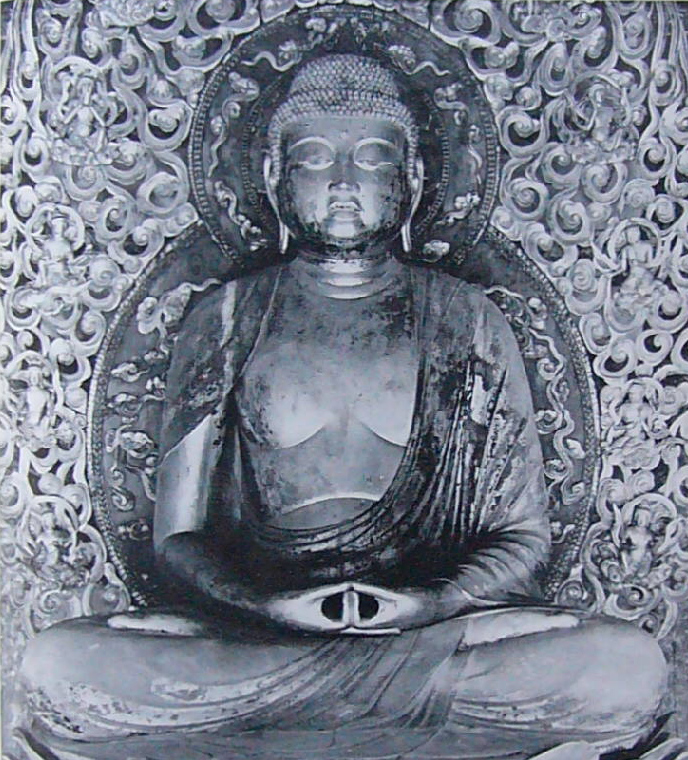
- Title
- Amida Nyorai zazō (阿弥陀如来坐像) — Byōdō-in Hōō-dō, the only confirmed surviving Jōchō
- Period
- Heian period, 1053
- Region
- Yamashiro / Kyoto
- Medium
- Wood with gold leaf and lacquer; *yosegi-zukuri* (joined-block construction) — the earliest surviving large-scale instance
- Dimensions
- 277.2 cm seated
- Collection
- Byōdō-in (平等院), Uji, Kyoto — Japanese National Treasure (国宝)
- Accession
-
Hōō-dō (Phoenix Hall) principal honzon - Rights
- Public domain (PD-Japan-oldphoto). Photograph from *Illustrated Byōdōin (Byōdōin Zukan)*, ed. Fukuyama Tsuneo and Mōri Tōru, published January 22, 1947 — pre-1957 PD-Japan-oldphoto eligible. Source: Wikimedia Commons.
The canonical anchor: Byōdō-in Hōō-dō Amida by Jōchō (1053), 277.2 cm. The only confirmed surviving Jōchō; the canonical Heian seated Amida; the earliest surviving *yosegi-zukuri* at large scale. The 1947 *Byōdōin Zukan* plate.
The Byōdō-in Hōō-dō Amida (平等院鳳凰堂阿弥陀如来坐像), dated 1053 to Jōchō (定朝, d. 1057), is the only confirmed surviving Jōchō and the canonical anchor for Heian seated Amida iconography. 277.2 cm gilt-wood, yosegi-zukuri joined-block construction at the earliest surviving large-scale, in jō-in meditation mudra. The Phoenix Hall (Yorimichi, 1053) frames the figure as the Pure Land Sukhāvatī’s central honzon: Tendai Pure Land per Genshin’s Ōjō yōshū (985), not the later Hōnen / Shinran schools. The wayō construct under which Jōchō is conventionally read is itself a 20th-century critical synthesis (Vaneian 2019).
One figure, one signed master, 1053
The conventional reading of Heian Buddhist sculpture turns on this single work. There are no other confirmed Jōchō pieces.
The Jōruriji nine-Amida hall (12th century) is Jōchō-school workshop production, not Jōchō’s own hand; the Sanzen-in Amida triad (1148) is post-Jōchō wayō in the lineage; the Hōkai-ji Amida (Hino, circa 1130s) is yosegi in the technique Jōchō established. Every later attribution traces back to this one work.
The master himself survives mostly through clerical records of the titles he received: Hokkyō (法橋, “Bridge of the Dharma”) in 1022, Hōgen (法眼, “Eye of the Dharma”) in 1048, busshi (仏師, Buddhist sculptor) by professional designation. He was the first sculptor to receive the Hokkyō: the granting of a Buddhist clerical title to a craftsman marks a substantive shift in the Heian institutional system, in which sculpture moved from craft into the ranks of recognised Buddhist labour.
He died in 1057, four years after completing the Byōdō-in Amida. The figure is essentially a late-career or final work, executed when his reputation was already settled and the institutional patronage at the highest level was in place.
Fujiwara no Yorimichi (992–1074), the regent and Byōdō-in’s patron, commissioned the figure as the honzon (主尊, principal image) of the Phoenix Hall (Hōō-dō, 鳳凰堂), itself completed in 1053 as the central architectural element of the temple complex Yorimichi was constructing on the Uji River.
The hall and the figure were designed together. The Phoenix Hall is shaped, in plan, like a phoenix with outstretched wings: the central hall containing the Amida flanked by long covered corridors (the wings) terminating in tower pavilions.
The conventional reading of the architectural programme is that the hall constitutes a built representation of the Pure Land Sukhāvatī, with the Amida at the centre and the surrounding wall paintings, ceiling decoration, and 52 wall-mounted bodhisattvas (the Unchū kuyō Bosatsu) extending the iconographic programme. The hall and the Amida together, not the Amida alone, are the canonical Heian Pure Land image.
What the figure shows
The Amida figure stands at 277.2 centimetres according to the temple’s own published measurement, a substantial seated icon, with the figure on its lotus pedestal reaching close to three metres in total height. The medium is gilt-wood: assembled cypress (hinoki) blocks, finished with lacquer ground, gold leaf, and surviving polychromy.
The construction is yosegi-zukuri (寄木造), the joined-block technique that Jōchō is conventionally credited with perfecting. The Byōdō-in figure is not the first Japanese yosegi work in any absolute sense (joined-block construction predates Jōchō in continental practice and at small scale in earlier Japanese workshops), but it is the earliest surviving large-scale exemplar of the technique, and the one that establishes yosegi as the dominant construction method for Heian and Kamakura Buddhist sculpture.
The figure is seated in kekka-fuza (結跏趺坐, full lotus posture), the hands resting in the lap with palms upward and the thumbs and forefingers each forming circles. This is the jō-in (定印, dhyāna mudra): the meditation mudra.
Saunders 1960 (Mudrā: A Study of Symbolic Gestures in Japanese Buddhist Sculpture) treats jō-in at the broader register without specifically pinning the Byōdō-in figure; the gesture is iconographically distinct from the raigō (来迎, welcoming-descent) mudras of the nine-grade Pure Land (Kubon-in) programme that develops in later Heian Pure Land iconography. The Byōdō-in Amida is not in a raigō mudra. It is in seated meditation, the central object of contemplation in the visualisation programme that Genshin codified.
The face is the most-cited element of the wayō reading. The features are calm and settled, the half-closed eyes set in a downward gaze, the mouth in the gentle closed-lipped expression that becomes the standard Jōchō-school countenance.
The proportions are more horizontal than the Tang-influenced earlier Buddha images at Tōdai-ji and elsewhere: the body broader through the shoulders and across the lap, the uṣṇīṣa lower and gentler, the iconographic programme calmer overall. The robes drape across the lap and arms in the shallow, smooth folds that the Jōchō-school workshop subsequently propagates across Heian sculpture.
The mandorla and the 52 bodhisattvas
Behind the figure rises a large carved-wood mandorla. The iconographic programme of the mandorla is not the multiple-Amida (kebutsu) reading that the canonical mandorla register sometimes preserves; the Byōdō-in mandorla carries Dainichi Nyorai (Mahāvairocana) at the apex, with twelve hiten (飛天, celestial beings) below, depicted as if floating around the central figure.
The temple’s official framing reads the mandorla programme as “the Avatar of the Twelve Merits of Amida Buddha”; six of the twelve hiten preserve their original 1053 carving, with the other six restored or replaced in subsequent conservation campaigns.
The hall’s interior walls preserve a separate iconographic register: 52 small wooden bodhisattva figures depicted as if descending on clouds: the Unchū kuyō Bosatsu (雲中供養菩薩, “Cloud-Borne Offering Bodhisattvas”). All 52 are designated Japanese National Treasures.
Twenty-eight of the figures play musical instruments: flutes, drums, biwa, koto, cymbals; the remainder dance, hold canopies, or join their hands in prayer. The 52 figures are workshop production under Jōchō’s direction, not his own hand; they are iconographically continuous with the central Amida and constitute the institutional acknowledgement that the Hōō-dō programme was a major workshop commission, not a single-master production.
The 52 bodhisattvas are now rotated between the hall and the Hōshōkan museum (the temple’s modern museum building, post-2001), with replicas mounted in the hall while the originals undergo conservation. The visitor today sees a mix of original carvings and replicas; the figures most often photographed in the Phoenix Hall interior are the originals, but the temple acknowledges the rotation explicitly in its publications.
The yosegi-zukuri technique
The single-block (ichiboku-zukuri, 一木造) construction that dominated earlier Japanese Buddhist sculpture has structural limits. A figure carved from a single block of wood is constrained by the diameter and length of the block; large icons require either an unworkably-thick log (rare and expensive) or a series of compromises in proportion.
The warihagi-zukuri (割矧造, split-and-rejoin) precursor (splitting the carved block in two, hollowing the interior, then rejoining the halves) partially addresses the structural problem but does not resolve the size constraint.
Yosegi-zukuri (寄木造, “joined wood construction”) resolves both. Multiple smaller blocks of cypress are individually carved for specific sections of the figure (the head, the torso, the arms, the legs, the lotus pedestal) and then joined into the assembled icon.
Each section can be carved by a different specialist; the work is workshop-distributable. The interior of the assembled figure is hollow, which reduces total weight and allows ritual deposits to be placed inside the cavity.
Mōri Hisashi’s Japanese Sculpture: A Survey (Heibonsha / Weatherhill, 1974) treats the technique as constitutive of late-Heian and Kamakura institutional sculpture: yosegi enables the proliferation of large-scale icons across Heian and Kamakura temples that would have been technically impossible under the older single-block constraint.
The Byōdō-in Amida is the institutional anchor for the technique at scale. The specific block count is not given in the accessible English-language scholarly record; Mōri 1974 and the Japanese-language sculpture-history literature would carry the technical detail at the level needed for a precise reading.
What is uncontested is that the figure marks the moment when yosegi moves from auxiliary technique to dominant construction method, with the Jōchō workshop carrying the technique into the broader Heian institutional sculpture programme.
The wayō question
Jōchō is conventionally read as the founder of the wayō (和様, “Japanese style”) of Buddhist sculpture: the calmer, more horizontal, gentler-faced register that defines Heian Japanese Buddha imagery against the imported Tang-Chinese precedents that fed the earlier Asuka, Hakuhō, and Nara programmes. The reading runs across the standard English-language Heian-sculpture literature: Mōri Hisashi, Donald McCallum, the Onmark Productions Buddhist-art reference site, the Wikipedia entries.
The reading is not uncontested. Anastasiia Vaneian’s 2019 article (“‘Japanese Style’ (wayō) in Heian Period Sculpture: History of the Term,” Actual Problems of History and Theory of Art, vol. 9) is the rigorous English-language historiographic treatment: the wayō construct is itself a 20th-century critical synthesis, retroactively organising what was a continuous Heian evolution into a periodisation that the Heian sources themselves did not articulate.
Heian-period Japanese sources do not consistently use the term wayō in the way modern scholarship deploys it; the construct names a real iconographic register but rests on a periodising frame that is itself the work of Mōri Hisashi, Kuno Takeshi, Nishikawa Kyōtarō, and the broader 20th-century Japanese sculpture-history literature.
The honest reading: the Byōdō-in Amida is iconographically distinct from earlier Tang-influenced Japanese Buddha images, and the specific markers (calmer face, more horizontal proportions, shallower drapery) are observable. Whether this constitutes a “Japanese style” in the strong periodising sense is the more contested claim.
Vaneian’s framing, that the iconographic markers are real but the historiographic category is constructed, is the more scholarly-careful reading and the one this article commits to.
The Pure Land textual context
The Phoenix Hall programme is anchored in the Tendai Pure Land tradition that Genshin (源信, 942–1017) synthesised in the Ōjō yōshū (往生要集, “Essentials of Birth in the Pure Land”), completed in 985. Genshin’s text is the doctrinal anchor for Yorimichi’s patronage: a Tendai-school monk whose Pure Land synthesis taught the visualisation programme that the Byōdō-in image and hall together enacted.
The textual sources behind the iconography are the Pure Land Three Sūtras (Jōdo Sanbukyō, 浄土三部経):
- The Larger Sukhāvatīvyūha Sūtra (Muryōju-kyō, 無量寿経): Taishō 360, vol. 12; conventionally attributed to Saṃghavarman, 252 CE. The principal scripture describing Amida’s vows and the Sukhāvatī Pure Land in detailed cosmological terms.
- The Contemplation Sūtra (Kanmuryōju-kyō, 観無量寿経): Taishō 365, vol. 12. The textual source for the visualisation programme that Genshin develops in the Ōjō yōshū.
- The Smaller Sukhāvatīvyūha Sūtra (Amida-kyō, 阿弥陀経): Taishō 366, vol. 12; Kumārajīva translation. The shorter Pure Land scripture, structurally paired with the Larger Sukhāvatīvyūha and the Contemplation Sūtra.
The Phoenix Hall is not the institutional anchor for the later Pure Land schools. Hōnen (法然, 1133–1212) founded the Jōdo Shū (浄土宗, “Pure Land School”) in 1175, more than a century after the Phoenix Hall was completed. Shinran (親鸞, 1173–1262) founded the Jōdo Shinshū (浄土真宗, “True Pure Land School”) in the mid-13th century.
Both schools post-date the Byōdō-in by a century or more; the Phoenix Hall and its Amida are anchored in the earlier Tendai Pure Land synthesis, where Pure Land devotion is one strand of the broader Tendai institutional programme rather than a separate school. The Byōdō-in’s modern dual Jōdo-shū / Tendai institutional affiliation is a post-Edo administrative arrangement and should not be retrojected onto the 1053 patronage.
Comparanda and reception
The Byōdō-in Amida is the prototype against which the broader Heian and Kamakura Amida sculptural record is read. Three Heian-period works are conventionally cited as immediate downstream comparanda:
- Jōruriji (浄瑠璃寺, Kyoto Prefecture): the nine-Amida hall preserves nine seated Amida figures, all 12th-century, in the Jōchō-school workshop tradition. The nine-figure programme is iconographically the Kubon-in (nine-grade Pure Land) reading codified after Jōchō’s death; the figures themselves are stylistic siblings of the Byōdō-in Amida, post-Jōchō wayō at workshop-scale production.
- Sanzen-in (三千院, Ōhara, Kyoto): the Amida triad of 1148 (Heian late, post-Jōchō by nearly a century). The central Amida is in the Jōchō-school wayō register; the flanking Kannon and Seishi bodhisattvas are seated in the unusual Yamato-zuwari (大和坐り, “Yamato-style sitting,” the flat-soled cross-legged sit) that the temple preserves as iconographic distinction.
- Hōkai-ji (法界寺, Hino, Kyoto): the Amida of circa 1130s, yosegi-zukuri, Heian late. The figure’s wall paintings (including the Pure Land paradise and the Twelve Heavenly Generals) are preserved in the same hall; the hall itself is a Heian-period structure, giving the Hōkai-ji programme the closest documentary parallel to the Byōdō-in’s hall-and-image unity that survives outside the Phoenix Hall.
The Kamakura reception is the more interesting story. The Kamakura Daibutsu (鎌倉大仏, 1252), the great seated bronze Amida at Kōtoku-in in Kamakura, is conventionally read as a Kamakura return to Song-Chinese realism, against the gentle Jōchō wayō. The face is more pronounced, the proportions more vertical, the iconographic register sterner.
The Kōfukuji Amida by Unkei (運慶, c. 1212) is the Kei-school assertion against Jōchō-school softness: the Kamakura sculptural realism programme that defines the post-Heian institutional sculpture against the Heian wayō it inherited.
What stays stable across these later receptions is the iconographic core: a seated Amida in jō-in meditation mudra, in the Pure Land programme. What changes is the stylistic register: the Jōchō wayō yields to Kamakura realism, but the iconographic programme that the Phoenix Hall enacts remains the canonical reference image.
Where this work sits
The Byōdō-in Hōō-dō Amida is the canonical anchor for the Heian Pure Land devotional image, and one of the four or five works that the standard Japanese Buddhist art-history syllabus cannot omit.
The figure is accessible to the public on the temple’s standard schedule: the Phoenix Hall is open during regular visiting hours, with timed entry to the interior, and the Amida is visible at moderate distance from the central viewing position. The 52 Unchū kuyō Bosatsu are partially visible in the hall (with replicas) and partially in the Hōshōkan museum on the temple grounds.
The hall appears on the verso of the Japanese 10-yen coin (since the 1951 redesign coinciding with the National Treasure designation). The rooftop phoenix sculpture that gives the hall its name, a separate gilt-bronze work, appears on the verso of the 2004 ¥10,000 note redesign; the note features the rooftop phoenix, not the building itself, a distinction that some popular sources elide.
For the reader looking at any later Japanese Amida, the Byōdō-in figure is the iconographic-and-stylistic reference. The seated Amida in jō-in mudra, in yosegi-zukuri construction, in the Pure Land Sukhāvatī programme, with the calm wayō face and the gentle drapery: every later Heian and Kamakura Amida is read against this work.
That this is the only confirmed surviving Jōchō makes the figure load-bearing in a way few Japanese Buddhist sculptures are: an entire stylistic period, an entire technical tradition, and an entire devotional programme converge on this one carved icon at Uji.
Related
Sources
-
Temple-authoritative source. 277.2 cm height. The mandorla programme: Dainichi Nyorai at the apex with 12 *hiten* (celestial beings) — six of them 1053-original. Designated Japanese National Treasure
-
Cypress *yosegi-zukuri* construction; Yorimichi (992–1074) patronage; 1053 completion
-
The rigorous English-language historiographic treatment: *wayō* as a 20th-century critical construct retroactively organizing what was a continuous Heian evolution. The article's principal R8 named-disagreement source. Cites Mōri Hisashi, Kuno Takeshi, Nishikawa Kyōtarō, McCallum
-
The standard English-language reading of Jōchō's wayō and the *yosegi-zukuri* technical-historical literature. Cited at work level; page numbers not verified against the print volume.
-
The downstream-from-Jōchō reading: the Kei-school Kamakura reaction *against* the Jōchō wayō softness; the Kamakura Daibutsu (1252) and the Kōfukuji Unkei Amida (c. 1212) as Song-Chinese-realism corrective
-
Heian visual culture context. Cited at work level; page numbers not verified.
-
Standard reference for *jō-in* (定印, dhyāna mudra). Treats the seated meditation gesture distinct from the *raigō* welcoming-descent mudras of the nine-grade Pure Land programme
-
Taishō Tripiṭaka 360, vol. 12; conventionally attributed to Saṃghavarman, 252 CE. The principal Pure Land scripture describing Amida's vows and the Sukhāvatī Pure Land
-
Taishō Tripiṭaka 365, vol. 12; the textual source for the Pure Land visualization programme that Genshin develops in the *Ōjō yōshū*
-
Taishō Tripiṭaka 366, vol. 12; Kumārajīva translation. The shorter Pure Land scripture, paired with the Larger Sukhāvatīvyūha and the Contemplation Sūtra as the Pure Land Three Sūtras (*Jōdo Sanbukyō*)
-
The Tendai Pure Land synthesis that conditioned Yorimichi's Phoenix Hall patronage. The doctrinal anchor for the Phoenix Hall programme — Tendai Pure Land, distinct from the later Hōnen Jōdo Shū (1175) and Shinran Jōdo Shinshū (mid-13th c.) schools
-
Built 1053 by Fujiwara no Yorimichi (992–1074). The original villa was acquired in 998; converted to a temple 1052; the Phoenix Hall completed 1053. The hall is itself a designated Japanese National Treasure. The hall's image appears on the verso of the Japanese 10-yen coin (since the 1951 redesign coinciding with the National Treasure designation); the rooftop phoenix sculpture — distinct from the hall — appears on the verso of the 2004 ¥10,000 note redesign. The 1053 *kuyō* (eye-opening) ceremony is universally repeated in the secondary literature; the specific primary documentary record has not been located in available English-language sources.
-
Hokkyō (法橋, 'Bridge of the Dharma') 1022 — the first sculptor (busshi) to receive this clerical honor. Hōgen (法眼, 'Eye of the Dharma') 1048 — for the Kōfukuji reconstruction work after the 1046 fire. The granting of clerical titles to a sculptor marks the professionalisation of busshi as a class within the Heian institutional system
-
All 52 figures designated Japanese National Treasures; 28 play musical instruments, others dance, hold canopies, or join hands in prayer. Workshop production under Jōchō's direction. Currently rotated between the Hōō-dō (with replicas) and the Hōshōkan museum (post-2001) for conservation
-
January 22, 1947 publication; pre-1957 PD-Japan-oldphoto eligible. Source for the available Wikimedia Commons photograph of the Amida Nyorai zazō. Image clearance for the bodhi corpus is the principal deferred work for this article