A Heian Abhidharmakośa scroll in gold and silver on indigo

- Title
- Abhidharmakośa-bhāṣya, fascicle 17 (阿毘達磨倶舎論 巻第十七)
- Period
- Heian
- Medium
- Handscroll; gold and silver on indigo-dyed paper
- Dimensions
- Overall: 26.4 × 670.6 cm
- Collection
- The Cleveland Museum of Art
- Accession
-
1916.1060 - Rights
- Public domain (Cleveland Museum of Art Open Access, CC0). Accession 1916.1060. Worcester R. Warner Collection.
Abhidharmakośa-bhāṣya (阿毘達磨倶舎論), fascicle 17 of Xuanzang's thirty-fascicle translation. Japan, Heian period (794–1185), 1100s. Handscroll, gold and silver on indigo-dyed paper; 26.4 × 670.6 cm. The Cleveland Museum of Art, Worcester R. Warner Collection, 1916.1060. Public domain (CC0).
The first column after the picture
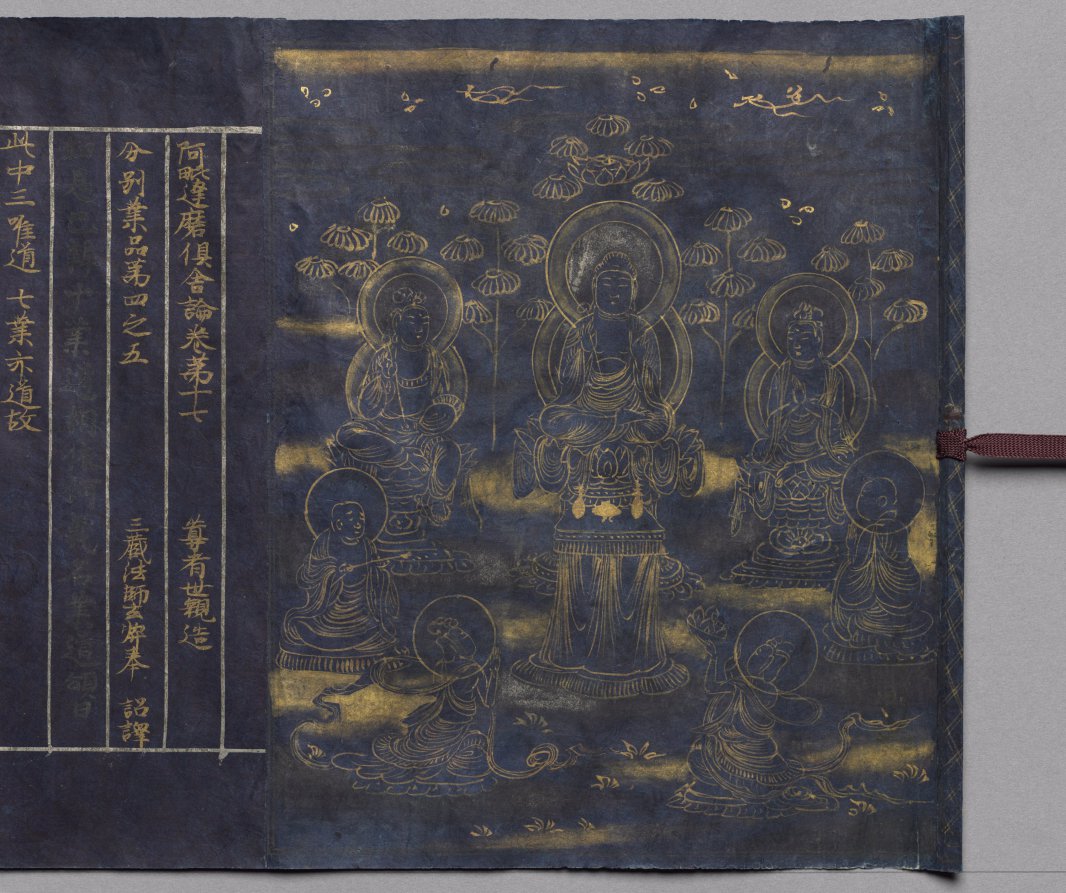
Past the cover and the painted frontispiece, the first ruled column of Cleveland 1916.1060 gives the title in gold: 阿毘達磨倶舎論巻第十七, Abhidharmakośa, fascicle seventeen. The next columns name Vasubandhu as author and Xuanzang as translator “by imperial command.” Then comes the address that matters: 分別業品第四之五, the fifth of six fascicles in chapter four, the Analysis of Karma.
The text that follows is the Taishō fascicle exactly. It opens with a line in silver, 如是已辯十業道相 (“the characteristics of the ten courses of action have been explained”), then the verse in gold, 此中三唯道, and it ends, 670 centimetres later, on a sentence that closes by naming the heaven without perception (唯無想處). Those are the first and last words of fascicle 17 in the Taishō edition, vol. 29, pp. 88b24 to 93a12.1 The scroll is a whole fascicle, head to tail.
Its subject is karma, start to finish. The ten courses of action and why they are called “paths.” How wrong view severs the roots of good. Which acts belong to which realms, the five kinds of fruit an act can bear, the claim that one act projects a single rebirth while many acts fill it in, and the three obstructions headed by the five deeds of immediate retribution.
Cleveland’s description says something else. The record summarises the text as analysing “human consciousness in its relationship to the environment and transformations that occur during meditation.” That fits the Abhidharmakośa as a whole tolerably. It does not fit this scroll. Meditation is chapter eight, fascicles 28 and 29 in Xuanzang’s division; knowledge is chapter seven.2
Cover and frontispiece
The outer cover is indigo like the rest, with the short title 倶舎論巻第十七 in gold down the edge that carries the tie cord, set on a small gold cloud. Everything else on the cover is a hōsōge arabesque in gold line: curling leaves and fan-shaped blossoms, packed edge to edge inside a ruled border, with a scalloped cloud band along the top. Sherman Lee reproduced this cover as fig. 3a of Japanese Decorative Style and read its “curling arabesques” as still recalling Tang Chinese ornament (Lee 1961, p. 11).
Inside the cover, before the text, is the frontispiece. A Buddha sits on a lotus raised on a tall draped dais, both hands lifted in front of the chest. Two bodhisattvas flank him on lotus seats. Below them two haloed monks sit facing inward, and in the foreground two kneeling figures with trailing scarves turn toward the dais, the right-hand one lifting a lotus. Behind them stand trees whose blossoms are drawn as flat, stacked parasols, and broad horizontal strokes of gold wash cross the whole sheet like banks of mist.
Cleveland’s note calls it Shakyamuni “preaching in a paradisical landscape”; Lee’s note to fig. 3 says “the Buddha surrounded by Bodhisattvas, monks, and devotees” (p. 135). Both are right and neither names the place. The faces are the clearest thing on the sheet: eyes and mouths reduced to a few short strokes, which is Lee’s general point about these panels, their “extremely simplified notations for facial features” and a symmetry “still in thrall to earlier iconic dispositions” (p. 11).
The panel is close to square, about as wide as the scroll is tall. A reader unrolling from the right meets the picture, then the gold title, within a forearm’s length of paper and before a single line of the treatise.
Gold line, silver line
The text alternates by column: gold, silver, gold, silver, between ruling lines drawn in silver. In Cleveland’s detail photographs the gold sits warm and legible. The silver has darkened to a grey only a little lighter than the paper, so that each silver column reads as a ghost between two gold ones, and the treatise has to be read in pairs of lines, one bright and one patient.
The scribe made mistakes and fixed them in the open. In the first stretch of text at least two characters left out of their lines were written small in the gutter beside the column where they belong: 釋, which completes the phrase 類此應釋, and a 故 a few lines earlier. Small, unfussy repairs, left visible on a luxury object.
At the far end the last written column closes the karma passage, and the next gives the end title in gold, 說一切有部倶舎論巻第十七. That wording follows the reading the Taishō prints from its base text; the Ming edition has 阿毘達磨 in its place.1 After it comes a run of empty ruled columns and the roller. No date, no dedicant, no scribe’s name. The last sheet is also a redder indigo than the one before it, a reminder that the scroll is glued up from separately dyed sheets.
”Hidehira Sutra,” 1916
Cleveland first showed the scroll in its inaugural exhibition, June to September 1916, and the printed catalogue lists it as cat. no. 26 on p. 195: “HIDEHIRA SUTRA. Buddhist scripture written in gold and silver on blue paper. Fujiwara Period. Lent by Mr. T. Kuroda.” It was still a loan that summer. The museum’s provenance records its sale by Kuroda Takuma of Tokyo in 1916.
“Hidehira” points to Hiraizumi. Fujiwara no Hidehira, third lord of the northern Fujiwara, dedicated a canon to Chūsonji in 1176; the Met catalogues its own Chūsonji chapter (2002.447.1, a Daihannya-kyō fascicle in gold and silver on indigo) as one of “more than five thousand scrolls” given that year for the salvation of his father Motohira.3 The 1916 label is therefore a claim about a specific set.
Forty-five years later Lee did not repeat it. He titled the scroll Further Discourses on the Supreme Truth, dated it late Heian, twelfth century, and in the note to a Honolulu Vinaya scroll named “three famous sets among others”: Chūson-ji, Jingo-ji, and the museum on Kōyasan (p. 135). He placed Cleveland’s in none of them. The current record names no set at all.
Lee’s list has a wrinkle of its own. He counted Chūson-ji and Kōyasan as two sets, but most of the Kiyohira canon has been on Kōyasan since 1598, moved to Kongōbuji on Toyotomi Hideyoshi’s order; the 4,296 scrolls designated National Treasure are there, against about fifteen left at Chūsonji.5 Whether Lee meant a separate Kōya set or the Kiyohira scrolls under their present address, his note does not say.
Height does not settle anything either. Cleveland’s scroll is 26.4 cm tall, a Kiyohira fascicle at the Umi-no-Mieru-Mori Museum is 25.8 cm, and Princeton’s Jingoji Vinaya fascicle (y1959-121, ca. 1150) is 25.9 cm. The twelfth-century luxury canons were made to nearly the same paper height.
Kuroda’s loan, Warner’s collection
Kuroda Takuma (黒田太久馬, 1867–?) lent heavily to the 1916 opening: seventeen entries in the catalogue carry “Lent by Mr. T. Kuroda,” from a dry-lacquer bodhisattva head to Seto tea wares. How he acquired the sutra, and from where, is not recorded.
The credit line, “Worcester R. Warner Collection,” does not name a donor of this object. Among the benefactions announced at the museum’s opening was Worcester R. Warner’s “gift of funds to establish a collection of Oriental art to bear his name” (1916 catalogue, p. 3). Warner (1846–1929) was co-founder of the Cleveland machine-tool firm Warner & Swasey. Since the provenance records a sale by Kuroda, the scroll entered as a purchase credited to that named collection.
Since then it has been shown in Japanese Decorative Style (Cleveland and Chicago, 1961), Rinpa (2021), and the Japanese religious art rotation of 2021–22. Sinéad Vilbar’s 2022 history of Cleveland’s Japanese collection reproduces it (p. 169, fig. 7.8, as Cleveland’s citation list records).
What stays open
The Kōyasan check is the decisive one. If Kongōbuji’s Kiyohira holdings include a run of the Abhidharmakośa with fascicle 17 missing, Cleveland’s scroll has a home; if fascicle 17 is present there, it does not belong to that set. Neither inventory has been compared in print as far as the English-language record shows.
Where “Hidehira” came from is unknown. The name may have been Kuroda’s, the museum’s, or a box inscription that did not travel with the scroll. Cleveland’s file on the 1916 purchase would be the place to look.
Vilbar’s 2022 chapter may already answer part of this. Its account of the 1916 purchases has not been checked against the questions above.
The dating window stays at the century. The Kiyohira set’s 1117–1126 would narrow it to a decade if the attribution held; without it, “1100s” is what the evidence supports.
Related
- Gold and silver on indigo: a late-Heian sutra volume and its lacquered storage at Cleveland
- A lacquered repository for the 600-fascicle Great Wisdom Sutra
- The sutra mound: burying the Dharma against the end of the age
- Cleveland 1987.39: a Heian Ninnōkyō mandala in the zuzō tradition
Footnotes
-
Taishō shinshū daizōkyō vol. 29, no. 1558, fascicle 17, pp. 88b24–93a12, read in the CBETA edition. The opening line 如是已辯十業道相, the verse 此中三唯道,七業亦道故, and the closing 在天趣中唯無想處 match the scroll as photographed by Cleveland. The Taishō apparatus notes 說一切有部 in its own text and 阿毘達磨 in the Ming edition for the end title. ↩ ↩2
-
Xuanzang’s thirty fascicles divide by chapter as follows in the Taishō: 1, elements (fascicles 1–2); 2, faculties (3–7); 3, the world (8–12); 4, karma (13–18); 5, latent tendencies (19–21); 6, the path and persons (22–25); 7, knowledge (26–27); 8, meditative attainments (28–29); 9, the refutation of the self (29–30). Fascicle headings checked in the CBETA text of T.1558. ↩
-
Metropolitan Museum of Art, 2002.447.1, “Great Wisdom Sutra (Daihannya-kyō), one of the Chūsonji Sutras,” ca. 1175, catalogue text. Hidehira d. 1187, Motohira d. 1157 as given there. ↩
-
Chūsonji, English visitor guide (PDF), “Chuson-ji Sutras”; Kyoto National Museum, “Chusonji-kyo Sutras,” which dates the copying from February 1117 to March 1126 and gives the set’s title as “Issai-kyo in Alternating Gold and Silver Characters on Blue Paper.” ↩
-
Nara National Museum, Daihannya-kyō fascicle 460 (Chūsonji-kyō), entry in Bunka Isan Online; Minoh City press release on the Ryūanji Chūsonji-kyō, for the 1598 transfer to Kongōbuji. ↩
Further works cited
- Title
- Abhidharmakośa-bhāṣya, fascicle 17: frontispiece and opening columns
- Period
- Heian
- Medium
- Handscroll; gold and silver on indigo-dyed paper
- Collection
- The Cleveland Museum of Art
- Accession
-
1916.1060 - Rights
- Public domain (Cleveland Museum of Art Open Access, CC0). Accession 1916.1060, museum detail photograph. Worcester R. Warner Collection.
Detail of 1916.1060: the frontispiece (right) and the opening columns (left), reading right to left: fascicle title, author and translator, the chapter line 分別業品第四之五, then the first lines of text. The Cleveland Museum of Art, Worcester R. Warner Collection. Public domain (CC0).
Sources
-
Open Access record (API: openaccess-api.clevelandart.org, accession_number=1916.1060). Gives date (1100s), medium, dimensions, credit line, provenance (Kuroda Takuma 黒田太久馬, 1867–?, Tokyo, sold to the museum ?–1916), the museum description, the frontispiece note, exhibition history, and twenty-eight detail photographs.
-
Cat. no. 26, p. 195: 'HIDEHIRA SUTRA. Buddhist scripture written in gold and silver on blue paper. Fujiwara Period. Lent by Mr. T. Kuroda.' Account of the opening, p. 3: Worcester R. Warner's 'gift of funds to establish a collection of Oriental art to bear his name.'
-
P. 11, figs. 3 and 3a: frontispiece and cover of 1916.1060 reproduced; text on decorated sutras with arabesque covers 'which still recalled T'ang Chinese motifs.' P. 135, notes to figs. 2–3: the scroll titled 'Further Discourses on the Supreme Truth', late Heian, 12th century; three famous sets named (Chūson-ji, Jingo-ji, Kōyasan) without assigning Cleveland's to any.
-
In Natsu Oyobe and Allysa B. Peyton, eds., Great Waves & Mountains: Perspectives and Discoveries in Collecting the Arts of Japan, pp. 160–197. Cleveland's citation list records the scroll as mentioned and reproduced on p. 169, fig. 7.8. Cited from the museum's listing; the chapter's text about the scroll has not been consulted.
-
Taishō vol. 29. Fascicle 17 runs from p. 88b24 to p. 93a12 and is headed 分別業品第四之五 (Analysis of Karma, chapter 4, part 5 of 6). The end title 說一切有部倶舍論卷第十七 is the Taishō reading; the Ming edition reads 阿毘達磨.
-
English translation (from Louis de La Vallée Poussin's French) in four volumes, 1988–1990. Chapter 4 (Karma) is the chapter Cleveland's fascicle belongs to; cited at chapter level.
-
Ca. 1175; gold and silver on indigo-dyed paper. Catalogue text: one of 'more than five thousand scrolls' dedicated in 1176 to Chūsonji by Fujiwara no Hidehira (d. 1187) for his father Motohira (d. 1157). Read via the Wayback Machine capture of 2026-01-25.
-
Kiyohira's set copied February 1117 to March 1126, 'Issai-kyo in Alternating Gold and Silver Characters on Blue Paper'; frontispieces in gold and silver; about 4,500 volumes survive, over 4,200 on Mt Kōya, about fifteen at Chūsonji.
-
The Kinginji Kōsho Issaikyō (alternating lines of gold and silver on dark blue paper) was commissioned by Kiyohira; the Kinji Issaikyō by Hidehira.
-
[10]2026-10-13Nara National Museum, via Bunka Isan Online online.bunka.go.jp/heritages/detail/182025Kiyohira set, copied from 1117 and dedicated 1126; cover with hōsōge arabesque, frontispiece of Shakyamuni preaching in gold and silver, text in alternating lines; 4,296 scrolls (National Treasure) at Kongōbuji, Kōyasan.
-
[11]2026-10-13Umi-no-Mieru-Mori Museum, via Bunka Isan Online online.bunka.go.jp/heritages/detail/236138Chūsonji Kiyohira sutra, 1117–1126, 25.8 × 812.8 cm. Commentary: gold-and-silver alternate-line copying is recorded from the Nara period, with surviving examples from the mid-Heian onward; cover in hōsōge, frontispiece of Shaka preaching at Vulture Peak.
-
Kiyohira set: text alternates gold and silver line by line; silver ruling on indigo paper; most of the set moved to Kongōbuji on Kōyasan in 1598 on Toyotomi Hideyoshi's order.
-
Life dates (1846–1929) and the Warner & Swasey firm, co-founded with Ambrose Swasey, Cleveland from 1881.
-
[14]2026-10-13Princeton University Art Museum artmuseum.princeton.edu/art/collections/objects/28405Late Heian, ca. 1150; gold and silver paste on indigo paper; 25.9 × 885 cm. A Jingoji-set comparandum of near-identical height.