A Heian cinerary urn engraved with Amida's Pure Land
- Title
- Cinerary Urn with Amida's Pure Land (阿弥陀浄土図骨壺)
- Period
- Heian period (794–1185), 800s–900s
- Region
- Japan
- Medium
- Gilt bronze
- Dimensions
- Diameter of mouth 12.4 cm (4 7/8 in.); overall height 26.1 cm (10 1/4 in.)
- Collection
- Cleveland Museum of Art
- Accession
-
1960.55 - Rights
- CC0 (Cleveland Open Access). Purchase from the J. H. Wade Fund.
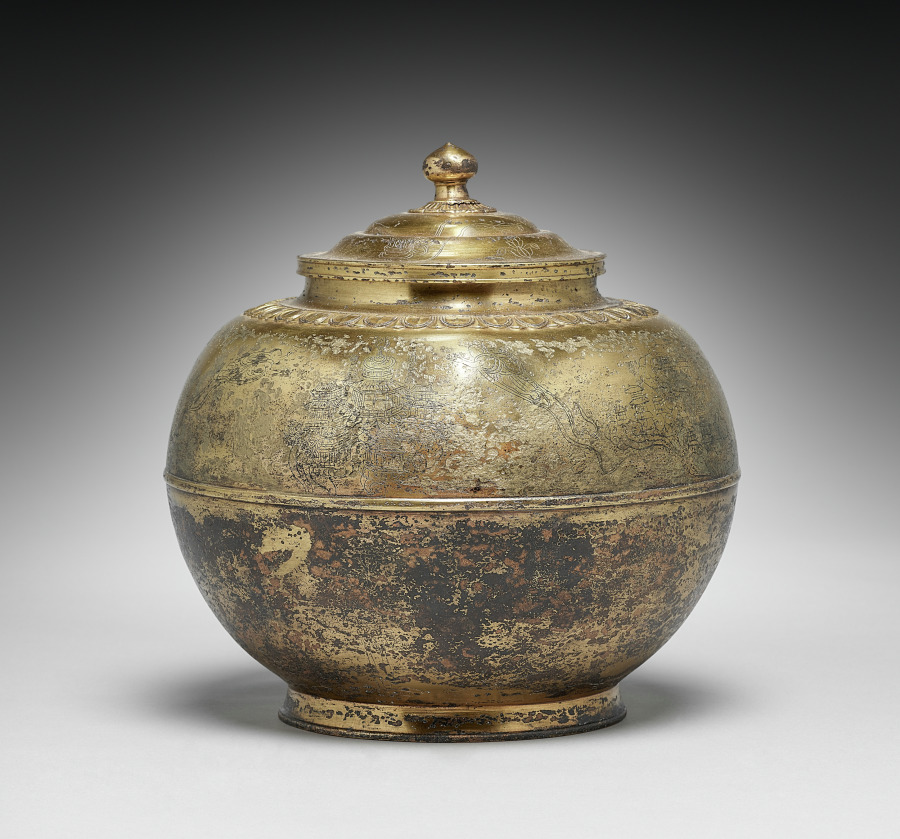
The vessel as it stands in Cleveland's storage today: bright on the upper hemisphere where the engraved Pure Land programme sits, dark on the lower bowl where the gilding has been worn or buried away. Lid and body separately accessioned (1960.55.a–b).
Cleveland 1960.55 is a 26 cm gilt-bronze cinerary urn from the early-to-mid Heian period (800s–900s), engraved over its lid and shoulder with the architecture, lotus pond, and self-playing instruments of Amida’s Pure Land. It is one of a small surviving class of bronze prestige urns made for aristocratic cremation deposits, before raigōzu had codified the visual language and before Hōnen had separated Pure Land devotion from the Tendai monastic settlement.
What stands on the table
The vessel is small and heavy in the way bronze is heavy. Twenty-six centimetres top to finial, twelve and a bit across the mouth.1 At eye-level on a museum table, it reads first as a covered jar in two hemispheres: a low rounded bowl on a thin stepped foot, and a domed lid that fits down over the shoulder and rises to a small bud-shaped knob. The proportions are not quite globular; the bowl has been pulled slightly out at the equator so the silhouette swells before it tucks back to the foot.
The surface is in two registers, and the difference is not artistic. The upper hemisphere (lid, shoulder, and the band immediately below the equator) still carries most of its gilding, a warm pale-gold tarnishing toward straw. Below the equator, the gilt is largely gone.
The lower bowl reads dark amber where the bronze underbody has corroded; in places, paler bronze shows through where flaking has cleaned the surface; in others, the patination is dense and granular and the original metal is not visible at all. The pattern is consistent with long burial in soil that contacted the bottom half of the vessel and left the top half in a different micro-environment, which is what one would expect of a cinerary urn deposited upright in a sealed outer container.
What carries the iconographic argument is the engraved decoration on the upper register. Around the shoulder, a continuous band of stylized lotus petals or stiffened acanthus leaves has been chased into the metal in low, even strokes. Above and below the petal-band, two finer encircling lines frame the chasing.
Across the broad curve of the upper bowl, the surface has been incised with a quieter and more interesting programme: faint architectural elements that read as palace pavilions with hipped roofs, a railing or pond-edge running horizontally beneath them, and small linear figures of musical instruments and birds drifting among the buildings.2
The lid carries a parallel programme of its own. Cleveland’s catalog summary identifies these scenes as Amida’s Pure Land: the lid populated by “musical instruments float[ing] about playing by themselves,” the body by “palatial structures and magnificent lotus pond.”3
The whole reading takes a moment. Under museum light, the chased work is shallow enough that the architecture only resolves with the eye held still and slightly tilted; the wear has carried away the highlights that would otherwise read as edges. A photograph at standard resolution flattens the engraving into a haze. This is part of why the object is rarely written about: its argument is at a register that does not photograph and does not survive a casual glance.
A funerary object, not a devotional one
The class of vessel matters before the iconography does. A cinerary urn (骨壺 kotsutsubo or 骨蔵器 kotsuzōki) is the inner container that held the cremated remains of a deceased person, deposited in a sealed outer vessel (typically a soapstone or pottery jar) and buried at a designated site. The form has a long pre-Buddhist history in Japan, but the Buddhist version begins with the documented cremation of Empress Jitō in 703 CE and spreads through the aristocracy across the Nara and early Heian periods.4
By the Heian aristocratic milieu of the 800s–900s, cremation had become the prestige funerary mode for those with enough resources to commission a vessel and a deposit site, though full-body burial continued in parallel and the two practices coexisted within single families.5
The urn was not, in other words, an object for use in front of the living. It was made to be filled once, sealed, and lost to view. Whatever decoration it carried was decoration the deceased’s family commissioned for the deceased, addressed (in the implicit grammar of Pure Land iconography) to Amida and to the deceased’s transit toward him. A reader trained on the visible-and-portable vocabulary of Buddhist art (paintings hung at services, sculptures placed in halls, sutras read aloud) has to register this as a different kind of object. Its working life was underground.
The Cleveland urn sits inside a small documented class. Three-color glazed Nara-period urns survive in some number; the Kyoto National Museum’s JK259, excavated in 1963 from Kitanokoso in Wakayama Prefecture, is the canonical example: 22.5 cm tall, 27.6 cm wide, three-color glaze on a wheel-thrown stoneware body, recovered from inside a soapstone outer container with the cremated remains intact.6
The Met holds an ash-glazed stoneware urn of the same general date, accession 50.213, which the Met’s catalog identifies bluntly as “an inexpensive substitute for a gilt-bronze container for ashes.”7
That single sentence is the documentary anchor. The Heian aristocracy’s funerary system included a prestige class of gilt-bronze urns, of which Cleveland 1960.55 is one of the few surviving examples. Glazed pottery was the affordable alternative.
How few survive is harder to say. The Cleveland catalog does not place the urn in a published corpus; the standard English-language references on Heian metalwork (the Asia House 1967 Japanese Arts of the Heian Period exhibition catalog edited by John M. Rosenfield, where Cleveland 1960.55 was loaned) treat it as a representative rather than as a member of a counted set.8 The honest position is that the surviving gilt-bronze Heian cinerary urns are rare enough to be cited individually, common enough that no major Japanese metalwork survey treats them as singular, and documented in scattered Japanese-language museum bulletins more than in any English-language synthesis.
The iconography on the surface
What the urn engraves is the standard Heian visual programme of Amida’s Pure Land, compressed onto a portable curved surface and rendered in the only mode bronze allows: thin chased lines.
The programme has three named elements that recur across the period’s painted, sculpted, and architectural treatments. Architectural pavilions (a palace complex with tile-roofed halls, side galleries, and connecting bridges) establish the Pure Land as a built environment: not a landscape, not a void, but a court. A lotus pond, set in front of the central hall, holds the lotus blossoms on which reborn beings appear. Self-playing musical instruments float in the air above the pavilions, their cords trailing, sounding the dharma without players.9
In the canonical large-scale Heian instance (the painted programme on the inner walls of Byōdō-in’s Phoenix Hall, completed 1053 under Fujiwara no Yorimichi) these elements are spread across nine descent scenes around an enthroned Amida, with the architecture and pond rendered in full landscape composition and the instruments scattered through the gold-clouded sky.10
The Cleveland urn translates this large-scale painted vocabulary into a miniature engraved one. Where the Phoenix Hall walls compose the Pure Land as a panorama with deep recession, the urn’s curved upper bowl gives the engraver a single horizontal band roughly 6–8 cm tall, wrapped 360 degrees.
The compositional logic flips: instead of panorama, the viewer gets a continuous frieze that the eye follows around the vessel. The architecture becomes shorthand: pavilion roofs and railing-edges set as horizontal anchors. The pond compresses to a line of paired curves at the lower margin. The instruments become small linear elements suspended in the upper margin of the band, their identifying ribbons and cords reduced to a few quick incised strokes.
This is the interesting thing about reading Pure Land iconography on Heian metalwork: the programme is compressed but recognizable. A reader who knows the Phoenix Hall reads the urn as the same cosmology, miniaturized. A reader who does not is given a band of architectural and floral chasing that reads as decoration. The iconography works in both registers, which is part of why it is on a funerary object: the family commissioning the urn knows what it depicts, and the soil that receives it does not need to.
Tendai, emergent Pure Land, and the dating window
The 800s–900s dating window the Cleveland catalog gives places the urn before the institutional emergence of Pure Land as a separate sect. This matters for how the iconography is read.
The Pure Land devotion the urn presupposes was, in the early-to-mid Heian period, a strand within Tendai-shū rather than an independent tradition. Saichō (767–822) had founded the Tendai establishment on Mt. Hiei in 805, and the Tendai institutional settlement of the ninth century included Pure Land practice as one of several soteriological tracks alongside the Lotus Sutra cult, esoteric (mikkyō) ritual, and the Bodhisattva precepts.
By the late tenth century, the Tendai monk Genshin (942–1017) would systematize Pure Land practice for an aristocratic lay audience in his Ōjōyōshū (985), which set the visual and ritual programme (the visualization of Amida’s descent, the deathbed posture, the chanting of the nembutsu at the moment of death) that the Heian aristocracy then adopted en masse.11 Hōnen would not establish Jōdo-shū as an independent sect until 1175, well after the urn’s manufacture.
This means the urn sits in an interpretively delicate window. The iconography it engraves (Amida’s Pure Land as architectural-and-aquatic destination) is the soteriological programme that Genshin would later codify and that Hōnen would later separate from the Tendai monastic settlement, but at the time of the urn’s manufacture, neither codification nor separation had yet happened. The vessel is evidence that the iconographic vocabulary was already in funerary use among elite patrons before the Ōjōyōshū gave it doctrinal scaffolding.
The dating window itself bears notice. “800s–900s” is a two-hundred-year span, which is wide. Cleveland’s published date is unhedged within that span, and there is no published technical study (alloy analysis, gilding-method dating, comparative engraving-style analysis) that would tighten it.
The narrower dating questions (early ninth century versus late, before or after Genshin) would substantially change how the urn is read theologically: a 9th-century date places it in the early-Tendai period before the Ōjōyōshū; a late-10th-century date places it in or just after the moment when Pure Land devotion was systematized for lay audiences. The honest position is that the published evidence does not yet distinguish.
The Fujiwara funerary milieu
The aristocratic context the urn presupposes is the late Heian Fujiwara settlement, in which a small number of senior court families controlled patronage of major Buddhist temples and the ritual programme around aristocratic death.
Fujiwara no Michinaga (966–1027), the regent at the apex of the Fujiwara network, is the best-documented case. His personal Amida-dō, the Hōjō-ji built in 1020 at Kyoto, was the period’s central instance of an aristocratic Pure Land funerary complex; on his death in 1027, the architectural programme of nine standing Amida images (now lost; the Hōjō-ji burned in 1058) staged the textual nine-grade rebirth scheme of Amida’s Pure Land as a literal hall the dying patron occupied.12
His son Fujiwara no Yorimichi’s 1053 Byōdō-in Phoenix Hall at Uji was the surviving architectural version of the same programme. These were the visible end-of-life arrangements available to the very top of the aristocratic settlement.
What a gilt-bronze cinerary urn signals is the next tier: the patron with sufficient resources to commission a prestige vessel for the post-cremation deposit, but not necessarily the resources to build an Amida-dō. The urn is a portable, durable, single-object version of the Hōjō-ji programme, compressed onto something the size of a small jar and intended to be sealed underground after one use.
It carries the Pure Land iconography into the burial deposit so the deceased is, iconographically speaking, deposited into the Pure Land. Not in the sense that the urn was thought to perform the rebirth (which the deathbed nembutsu and the visualization had already addressed), but in the sense that the visual environment of the Pure Land surrounded the remains in the way the painted walls of the Phoenix Hall would later surround a dying patron.
The reading is conjectural in its specifics. Cleveland does not publish provenance for the urn, no excavation site is recorded, and the deceased whose ashes once filled it is unknown.13 But the class of patron the urn presupposes is legible from the materials and the iconographic competence: an aristocratic Heian household with a workshop relationship sufficient to commission a chased gilt-bronze vessel with a proper Pure Land programme. That is a small set, and it does not extend below the senior court tier.
What the urn asks of a reader
The urn is a difficult object to encounter in person, because it is not on view. Cleveland’s catalog page records its current status as “not on view,” which is the standard condition for the museum’s smaller Heian metalwork; the gallery rotation favors the larger sculptures and the painted scrolls, and the urn sits in storage between research requests.14 A visitor who wants to see it has to ask.
For a digital reader, the conditions are kinder. Both the lid (1960.55.b) and the body (1960.55) have been released by Cleveland under CC0 with high-resolution imagery that resolves more of the chased Pure Land programme than any in-person glance under museum lighting would. The Internet Archive mirror provides a stable secondary copy. A reader who wants to read the engraving carefully has the resources to do so without leaving home, which is itself an interesting twist on what a Heian funerary deposit was meant to do.15
What the urn rewards, in the end, is the slow look. The petal-band on the shoulder is decoration; the chased Pure Land programme on the upper bowl is a complete iconographic statement compressed into a few square centimetres of curved metal; the lower bowl’s worn dark patina is the soil-history of the object; the small bud-shaped finial on the lid sits where the central pavilion of the painted Phoenix Hall programme would sit in larger compositions. None of this announces itself.
The object was made for one event (a funeral), one deposit (a burial), and one notional viewer (Amida, addressed by the iconography, not by the engraving’s legibility to humans).
It survives now as a study object, miscatalogued by the modern division between art and archaeology: too iconographically ambitious to be only a vessel, too small and too funerary to read like Heian devotional art proper. The honest reading is that Heian aristocratic burial culture produced objects this category does not yet have a clean name for, and Cleveland 1960.55 is one of the readable surviving instances.
Related
- Yūzū Nenbutsu engi at Cleveland: reading the second scroll
- The white path between two rivers: a Pure Land parable
Footnotes
-
Cleveland Museum of Art, accession 1960.55, “Cinerary Urn with Amida’s Pure Land (阿弥陀浄土図骨壺),” catalog page accessed 2026-04-26: overall height 26.1 cm, diameter at the mouth 12.4 cm, gilt bronze, Japan, Heian period (794–1185), 800s–900s. Credit line: Purchase from the J. H. Wade Fund. CC0 (Cleveland Open Access). Lid separately accessioned as 1960.55.b. ↩
-
The architectural-and-aviary identification follows the Cleveland catalog summary; the petal-band reading is the standard description of the rope-or-leaf border conventional on Heian gilt-bronze ritual metalwork. A direct surface examination of the engraved figures (whether the birds are kalaviṅka, whether the palaces follow the Byōdō-in elevation type, whether the instruments include the canonical biwa-shō-ryūteki cluster) requires high-resolution imaging not currently published; the catalog identification is taken at face value here pending that pass. ↩
-
Cleveland’s published catalog text is brief and worth quoting in full where it concerns the iconography: “On the lid, musical instruments float about playing by themselves. The body bears palatial structures and a magnificent lotus pond.” The text continues with the doctrinal framing: Heian-period devotees believed that calling Amida’s name with sincerity at death would bring rebirth in the Pure Land, the Western Paradise, and so escape the cycle of rebirth. Catalog accessed 2026-04-26. ↩
-
The 703 cremation of Empress Jitō as the documented start of aristocratic Buddhist cremation in Japan is uncontested across the secondary literature; it appears in the Wikipedia overview of cremation in Japan (accessed 2026-04-26) and in every standard treatment of Heian funerary practice. The practice spread through the aristocracy across the eighth and ninth centuries and became broadly normative in the Heian period, though never universal. ↩
-
Heian-period elite burial included both inhumation and cremation, sometimes within a single family’s funerary record. Aristocrats were buried at sites like Toribeno on Kyoto’s eastern outskirts; some had ashes interred in temple Amida-dō or Lotus halls. The mixed pattern is well documented in the Japanese-language burial-archaeology literature (the Samurai Wiki burial-practices entry summarizes the consensus in English) and explains why bronze cinerary urns coexist with grave-goods deposits in non-cremation tombs across the same period. ↩
-
Kyoto National Museum, accession JK259, “Cinerary Urn,” three-color-glazed pottery, Nara period (8th century), 22.5 cm × 27.6 cm; excavated 1963 at Kitanokoso, Wakayama Prefecture, encased in a soapstone container with cremated remains. Museum catalog accessed 2026-04-26. The KNM treats it as one of the representative works of Nara three-color glazed pottery. ↩
-
Metropolitan Museum of Art, accession 50.213, “Urn,” Japan, Nara period (710–794); ash-glazed stoneware, wheel-thrown. Catalog text accessed 2026-04-26: the vessel is described as having been intended as a cinerary urn and as “an inexpensive substitute for a gilt-bronze container for ashes.” The acknowledgment of the gilt-bronze class as the prestige form is the catalog’s, not this article’s. ↩
-
Japanese Arts of the Heian Period: 794–1185, exhibition catalog edited by John M. Rosenfield, Asia House Gallery (New York) and Fogg Art Museum, Harvard University, 1967–68. Cleveland 1960.55 was included in the metalwork section. The catalog is the early English-language documentation of the urn’s loan history; the entry treats it as a representative Heian gilt-bronze object rather than as the central exemplar of a defined corpus. ↩
-
For the canonical three-element Pure Land iconographic programme (architecture, lotus pond, self-playing instruments) see Joji Okazaki’s Pure Land Buddhist Painting, translated by Elizabeth ten Grotenhuis (Kodansha International, 1977), the standard English-language treatment. The instruments (typically including biwa, shō, ryūteki, and various drums) derive textually from the Sukhāvatīvyūha sutras’ description of Amida’s Pure Land as filled with spontaneous music; the visual convention is well established by the early Heian period. ↩
-
For the Byōdō-in Phoenix Hall (1053) painted programme as the canonical Heian visual treatment of Amida’s Pure Land (built by Fujiwara no Yorimichi at Uji as a personal Amida-dō retreat) see ten Grotenhuis 1977 and her Japanese Mandalas: Representations of Sacred Geography (University of Hawaiʻi Press, 1999), which reads the architectural Pure Land programme as a kind of three-dimensional mandala. The Phoenix Hall postdates the Cleveland urn by something like a century to a century and a half; the urn carries an earlier moment in the same iconographic tradition’s visual development. ↩
-
Genshin’s Ōjōyōshū (往生要集, “Essentials of Rebirth”), composed 985, is the foundational systematizing text of Pure Land practice in Heian Japan. It collects scriptural and exegetical material on Amida’s Pure Land, prescribes the visualization sequence and the deathbed ritual, and provides the doctrinal framework that the late Heian aristocracy adopted. Standard English treatment in ten Grotenhuis 1977; Robert Rhodes’ Genshin’s Ōjōyōshū and the Construction of Pure Land Discourse in Heian Japan (University of Hawaiʻi Press, 2017) is the recent monograph. The Ōjōyōshū postdates the lower bound of the urn’s dating window by a century-plus, but its visual programme is contemporary with the upper bound. ↩
-
For Michinaga’s Hōjō-ji and its nine-image programme as the canonical aristocratic Pure Land funerary complex see ten Grotenhuis 1999 and the standard treatments in the Heian-period architectural-history literature; the building is lost (burned 1058) but the programme is well documented in contemporary diaries, including Michinaga’s own Midō kanpaku ki. The Phoenix Hall (Byōdō-in) is the surviving architectural successor, Yorimichi’s 1053 conversion of his father’s Uji villa into an Amida-dō. ↩
-
Cleveland’s published provenance for 1960.55 records only the J. H. Wade Fund purchase in 1960 and is silent on excavation site, prior collection history, and the identity of the deceased. The Asia House 1967 catalog entry (Rosenfield ed.) does not appear to add provenance detail beyond the museum’s own. This is not unusual for Heian metalwork acquired through the mid-20th-century international market; what is unusual is the absence of any subsequent published study tightening the record. ↩
-
Cleveland Museum of Art, accession 1960.55, current status as published on the catalog page accessed 2026-04-26: “Not on view.” The same status applies to the lid, accessioned separately as 1960.55.b. This is the museum’s current rotation policy for the smaller Heian metalwork holdings, not a condition statement on the object itself. ↩
-
The Cleveland Open Access programme released the urn imagery under CC0 along with the museum’s broader 2019 open-access initiative; the Internet Archive mirror at archive.org/details/clevelandart-1960.55-cinerary-urn provides a redundant high-resolution copy. Both URLs accessed 2026-04-26. ↩
Sources
-
[3]2026-04-26Internet Archive (Cleveland Open Access mirror) archive.org/details/clevelandart-1960.55-cinerary… -
Touring exhibition (1967–68); Cleveland 1960.55 cited as a loaned object in the Heian metalwork section. Exhibition catalog edited by John M. Rosenfield is the early-English-language reference for the loan group.
-
Comparandum: an ash-glazed stoneware urn the Met catalog explicitly characterizes as 'an inexpensive substitute for a gilt-bronze container for ashes' — the documentary anchor for the existence of the gilt-bronze prestige class.
-
Comparandum from the prior period: three-color glazed Nara urn excavated 1963 at Kitanokoso, Wakayama; 22.5 × 27.6 cm; encased in a soapstone outer container with cremated remains. Establishes the Nara baseline before the Heian Pure Land iconographic shift.
-
Standard English-language reference for the Heian Pure Land visual programme. Treats the architecture-and-lotus-pond compositional formula and the instrument iconography that this urn engraves; the painted programme on Byōdō-in's Phoenix Hall walls (1053) is the canonical large-scale instance.
-
Methodological reference for reading Pure Land cosmology as architectural-visionary mandala; useful for the urn's engraved palace-and-pond programme.
-
General reference for the documented start of aristocratic cremation in Japan with Empress Jitō (703 CE) and the Heian-period spread of the practice through Buddhist temple-managed crematoria. Cited only for the broad chronology, which is uncontested across the secondary literature.
-
Cleveland's late-Heian Amida sculpture, accessioned the same year as the urn (1960). A useful sibling holding for the cluster page, though no documentary link between the two acquisitions is published.