Gold and silver on indigo: a late-Heian sutra volume and its lacquered storage at Cleveland

- Title
- Meta-Discourse on the Teachings from the Treasury (Abidharmakosha-Bhashya), handscroll fragment
- Period
- Japan, Heian period (794–1185), 1100s
- Region
- Japan
- Medium
- Handscroll; gold and silver on indigo-dyed paper
- Dimensions
- 26.4 × 670.6 cm (10 3/8 × 264 in.)
- Collection
- Cleveland Museum of Art
- Accession
-
1916.1060 - Rights
- Cleveland Museum of Art (CC0). Worcester R. Warner Collection.
Cleveland 1916.1060: the seventeenth section of a thirty-part Xuanzang translation of the Abhidharmakośa-bhāṣya (倶舎論, J. Kusha-ron), 26.4 × 670.6 cm. Japan, Heian period, 1100s. Handscroll; gold and silver on indigo-dyed paper. Worcester R. Warner Collection. CC0.
Cleveland holds two registers of late-Heian sumptuous-sutra production. Accession 1916.1060 is a single twelfth-century handscroll fragment of the Abhidharmakośa-bhāṣya, written in gold and silver ink on indigo-dyed paper. Accession 1969.130 is the other half of the apparatus: a lacquered wooden repository made for a Daihannya-kyō dedication, with eleven surviving companion handscrolls in gold ink on dyed paper. Together they record the text-and-container infrastructure of the twelfth-century aristocratic merit-copying programme.
What the indigo paper carries
The surviving handscroll is 26.4 cm tall and 670.6 cm long — a 6.7-metre fragment, not a single sheet, identified by the Cleveland catalog as the seventeenth section of the thirty-part Xuanzang translation of Vasubandhu’s Abhidharmakośa-bhāṣya. The first thing the scroll does, as the unrolling begins, is colour: a deep, dense blue that fills the field before the text resolves.
The ground is paper, dyed with ai (藍, Persicaria tinctoria, Japanese indigo) in the standard late-Heian process: multiple immersion baths in fermented indigo vat, alternated with rinsing and partial drying, until the fibre is saturated to a colour that reads almost black at low light and reveals its blue under sunlight or museum lamp. The result is a paper that was meant to read at two distances: from across a room, a dark uniform field; in the hand, a saturated blue that catches and holds the viewer at column-by-column reading distance.1
Across that ground the text columns are ruled in faint lines and filled with vertical sutra-script characters in two metallic inks. Gold (kondei, 金泥) carries the principal text: the canonical run of the Abhidharmakośa-bhāṣya in Xuanzang’s translation. Silver (gindei, 銀泥) carries the secondary register, which may be chapter divisions, marginal annotations, or alternating column blocks, depending on the local convention of the scriptorium that produced the volume. The combined gold-and-silver-on-indigo programme is the high-prestige variant of the type; the more common late-Heian sumptuous-sutra programme uses gold alone (konkonji-kyō, 紺紙金字経, ‘indigo-paper gold-character sutra’), with silver reserved for the more elaborate court-and-temple commissions.2
Two technical points organize the surface. The pigments are not paint in the western sense; they are metallic powders (gold leaf and silver leaf, ground in animal-glue binder and applied with a brush) that sit on the paper rather than penetrating it. This is why the characters retain their crispness across nine hundred years: the metal is held at the surface and has not bled into the indigo ground.
The second point follows from the first. Silver oxidizes; gold does not. On most surviving gold-and-silver-on-indigo sheets, the silver characters have darkened to a near-black or grey-brown that no longer reads clearly against the indigo, while the gold characters stand out in their original brightness. The extent of silver tarnishing on Cleveland 1916.1060 cannot be confirmed from the catalog page’s published image alone, but the conservation expectation is set by the type.3
The museum’s main photograph is a strip of the whole length, too narrow to show the frontispiece, but the scroll has one. The canonical late-Heian sumptuous sutra opens with a mikaeshi (見返し, ‘looking-back’, the inside-back of the protective cover that becomes the inside-front when the scroll is unrolled): a figural painting in gold and silver line on the same indigo ground, depicting the sutra’s principal narrative or doctrinal program.
For the Lotus Sutra, the mikaeshi typically depicts a chapter scene: Śākyamuni preaching on Vulture Peak, the Burning House parable, the Bodhisattva Avalokiteśvara delivering beings from peril. For the Abhidharmakośa, a philosophical commentary without a narrative arc, the painters did not illustrate the text at all. Cleveland’s frontispiece shows Shakyamuni preaching in a paradisical landscape, the generic preaching scene used across whole canons, and Sherman Lee reproduced it with the gold arabesque cover in Japanese Decorative Style (1961), p. 11. The scroll is read in detail, frontispiece included, in the single-work study of 1916.1060.
What the standing repository carries
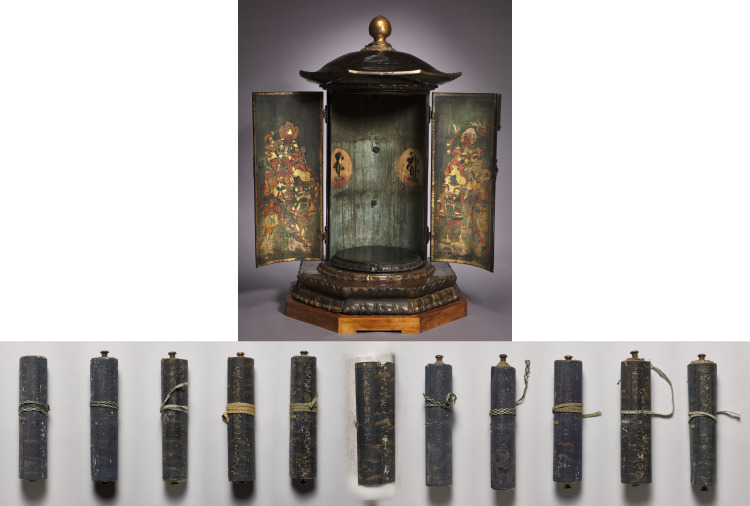
The companion piece is a different object class and a different problem. Cleveland accession 1969.130 is not a flat sutra box but a tall standing shrine-style repository (kyō-zushi register, 経厨子 / 経蔵 reading): 160 cm in overall height, with a domed-finial lid over a cylindrical body, swing-out front doors, and a tiered octagonal base.
The catalog identifies it as one of an originally-paired set; the second repository is lost. Cleveland holds the surviving repository plus eleven companion sutra-volume handscrolls from the dedication. The repository alone is separately accessioned as 1969.130.1; the individual sutra volumes are 1969.130.2.a through .l (or whichever sub-suffix the museum has assigned to the surviving eleven).
One representative volume, 1969.130.2.d (“Volume from the Great Perfection of Wisdom Sutra”), is recorded as a handscroll in ink and gold on dyed paper, the more common gold-only register of the type rather than the gold-and-silver of 1916.1060.4
The repository is the kind of object that organizes how one thinks about the sutra-copying programme. The Daihannya-kyō in the canonical Xuanzang translation runs to six hundred fascicles, the longest single text in the East Asian Buddhist canon and the standard scripture for issaikyō-class merit-copying programmes (一切経, ‘all the sutras’, the complete tripiṭaka).5
A complete copying programme produced six hundred handscrolls, each rolled around a wooden core with bone or lacquer end-knobs, and each bound between paired protective covers. To house six hundred volumes a single repository is insufficient; the canonical solution was paired storage at temple scale, and the surviving Cleveland repository is the surviving half of one such pair. The lost mate would have held the other portion of the set.
What is on the doors and back panel is the iconographic argument the object actually makes. The Cleveland catalog records both halves clearly.
On the doors: “Eight of the 16 benevolent but fierce looking deities who protect the text appear on the doors.” These are the Jūroku Zenjin (十六善神, ‘sixteen good gods’), the canonical guardian retinue of the Mahāprajñāpāramitā-sūtra in the East Asian Buddhist tradition. Each door panel of the Cleveland repository carries four protectors — eight in total, a half-set — and the lost mate-repository would have carried the other eight. The visual programme is the standard Daihannya tenmae (大般若転読, ritual recitation of the prajñāpāramitā) protective iconography.
On the back panel: “Two discs painted on the back have the sacred syllables representing the Buddha Shakyamuni and the Buddha Amida.” These are bīja (種字, shuji), Sanskrit seed-syllables encoding the deity in a single graph. Shakyamuni and Amida, paired, place the dedication doctrinally between historical-Buddha veneration and Pure Land aspiration: a hybrid configuration that is plausible for a late-twelfth-century commission contemporary with the Hōnen-Shinran formative period but pre-Jōdo-shū institutional consolidation.
The medium specification on Cleveland 1969.130 spells out the canonical Heian sumptuous-lacquer programme: black or red urushi ground (urushi, 漆), painted figural and floral decoration in ink and pigment, applied gold pigment and gold leaf, kirikane (截金, cut-gold linear ornament applied as fine strips of beaten gold leaf), and gilt-bronze metalwork (typically corner mounts, lockplates, and hinges).
On a 160-cm standing repository this surface programme is substantially larger than a small-format kyōbako would carry: the painted figural panels on the inside of the doors (each roughly 60–80 cm tall in proportion) become themselves devotional pictures rather than decorative ornament, and the seed-syllable discs on the back panel function liturgically as the focus of a closed-door reverence. The combination is a register one or two below the maki-e (蒔絵, sprinkled-metal-powder lacquer) cabinetry that the highest-prestige Heian aristocratic commissions used, but it sits comfortably within the upper tier of twelfth-century ritual-object production.6
What the eleven surviving volumes register is a programmatic survival in fragment. A late-twelfth-century Daihannya-kyō dedication produced six hundred volumes; eleven survive in Cleveland’s holding, kept with the surviving repository half. The other five hundred and eighty-nine volumes are dispersed, lost, or held elsewhere under separate accession numbers and untraced provenance — and the paired-mate repository has not been located in published institutional records.
The Cleveland eleven are an instructive small sample: enough to confirm that the dedication used the canonical Xuanzang text in gold-on-dyed-paper format, with the repository in the matching lacquer programme, but not enough to reconstruct the dedication’s commissioning patron, its temple destination, or its date within the late twelfth century beyond what the repository’s lacquer style and the Shakyamuni-Amida bīja pairing support. Tracking the lost mate-repository through other museum or temple holdings, if it survives, would substantially tighten the picture.
The institutional ground: aristocratic merit-copying programmes
The class of object both Cleveland accessions belong to is the dedicated sutra copy (hōkō-shakyō, 奉行写経, or more loosely kuyō-kyō, 供養経): a sutra produced not for everyday liturgical use but as the material vehicle of a merit-transfer dedication, commissioned by an aristocratic patron for a specific religious purpose and presented to a temple as the tangible offering.7 By the late Heian period, two principal dedication motives had stabilized.
The first was tsuizen-kuyō (追善供養, posthumous merit-transfer): a dedication for the benefit of a deceased family member, typically a parent, a spouse, or a child, in which the merit accrued by commissioning and producing the sutra was formally transferred to the deceased to assist their rebirth into a favorable destination. Genshin’s Ōjōyōshū (985) had codified the deathbed-and-postmortem ritual programme that aristocratic Heian families followed; commissioning a dedicated sutra in the year following a death was one of the standard merit-acts a senior family would undertake, alongside building or endowing a memorial chapel.8
The second was hōkō (奉行): a dedication on behalf of the living, often the patron themselves, intended to accumulate merit during the patron’s lifetime to ensure favorable conditions in the present life and a favorable rebirth. Both Fujiwara no Michinaga’s Hōjō-ji programme (1020) and Fujiwara no Kiyohira’s Chūson-ji issaikyō (begun 1117) belong to this class: a sustained, multi-decade commissioning programme in which the patron systematically produced sumptuous sutra copies as part of a broader Pure Land merit-construction programme tied to the patron’s own posthumous trajectory.9
The Cleveland materials sit somewhere within this dedication framework, but the specific patron, temple, and date for either accession have not been published. The 1969.130 Daihannya-kyō dedication is the clearer case in class terms: an issaikyō-tier commission of a six-hundred-fascicle text plus a matching prestige repository is a substantial undertaking, plausibly Fujiwara-network or senior-temple-affiliated, plausibly tied to a sustained merit-construction programme rather than a single posthumous offering.
The 1916.1060 Abhidharmakośa fragment is harder to place. The text is a doctrinal commentary central to the Hossō and Kusha schools rather than a Pure Land devotional text, and a sumptuous gold-and-silver copy of it is more plausibly tied to a Nara-temple or Hossō-affiliated commission than to a Fujiwara Pure Land programme. The published Cleveland record does not tighten the attribution.
Reading against the canonical comparanda
Two large-scale dated comparanda anchor the surviving Heian sumptuous-sutra corpus. Both are unavoidable when reading any unattributed twelfth-century gold-on-indigo fragment.
Chūson-ji (中尊寺) at Hiraizumi in Iwate Prefecture holds the principal surviving Heian issaikyō programme. Two Heian canons are tied to it. Fujiwara no Kiyohira (1056–1128) had a complete tripiṭaka copied between 1117 and 1126 in alternating lines of gold and silver on indigo, with hōsōge-arabesque covers and frontispieces of Shakyamuni preaching; his grandson Hidehira later commissioned a second canon in gold characters only. Most of the surviving Kiyohira volumes, more than four thousand scrolls designated National Treasure, are now at Kongōbu-ji on Kōyasan rather than at Chūson-ji itself, and the set is the canonical reference point for Heian gold-and-silver sutra dating.10
Cleveland 1916.1060 matches the Kiyohira format point for point: alternating gold and silver lines, a gold arabesque cover, a preaching-Shakyamuni frontispiece. That is consistent with the Kiyohira canon but does not prove membership. The museum’s 1916 inaugural catalogue called it a “Hidehira Sutra,” a label nothing in the scroll explains.
Itsukushima Shrine at Hatsukaichi in Hiroshima Prefecture holds the Heike Nōkyō (平家納経), the thirty-three-scroll Lotus Sutra dedication commissioned by Taira no Kiyomori (1118–1181) and his Heike-clan family members in 1164. Each of the thirty-three scrolls was assigned to a different Heike family member as commissioner, and each was produced by a different team of calligraphers, painters, and metalworkers, yielding a set in which no two scrolls follow the same visual programme.
The combined apparatus (gold and silver pigments, applied gold and silver leaf, kirikane, figural mikaeshi, gilt-bronze fittings, brocade covers) is the apex case of the late-Heian sumptuous-sutra dedication class.11 The Heike Nōkyō is a calibration object: nothing in the surviving Heian corpus surpasses it in finish, and any twelfth-century sumptuous-sutra fragment is read against its register.
The Cleveland 1916.1060 fragment cannot be placed within either programme on the published evidence. It is twelfth-century, it is gold-and-silver-on-indigo, it carries the Abhidharmakośa-bhāṣya text, and the Worcester R. Warner Collection bequest in 1916 is its earliest documented owner. Pre-1916 provenance (the temple of origin, the patron, the dispersal route into the late-nineteenth or early-twentieth-century international market) is not in the published record.
The text itself argues against a Pure Land aristocratic commission: the Abhidharmakośa is a Hossō-school doctrinal text, more plausibly tied to a Nara temple commission than to a Heike or Fujiwara Pure Land programme. The 1969.130 Daihannya-kyō dedication is on the other side of the textual line, in standard issaikyō-class Mahāyāna scripture, but its lacquer repository’s late-twelfth-century date and high-prestige finish are equally unattributed.
What the photographs cannot resolve
Both Cleveland accessions sit in storage. The catalog records list both as not currently on view; high-resolution Cleveland-Open-Access imagery is the principal access route for a researcher today. That access has limits the printed record makes plain.
For 1916.1060, the published image resolves the column ground, the gold characters, and the indigo paper at a register sufficient to read the text technique. What it does not resolve is the silver oxidation extent (whether the silver register is still differentially legible against the gold or has darkened to near-uniform grey-brown), the paper’s surface texture (whether the indigo-dyeing has the characteristic uneven mottling of late-Heian ai-vat work or the more uniform machine-like dyeing of later Edo restorations), the column-ruling technique (whether ruled in gold on the indigo ground, in silver, or in a fugitive third pigment), and the original cover apparatus (the wooden core, the cover materials, the protective wrapper, all of which are unrecorded in the catalog).
For 1969.130, the parent record image (the open-doors-with-volumes-laid-out composite reproduced above) resolves the repository’s overall form, the doors-and-back iconographic programme at the level of identifying figural panels and bīja discs, and the eleven companion volumes’ indigo-cord-tied register.
What it does not resolve is the specific identification of which eight of the sixteen Jūroku Zenjin are present (the catalog says eight without naming them; the named-protector identifications would require either Cleveland’s internal documentation or closer examination at higher resolution), the precise kirikane patterning, the maki-e-or-not status of the gold areas (whether sprinkled-powder or applied-leaf or painted pigment), the metalwork’s alloy composition, or the back-panel bīja in their specific Siddhaṃ forms (the catalog gives the deity-identification, not the specific seed-syllable graphs used).
The eleven companion volumes are imaged in the same composite; the published reproduction does not separately resolve the mikaeshi, the cover apparatus, or any dedication colophon at the head or tail of an individual scroll.
The honest reading. The Cleveland materials are good evidence for the type-class and reasonable evidence for the late-twelfth-century dating window. They are not, on the published evidence, sufficient to attribute either accession to a specific dedication, commissioning patron, temple of origin, or workshop.
The 1969.130 repository’s Shakyamuni-Amida bīja pairing and Jūroku Zenjin doors give the object a specific iconographic identity that future research can build from; the 1916.1060 fragment’s identification as fascicle 17 of 30 in the Xuanzang Abhidharmakośa-bhāṣya translation similarly gives a textual specificity that any future search of Heian sutra-fragment holdings can use to test for matched fascicles in other collections.
Closing the broader attribution gap would require a Cleveland conservation report (technical analysis of the indigo-dye chemistry, the gold-and-silver pigment alloys, and the urushi composition), a search of the Worcester R. Warner Collection’s pre-1916 acquisition records, location of the lost paired-mate repository for 1969.130, and a comparative-style analysis against the dated comparanda at Chūson-ji, Itsukushima, and the better-documented late-Heian sutra-fragment holdings at Tōkyō National Museum, Nara National Museum, and the Kyoto National Museum. None of that work is in the published English-language record as of the access date.
What the materials do support, without the attribution apparatus, is a clearer view of the late-Heian sumptuous-sutra production system in its institutional shape: the indigo-paper-and-metallic-ink text technique on one side, the lacquered prestige-repository cabinetry on the other, both tied into the aristocratic and temple commissioning programmes that produced the canonical twelfth-century corpus. Cleveland 1916.1060 and 1969.130 are two pieces of that apparatus in a North American holding, and they read better together than either does alone.
Related
- The Yūzū Nenbutsu engi: a Cleveland illuminated handscroll
- A Heian cinerary urn engraved with Amida’s Pure Land
- A late-Heian bosatsu-men at Cleveland: 1950.581
- Kirikane on a Kamakura bodhisattva: Cleveland 1983.18
- The white path between two rivers: a Pure Land parable
- Cleveland’s Nanbokuchō raigō: the twenty-five-bodhisattva descent
Footnotes
-
Cleveland Museum of Art, accession 1916.1060, “Meta-Discourse on the Teachings from the Treasury (Abidharmakosha-Bhashya),” Japan, Heian period (794–1185), 1100s; medium “handscroll; gold and silver on indigo-dyed paper”; classification Manuscript; credit line Worcester R. Warner Collection; CC0 (Cleveland Open Access). Catalog page accessed 2026-04-26 at clevelandart.org/art/1916.1060. The accession is single (no .a/.b component split). The museum’s provenance record gives Kuroda Takuma (1867–?), Tokyo, who sold it to the museum in 1916; the Worcester R. Warner Collection was a purchase fund Warner gave for Asian art, not a bequest. ↩
-
For the technical-and-historical conventions of konshikyō (紺紙経, ‘indigo-paper sutra’) and konkonji-kyō (紺紙金字経, ‘indigo-paper gold-character sutra’), see JAANUS (aisf.or.jp/~jaanus/deta/k/konshikyou.htm, accessed 2026-04-26) for the Tier-2 institutional summary, and Willa Jane Tanabe, Paintings of the Lotus Sutra (Weatherhill, 1988), which treats the technical apparatus across the surviving Heian and Kamakura sumptuous-sutra corpus. The gold-and-silver-on-indigo variant is high-prestige; the gold-only variant is the more common late-Heian dedicated-sutra programme. The 1969.130.2.d Cleveland Daihannya volume is gold-only (“ink and gold on dyed paper”), placing the two Cleveland materials on either side of the high-prestige line. ↩
-
Silver tarnishing on gindei (銀泥) sutra texts is the standard late-Heian conservation observation. The 1164 Heike Nōkyō scrolls at Itsukushima Shrine and the early-twelfth-century Chūson-ji issaikyō volumes at Hiraizumi both display extensive silver-character oxidation; on most surviving gold-and-silver-on-indigo scrolls the silver register has darkened to grey-brown or near-black and reads at much lower contrast than the gold. See Komatsu Shigemi, Heike Nōkyō no kenkyū (Kōdansha, 1976), volume on conservation history, for the standard treatment of the oxidation pattern; Tanabe 1988 summarizes the issue in English. The Cleveland 1916.1060 page does not publish a conservation report, so the specific tarnishing extent on this sheet is not confirmable without direct examination. ↩
-
Cleveland Museum of Art, parent accession 1969.130, “Repository for the Great Perfection of Wisdom Sutra and Eleven Volumes of the Great Perfection of Wisdom Sutra,” Japan, Heian period (794–1185), late 1100s; medium “lacquered wood with ink, color, gold, cut gold, and metalwork”; classification Lacquer; credit line John L. Severance Fund; dimensions overall height 160 cm; CC0 (Cleveland Open Access). The catalog text identifies the object as “one of a pair” with eight of the sixteen Jūroku Zenjin protectors on the doors and Sanskrit bīja for Shakyamuni and Amida on the back-panel discs. The repository alone is separately accessioned as 1969.130.1; a representative companion volume 1969.130.2.d (“Volume from the Great Perfection of Wisdom Sutra”; medium “Handscroll; ink and gold on dyed paper”; credit line Anonymous Gift) follows the more common gold-only late-Heian sumptuous-sutra programme rather than the gold-and-silver of 1916.1060. The mixed credit lines (Severance for the parent and the repository, Anonymous Gift for at least one volume) indicate that the repository and the volumes entered the museum’s holdings through different gift channels and were collated under the parent accession 1969.130 for cataloguing purposes. Catalog pages accessed 2026-05-07. ↩
-
For the Daihannya-kyō (大般若経, Mahāprajñāpāramitā-sūtra) in the canonical Xuanzang translation (660–663 CE), running to six hundred fascicles and constituting the longest single text in the East Asian Buddhist canon, see Peter Kornicki, Languages, Scripts, and Chinese Texts in East Asia (Oxford University Press, 2018), on the East Asian transmission of Buddhist canonical texts and the canonical organization of the prajñāpāramitā corpus. The text is the standard scripture for issaikyō-class (一切経) merit-copying programmes; a complete copying programme produced six hundred handscrolls, with the larger commissioning programmes copying the entire tripiṭaka in the thousands of fascicles. ↩
-
For the Heian sumptuous-lacquer cabinetry programme combining urushi ground, ink-and-color decoration, gold pigment and applied gold leaf, kirikane (截金) linear ornament, and gilt-bronze metalwork, see the standard treatments in the Heian metalwork-and-lacquer survey literature; the Tōkyō National Museum and Nara National Museum both hold comparable late-twelfth-century kyōbako with documented temple provenance. The Cleveland 1969.130 repository sits within the upper tier of twelfth-century ritual-object production: a register or two below the maki-e (蒔絵) cabinetry of the very highest aristocratic commissions, and comfortably within the production capacity of an established temple lacquer workshop or a senior Fujiwara-affiliated atelier. ↩
-
For the dedicated-sutra-copy (hōkō-shakyō, kuyō-kyō) class as the institutional context for late-Heian sumptuous sutra production, see Willa Jane Tanabe, Paintings of the Lotus Sutra (Weatherhill, 1988), chapter on the dedication and presentation context; and Peter Kornicki, Languages, Scripts, and Chinese Texts in East Asia (Oxford University Press, 2018), on the institutional apparatus of sutra-copying programmes in Heian Japan. The dedicated copy is distinguished from the everyday liturgical or study copy by its material apparatus (sumptuous paper, metallic inks, figural frontispiece, prestige cover-and-knob mountings) and by its formal dedication ceremony at the receiving temple. ↩
-
For tsuizen-kuyō (追善供養, posthumous merit-transfer) as a standard Heian aristocratic ritual practice, with dedicated sutra-copying as one of the canonical merit-acts, see Robert F. Rhodes, Genshin’s Ōjōyōshū and the Construction of Pure Land Discourse in Heian Japan (University of Hawaiʻi Press, 2017), on Genshin’s codification of the deathbed-and-postmortem programme that the Heian aristocracy adopted from the late tenth century forward. The diaries of Heian aristocrats (notably Michinaga’s Midō kanpaku ki, 御堂関白記) document the commissioning of dedicated sutras as part of the standard ritual response to family deaths. ↩
-
For Fujiwara no Michinaga’s Hōjō-ji Pure Land complex (1020) and the eleventh-century aristocratic Pure Land merit-programme, see Rhodes 2017 and the standard Heian-period architectural-and-religious literature; the Hōjō-ji burned in 1058 and the building complex is lost, but the documentary apparatus (Michinaga’s diary and the Eiga monogatari account) survives. For Fujiwara no Kiyohira’s Chūson-ji issaikyō (begun 1117 and continued by Motohira and Hidehira through the late twelfth century), see Mimi Hall Yiengpruksawan, Hiraizumi: Buddhist Art and Regional Politics in Twelfth-Century Japan (Harvard University Asia Center, 1998), the standard English-language treatment of the Northern Fujiwara cultural complex. The Chūson-ji set is the single largest surviving Heian issaikyō-class konkonji-kyō programme. ↩
-
For the Chūson-ji issaikyō (中尊寺一切経) commissioned by Fujiwara no Kiyohira (1056–1128) at Hiraizumi from 1117 forward and continued by his successors, see Mimi Hall Yiengpruksawan, Hiraizumi: Buddhist Art and Regional Politics in Twelfth-Century Japan (Harvard University Asia Center, 1998), the standard English-language monograph on the Northern Fujiwara cultural complex, and Wikidata Q1086094 for the temple. The original commission ran to a complete tripiṭaka in the thousands of fascicles; a substantial portion survives at Chūson-ji’s Konjiki-dō treasury. Yiengpruksawan’s chapter on the issaikyō programme is the single most useful English-language treatment of the patronage-and-production apparatus behind a late-Heian sumptuous-sutra commission at scale. ↩
-
For the Heike Nōkyō (平家納経) Lotus Sutra dedication of 1164 (Chōkan 2) at Itsukushima Shrine, the canonical Japanese-language treatment is Komatsu Shigemi, Heike Nōkyō no kenkyū (Kōdansha, 1976), in three volumes. Wikidata Q1043037 records the set. The thirty-three-scroll set was commissioned by Taira no Kiyomori (1118–1181) and his Heike-clan family members in the period leading up to the Genpei War; each scroll was assigned to a different family-member commissioner and produced by a different team of calligraphers, painters, and metalworkers, producing a set with no internal visual uniformity. The set is designated a Japanese National Treasure and is the apex case of the late-Heian sumptuous-sutra dedication class. ↩
Further works cited
- Title
- Repository for the Great Perfection of Wisdom Sutra and Eleven Volumes of the Great Perfection of Wisdom Sutra
- Period
- Japan, Heian period (794–1185), late 1100s
- Region
- Japan
- Medium
- Lacquered wood with ink, color, gold, cut gold, and metalwork
- Dimensions
- Height 160 cm (63 in.)
- Collection
- Cleveland Museum of Art
- Rights
- Cleveland Museum of Art (CC0). John L. Severance Fund.
Cleveland 1969.130: 160-cm standing lacquered repository, one of an originally-paired set, with the eleven surviving companion volumes of the Daihannya-kyō dedication. The two open doors carry eight of the sixteen Daihannya protector deities (Jūroku Zenjin, 十六善神); the back panel carries Sanskrit bīja for Shakyamuni and Amida. Lacquered wood with ink, color, gold, cut gold (kirikane), and metalwork. John L. Severance Fund. CC0.
Sources
-
Cleveland's catalog records the work as 'Meta-Discourse on the Teachings from the Treasury (Abidharmakosha-Bhashya)' (阿毘達磨倶舎論), Japan, Heian period (794–1185), 1100s; medium 'handscroll; gold and silver on indigo-dyed paper'; classification Manuscript; dimensions 26.4 × 670.6 cm (10 3/8 × 264 in.). Credit line Worcester R. Warner Collection 1916.1060. CC0 (Cleveland Open Access). The catalog text identifies the surviving handscroll as 'the 17th section of a 30-part translation by Xuanzang' — i.e., fascicle 17 of the canonical thirty-fascicle Xuanzang translation (T 1558, completed 651–654) of Vasubandhu's c. fourth- or fifth-century Sarvāstivāda-Sautrāntika philosophical commentary on the Abhidharmakośa, a foundational text of the Hossō and Kusha schools of Nara Buddhism. The 6.7-metre length is consistent with the surviving fascicle being substantially complete rather than a small fragment. The accession is single (no .a / .b suffix). Pre-acquisition provenance prior to the Worcester R. Warner Collection bequest is not published in the catalog page accessed 2026-05-07.
-
Cleveland's catalog records the parent accession 1969.130 as a composite: a tall standing lacquered repository (overall height 160 cm) and eleven companion sutra-volume handscrolls in the same dedication group. Period Heian (794–1185), date late 1100s; medium 'lacquered wood with ink, color, gold, cut gold, and metalwork'; classification Lacquer; credit line John L. Severance Fund. CC0 (Cleveland Open Access). The catalog text identifies the repository as 'one of a pair that once contained the scrolls of a religious text called the Great Perfection of Wisdom Sutra. Two discs painted on the back have the sacred syllables representing the Buddha Shakyamuni and the Buddha Amida. Eight of the 16 benevolent but fierce looking deities who protect the text appear on the doors.' The Daihannya-kyō (大般若経, Mahāprajñāpāramitā-sūtra) in the canonical Xuanzang translation (660–663) is six hundred fascicles, the longest single text in the East Asian Buddhist canon. The sixteen protector deities (Jūroku Zenjin, 十六善神) are the standard guardian iconography for Daihannya-kyō dedications; the surviving Cleveland repository carries eight of them on its two doors, while the lost paired repository carried the other eight. Pre-acquisition provenance is not published in the catalog page accessed 2026-05-07.
-
The repository (kyōbako) component of accession 1969.130, separately accessioned as 1969.130.1. Lacquered wood ground with painted, gilded, and cut-gold (kirikane, 截金) decoration and metal fittings. The combination of materials in the medium field describes the canonical Heian sumptuous-lacquer programme: black-or-red urushi ground, ink-and-color painted figural and floral decoration, gold pigment and applied gold sheet for high-prestige passages, cut-gold leaf for fine linear decoration, and metalwork (typically gilt-bronze hinges, lockplates, and corner mounts). MANIFEST.tsv row cma-400993.jpg.
-
One of the surviving sutra-volume handscrolls in the Cleveland Daihannya-kyō dedication group, a sub-component of accession 1969.130. Medium 'Handscroll; ink and gold on dyed paper' — note the medium is gold (without silver) on dyed paper, distinct from the gold-and-silver-on-indigo programme of 1916.1060. The credit line on this sub-component is 'Anonymous Gift' rather than the parent accession's John L. Severance Fund, indicating that the volumes and the repository entered the museum's holdings through different gift channels and were collated under a single accession number 1969.130 for cataloguing purposes. MANIFEST.tsv row cma-401002.jpg.
-
Tanabe's monograph on the Heian and Kamakura illustrated-Lotus-Sutra tradition is the standard English-language treatment of the sumptuous-sutra production class, including frontispiece (mikaeshi, 見返し) figural design, the gold-and-silver-on-indigo (konkonji-kyō, 紺紙金字経) text technique, and the aristocratic dedication programmes within which the high-prestige sutra copies were commissioned. Cited for the technical-and-iconographic frame within which the Cleveland 1916.1060 Abhidharmakośa volume sits, even though the Abhidharmakośa is not itself the Lotus Sutra; the technical apparatus (indigo-dyed paper, kondei application, brush-ruled column ground) is shared across the whole sumptuous-sutra class.
-
Yiengpruksawan's monograph on the twelfth-century Northern Fujiwara cultural complex at Hiraizumi treats the Chūson-ji issaikyō (中尊寺一切経) — a complete tripiṭaka-copying programme commissioned by Fujiwara no Kiyohira (1056–1128) and continued by his successors, originally in the thousands of fascicles, surviving substantially today — as the canonical regional instance of late-Heian sumptuous-sutra production. The Chūson-ji set is the single largest surviving issaikyō-class konkonji-kyō programme and the principal comparandum for any unattributed Heian gold-on-indigo sutra fragment. Cited for the institutional and aristocratic-merit framework within which Cleveland's late-twelfth-century materials sit.
-
Komatsu's three-volume study of the Heike Nōkyō (平家納経), the thirty-three-scroll Lotus-Sutra dedication commissioned by Taira no Kiyomori (1118–1181) and presented to Itsukushima Shrine in 1164, remains the standard Japanese-language treatment. The Heike Nōkyō is the most ornate surviving example of late-Heian Heike-clan dedicated-sutra production: each scroll given to a different family member, frontispieces in different hands, each scroll in a distinct visual programme combining gold and silver pigments, applied gold and silver leaf, kirikane, and figural mikaeshi. Cited as the apex case of the dedication-and-display class within which Cleveland's 1916.1060 and 1969.130 materials sit at a humbler register.
-
Kornicki's monograph treats the East Asian transmission of Buddhist canonical texts and the institutional apparatus of sutra-copying in Japan, including the Nara-period state-sponsored scriptoria (shakyōjo, 写経所), the Heian-period shift to aristocratic and temple-based copying programmes, and the canon's textual stability across translation lineages. Cited for the broader context of issaikyō-class commissioning programmes and the canonical organization of the Daihannya-kyō within the East Asian Buddhist canon.
-
Rhodes treats Genshin (源信, 942–1017) and the Ōjōyōshū (985), the formative Heian-period text of Japanese Pure Land Buddhism, and the late-tenth- and eleventh-century institutional context within which aristocratic merit-copying programmes (including dedicated sutra production) became the standard form of tsuizen-kuyō (追善供養, posthumous merit-transfer). Cited for the doctrinal-and-institutional context within which the Cleveland sutra materials' commissioning is read.
-
Pelliot's mid-twentieth-century cataloguing of Dunhuang and East Asian sutra-copying material, continued in subsequent French-and-Chinese-language scholarship, supplies the broader Silk-Road context for the transmission of the Daihannya-kyō (Xuanzang's 660–663 translation of the Mahāprajñāpāramitā-sūtra in six hundred fascicles) and the Abhidharmakośa-bhāṣya from Chinese-Buddhist into Heian-Japanese institutional use. Cited as the canonical entry point to the broader transmission literature.
-
The Chūson-ji issaikyō (中尊寺一切経, Chūson-ji tripiṭaka) is the principal surviving Heian sumptuous-issaikyō programme, commissioned by Fujiwara no Kiyohira (1056–1128) at his northern Hiraizumi seat from 1117 forward and continued by his son Motohira and grandson Hidehira through the late twelfth century. The original commission ran to a complete tripiṭaka in the thousands of fascicles, with each scroll in gold ink on indigo-dyed paper or in gold-and-silver alternating columns; a substantial portion survives at Chūson-ji's Konjiki-dō treasury and at affiliated institutions. The Chūson-ji set is the single largest surviving Heian konkonji-kyō programme and the closest large-scale dated comparandum for the Cleveland 1916.1060 fragment and the 1969.130 dedication group. Wikidata Q1086094 records the temple.
-
The Heike Nōkyō (平家納経, 'sutra dedication of the Heike') is a thirty-three-scroll set of the Lotus Sutra (Hokke-kyō), the Sutra of Innumerable Meanings, the Sutra of the Practice of Visualizing the Bodhisattva Universal Worthy, and the Heart Sutra, dedicated by Taira no Kiyomori (1118–1181) and his Heike (Taira) clan to Itsukushima Shrine in 1164 (Chōkan 2). Each scroll was assigned to a different Heike family member as commissioner, and each was produced by a different team of calligraphers, painters, and metalworkers, yielding a thirty-three-scroll set in which no two scrolls follow the same visual programme. The set combines gold and silver pigments (kondei, gindei), applied gold and silver leaf, kirikane, figural mikaeshi (frontispiece) paintings, and elaborate cord-and-tassel mountings. The set is designated a Japanese National Treasure and is the apex case of the late-Heian sumptuous-sutra dedication class. Wikidata Q1043037 records the set.
-
Fujiwara no Michinaga (藤原道長, 966–1027), the Sekkanke regent at the apex of the eleventh-century Heian aristocracy, commissioned the Hōjō-ji (法成寺) Pure Land complex (1020) at his Kyoto residence, including a nine-Amida hall, a yakushi-dō, and an associated sutra-storage and copying programme. His diary (Midō kanpaku ki, 御堂関白記) documents the commissioning of dedicated sutra copies as part of the Pure Land merit-programme around his last years and his daughters' birth-and-death rites. The Hōjō-ji burned in 1058 and the building complex is lost; the documentary apparatus survives. Cited as the canonical eleventh-century aristocratic-Pure-Land case for the late-Heian sumptuous-sutra commissioning context within which the Cleveland materials sit.
-
Ten Grotenhuis treats the late-Heian Pure Land visual programmes within which the sumptuous-sutra production class operated; the Phoenix Hall painted programme at Byōdō-in (1053) is treated as the canonical large-scale Heian Pure Land visual treatment, contemporary with the upper margin of the Cleveland materials' dating window. Cited for the broader visual-cultural context of late-Heian aristocratic merit-and-display programmes.
-
Kornicki's chapter-level work on Heian-Kamakura Buddhist material culture, including dedicated sutra-copying programmes by aristocratic women patrons (sometimes in tsuizen-kuyō for deceased husbands or children), supplies a useful gender-and-patronage frame for reading otherwise unattributed sumptuous-sutra fragments. Cited as a contextual reference for the diversity of patronage routes by which a twelfth-century gold-and-silver-on-indigo sutra fragment could enter the surviving record.
-
The Japanese Architecture and Art Net Users System (JAANUS) entries on konshikyō (紺紙経, 'indigo-paper sutra') and konkonji-kyō (紺紙金字経, 'indigo-paper gold-character sutra') summarize the technical-and-historical conventions of the type. Cited as a Tier-2 institutional reference for the technical vocabulary; JAANUS is read against the more recent monograph literature where they conflict.
-
Wikidata Q-item for Chūson-ji (中尊寺) at Hiraizumi, Iwate; the temple holding the principal surviving Heian issaikyō konkonji-kyō programme. Cited as the institutional Q-item for the closest dated large-scale comparandum to Cleveland's late-twelfth-century materials.
-
Wikidata Q-item for the Heike Nōkyō (平家納経) Lotus Sutra dedication of 1164 at Itsukushima Shrine, the apex case of late-Heian Heike-clan sumptuous-sutra production. Cited as the institutional Q-item for the high-prestige dedication-class comparandum.
-
No dedicated Wikidata item for Cleveland 1916.1060 has been located.
-
No dedicated Wikidata item for Cleveland 1969.130 (the lacquered Daihannya-kyō repository and companion volumes) has been located.