Gōshō mandara: Amida receives a warrior's soul, c. 1300
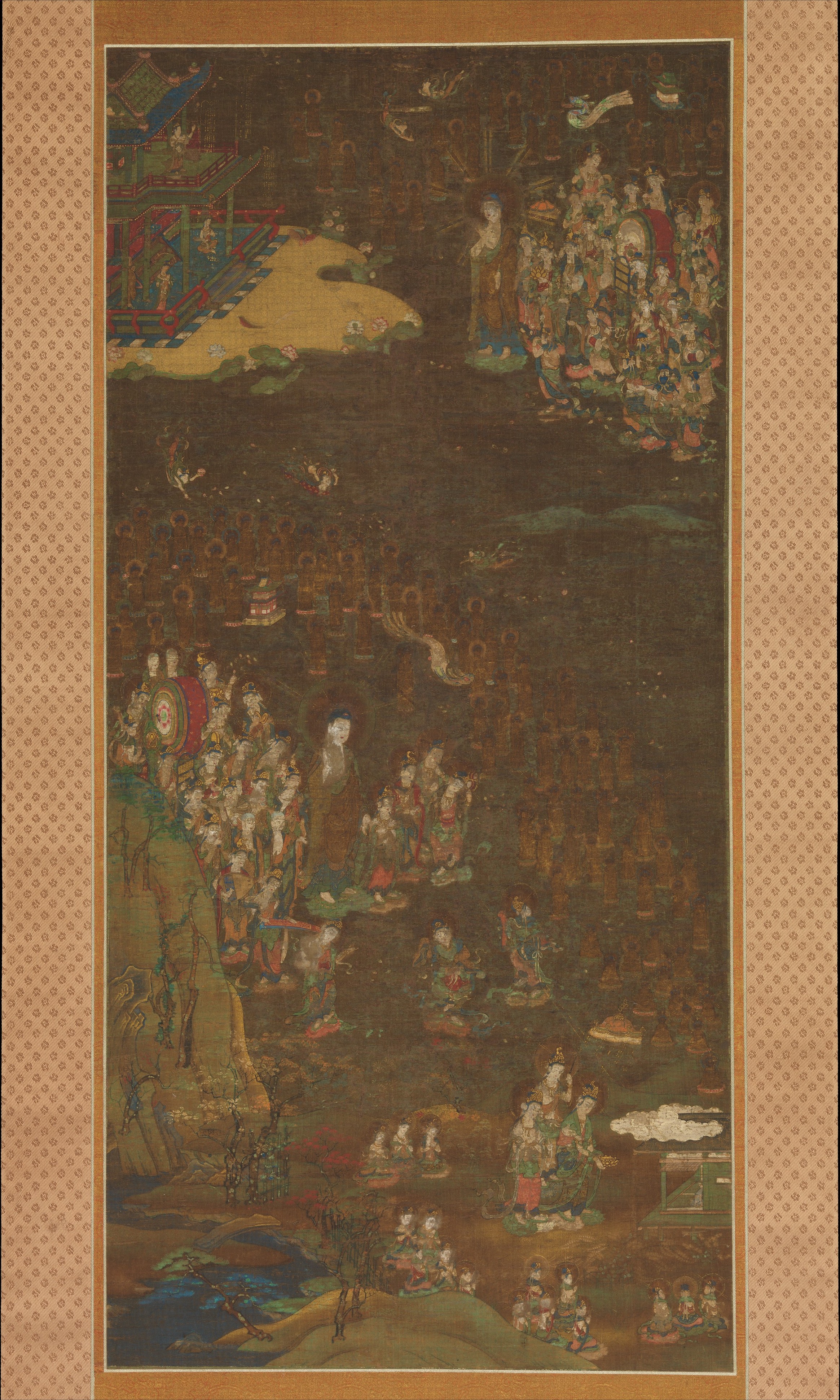
- Title
- Descent and Return of Amida to Western Paradise with a Believer's Soul (Gōshō mandara) — Met 1975.268.21, c. 1300
- Period
- Kamakura period (1185–1333), c. 1300 (1290–1310)
- Region
- Japan
- Medium
- Hanging scroll; ink and color on silk
- Dimensions
- Image: 111.8 × 53 cm (44 × 20 7/8 in.). Overall with mounting: 204.5 × 70.5 cm (80 1/2 × 27 3/4 in.)
- Collection
- Metropolitan Museum of Art, New York
- Accession
-
1975.268.21 - Rights
- Public Domain. The Metropolitan Museum of Art, New York, The Harry G. C. Packard Collection of Asian Art, Gift of Harry G. C. Packard, and Purchase, Fletcher, Rogers, Harris Brisbane Dick, and Louis V. Bell Funds, Joseph Pulitzer Bequest, and The Annenberg Fund Inc. Gift, 1975 (acc. 1975.268.21). Met Open Access (OASC).
Met 1975.268.21: the descent (right) and return (left) on a single picture plane. The believer at the foot of the scroll is the Genpei-War warrior Kumagai Naozane (1141–1208), whose salvation Hōnen (1133–1212) saw in a dream and recorded. The descent-and-return type is rare — perhaps two surviving examples (Met c. 1300; Hakata Zendō-ji, 16th c.).
Two cloud-bands cross a single picture plane. The right band sweeps down; the left band rises up. They join at the top centre, at a small palatial gate. The descent and the return are painted on the same silk: neither in sequence, nor in two panels, but on one surface, with the picture itself becoming the round trip.
The cloud-band on the right carries Amida down. He is gold-bodied, central, framed by Kannon and Seishi, attended by smaller bodhisattvas and celestial musicians. The cloud-band on the left carries the same retinue back up, and this time something has been added. A small figure rides on a lotus pedestal at the centre of the returning procession: the believer’s soul, escorted back to the Pure Land.
This is what the Met catalog calls a Gōshō mandara (迎接曼荼羅), and what scholarship calls the descent-and-return type. It is a rare variant of raigō: perhaps only two surviving examples, this one c. 1300 at the Met and a 16th-century version at Hakata’s Zendō-ji.
The warrior at the foot of the scroll
In the lower foreground sits the believer’s house: a tiled veranda and a wooden hall, drawn in steep recession so that the corner of the roof presses against the picture plane. Inside the hall, very small, lies a dying man. The same figure reappears halfway up the left-hand return path, now on the lotus pedestal, carried.
The dying man has a name. The Met’s catalog is precise about it: this is Kumagai Naozane (1141–1208), the warrior who at the 1184 battle of Ichinotani killed the young Taira noble Atsumori, a boy of fifteen or sixteen, found with a flute in his belongings after the helmet came off. The killing was dutiful: Atsumori was a high-ranking enemy commander, and the campaign was the Genpei War, then in its second year. The killing was also unbearable. Within a few years, Naozane sought out Hōnen (1133–1212), the founder of Jōdo-shū, and took the tonsure under him as the priest Rensei. He spent the last two decades of his life in continuous nenbutsu and died in the summer of 1206, by Hōnen-school accounts, in front of a hung image of Amida, while reciting the Buddha’s name.
It is from one of those Hōnen-school accounts that this painting comes. The Met catalog cites a recorded dream of Hōnen in which Amida is seen receiving Naozane’s soul. The picture is the visualisation of the dream, not a generic raigō put together from iconographic primers, but a particular salvation set down on silk a century after the events.
Right side: descent
Look at the right-hand cloud-band first. Amida occupies its centre, full-frontal, gold body against a darker mandorla worked with kirikane, cut gold leaf strips laid into the painted ground in narrow concentric arcs that catch the light when the scroll is hung in proper viewing conditions. His mudra is the raigō-in: the welcoming gesture, both hands held forward, palms outward, thumb-and-finger circles formed.
Kannon flanks Amida on one side and bears the lotus pedestal on which the soul will travel. Seishi flanks the other side, hands in gasshō. The smaller bodhisattvas to either side carry musical instruments (flutes, a hand-drum, a biwa) and the conventional offerings of the twenty-five-bodhisattvas formula condensed into a more economical retinue.
The descent angle is steep but not catastrophic. The Cleveland Museum’s well-known raigō (1953.123) is symmetrical and tranquil, in the Genshin-style register; the Chion-in Hayaraigō is diagonal and headlong. The Gōshō mandara is neither: the descent is a controlled diagonal, fast enough to read as movement, slow enough to read as ceremony. The painter has chosen the middle register because the descent here is only half the picture: there is a return to come, and the eye must have somewhere to go next.
Left side: return
The return is the iconographic singularity that names the type. Standard raigō paintings show descent and stop there: the dying believer in the lower corner, the deity descending, the lotus pedestal extended forward. What happens next is implied but not drawn. The believer dies; the painting holds the moment before that death.
The Gōshō mandara goes through the moment. The dying figure has died; his soul has been seated on the lotus pedestal; the procession reverses and climbs back up. The viewer’s eye, which has just travelled down the right-hand band with Amida, can now travel up the left-hand band with Naozane.
The painter signals the difference with small but specific moves. The figures on the return band face slightly upward; the descent figures face slightly down. The cloud edges on the right curl outward and down; on the left, inward and up. The small palatial gate at the upper centre, where the two bands meet, is the threshold of the Pure Land itself: the descent leaves from it, the return enters through it.
This is not a doctrinal abstraction. It is a salvation in twenty linear minutes: the time it would take a viewer at the deathbed to read down, then up, with the dying nenbutsu in the room.
From Genshin’s 985 text to Hōnen’s 1212 dream
The Met Gōshō mandara is c. 1300. Hōnen died in 1212. Naozane died in 1206. Genshin died in 1017. The text that gives the descent-and-return its iconographic vocabulary is older still: Genshin’s Ōjō-yōshū, the Essentials of Rebirth in the Pure Land, completed in 985 at his Yokawa retreat on Mount Hiei.
The Ōjō-yōshū is organised in ten chapters across three volumes. Chapter 1 (“Detestation of the Defiled Realms”) supplies the graphic six-realms imagery (hell, hungry ghosts, animals, asura, humans, devas) that later medieval Japanese painting will use for the rokudō-e tradition. Chapter 2 (“Aspiration for the Pure Land”) supplies the descent imagery this painting elaborates. Chapter 6 (“Special Occasion Nenbutsu”) prescribes the deathbed practice that the painting is hung for: the dying person holds a five-coloured thread tied to the hand of the Amida image, recites the nenbutsu, and visualises the descent.
Genshin himself was a painter, and the early sources credit him with the prototype raigōzu paintings. He also co-founded the Nijūgo Zanmai-e (the Twenty-Five Samadhi Society) in 986, a confraternity of Mount Hiei monks who promised to attend each other’s deaths and chant the nenbutsu at the bedside. The Society’s monthly vigils and collective hospice care are the lived practice that the iconography exists to support.
The chain is unbroken across three centuries: Genshin’s text (985) → Genshin’s prototype paintings (late 10th c.) → Byōdō-in’s Phoenix Hall (1053) as a three-dimensional Pure Land tableau → Heian and early Kamakura raigōzu (12th c.) → Hōnen’s Jōdo-shū formalisation (late 12th c.) → the Naozane-specific Gōshō mandara (c. 1300).
The Met painting sits at the end of that chain. It is what happens when three centuries of iconographic vocabulary meet one particular warrior’s death.
Gōshō as a rare iconographic type
Most extant raigō paintings (and there are many) show descent only. Cleveland’s 1953.123 in the symmetrical Genshin register, Chion-in’s Hayaraigō in the headlong diagonal register, Kōyasan’s three-piece triptych in the yamagoshi over-the-mountains register, the Met’s own later 14th-century Welcoming Descent of Amida and Bodhisattvas (45.156, Nanbokuchō): these are all descents. The believer is at the foot of the scroll, the deity at the upper centre, the salvation about to be received.
The descent-and-return type is uncommon enough that the field’s primary English-language survey, Okazaki’s Pure Land Buddhist Painting (1977, with ten Grotenhuis’s English adaptation), treats it as a Kamakura-period variant alongside the standard descent. Kanda’s 2002 Yale dissertation, the major English-language study of the genre’s development, locates the descent-and-return innovation precisely in the personal-salvation narratives that flowered around Hōnen and his disciples: where standard raigō is generic and instructional, the Gōshō mandara is biographical and singular.
The two surviving examples that scholarship documents are this one (Met 1975.268.21, c. 1300) and a 16th-century version at Hakata’s Zendō-ji. Whether more existed and were lost is impossible to say from the surviving record. What is documented is that the Met c. 1300 example is the earlier of the two (the closer in time to the Naozane and Hōnen dates) and the one in the better state of preservation.
The Packard 1975 gift
The painting reached the Met as part of one of the largest single transformations of an American Japanese-art collection in the 20th century. In 1975, the museum acquired more than 400 works of Japanese art from the American collector Harry G. C. Packard (1914–1991), by combined gift and purchase. The acquisition turned a serviceable Japanese collection into one of the finest in the West, with encyclopedic range from the Neolithic to the late 19th century, particular strengths in Buddhist iconographic scrolls and in Heian and Kamakura sculpture.
The Met’s institutional account names Packard as an unusual collector among Japanese-art Americans: rather than focusing on one period or one medium, he assembled with encyclopedic ambition. The Gōshō mandara entered with its accession number 1975.268.21: the .21 placing it twenty-first in the .268 register, well into a sustained acquisition lot rather than the first or marquee piece.
That positioning is itself informative. The Packard-gift Pure Land paintings include both the Gōshō mandara and the Amida Triad in the Form of Sacred Sanskrit Syllables (1975.268.22), an embroidered bonji triad in silk and gold-wrapped thread with human hair worked into the embroidery, a related Pure Land devotional object at consecutive accession numbers. The two were almost certainly acquired together as a Pure Land sub-group within the larger gift.
The longer arc is institutional. The Met’s first major Asian-art instrument was the Fletcher Fund of 1917, which acquired the Nanbokuchō Taima Mandala (27.176.2) and other early Pure Land works. The Burke Gift began in 1966 with the Aizen Myōō (66.90). The Packard Gift in 1975 added the largest Japanese-art lot. The Burke Bequest of 2015 supplied the Kaikei Jizō (2015.300.250). Four acquisition events, spread across nearly a century, built the Met’s Japanese Buddhist holdings from a small set of Fletcher-era pieces into the present collection.
What stays open
The Met catalog identifies the Hōnen-dream source but does not pin the textual citation. Hōnen’s recorded dreams are dispersed across several biographical sources: the Hōnen Shōnin Eden (the illustrated forty-eight-scroll biography, early 14th c.), the Shūikotokūden-e (of which the Met holds a section, 1980.221, also c. 1310–20), and the Hōnen Shōnin Gyōjō Ezu. The Naozane dream-record’s specific source-locus is a question for a Hōnen Shōnin biographical scholar.
Whether the Met scroll is from a known workshop, or single-attributable to a named painter, is also open. The catalog assigns no painter and no workshop. The figure-style is mainstream late-Kamakura: competent but not signed.
The pre-Packard ownership chain of the Met scroll is not in the public catalog text. Packard collected in Japan from the late 1940s through the early 1970s; the scroll’s earlier provenance (temple deaccession, dealer chain, family holding) is unsurfaced.
The Hakata Zendō-ji 16th-century Gōshō mandara has not been studied alongside the Met version in published English-language scholarship that surfaces in standard searches. A comparative study of the two surviving examples is one of the open scholarly opportunities the rarity of the iconographic type invites.
Related
For the raigō genre and its descent-only register, see Amida raigō: the welcoming descent, read panel-by-panel. For the Phoenix Hall as the Pure Land iconographic environment that Genshin’s text presupposes, see Byōdō-in Phoenix Hall Amida and Jōchō. For the twenty-five-bodhisattvas raigō programme that this Gōshō mandara condenses, see The Nanbokuchō twenty-five-bodhisattvas raigō. For the Met’s other major Pure Land hanging scroll acquired through the 1927 Fletcher Fund, see Met 27.176.2 Nanbokuchō Taima Mandala. For the Pure Land parable that the descent visualises, see The white path between two rivers.
Sources
-
[1]2026-05-12The Metropolitan Museum of Art, New York collectionapi.metmuseum.org/public/collection/v1/objects/45201Met Open Access API entry. Confirms: accession 1975.268.21; Kamakura period; c. 1300 (1290–1310); medium hanging scroll, ink and color on silk; image 111.8 × 53 cm; overall with mounting 204.5 × 70.5 cm; public domain (CC0); credit line names Harry G. C. Packard Collection gift and purchase, 1975.
-
Met curatorial text (read in search excerpt 2026-05-12): 'This painting of Amida receiving the soul of the warrior Kumagai Naozane (1141–1208) is based on a dream recorded by the founder of the Pure Land sect, Hōnen (1133–1212). Naozane's taking of the tonsure after dutifully but ruefully killing the young Taira no Atsumori at the battle of Ichinotani during the Genpei War is one of the most affecting stories in Japanese war lore. Unique to this version of the raigō welcoming descent theme is the addition of the returning procession.' This is the Met's catalog identification of the work as a Gōshō mandara of the Naozane salvation.
-
Encyclopedic synthesis. Confirms: Genshin (942–1017), Tendai monk, trained under Ryōgen on Mount Hiei, retired to Yokawa by 981. *Ōjō-yōshū* completed 984–985, three fascicles. Founded Eshin-ryū lineage. Co-founded Nijūgo Zanmai-e (25 Samadhi Society) 986. Genshin himself credited with early raigōzu paintings; deathbed nenbutsu practice innovation.
-
Encyclopedic synthesis. Confirms: composed 985 CE; 80,000 Chinese characters; three volumes, ten chapters (1: Detestation of the Defiled Realms; 2: Aspiration for the Pure Land; 3: Scriptural Proofs; 4: Nenbutsu Classification; 5: Aids to Nenbutsu; 6: Special Occasion Nenbutsu including deathbed practice; 7: Benefits of Nenbutsu; 8: Scriptural Efficacy; 9: Alternative Practices; 10: Resolution of Doctrinal Questions). The graphic descriptions of the six realms are in Chapter 1. Strong downstream influence on Hōnen and Shinran.
-
Encyclopedic synthesis. Confirms: Kumagai Naozane (1141–1207/8), Minamoto retainer (initially Taira), killed Taira no Atsumori at Ichinotani (1184), found a flute among the boy's belongings, sought out Hōnen for confession and tonsure, took priest name Rensei. Died summer 1206 in front of a hung Amida image while reciting the nenbutsu. The story is canonised in *Heike Monogatari* and re-performed in Noh, kabuki, and jōruri.
-
Met's institutional account of the 1975 Packard acquisition. Confirms: more than 400 works of Japanese art by gift and purchase from Harry G. C. Packard (1914–1991); transformed the Met into one of the finest Japanese collections in the West; encyclopedic range Neolithic-to-19th-century; particular strengths in archaeological artifacts, Buddhist iconographic scrolls, ceramics, Momoyama/Edo screen paintings, Heian-Kamakura sculpture.
-
Foundational English-language survey of raigō-zu iconography and chronology. The descent-and-return variant (*gōshō*) is treated as a rare iconographic type alongside the standard descent (*raigō*) and the over-the-mountains descent (*yamagoshi raigō*). Reading the Met work against the standard descent type requires the Okazaki taxonomy.
-
Major English-language scholarly synthesis of the genre's Heian-to-Kamakura stylistic development. Treats the descent-and-return type as a Kamakura-period innovation tied to the personal-salvation narrative — where standard raigō is generic, the gōshō names the believer.
-
The forty-eight-scroll illustrated biography of Hōnen compiled in the early 14th century. Contains the dream narrative of Kumagai Naozane's salvation that the Met Gōshō mandara visualizes. The Met holds a section of a related Hōnen biography (1980.221, *Shūikotokūden-e*) from the same period, also Kamakura c. 1310-20.
-
On Byōdō-in Phoenix Hall (1053) as the founding Pure Land iconographic environment a generation downstream of Genshin's *Ōjō-yōshū*. Sets the chain: Genshin (985 text) → Byōdō-in (1053 building) → Kamakura raigō paintings.