Amida raigō: the welcoming descent, read panel-by-panel
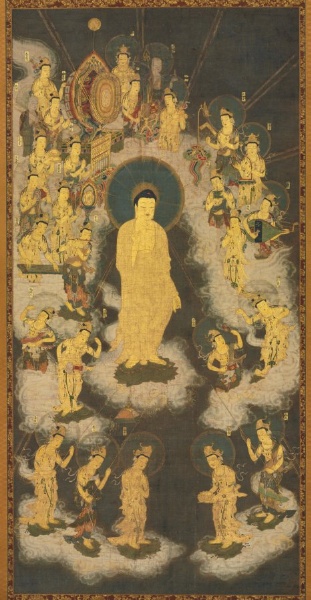
- Title
- Welcoming Descent of Amida (Amida Raigō)
- Period
- Kamakura period (1185–1333), 1300–1333
- Region
- Japan
- Medium
- Hanging scroll; ink, color and gold on silk
- Dimensions
- Painting: 171.8 × 84.5 cm; mounted: 269.1 × 113.3 cm
- Collection
- Cleveland Museum of Art
- Accession
-
1953.123 - Rights
- Cleveland Museum of Art (Public Domain / CC0); credit line: John L. Severance Fund, 1953.123
Cleveland's Amida is full-frontal and tranquil, distributed symmetrically — the *Genshin-style* register, not the diagonal *hayaraigō* of Chion-in. The standing posture means descent; the symmetry means iconic devotional mode rather than narrative speed.
The Cleveland scroll is what most introductions to the genre omit on the way to the famous one in Kyoto. The famous Chion-in Rapid Descent — diagonal, streaming, all motion — is the photograph that travels in textbooks.
Cleveland 1953.123 is the other thing: a tranquil, full-frontal Amida, head haloed in concentric green rings, feet planted on a small lotus pedestal, the entourage arranged in symmetry on either side. Same deity, same descent, different register. The what is identical; the how is not.
The catalog gives a date of 1300–1333. That is late Kamakura, almost contemporary with the Chion-in Rapid Descent. They are roughly the same age. They are not the same painting.
What you actually see
Look at Amida first. He is full-face, gold-leaf body, hands held forward in the raigō-in welcome. He stands — not sits — and the posture is the single most reliable iconographic flag for descent paintings: standing Amida means moving toward us, even where the figure is otherwise still. (Seated Amida is for sutra-illustration and for the central Pure Land mandala.)
The green concentric halo behind his head is the painting’s brightest passage of preserved pigment. Below him, a small lotus pedestal floats on a cloud bank.
Around him: a roughly symmetrical mandorla of attendant bodhisattvas. I count seventeen or eighteen at this resolution. The catalog title — 阿弥陀 二十五菩薩来迎図, Amida nijūgo bosatsu raigō-zu, “Amida and Twenty-Five Bodhisattvas Welcoming Descent” — names twenty-five. Several may be hidden in the cloud-banks behind larger foreground figures, or behind Amida’s gold mass; this is a known issue in raigō-counting that recurs across the corpus.
Three foreground bodhisattvas kneel on lotus thrones at the bottom of the composition, and one carries the empty lotus throne intended for the dying soul. That carrier is Kannon. Beside her, hands in gasshō, is Seishi.
The musicians are at upper-middle level, arranged on cloud-tongues. Instruments visible: the small biwa lute at upper right, a shō mouth-organ at upper left, drum forms in the middle band, a flute.
At low resolution they are difficult to count individually; the Bo Lawergren survey of comparable raigō counts fifteen instruments on the Kōyasan triptych and fourteen on the Chion-in Rapid Descent, with percussion roughly half the total. Cleveland sits within that range.
The silk ground is dark — closer to brown-black than the teal-green it is sometimes described as. Gold leaf is intact across Amida and the principal attendants; on the smaller secondary figures it has thinned to outline-only in places.
What is not there matters too. There is no sweeping diagonal cloud bank descending from upper-left to lower-right. There is no foreground deathbed, no dying donor portrait, no two-storey mansion at the corner of the composition (compare the early-fourteenth-century descent-and-ascent raigō Lawergren reproduces, where a one-storey verandah is explicit, and a Pure Land mansion appears in the upper register).
Cleveland is iconic, not narrative. It shows the descent as devotional schema, not as event.
Two registers, not one
The single most useful fact about raigō painting, and the one most general introductions skip, is that the genre operates in two distinct iconographic registers. Bo Lawergren names them cleanly:
- The symmetrical-iconic mode, associated with the monk Genshin (942– 1017). Tranquil pose, full-faced Amida, bodhisattvas arranged symmetrically on either side of a central vertical axis. The Kōyasan Reihōkan triptych (1150–80) is the canonical early example. Stylistic models trace to eleventh-century painting; the iconography is anchored in Genshin’s Ōjōyōshū.
- The rapid-descent mode, hayaraigō (早来迎). Diagonal composition. Clouds congealed into a streaming sheet. Two musician-streams flanking Amida, both heading toward the dying person at the lower edge of the composition. The Chion-in Rapid Descent (14th c., 145.1 × 154.5 cm, jo-bon jo-shō register, with a deceased figure and celestial pagoda) is the canonical example. Kanda traces hayaraigō as a Kamakura-period innovation responsive to the popularization of nembutsu practice and shifts in deathbed ritual.
Cleveland 1953.123 is the symmetrical-iconic mode, displaced chronologically. By 1300–1333 the hayaraigō is being innovated and disseminated; Cleveland’s painters are still working in the older register.
This is not a defect — the symmetrical-iconic register persists alongside the rapid mode well into Edo, as Lawergren documents in a 1690 example that retains all the instruments seen six centuries earlier. Two parallel modes serving slightly different devotional purposes: the iconic for sustained visualization, the rapid for the urgency of the deathbed scene.
The article you may have read on Cleveland 1953.123 elsewhere — including, until recently, on this site — described its composition as “a single sweeping cloud bank that descends diagonally from upper-left to lower-right.” That description is wrong for this painting. It would be correct for the Chion-in Rapid Descent. It is the kind of mistake that happens when the hayaraigō photograph carries the genre’s representation in a writer’s mind.
What the painting owes Genshin
The most common framing of raigō painting in non-specialist sources begins with Hōnen, who founded Jōdo-shū in 1175, and Shinran, who founded Jōdo Shinshū in the next generation. That framing skips the most consequential figure for the iconography. The 25-bodhisattva configuration, the deathbed visualization, the standing welcoming Amida — these are not inventions of the Pure Land schools. They are inventions of an earlier Tendai monk working at Mt. Hiei a hundred and seventy-five years before Hōnen.
Genshin (源信, 942–1017), also known as Eshin Sōzu, was a Tendai monk and practitioner-scholar. His Ōjōyōshū (往生要集, “Essentials for Birth in the Pure Land”), completed in 985, is the foundational text for raigō iconography in Japan. Genshin compiled the work as a practical guide to Pure Land rebirth, drawing on Chinese Pure Land sources (notably Shandao) and on the Sukhāvatī-vyūha and Amitāyurdhyāna sutras.
He prescribed deathbed visualization: at the moment of death, the practitioner should call to mind Amida’s form and the descent of the twenty-five bodhisattvas. The painting’s job, downstream, is to make that visualization possible for the dying person who can no longer hold the figure unaided in the mind.
The image is hung facing the dying person; in some surviving medieval practice, silk threads ran from Amida’s painted hands to the dying person’s hand, making the descent literal as well as imagined.
The number twenty-five comes from the Sukhāvatī-vyūha via Genshin’s selection. The nijūgo zanmai-e, “twenty-five samādhi society,” is a Tendai practice group: monks of the Yokawa hermitage on Mt. Hiei vowed in groups of twenty-five to attend each other’s deaths and chant the nembutsu on behalf of the dying.
Genshin organised the first such group at Yokawa in 986, the year after the Ōjōyōshū was completed. The painting’s twenty-five bodhisattvas are the cosmic equivalent of those attending monks.
Hōnen’s contribution, two centuries later, was to insist on exclusive nembutsu practice and to break with Tendai monastic exclusivity. Shinran’s was to push the doctrine of grace further. But the iconographic furniture — the descending Amida, the twenty-five attendants, the deathbed setting — is already in place by Hōnen’s time. Cleveland 1953.123 is downstream of Genshin first, and downstream of Hōnen and Shinran only secondarily.
The Phoenix Hall, before paintings could do this work
The earliest fully-developed Pure Land iconographic environment is not a painting at all. It is Byōdōin’s Phoenix Hall (鳳凰堂, Hōōdō) at Uji, finished in 1053 — about seventy years after the Ōjōyōshū. The Phoenix Hall is what Mimi Hall Yiengpruksawan, in her 1995 Art Bulletin essay, calls “a three-dimensional realisation of the raigō idea.”
The interior walls of the central hall carry a frieze of fifty-two carved wooden bodhisattvas, twenty-eight of them playing instruments, all from the workshop of Jōchō (定朝, d. 1057), the most influential sculptor of his generation. They cluster on either side of a five-meter-high seated Amida. Their bodies sit on individual cloud-form supports. They were originally gilt and pigmented; the gold survives only in traces today.
The Phoenix Hall is the first time the descent-iconography is realised at architectural scale, and it precedes the painted raigō tradition by close to a century. The painted hangings of the late Heian and Kamakura periods are working from a sculptural template as much as from a textual one.
When Lawergren documents fifteen-instrument orchestras on the Kōyasan triptych and fourteen on Chion-in, those numbers are downstream of the twenty-eight-instrument scheme Jōchō and his workshop already realised at Byōdōin in 1053.
Cleveland 1953.123, dated 1300–1333, sits two and a half centuries after the Phoenix Hall. The composition’s tranquillity, the symmetry, the full-faced Amida — all of these are echoes of the Jōchō-Byōdōin scheme as filtered through twelfth-century painting (Kōyasan triptych) and held into late Kamakura.
The Ode to the Twenty-five Bodhisattvas
The thirteenth-century Ode to the Twenty-five Bodhisattvas (二十五菩薩 和讃, Nijūgo bosatsu wasan) is the iconographic source most directly relevant to reading the musicians. The Ode names each of the twenty-five bodhisattvas individually and pairs each with a specific instrument or function: Yakuō plays the biwa; Hōzō plays the flute; Sammai-ō scatters flowers; Kegon-ō plays an instrument whose Chinese graph survives only on the cartouche of the Met’s late-fourteenth-century labeled raigō (Met acc. 45249), which Lawergren analyses to attempt identification.
A painted raigō rarely matches the Ode in every figure. The Met cartouche example explicitly labels its bodhisattvas, and even there Sammai-ō appears playing a metallophone rather than scattering flowers. The mismatch tells us the painters had room to vary the scheme. In Cleveland 1953.123, no cartouches are present; the bodhisattvas are not named. We know from the Ode and from comparable raigō paintings what is probably there, but the specific identification is not retrievable from the painting itself.
The two foreground attendants flanking Amida are Kannon (carrying the lotus throne) and Seishi (hands in gasshō). These two are the principal attendants of the Pure Land triad and appear on every raigō. They are not counted among the twenty-five; the count is “Amida and twenty-five,” with Kannon and Seishi as the two flanking principals plus twenty-three more.
Where the genre and the reading remain uncertain
Three honest gaps remain when reading Cleveland 1953.123:
The bodhisattva count. I count seventeen or eighteen attendants at the resolution available. The catalog title names twenty-five. The catalog itself is silent on whether the missing figures are hidden in cloud forms, whether the count was ever literal, or whether the painting has been trimmed at any edge in its acquisition history. A high-resolution scan would resolve the count; a conservation report would resolve the trim question. Neither is public.
The painter, the workshop, and the temple of origin. The Cleveland catalog gives only “Japan, Kamakura period (1185–1333), 1300–1333” with no attribution and no provenance prior to the 1953 Severance Fund acquisition. Late-Kamakura raigō-zu were produced in temple workshops associated particularly with the Jōdo and Tendai schools; the Cleveland piece may have come out of a Kyoto or Mt. Hiei atelier, or a regional workshop, but the internal evidence is not public, and the catalog does not push.
Why the symmetrical-iconic mode survives at Cleveland’s date. By 1300– 1333, the hayaraigō is well-established at major centres (Chion-in’s Rapid Descent is dated to the 14th century, very close to Cleveland’s date range). Why does Cleveland’s painter stay in the older symmetrical register?
Two readings are possible. Conservatism: a regional or sub-mainstream workshop continues a Heian-Kamakura model that the central ateliers have moved past. Function: the iconic mode was preferred for sustained pre-deathbed visualization (the painting hung in a temple chapel or family altar across years), where the hayaraigō served the moment of the deathbed itself.
Lawergren’s survey suggests the modes coexist throughout the medieval period rather than one displacing the other; the choice is a function of devotional use as much as of date. Cleveland’s piece gives no internal evidence to discriminate the two readings.
How to read another raigō next time
Find the standing Amida. (Seated means sutra-illustration; standing means descent.) Read the cloud-arrangement: symmetric mandorla means Genshin-style; diagonal sheet means hayaraigō. Find the lotus-throne carrier — that is Kannon, on Amida’s right (the viewer’s left in many compositions, but iconographically on Amida’s right hand). Find the praying attendant in gasshō — that is Seishi. Count the musicians, knowing that the total may not match the Ode.
Look for the dying-donor figure in the lower register; if absent, the painting is functioning iconically rather than narratively. If present, look at the silk threads, where they survive, that ran from Amida’s hand to the dying person’s hand. The painting was the last thing many medieval Japanese saw; it is staged for that single use.
Cleveland 1953.123 is staged for that single use, in the iconic mode that Genshin first prescribed three centuries before this scroll was painted. That continuity is the painting’s quietest and most consequential fact.
Sources
-
[2]— Bo Lawergren, Music on Japanese Raigō Images, 700–1700 — and Chinese Influences (in Medieval Sacred Chant: from Japan to Portugal, 2009) print referenceThe standing taxonomy of symmetrical (Genshin-style) vs. rapid (hayaraigō) raigō and the instrument inventory; Hunter College open-access PDF.
-
[3]— Fusae C. Kanda, The Development of Amida Raigo Painting: Style, Concept, and Landscape (PhD dissertation, Yale University, 2002) print referenceThe current major scholarly synthesis in English; Kanda treats the genre's Heian-to-Kamakura stylistic development.
-
The canonical Japanese-language survey of raigō painting; numbered catalogue including Kōyasan triptych, Chion-in *hayaraigō*, and the Met cartouche raigō.
-
[5]— Joji Okazaki, Pure Land Buddhist Painting, trans. Elizabeth ten Grotenhuis (Tokyo: Kodansha, 1977) print referenceFoundational English-language survey of raigō-zu iconography and chronology.
-
[6]— Elizabeth ten Grotenhuis, Japanese Mandalas: Representations of Sacred Geography (Honolulu: University of Hawai'i Press, 1999) print referenceSpatial logic of Pure Land painting; chapters on the Taima mandala and raigō spatial conventions.
-
[7]— James Foard, Michael Solomon, Richard Payne (eds.), The Pure Land Tradition: History and Development (Berkeley: Berkeley Buddhist Studies Series, 1996) print referenceDoctrinal context for Genshin, Hōnen, Shinran, and the descent-painting cult.
-
[8]— Genshin (源信), Ōjōyōshū (往生要集), 985 CE — partial English translation in August Karl Reischauer, Genshin's Ōjō Yōshū: Collected Essays on Birth into Paradise (Transactions of the Asiatic Society of Japan, 2nd ser. 7, 1930) print referenceThe doctrinal foundation of the genre; describes Amida's descent with twenty-five bodhisattvas and prescribes deathbed visualization.
-
[9]— Mimi Hall Yiengpruksawan, 'The Phoenix Hall at Uji and the Symmetries of Replication,' The Art Bulletin 77 (1995): 647–672 print referenceOn Byōdōin's Phoenix Hall (1053) as the founding Pure Land iconographic environment; Jōchō workshop bodhisattvas as a three-dimensional raigō.