The Met's Nanbokuchō Taima Mandala: late-14th-c. recension, 1927 Fletcher Fund
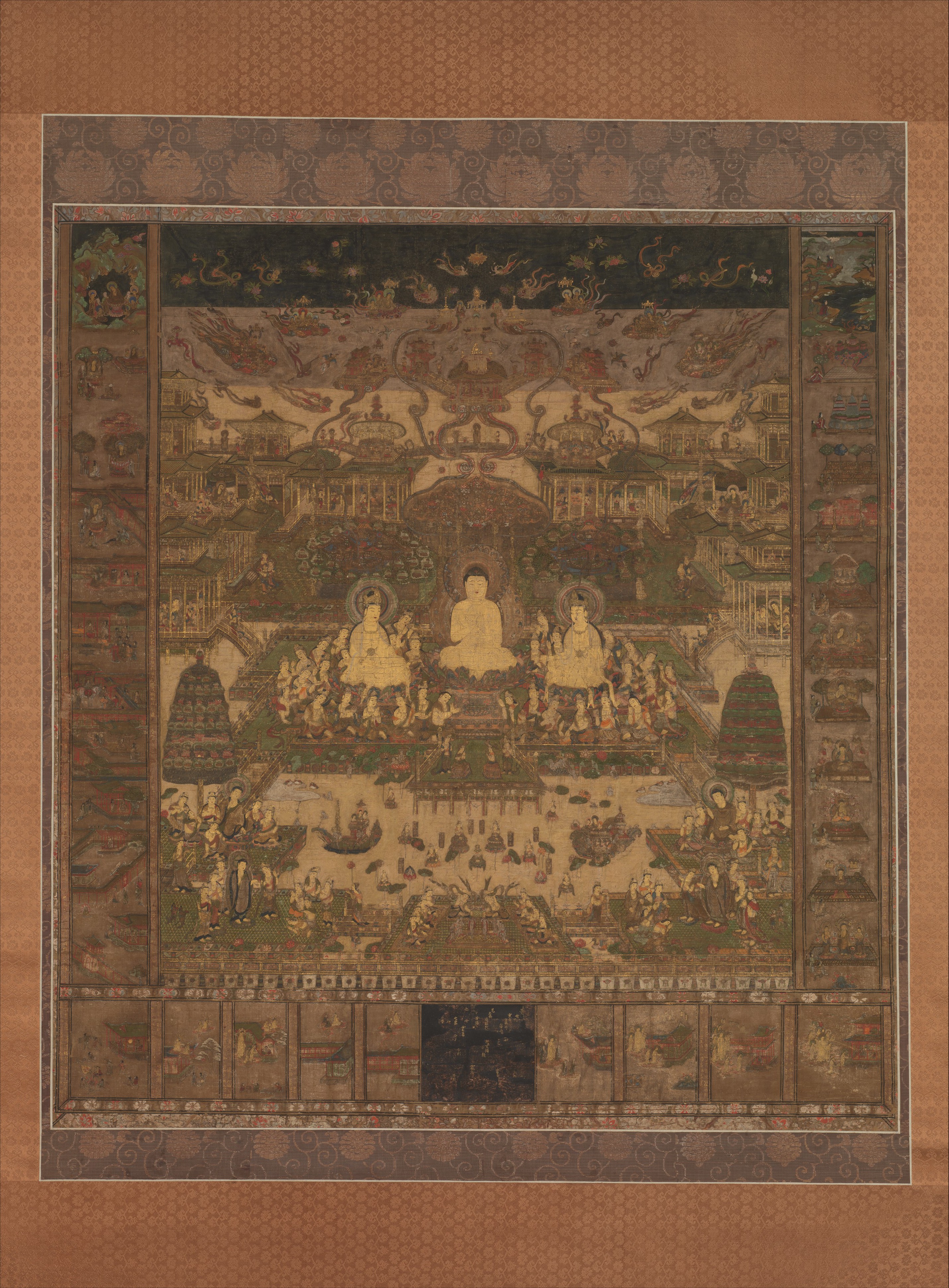
- Title
- Taima Mandala (当麻曼荼羅) — Met 27.176.2, Nanbokuchō, probably late 14th c.
- Period
- Nanbokuchō period (1336–92), probably late 14th century
- Region
- Japan
- Medium
- Hanging scroll; color and gold on silk
- Dimensions
- Image: 133.4 × 121.9 cm (52 1/2 × 48 in.). Overall with mounting: 249.6 × 147 cm (98 1/4 × 57 7/8 in.)
- Collection
- Metropolitan Museum of Art, New York
- Accession
-
27.176.2 - Rights
- Public Domain. The Metropolitan Museum of Art, Fletcher Fund, 1927 (acc. 27.176.2). Met Open Access (OASC).
Met 27.176.2: Nanbokuchō Taima Mandala, probably late 14th c. Acquired through the Fletcher Fund in 1927 — the Met's foundational early-Asian-art acquisition instrument. The work is one of the higher-quality post-Kamakura recensions of the 763 Taima-dera original.
The original Taima Mandala at Taima-dera in Nara is approximately 4 m × 4 m: a silk kesi tapestry made around 763 (per the standard dating), the primary object of worship of the Taima-dera complex, designated a National Treasure of Japan in 1961. The Met’s Nanbokuchō recension is 1.33 × 1.22 m, roughly one-quarter the linear dimensions, or one-sixteenth the area. It is a hanging-scroll painting, not a tapestry; color and gold on silk, not woven fibre. It is a copy, made roughly six centuries after the original, in a medium the original was not made in, at a scale the original was not made at.
That is the framing. The Met scroll is not the original. It is a recension, a copy that participates in the iconographic tradition that the original anchored. The Taima Mandala tradition is unusually copy-driven: the Taima-dera original deteriorated continuously across the medieval period, and the institutional Pure Land establishment in Japan responded by producing successive recensions that preserved and circulated the iconographic programme. Met 27.176.2 is one of the higher-quality post-Kamakura nodes in that copying tradition.
Three-and-a-half times smaller than the original
The Met catalog gives the explicit comparison: “the earliest Japanese version [is] an eighth-century brocade approximately four times larger than the present mandala.” Four times larger linearly, sixteen times larger in area. The Taima-dera original was a temple-altar object on architectural scale, the kind of work that occupied an entire altar bay at the principal hall of the temple. The Met scroll is a hanging-scroll object on private-or-sub-temple-altar scale, the kind of work that hangs in a sub-hall, in a private chapel, in a wealthy donor’s residence.
The scale shift is consequential. The four-zone iconographic structure (centre Sukhāvatī plus three narrative borders) is preserved in the recension, but the legibility of the smaller framed scenes inside the borders changes with the change of scale. At the original 4 m scale, the thirteen contemplations on the right border read as discrete narrative panels that a viewer at altar-floor distance could read one by one. At the Met’s 1.33 m scale, the contemplations are compressed into smaller framed scenes that require closer viewing distance; the work has moved from temple-altar-public to hanging-scroll-private even within the same iconographic programme.
The medium shift is equally consequential. Kesi (Chinese kèsī 緙絲) is a silk-tapestry technique where the design is woven directly into the cloth: each block of colour is a separate weft inserted into the warp, with the result that the design is integral to the fabric rather than applied on top. The Taima-dera 763 original is kesi. The Met 1927 scroll is painted silk, pigment and gold leaf applied to a pre-woven silk ground. The painted silk reads as a much more familiar Japanese hanging-scroll register; the kesi original reads as an unusual continental textile object. Whether the eighth-century Japanese makers understood the original as primarily painting-tradition or primarily textile-tradition is the kind of question the Wikipedia article on the kesi original and the existing bodhi iconographic-reading guide engage with at length.
The centre, the borders, and the bottom
The iconographic programme is the canonical Taima Mandala. Centre: Amida enthroned at Sukhāvatī, the Western Pure Land, flanked by Kannon and Seishi. Multi-tiered palace receding behind. Musicians, dancers, and the conventional thirty-seven celestial figure-types filling the air. The lotus pond in the lower foreground with reborn beings emerging from the open lotuses.
Left border: Queen Vaidehi’s narrative. Imprisoned by her son Ajātaśatru (in the Kanmuryōju-kyō, the king’s son who has imprisoned both parents in a coup), Vaidehi appeals to Śākyamuni Buddha for instruction. Śākyamuni teaches her the sixteen contemplations as a means of attaining rebirth in the Pure Land. The narrative band shows the imprisonment, the appeal, and the teaching.
Right border: thirteen of the sixteen contemplations, each in a small framed scene. The remaining three contemplations are not visually rendered in the standard programme; the canonical recension consistently shows thirteen-of-sixteen. The contemplations move from the simpler (visualising the setting sun, the water, the ground of the Pure Land) to the more advanced (visualising the lotus throne, Amida, the two attendant bodhisattvas, the entire scene).
Bottom border: the nine grades of rebirth. The standard Pure Land programme divides aspirants into nine grades based on their conduct and devotion, with each grade attaining a different rebirth quality. The lowest grade rebirths occur inside closed lotuses that take long periods to open; the higher grade rebirths occur on already-open lotuses with immediate vision of Amida. The bottom border renders all nine grades.
The full iconographic-reading is in the existing bodhi guide. This article does not re-cover it.
The Tang precedent and the silk-tapestry-to-silk-painting move
The Met catalog names the Tang-dynasty Chinese precedent explicitly: “Mandalas of this type are based on Tang-dynasty Chinese images that were transmitted to Japan along with Pure Land Buddhist teachings during the Nara period (710–94).” The Pure Land tradition itself is Chinese (Tanluan 476–542, Daochuo 562–645, Shandao 613–681), and the iconographic programme for visualising Sukhāvatī develops in Tang China before transmission to Nara Japan.
The 763 Taima-dera original is the canonical Japanese rendering of the iconographic programme, but it is not an invention. It is the Tang Chinese Pure Land mandala tradition naturalised to Japan, in the kesi tapestry medium that Tang Chinese workshops were producing for Buddhist altar use. The 763 work is essentially a Tang import object made in Japan, possibly even physically made by Chinese craft hands brought to Japan, possibly made by Japanese craft hands working under Chinese instruction. The Wikipedia entry’s Chūjō-hime legend (the work was woven by two nuns understood to be Amida and Kannon in disguise) is the religious-explanation overlay on what is, in art-historical terms, a Tang-precedent transmission.
The recension tradition (the centuries of copying after the original began to deteriorate) moves the work from the kesi tapestry medium into the painted-silk hanging-scroll medium. This is the medium-shift that produces the Met 27.176.2. The Kamakura, Nanbokuchō, Muromachi, and Edo recensions are all painted silk; the kesi original is the singular textile object that anchors the tradition without being part of the copy chain.
Where Met 27.176.2 sits in the recension chain
The recension chain (in approximate chronological order, simplified):
- 763: Taima-dera original kesi tapestry (the Nara anchor; deteriorating)
- late 12th – early 13th c.: Heian-late and early-Kamakura recensions (the earliest copies post-original)
- early 14th c.: Cleveland 1990.82 (the bodhi-anchored Kamakura recension)
- mid–late 14th c.: Met 27.176.2 (this work; Nanbokuchō)
- 15th c.: Muromachi recensions (multiple)
- 17th–19th c.: Edo recensions including Met 45594
Met 27.176.2 sits in the Nanbokuchō node of the chain, roughly half a century after the Cleveland Kamakura recension. The two works belong to the same broad iconographic tradition with the same four-zone programme, but the Nanbokuchō register is stylistically distinct from the Kamakura register. The figural type has shifted slightly toward the more elongated late-14th-century proportional scheme, the drapery line is somewhat more fluent and decorative, the gold-leaf passages are more extensively used. These are the standard period-stylistic markers of the late Kamakura → Nanbokuchō transition.
The “probably late 14th century” qualifier on the Met catalog dating is significant. Late-Nanbokuchō (1370s–1392) versus early-Nanbokuchō (1336–1350s) places the work in the second half of the period rather than the first half, which positions it relative to the Cleveland early-14th-century work as a generation later rather than as a near-contemporary. The two works are roughly two generations apart in the tradition.
The 1927 Fletcher Fund and early-Met Asian collecting
The credit line reads “Fletcher Fund, 1927.” The Fletcher Fund was established by the 1917 bequest of Isaac D. Fletcher (1844–1917), a Met trustee who left the museum his collection and an endowment. The fund became the primary acquisition instrument for the Met’s Asian holdings through the 1920s and 1930s, the period during which the Met’s Japanese collection was substantially established.
The Met’s Asian Art Department was formally created in 1915, with the Fletcher Fund (active from 1917) supplying the financial mechanism for the first major acquisition wave. The 1927 Taima Mandala falls in the heart of this foundational acquisition period. Other Fletcher-Fund Japanese acquisitions in the same decade include screens, scrolls, and sculptures that now constitute the spine of the Met’s Japanese painting holdings.
Reading the 1927 Fletcher Fund Taima Mandala alongside the 1966 Burke Gift Aizen Myōō (Met 66.90, bodhi article) and the 2015 Burke Bequest Kaikei Jizō (Met 2015.300.250, bodhi article) places three distinct acquisition mechanisms across the Met’s twentieth-century Japanese-art collecting:
- 1927 Fletcher Fund: the founder-era institutional endowment, Met-led acquisition decisions
- 1966 Burke Gift: the major-collector era, gift-funded purchase
- 2015 Burke Bequest: the major-collector era, direct collection transfer
Each mechanism produced different acquisition logics. The 1927 Fletcher Fund worked through dealers (likely Yamanaka & Co. New York or comparable East Asian art dealers active in 1920s New York) on Met curatorial selection; the 1966 Burke Gift worked through Burke’s personal collecting choices funded by her financial gift; the 2015 Burke Bequest brought the full Burke private collection into the institutional collection en bloc. The three mechanisms are layered through the Met’s Japanese holdings rather than sequenced; works from all three logics now sit side by side in the galleries.
What stays open
The Met catalog gives the firm anchors: Nanbokuchō probably late 14th c.; 133.4 × 121.9 cm; color and gold on silk; PD; Fletcher Fund 1927. What is less firm:
- Within-Nanbokuchō dating narrowing. Late-Nanbokuchō (1370s–1392) is the catalog’s preferred reading; tighter dating (e.g., to a specific decade) is not established and would require closer comparison to dated Nanbokuchō Pure Land paintings.
- Original temple commission. Where this work was painted, for which sub-temple or private altar, is not in the public catalog. The pre-1927 ownership chain is also not in the catalog.
- Specific dealer / acquisition route to Met. The 1927 Fletcher Fund acquisitions are documented institutionally; the dealer or private collection that supplied this specific Taima Mandala to the Met in 1927 is not in the public catalog.
- Workshop attribution. Nanbokuchō Pure Land painting workshops (the bussho of Kyoto and Nara) are partially documented but not at the granularity of named-painter attribution for unsigned works. Met 27.176.2 is unsigned.
- Comparison to other surviving Nanbokuchō recensions. A comprehensive comparison would name the half-dozen highest-quality Nanbokuchō Taima Mandala recensions and place 27.176.2 within them. That comparative work is in ten Grotenhuis 1985 and adjacent scholarship; the present article does not duplicate it.
The work is anchored deeply enough to read against the existing bodhi iconographic guide and against the Cleveland 1990.82 Kamakura recension. The gaps mark where further study could deepen the reading.
Related
- Reading the Taima Mandala: the iconographic-programme reading guide (Sukhāvatī, Vaidehi, sixteen contemplations, nine grades of rebirth, Chūjō-hime legend, Cleveland 1990.82).
- Amida raigō: the welcoming descent: the raigō tradition, the visual-religious complement to the Taima Mandala in Pure Land devotion.
- Nanbokuchō raigō with twenty-five bodhisattvas: late-14th-century Pure Land painting in the same period as Met 27.176.2, different register.
- Byōdō-in Amida (Jōchō, 1053): the Heian sculptural Amida that anchors the Pure Land tradition.
- Yūzū Nenbutsu Engi handscroll: the post-Kamakura Pure Land narrative-illustration register.
Sources
-
[1]2026-05-12The Metropolitan Museum of Art, New York collectionapi.metmuseum.org/public/collection/v1/objects/44983Met Open Access API entry. Confirms: accession 27.176.2; Nanbokuchō period; probably late 14th century; medium hanging scroll color and gold on silk; image 133.4 × 121.9 cm; overall with mounting 249.6 × 147 cm; public domain (CC0); credit line 'Fletcher Fund, 1927'.
-
Met curatorial text (read in search excerpt): 'a resplendent vision of the Western Pure Land, a paradise over which Amida presides … Amida sits enthroned at the center of the mandala, flanked by the bodhisattvas Seishi and Kannon and surrounded by throngs of musicians, dancers, celestial beings, and pavilions adorned with jewels. In the lower foreground is a lotus pond in which the faithful are reborn, and surrounding this scene are vignettes from the Contemplation Sutra that teach the living how to attain salvation. Mandalas of this type are based on Tang-dynasty Chinese images that were transmitted to Japan along with Pure Land Buddhist teachings during the Nara period (710–94), with the earliest Japanese version being an eighth-century brocade approximately four times larger than the present mandala, and the primary object of worship at the Taima-dera Temple in Nara.'
-
Encyclopedic synthesis. Names: 763 original date; Chūjō-hime legend (lotus-stem-fibre tapestry crafted by two nuns understood as Amida and Kannon in disguise); the four-zone iconographic structure (centre: Sukhāvatī; left: prefatory legend; right: thirteen contemplations; bottom: nine grades). Designated National Treasure of Japan, April 27, 1961.
-
bodhi iconographic-reading guide for the Taima Mandala programme. Reads the centre (Sukhāvatī), the three borders (Vaidehi narrative, sixteen contemplations, nine grades of rebirth), the Cleveland 1990.82 (early-14c Kamakura) recension, and the Chūjō-hime legend. This article does not re-cover the iconographic reading; the cross-link is the primary reference for readers who arrive on 27.176.2 without the iconographic-programme context.
-
The canonical scripture the Taima Mandala visualises. The text describes the sixteen contemplations through which a practitioner attains rebirth in Sukhāvatī, the Pure Land of Amida. The Vaidehi narrative frame (the queen's suffering at the hands of her son Ajātaśatru and her plea to Śākyamuni for instruction) sets up the contemplations as the Buddha's teaching to a specific suffering being. The text is one of the Three Pure Land Sūtras alongside the *Sukhāvatīvyūha* (T.366) and the *Amitāyurdhyāna* (T.365).
-
The major English-language scholarly monograph on the Taima Mandala recension tradition. Reads the Kamakura, Nanbokuchō, and Muromachi recensions as a coherent visual-religious revival within the Pure Land institutional context. The standard reference for any article in the Taima Mandala cluster. Page numbers not verified. Cited by name + title + year + publisher; specific claims drawn from general synthesis.
-
Cross-link to the broader pattern of Met Japanese-art acquisition mechanisms across the twentieth century. The 1927 Fletcher Fund acquisition (this article) and the 1966 Mary Griggs Burke Gift acquisition (the Aizen Myōō at [Met 66.90](/articles/met-66-90-aizen-myoo-nanbokucho-hanging-scroll/)) bracket two phases of Met Japanese-art collecting: the founder-era Fletcher Fund (1920s–1950s) and the major-collector-era Burke (1960s–2015).