Hōnen inscribing the portrait for Shinran: the Shūikotokuden-e at the Met
- Title
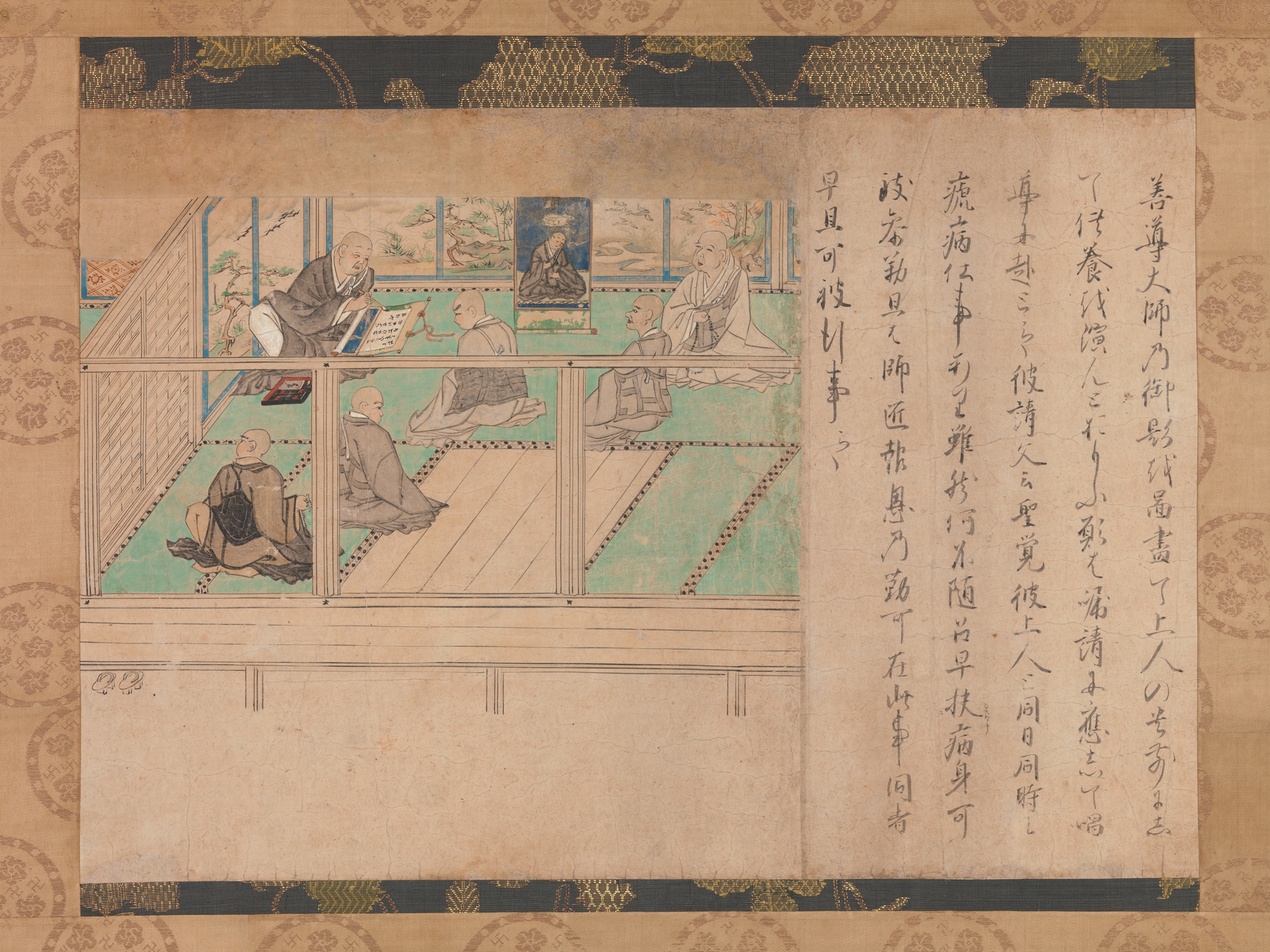
- Illustrated Biography of Hōnen (Shūikotokūden-e, 拾遺古徳伝絵), section showing Hōnen inscribing his portrait for Shinran
- Period
- Kamakura period (1185–1333), ca. 1310–20
- Region
- Japan
- Medium
- Section of handscroll mounted as hanging scroll; ink and color on paper
- Dimensions
- Image 40.7 × 38 cm; overall with mounting 139.7 × 72.7 cm
- Collection
- The Metropolitan Museum of Art
- Accession
-
1980.221 - Rights
- The Metropolitan Museum of Art (Public Domain / OASC). Gift of Lincoln Kirstein, in honor of Fumio Yoshimura, 1980; Rogers Fund, by exchange, 1980 (1980.221).
Met 1980.221. The pivotal scene from a nine-handscroll set: Hōnen inscribes a sutra passage onto a copy of his own portrait, made for his disciple Shinran. The portrait hanging in the centre of the room is the master image from which the copy is taken. Section of a Kamakura handscroll, ca. 1310–20, later mounted as a hanging scroll. Public domain via the Met's Open Access programme.
The scene, in one frame
Two seated figures face each other across a low desk. The figure on the left holds a brush above a sheet of paper; the figure on the right waits with hands folded into the lap. Between them, suspended in the centre of the painted interior, hangs a third image: a portrait of the figure on the left.
The figure with the brush is Hōnen (1133–1212), founder of the Jōdo-shū, the Pure Land school whose central doctrinal claim is that the recitation of Amida’s name (the nenbutsu) is sufficient for rebirth into the Pure Land. He is seated in monk’s robes, in old age, the master in the master’s pose.
The figure waiting opposite him is the young Shinran (1173–1262), the disciple who will, a generation later, leave the lineage Hōnen founded and establish what becomes the Jōdo Shinshū, the largest Pure Land school in Japan, eventually larger than the parent school. Shinran is identifiable in the painting by the distinctive iconographic mark Kamakura biographical painters give him: thick, black, almost-joined eyebrows.1
What Hōnen is doing in the painting is, in narrative terms, very specific: he is inscribing a calligraphic passage onto a copy of his own portrait, made expressly as a gift for Shinran. The portrait hanging in the centre of the room is the master image, the original from which the copy is taken.
The passage being inscribed, according to the curatorial reading, transcribes a sutra in which Amida vows to save all those who call his name: the doctrinal core of Pure Land soteriology.2
In iconographic terms, the painted scene compresses every Shinshū institutional claim into a single image. Hōnen is the master; Shinran is the disciple who waits to be given the master’s likeness; the master’s likeness, in turn, is inscribed with the doctrinal teaching that the disciple will later carry forward. The continuity is materialised in three artefacts arranged across one painted room: the master, the master’s portrait, and the inscribed copy that will travel with the disciple.
What the painting shows, register by register
The compositional logic of the scene rewards close reading. The master portrait at the centre, the inscribing master at the left, the receiving disciple at the right: the three elements form a triangle whose apex is the master’s hanging image. The narrative argument moves along the triangle’s left side (from the master’s living person to the master’s portrait) and then along its right side (from the master’s portrait to the disciple who will receive a copy).
The act of inscription is the painting’s load-bearing iconographic gesture. Hōnen is not handing Shinran the portrait; he is inscribing the portrait with the doctrinal text that gives the portrait its iconographic weight. The Met’s curatorial reading specifies the passage as Amida’s saving vow, the doctrinal core of Pure Land devotion. The inscription scene is, in Shinshū terms, the moment at which the founder’s likeness is fused with the founder’s teaching, into a single object the disciple will carry away.
Who made this, and when, and for whom
The Met fragment is a section cut from one of the nine handscrolls that make up the Shūikotokuden-e (拾遺古徳伝絵), the illustrated biography of Hōnen compiled in 1301 by Kakunyo (覚如, 1270–1351).3
Kakunyo is not, in the standard Pure Land Buddhist genealogies, a Jōdo-shū figure. He is the third monshu (門主, “chief priest”) of Hongan-ji and a great-grandson of Shinran through Shinran’s youngest daughter Kakushin-ni, which makes him a Jōdo Shinshū institutional figure operating in the generation that consolidated Hongan-ji into a permanent organisation.
Dobbins (2002) gives the institutional sequence:4 Shinran died in 1262, leaving his teachings to a network of provincial communities rather than a single institutional centre; Kakushin-ni founded the Ōtani mausoleum at Higashiyama in 1272 to house his remains; her son Kakue and then Kakue’s son Kakunyo successively transformed the mausoleum caretaker-ship into the Hongan-ji institution. Hongan-ji became Hongan-ji during Kakunyo’s tenure, and the institutional argument that turned a mausoleum into a temple was that Shinran was Hōnen’s rightful successor, which is the doctrinal core of Jōdo Shinshū’s claim on Pure Land orthodoxy.
The textual Shūi kotoku den (the prose version of the work) is dated 1301. The illustrated nine-handscroll Shūikotokuden-e (the version the Met fragment comes from) is dated by the Met to ca. 1310–20, placing it inside the productive decade of Kakunyo’s middle years and well after the textual version’s compilation.
The Met fragment is, in scale terms, intimate. The painted image is 40.7 × 38 cm: smaller than a sheet of A3. The fragment was at some later date cut from the original handscroll and remounted as a hanging scroll (overall 139.7 × 72.7 cm with the mounting). The fragment-as-hanging-scroll format is a 19th- or 20th-century intervention (the original 14th-century handscroll would have been unrolled scene-by-scene at a low table, not hung on a wall), but the painted scene itself is the early-14th-century Kakunyo production.5
The remaining eight scrolls of the original nine-scroll set, or the remaining segments of the same scroll, are not in the public record under the Met’s catalog entry. The corpus of surviving Shūikotokuden-e recensions is, like the related Hōnen Shōnin Eden corpus, fragmentary and dispersed, and the location of the rest of the scroll from which the Met fragment came is one of the things this article cannot resolve from the open sources.6
Two biographical traditions, two doctrinal projects
The Met fragment sits inside one of two rival biographical-eden traditions that grew up around Hōnen across the 13th and 14th centuries. The two traditions are distinct enough that mistaking one for the other obscures what either of them is doing.
The first tradition is the Hōnen Shōnin Eden (法然上人絵伝), the 48-scroll illustrated biography compiled and reproduced under Jōdo-shū patronage at Chion-in (the head temple of Jōdo-shū). It is the canonical Jōdo-shū biographical text and a National Treasure of Japan; the Tokyo National Museum’s e-Museum holds the Rinna-bon (Rinna version), a single scroll corresponding to volume 8 of the 48-scroll structure, depicting Hōnen’s final teaching and death.7 The Kyoto National Museum’s museum-dictionary entry treats the Hōnen Shōnin Eden as the canonical biographical record.8
The second tradition is the Shūikotokuden-e (拾遺古徳伝絵), the nine-scroll illustrated biography compiled by Kakunyo at Hongan-ji. The Met fragment is from this tradition. The institutional patron is Jōdo Shinshū, not Jōdo-shū; the production occurs at Hongan-ji, not Chion-in; the doctrinal narrative the scrolls construct around Hōnen’s life emphasises the moments in which Shinran appears alongside Hōnen and the moments in which Hōnen authorises Shinran’s discipleship.
Kehoe (2012) treats both corpora as a single production system at the dissertation level. Both are eden-tradition illustrated biographies of Hōnen, both emerge in the same early-14th-century window, both rely on the same narrative-painting idiom. The doctrinal arguments the two sets make about Hōnen’s place in the Pure Land lineage, however, are not the same.9
The Jōdo-shū’s Hōnen Shōnin Eden is constructing Hōnen as the founder of its own tradition: his teachings, his disciples (collectively), his Senchaku hongan nenbutsu shū as the doctrinal core, his exile, his death. Shinran appears, but as one disciple among many; the soteriological argument is the Jōdo-shū’s, not the Shinshū’s.
The Shinshū’s Shūikotokuden-e is constructing Hōnen as the master through whom Shinran’s legitimacy is established. The scene the Met fragment preserves is, in this institutional reading, exactly the scene the Shūikotokuden-e was made to canonise: Hōnen, in his own person, conferring his likeness and his teaching on Shinran, by Shinran’s own visual presence in the room. The work is not neutral biography. It is a Shinshū institutional argument made in a biographical register.
The 2024 Tokyo National Museum special exhibition “Hōnen and Pure Land Buddhism,” timed to the 850th anniversary of Jōdo-shū, surfaced the Hōnen Shōnin Eden corpus at full institutional scale.10 One published critical review noted that the exhibition’s framing was substantially a Jōdo-shū framing: the relationship between the Jōdo-shū and the later, larger Jōdo Shinshū was underdiscussed, despite the Shinshū’s historical centrality to Pure Land Buddhism in Japan since the 14th century.11 The Met fragment occupies precisely the position the exhibition declined to develop: the Shinshū’s institutional appropriation of Hōnen, painted at the moment of the painting’s historical project.
The portrait-within-the-portrait
The painting’s most economical iconographic gesture is the master portrait suspended on the wall behind the inscribing figure. A reader who registers the painted scene as a domestic narrative (two monks, a desk, a brush) risks missing what the painting puts at its compositional centre, which is not the figures but the portrait of one of them.
The hanging master portrait is the painting’s argument about authority. In the chinsō (頂相) tradition of Buddhist portrait painting that the Kamakura Pure Land schools inherited from Chinese Chan/Zen practice, the finished portrait of a master, given by the master to a disciple, is the formal token of discipleship-recognition.12 A chinsō is not a sentimental likeness; it is a transmission certificate in pictorial form.
The Shūikotokuden-e scene literalises the moment of certification. Hōnen is depicted not handing Shinran a finished portrait but inscribing the portrait at the moment of handing. The inscription is the master’s authorisation; the recipient is the disciple; the act is captured in the moment of its happening.
What the Shinshū institutional argument needs from this scene is precisely the documented act of transmission. Shinran left Hōnen’s lineage and founded his own, and the question that hung over the Shinshū’s first two centuries was whether Shinran’s departure was a continuation of Hōnen’s teaching or a deviation from it. The Shūikotokuden-e’s answer is the painted scene: Hōnen, in his own person, gave Shinran the chinsō. The transmission is documented. The Shinshū’s claim on Hōnen is documented in the same act.
The portrait-within-the-portrait device returns the painting’s iconographic argument to its own form. The Met fragment is a painted image of a moment of authoritative inscription. The painted image is itself, three centuries later, an inscription: Kakunyo’s pictorial inscription of Shinran’s discipleship into the visible record. The form and the content rhyme.
The doctrinal text being inscribed
The Met’s curatorial reading specifies what Hōnen is writing on the portrait: “a passage from a sutra in which the Buddha Amida vows to save all those who call his name.”13 This is the Eighteenth Vow of Amida from the Larger Sukhāvatī-vyūha Sūtra (Muryōjukyō, 無量寿経), the doctrinal core of Pure Land Buddhism, the textual hinge from which both the Jōdo-shū and the Jōdo Shinshū derive their salvific claim.
Hōnen’s own 1198 doctrinal compilation, the Senchaku hongan nenbutsu shū (選択本願念仏集, “Passages on the Selected Original Vow of Nenbutsu”), takes the Eighteenth Vow as its anchoring scriptural source. The text was presented to the regent Kujō Kanezane in 1198 and circulated in manuscript within Hōnen’s immediate circle thereafter, becoming widely available only after Hōnen’s exile and death.14
A reader looking at the inscribed sutra-passage in the Met fragment is therefore not looking at a generic devotional text. The painted scene depicts the master inscribing onto the disciple’s portrait the precise textual basis of his own life’s work: the vow on which the nenbutsu rests, which is the practice that the disciple will, in turn, propagate.
The Shinshū institutional argument compresses further. The Eighteenth Vow is the Shinshū’s doctrinal core too. Shinran’s Kyōgyōshinshō (教行信証, 1247) takes it as its anchoring scriptural source, just as Hōnen’s Senchakushū did. The painted scene therefore depicts not just Hōnen transferring his teaching to Shinran, but Hōnen inscribing the precise text that grounds Shinran’s own later doctrinal articulation. The two doctrinal projects rhyme through the Eighteenth Vow, and the painted scene makes that rhyme visible.
How the fragment reached the Met
The Met’s accession line for 1980.221 reads: “Gift of Lincoln Kirstein, in honor of Fumio Yoshimura, 1980; Rogers Fund, by exchange, 1980.” The work entered the Met through a combined-gift-and-exchange in 1980.
Lincoln Kirstein (1907–1996), better known as the co-founder, with George Balanchine, of the New York City Ballet, was a serious collector of Japanese art and a sustained donor to the Met’s Japanese department in the 1970s and 1980s. The “in honor of Fumio Yoshimura” formulation acknowledges the Japanese sculptor Yoshimura, Kirstein’s longtime partner, whose own artistic practice and personal connection to Japanese visual traditions situated Kirstein’s collecting.
The fact that the Met acquired the scroll in 1980, five years after the 1975 Harry G. C. Packard transformative gift that built the Met’s Kamakura sculpture register, places the Shūikotokuden-e fragment in the post-Packard phase of the Met’s Asian Art programme, when the institution was assembling the painting holdings that contextualise the Packard sculptures.
The work’s provenance before Kirstein is not in the public Met record under the open catalog. Whether the fragment was cut from its original scroll in Japan or in the West, when, and under what dealer’s hands it travelled, are open questions. The Met catalog does not specify.
What stays open
The location of the remaining eight scrolls of the original Shūikotokuden-e nine-scroll set — or the remaining segments of the scroll the Met fragment came from — is not visible in the public Met record. The Shūikotokuden-e corpus is dispersed, fragmentary, and less institutionally consolidated than the Jōdo-shū’s Hōnen Shōnin Eden corpus. The published English-language treatment is thinnest at exactly this point.
The named workshop, named painter, and named calligrapher are not assigned by the Met catalog and are not assigned here. The early-14th-century Kamakura biographical-painting workshops produced eden corpora largely anonymously, as a matter of genre convention; the Shūikotokuden-e’s production setting at Hongan-ji is institutional but the individual attribution is not.
The kotobagaki passage at the upper register of the painted surface has not been transcribed and translated here. The text would, in principle, contain the prose narrative the painted scene illustrates and would specify the doctrinal text Hōnen is inscribing on the portrait beyond what the painted brushstroke can show. A reading of the kotobagaki against Kakunyo’s prose Shūi kotoku den (1301) would establish the textual anchoring at primary-source precision; that reading is deferred.
The exact date and circumstance of the fragment’s separation from its original handscroll — when it was cut, where, by whom, and into whose hands it then travelled — is not in the public Met record. The fragment arrived at the Met in 1980 already in its hanging-scroll mounting; the remounting itself is a later intervention whose date the Met catalog does not specify.
What is firm is the painted scene itself, and the institutional argument the scene was made to make. Hōnen, in 1310–20 as Kakunyo’s painter depicted him, inscribes a copy of his own portrait for the young Shinran. The portrait will travel with the disciple. The disciple will, in time, found a separate Pure Land school. The school will, in time, become larger than the master’s. The painted scene insists that the school descends, by document, from the master’s own hand. The Met fragment is the painted document.
Related
- Byōdō-in’s 1053 Amida by Jōchō — the canonical late-Heian Pure Land image that Hōnen’s doctrinal-textual programme inherits as its visual register
- Met 19.140: a standing Kamakura Amida — the sculptural register of mid-Kamakura Pure Land devotion, contemporaneous with the Met fragment’s production decade
- Cleveland 1956.87: the Yūzū Nenbutsu engi — a parallel Kamakura Pure Land biographical-engi tradition, also working through the eden form as institutional apparatus
- Amida raigō: the welcoming descent — the painted-iconographic register that Hōnen’s Senchakushū doctrine grounds
- Nanbokuchō raigō and the twenty-five bodhisattvas — the post-Hōnen Pure Land painting tradition in its mature 14th-century form
- The white path and the two rivers — the parabolic-iconographic Pure Land tradition that runs alongside the biographical-eden tradition
Footnotes
-
The “bushy-eyebrowed young Shinran” iconographic mark is consistent across Kamakura biographical paintings of Shinran’s pre-exile period; the Met curatorial description treats it as the diagnostic identifier in this scene. The convention is rooted in the early chinsō tradition for Shinran portraits (the “Mirror Portrait” / Kagami no goei at Nishi Hongan-ji being the National Treasure type-specimen). ↩
-
Metropolitan Museum of Art catalog page for 1980.221, accessed via the Open Access API on 2026-05-14. The curatorial reading: “This pivotal scene from a nine-handscroll set depicts the monk Hōnen (1133–1212), founder of the Pure Land School of Buddhism, inscribing a portrait of himself for one of his foremost disciples, Shinran (1173–1262). The young Shinran, easily recognizable by his bushy eyebrows, waits patiently as his master transcribes a passage from a sutra in which the Buddha Amida (Sanskrit: Amitābha) vows to save all those who call his name. The portrait Hōnen inscribes was made as a copy of the painting hanging in the center of the room.” ↩
-
Standard biographical sequence per the Wikipedia entry on Kakunyo (覚如) (accessed 2026-05-14), cross-checked against Dobbins 2002 for the institutional sequence at Hongan-ji. Kakunyo’s documented life dates are 1270–1351; his major works include the Shūi kotoku den (1301, the prose biography of Hōnen treated here as the textual source), the Honganji Shōnin den’e (1295 and again 1342 in its standard edition, the illustrated biography of Shinran), and the Kudenshō (1331, a doctrinal-instruction text). His sustained production of biographical and doctrinal apparatus across a 50-year career is one of the institutional facts that distinguishes Hongan-ji from the more amorphous early Shinshū lineages. ↩
-
James C. Dobbins, Jōdo Shinshū: Shin Buddhism in Medieval Japan (University of Hawai’i Press, 2002). Kakunyo’s institutional programme is treated at chapter length; the specific argument that biographical illustration functioned as institutional consolidation runs through Dobbins’s reading. Chapter-level citation; page numbers not verified. ↩
-
The cutting-and-remounting practice for handscroll fragments was widespread in late-Edo and Meiji-period Japan, particularly for biographical and narrative scrolls whose original ritual-use context (read aloud at temple-festival unrollings, recited at memorial services) had attenuated by the modern period. The Met catalog does not specify the date of the remounting; the fragment’s current dimensions of 40.7 × 38 cm are consistent with a single scene cut from a scroll of standard 30–35 cm height. ↩
-
The dispersal of biographical-eden corpora is the structural condition of the genre. The 48-scroll Hōnen Shōnin Eden at Chion-in (the Jōdo-shū version) survives substantially intact as a National Treasure; the Shūikotokuden-e nine-scroll set does not have an equivalent intact survival on the public record. The published record for the Shūikotokuden-e corpus is thinner in English than the Hōnen Shōnin Eden record; Kehoe 2012 (Princeton) gives the principal English-language treatment of both corpora as a connected production system. ↩
-
Tokyo National Museum, e-Museum entry for “The Biography of the Monk Hōnen” (Hōnen Shōnin eden), Rinna-bon, content_base_id 100302, accessed 2026-05-14. Important Cultural Property; 32.7 × 1409.3 cm; one scroll corresponding to volume 8 of the 48-scroll Hōnen Shōnin Eden tradition. Donated by Matsunaga Yasuzaemon. Citable as the Jōdo-shū institutional comparandum; image reproduction follows the ColBase / e-Museum Tier-2 attribution practice and is not reproduced here. ↩
-
Kyoto National Museum, “The Illustrated Biography of Priest Hōnen,” Museum Dictionary entry, accessed 2026-05-14. The Kyohaku entry treats the 48-scroll Hōnen Shōnin Eden tradition (Chion-in / Jōdo-shū) at overview length. ↩
-
Sinead Kehoe, Pictures of Patriarchs: The Illustrated Life and Acts of Hōnen (Princeton University, Department of Art and Archaeology, Ph.D. dissertation 2012). Princeton DataSpace handle 88435/dsp01sb3978294. Kehoe treats both the Hōnen Shōnin Eden (Jōdo-shū / Chion-in 48-scroll tradition) and the Shūikotokuden-e (Jōdo Shinshū / Hongan-ji nine-scroll tradition) as a connected production system across the 13th–14th-century Pure Land institutional landscape. Chapter-level cite; the dissertation is the principal English-language treatment of the corpus. ↩
-
Tokyo National Museum, “Special Exhibition: Hōnen and Pure Land Buddhism,” 850th-anniversary special exhibition for the founding of Jōdo-shū. Tokyo (TNM Heiseikan, April–June 2024) and Kyoto (Kyohaku, October–December 2024). The exhibition catalog is the most recent institutional review of the corpus; reproduces both the Senchaku hongan nenbutsu shū Rosanji-bon and the Hōnen Shōnin Eden at full scale. ↩
-
Published exhibition review accessed via the Taito Cultural City Culture Council reportage on the 2024 TNM exhibition (culture.city.taito.lg.jp), and cross-checked against the TsukuBlog and Tokyo Art Beat reviews. The “exhaustive but exhausting” framing and the Jōdo-shū / Jōdo-shinshū comparative gap are the published critical observations on the exhibition’s scope. ↩
-
For the chinsō tradition as transmission certificate, see the bodhi article on Cleveland 1970.67 (the Hottō Kokushi chinsō portrait) for the Zen-school application; the Pure Land schools’ inheritance of the form is treated in Dobbins 2002 (chapter-level) and across the Kehoe 2012 dissertation. The chinsō’s primary documentary function (the formal token of authorised discipleship) distinguishes it from devotional iconic portraits and from secular likeness traditions. ↩
-
Met catalog page for 1980.221, accessed 2026-05-14. The curatorial text identifies the inscription content as Amida’s saving vow, in the standard formulation of Pure Land sutra exposition. ↩
-
For the Senchaku hongan nenbutsu shū in 1198 and its transmission history, see Mark L. Blum’s standing work on Pure Land textual scholarship (Blum, The Origins and Development of Pure Land Buddhism, Oxford 1985, treats the genre context). Blum’s ongoing complete-works translation of Hōnen is the standing reference project for English-language access to the corpus; the Senchakushū is the load-bearing text for Hōnen’s doctrinal claim and is read here at primary-source level via the Shinshū Shōgyō Zensho standard edition (Senchakushū zenshū). Chapter-level citation; page numbers not verified. ↩
Sources
-
Met OA API record verified 2026-05-14. Primary image DP270170.jpg, 2000×1500. Wikidata Q78851289.
-
[2]— Princeton University, Department of Art and Archaeology dataspace.princeton.edu/handle/88435/dsp01sb3978294The principal English-language doctoral treatment of the illustrated Hōnen biographical corpus. Treats both the Jōdo-shū Hōnen Shōnin Eden (Chion-in 48-scroll tradition) and the Jōdo Shinshū Shūikotokuden-e (Kakunyo's nine-scroll tradition) as a connected production system. Chapter-level citation; page numbers not verified.
-
Blum (UC Berkeley, Shinjō Itō Distinguished Chair in Japanese Studies) is the named-scholar anchor for English-language Pure Land textual scholarship. The Origins and Development volume gives the institutional context within which Hōnen's Senchaku hongan nenbutsu shū sits; Blum's ongoing complete-works translation of the Hōnen corpus is the standing reference project.
-
The foundational English-language methodological treatment of the medieval Japanese illustrated biography (eden) as institutional apparatus rather than personal commemoration. Cited for the genre framework applied here.
-
Standard English-language history of Jōdo Shinshū through the institutional consolidation of Hongan-ji. Treats Kakunyo's biographical and ritual programme at chapter length; the named-scholar anchor for the institutional argument the Shūikotokuden-e is making.
-
Biographical summary for Kakunyo (1270–1351), third Hongan-ji monshu. Reference-level; cross-checked against Dobbins 2002 for the institutional sequence.
-
Kyoto National Museum's reference entry treats the 48-scroll Hōnen Shōnin Eden tradition (Chion-in / Jōdo-shū) at overview length. Cited for the comparison register against which the Met's Shūikotokuden-e fragment is read.
-
850th-anniversary special exhibition marking the founding of Jōdo-shū. Tokyo (TNM, Apr–Jun 2024) and Kyoto (Kyohaku, Oct–Dec 2024). Surfaced the National Treasure 48-scroll Hōnen Shōnin Eden alongside the Senchaku hongan nenbutsu shū Rosanji-bon. Cited as the most recent institutional review of the corpus.
-
TNM's single-scroll Rinna-bon recension (corresponds to volume 8 of the 48-scroll Hōnen Shōnin Eden tradition), Important Cultural Property, 32.7 × 1409.3 cm. The Jōdo-shū comparandum: a fragment from the rival biographical tradition. Donated by Matsunaga Yasuzaemon.
-
MFAH holds a related illustrated biographical fragment; cited as a Western-collection comparandum for the dispersed Shūikotokuden-e and Hōnen Shōnin Eden corpus.
-
Hōnen's foundational doctrinal compilation, presented to Kujō Kanezane in 1198. The text that the Shūikotokuden-e's inscription scene is, narratively, making visual: Hōnen as the transmitter of Amida's selecting original vow. Primary-text reading via Blum's ongoing complete-works translation project and the standard Japanese-language edition in Senchakushū zenshū (Shinshū Shōgyō Zensho ed.).