Reading the Taima Mandala: Sukhāvatī, the sixteen contemplations, the nine grades of rebirth
- Title
- Taima Mandala — Cleveland Museum of Art (acc. 1990.82)
- Period
- Kamakura period (1185–1333), early 14th century
- Region
- Japan
- Medium
- Hanging scroll; ink, color, and gold on silk
- Dimensions
- Painting: 135.6 × 140.3 cm; mounted: 170.5 × 203.2 cm
- Collection
- The Cleveland Museum of Art — Open Access (OASC)
- Rights
- The Cleveland Museum of Art (Open Access / OASC, public domain). Acc. 1990.82, copy after the 8th-century Taima-dera mandala original. Early 14th century, Kamakura period.
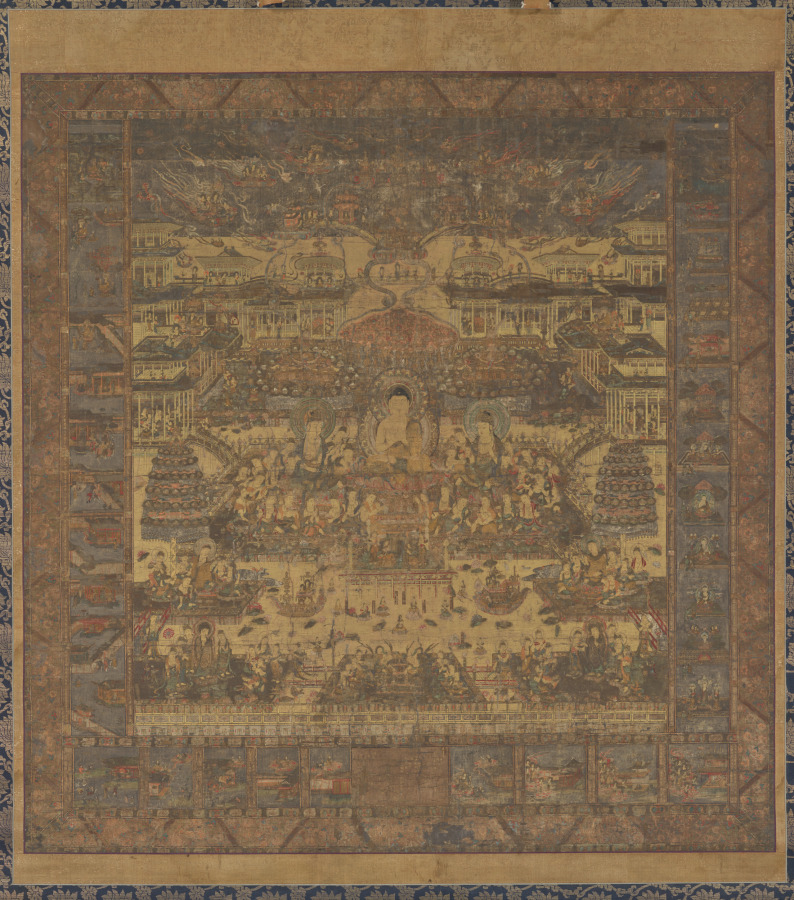
Cleveland 1990.82: an early-14th-century Kamakura recension of the Taima Mandala (135.6 × 140.3 cm, ink/color/gold on silk). The painting reads the canonical four-part structure cleanly — Sukhāvatī at the centre, the Vaidehi narrative on the left, thirteen of the sixteen contemplations on the right, the nine grades of rebirth at the bottom. The 763 silk *kesi* original at Taima-dera (Nara) is severely deteriorated; this Cleveland recension and the Kamakura Met holding (acc. 39669) are the cleanest accessible visual references for the iconographic programme.
The Taima Mandala (当麻曼荼羅) is the canonical pictorial reading of the Contemplation Sūtra (Kanmuryōju-kyō, T.365). The 763 silk kesi tapestry at Taima-dera (Nara) is the deteriorated original; the Cleveland Museum’s 1990.82 hanging scroll (early 14th c., Kamakura) is one of the high-quality recensions through which the iconographic programme is now read. Centre: Amida’s Sukhāvatī. Left border: Queen Vaidehi’s encounter with Shakyamuni. Right border: thirteen of the sixteen contemplations. Bottom: the nine grades of rebirth.
The 763 tapestry and the recensions that read it
The Taima Mandala that the modern viewer sees is almost never the 763 original. The original is a silk kesi (緙絲, “cut-thread tapestry”) work at Taima-dera in the foothills west of Nara, approximately four metres square. Designated a Japanese National Treasure in 1961.
The tapestry is severely deteriorated. Centuries of light, humidity, and devotional handling have left the original largely illegible. Taima-dera shows the modern Genshin (現信) reproduction in the temple’s Mandara-dō (曼荼羅堂); the original itself is conserved separately and rarely on view.
The iconographic programme survives because the mandala generated copies in Heian, Kamakura, and Edo recensions. The Cleveland Museum’s 1990.82 painting — early 14th century Kamakura, hanging scroll, ink and colour and gold on silk, 135.6 × 140.3 cm — is one of the high-quality Kamakura recensions. The Metropolitan Museum holds two: a Kamakura recension (acc. 39669) and an Edo recension (acc. 45594).
This article reads the iconographic programme through the recensions. The 763 original is the historical anchor; the Cleveland and Met paintings are how a modern viewer can actually look at the structure that the original codified.
Reading the centre: Amida’s Sukhāvatī
The central panel is the Pure Land of Amida — Sukhāvatī (極楽浄土, gokuraku jōdo), the Western Paradise. Amida is enthroned at the centre on a lotus throne, flanked by his canonical attendants Kannon (Avalokiteśvara, on Amida’s left) and Seishi (Mahāsthāmaprāpta, on Amida’s right).
The composition surrounding the central triad is dense. Bodhisattvas, monks, and kalaviṅka (迦陵頻伽, half-bird half-human celestial beings) occupy the lotus pond, the terraces, the jewelled trees, and the music-pavilions of the paradise. The architectural register draws from Tang continental temple-complex layouts: tile roofs, balustraded terraces, raised walkways across the lotus pond, the central honzon enthroned at the back of the principal hall.
The lotus pond at the foreground carries the iconographic anchor for the rebirth programme. Souls are reborn into Sukhāvatī by emerging from lotus flowers in the pond — the lotus is the matrix of birth into the Pure Land. The nine grades of rebirth on the bottom border are read as nine specific lotus flowers in the pond, each grade arriving in a flower of corresponding quality.
The visual register is one of orderly multiplicity. Hundreds of small figures are visible at any moderate viewing distance, all in iconographically determined positions. The programme is exhaustive — Sukhāvatī is depicted as a fully articulated cosmological space, not as a generalised paradise.
The right border: thirteen of the sixteen contemplations
The right border carries thirteen narrow vertical scenes, each depicting a single visualisation from the Contemplation Sūtra. The Contemplation Sūtra (Kanmuryōju-kyō, 観無量寿経, Taishō 365) presents sixteen contemplations as a structured visualisation programme through which the practitioner can directly perceive Amida’s Pure Land.
The sixteen are sequential. The early contemplations are sensory anchors: contemplate the setting sun (1), water (2), the ground of the Pure Land (3), the jewelled trees (4), the lotus pond (5). The middle contemplations build the architectural and bodily details: the temple buildings (6), the lotus throne (7), Amida’s body (8 and 9), Kannon’s body (10), Seishi’s body (11). The final contemplations integrate: contemplate yourself reborn into the Pure Land (12), contemplate the appearance of Amida and the bodhisattvas (13).
Thirteen of these sixteen are depicted on the right border of the mandala. Each scene reads as a small framed window: the practitioner-figure on the left, the visualised object on the right, sometimes with an explanatory cartouche above.
The remaining three contemplations — the fourteenth, fifteenth, and sixteenth — are the nine grades of rebirth. They occupy the bottom border in their own dedicated programme.
The bottom: the nine grades of rebirth
The Contemplation Sūtra’s last three contemplations are not visualisations of the Pure Land’s features but of the practitioner’s own rebirth into it. The Sūtra divides souls into nine grades by their religious cultivation in life, arranged in a 3×3 hierarchy: upper, middle, lower — each subdivided into superior, middle, inferior.
The top three grades (upper-superior, upper-middle, upper-inferior) are the practitioners of strict cultivation: those who have observed the precepts, cultivated meditation, and aspired to rebirth. They are reborn quickly and into superior lotus flowers.
The middle three grades are the moderate practitioners: those who have cultivated some discipline but not consistently. They are reborn after waiting periods, into less-ornate flowers.
The bottom three grades — the most consequential for the iconographic-and-doctrinal reading — are the karmically-burdened beings, including those who have committed serious offences (the lower-inferior grade includes those who have committed the five grave sins, the anantarya-level offences, and the ten unwholesome acts). They are reborn after extended waiting periods (12 great kalpas in the lowest grade) and only after the lotus flowers in which they wait have finally bloomed.
The doctrinal programme is universalist. Even the lower-inferior practitioner can attain rebirth in the Pure Land. This is the doctrinal claim that anchors the broader Pure Land devotional culture: rebirth is not limited to the cultivated. The mandala’s bottom border renders the claim pictorially.
The left border: Queen Vaidehi and the origin of the contemplations
The left border carries the narrative of how the Contemplation Sūtra came to be taught. The story is itself part of the Sūtra: Queen Vaidehi (韋提希夫人, Idaike-bunin) is imprisoned by her son Ajātasattu (阿闍世, Ajase), who has imprisoned his father King Bimbisara (頻婆娑羅, Binbashara) in a separate cell.
Vaidehi is permitted by her son’s guards to bring food to her husband. When the guards realise she is sustaining the king and report it, Ajātasattu attempts to kill her with a sword; he is dissuaded by his ministers. Vaidehi, distraught, prays to Shakyamuni Buddha for guidance.
Shakyamuni appears to her in her cell. He teaches her the sixteen contemplations as a programme through which she can perceive the Pure Land directly even from the prison and aspire to rebirth there. The Contemplation Sūtra is the textual record of this teaching.
The left border depicts the narrative scene-by-scene: the king imprisoned in the cell, Vaidehi feeding him through the wall, Ajātasattu’s sword, the ministers’ intervention, Shakyamuni’s appearance, the contemplations being given. The narrative is the textual ground for the iconographic programme on the right border and at the centre.
The recensions: Cleveland 1990.82 and the Kamakura register
The Cleveland Museum of Art’s painting (acc. 1990.82) is an early-14th-century Kamakura recension of the canonical structure. The hanging scroll is 135.6 × 140.3 cm — slightly less than half the size of the original tapestry, suitable for institutional viewing in a private chapel or domestic shrine rather than a temple’s principal hall.
The medium is ink, colour, and gold on silk. Gold is used heavily in the central paradise, particularly for Amida’s body and the jewelled trees and architectural details; the gold tracks the high-status devotional register of the Kamakura Pure Land patronage culture.
The Cleveland painting reads the iconographic programme cleanly. The centre is Sukhāvatī with the canonical Amida-Kannon-Seishi triad. The right border has the contemplations. The left has the Vaidehi narrative. The bottom has the nine grades of rebirth in their 3×3 hierarchy. A first-time reader with the iconographic programme in mind can locate every element of the structure on the painting at moderate viewing distance.
The Met’s Kamakura recension (acc. 39669) and Edo recension (acc. 45594) carry the same structure with workshop variations in the figure-style and the gold-application. The Met catalog text for these two could not be consulted; the Edo recension’s existence at all is iconographically significant. The structure proves stable across nearly six centuries from the Tenpyō original to the Edo workshop reproduction.
The Chūjō-hime legend
The Taima-dera tradition attributes the original mandala to a princess named Chūjō-hime (中将姫). The legend: the princess, weighed down by family suffering, prayed to Amida; Amida and Kannon appeared to her as two nuns; the nuns wove the mandala in a single night using lotus-stem fibres.
The legend belongs to the post-Heian devotional reception of the work. Modern scholarship treats it as later legendary attribution rather than historical account. The original kesi tapestry technique points toward Tang Chinese silk-weaving — the mandala is more plausibly a Tang import or a Tang-influenced product made in Japan, not a single-night miraculous weaving.
The Chūjō-hime legend is itself iconographically productive. The story generated its own narrative-painting tradition, the Taima Mandala engi-emaki (当麻曼荼羅縁起絵巻, “Origin scrolls of the Taima Mandala”), as Kamakura-period handscrolls. These engi scrolls are a separate genre from the mandala paintings themselves, and they deserve treatment as Kamakura narrative painting rather than as Pure Land iconography.
Where this reading sits
The Taima Mandala is the canonical pictorial reading of the Pure Land devotional programme — earlier than Genshin’s Ōjō yōshū (985), earlier than Hōnen’s Jōdo-shū (1175), earlier than Shinran’s Jōdo Shinshū (mid-13th century). The 763 original belongs to the Tenpyō Pure Land programme, contemporary with the Tōdai-ji Daibutsu and the Hokke-dō Fukūkenjaku Kannon — the broader Nara-period Buddhist consolidation rather than a sectarian Pure Land context.
By the Kamakura period the mandala has been absorbed into the active Pure Land schools. The Cleveland 1990.82 painting and the Met Kamakura recension carry the iconographic programme into Hōnen-school institutional space; the Edo recension (Met 45594) carries it into Shinran-school and folk-Pure-Land space.
The pictorial programme is more textually disciplined than most Pure Land devotional images. The Contemplation Sūtra’s exact structure — sixteen contemplations, nine grades, the Vaidehi narrative — is rendered on the painting with minimal iconographic invention. A reader holding T.365 in one hand and the painting in the other can verify the structure scene-by-scene.
For the modern viewer, the Cleveland 1990.82 painting is the cleanest accessible recension. Its OASC open-access availability means the painting can be downloaded at high resolution and read against the Sūtra text directly; the same is not true for the deteriorated Taima-dera original.
Related
Sources
-
Early 14th-century Kamakura recension, hanging scroll, ink/color/gold on silk, 135.6 × 140.3 cm. CMA Open Access (OASC). The painting reads the centre paradise + sixteen contemplations + nine grades of rebirth structure cleanly; one of the cleanest Kamakura recensions accessible to a Western reader
-
Kamakura period (1185–1333) Taima Mandala recension.
-
Edo period (1615–1868) recension. Useful as the late-tradition counter-example showing the iconographic programme stable across centuries
-
Taishō Tripiṭaka 365, vol. 12. The textual source for the sixteen contemplations and the nine grades of rebirth that the Taima Mandala renders pictorially. The mandala is best read as the Sūtra's pictorial gloss rather than as an independent iconographic programme
-
Taishō Tripiṭaka 360, vol. 12; the principal Pure Land scripture describing Amida's vows and the Sukhāvatī Pure Land. Read in tandem with the Contemplation Sūtra and the Smaller Sukhāvatīvyūha as the *Jōdo Sanbukyō*
-
Taishō Tripiṭaka 366, vol. 12; Kumārajīva translation. The third of the Three Pure Land Sūtras
-
The Tendai Pure Land synthesis that codifies the visualisation programme central to the Taima Mandala's reading. The mandala becomes a pre-Genshin pictorial anchor that Genshin's reading subsequently consolidates as devotional reference
-
Folk-tradition attribution of the original mandala to a princess Chūjō-hime, who is said to have woven it in a single night with the help of Amida and Kannon (depicted as nuns) using lotus-stem fibres. Modern scholarship treats this as later legendary attribution; the original is a Tang import or Tang-influenced silk kesi tapestry
-
The 763 original kesi tapestry, ~4m square, severely deteriorated. Designated National Treasure (1961). Currently shown as the *Genshin* (現信) reproduction in the temple's Mandara-dō (曼荼羅堂), with the original itself preserved separately for conservation
-
Heian visual culture context. Cited without page numbers.
-
[11]— Tokyo: Iwanami / English translations in Japanese Journal of Religious Studies 23/3-4 print referencePure Land devotional culture in the Heian institutional system; Taima-dera as the early Pure Land institutional anchor distinct from the later Hōnen / Shinran schools