A Heian zuzō for the Benevolent Kings Sutra mandala, 1100s
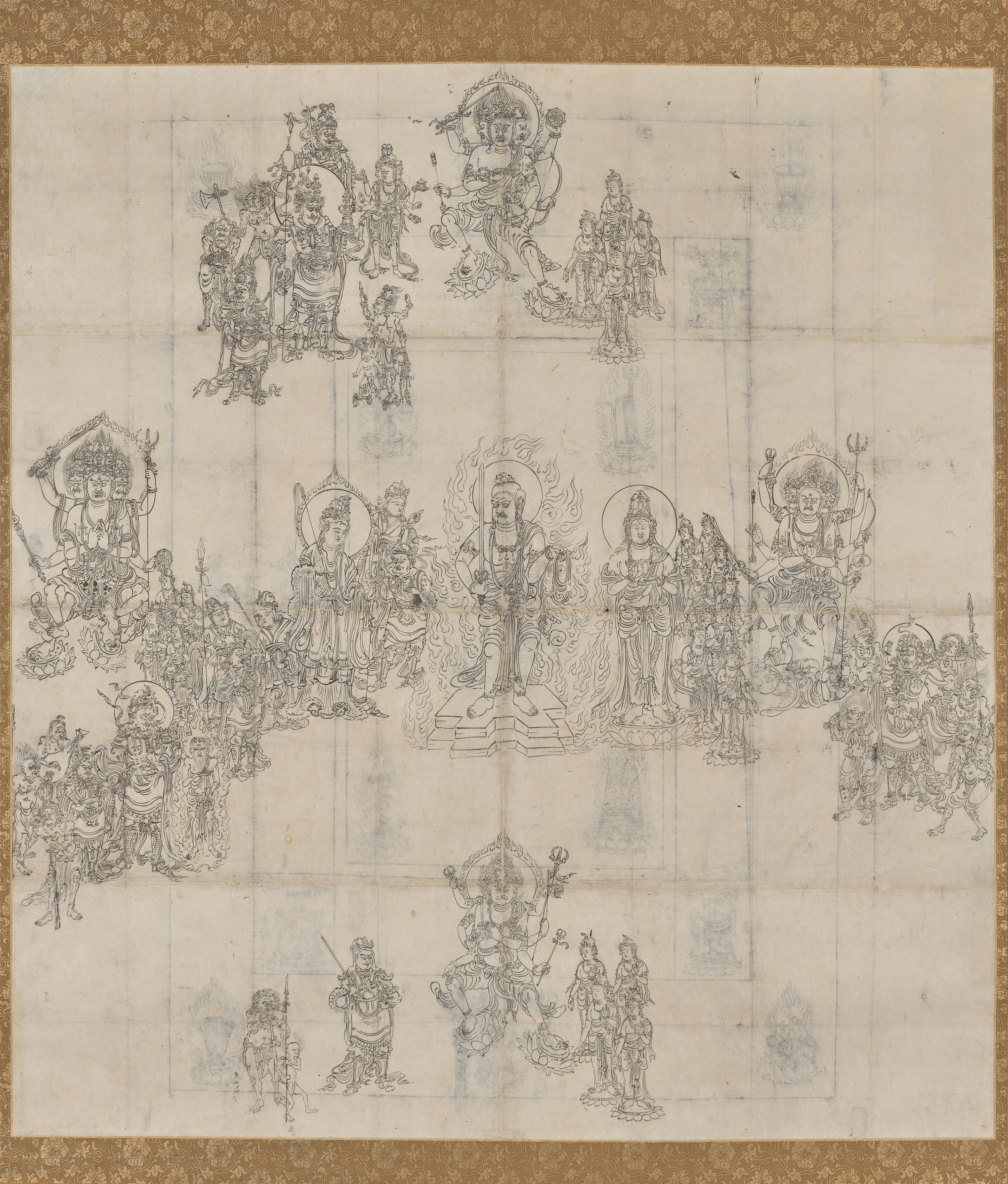
- Title
- Iconographical Sketch (Zuzō) for the Benevolent Kings Sutra Mandala — Cleveland 1987.39, Heian 1100s
- Period
- Heian period (794–1185), 1100s
- Region
- Japan
- Medium
- Hanging scroll; ink on paper
- Dimensions
- Image 122.2 × 112.2 cm (48 1/8 × 44 3/16 in.); mounted 203.4 × 130.7 cm (80 1/16 × 51 7/16 in.)
- Collection
- The Cleveland Museum of Art
- Accession
-
1987.39 - Rights
- Public domain (CC0). The Cleveland Museum of Art, Leonard C. Hanna Jr. Fund. Open Access, Cleveland Museum of Art.
Cleveland 1987.39 — a 1100s working drawing for the *Ninnōkyō* (Benevolent Kings) mandala. Fudō Myōō centre, Five Great Kings holding the directions. The genre is *zuzō*: an iconographic-template drawing used by painters and ritualists to maintain canonical fidelity when commissioning the finished mandala.
The centre is Fudō
The CMA did you know line gives the iconographic anchor in nine words: The deity at the center is Fudō Myōō, the Immovable One. Read the figure first as drawing, then as deity. The brushwork is steady, even, and patient: not the gestural ink of a literati painter and not the colour-and-gold finish of a votive mandala, but the calibrated outline of a working drawing made for repeated consultation. The flames around Fudō are not built up tonally; they are described in line, an unbroken flame-pattern that an eshi (Buddhist painter) could match in pigment with confidence.
Fudō at centre fixes the work inside one specific ritual programme. The Five Great Wisdom Kings (Godai Myōō: Fudō centre, Gōzanze east, Gundari south, Daiitoku west, Kongōyasha north) are not generic Buddhist deities; they are the protection-of-the-state iconography articulated by Amoghavajra (705–774) in his Tang ritual manual for the Benevolent Kings Sutra. The instant the centre reads as Fudō, the audience for the drawing reads as the imperial-palace state-protection rite.
The Ninnōkyō, from Nara recitation to Heian mandala
The Benevolent Kings Prajñā Sutra (Ninnō hannya-kyō, 仁王般若経) had been recited in Japan since the Nara period (710–794) as a state-protection scripture. Imperial-palace recitation ceremonies invoking the sutra were held to pray for national peace, good harvests, and the safety of the emperor, a long-running tradition that pre-dated Kūkai’s Shingon expansion by more than a century.
What Kūkai did in the early 9th century was reframe the Ninnōkyō ritual cycle through Amoghavajra’s Tang-tantric apparatus. Amoghavajra had written, in mid-8th century China, a ritual procedure text (giki, 儀軌) for the Ninnōkyō, the Ninnōkyō-giki (T.994 in the Taishō canon), that supplied a specifically esoteric ritual frame for the sutra and a specifically esoteric iconographic programme: the Five Great Wisdom Kings as guardians of the state, deployed across the centre and the four directions. Kūkai brought Amoghavajra’s lineage materials to Japan in 806, on his return from Chang’an, and inaugurated the Goshichinichi mishuhō (Latter Seven Day’s Rite) at the imperial palace’s Shingon-in chapel in 835. From that moment forward the Ninnōkyō recitation sat inside a Ninnōkyō mandala: a visible iconographic frame for what had been a sound-only rite.
Kūkai’s imported zuzō, 806 CE
Five sets of Kūkai-derived zuzō for the Ninnōkyō mandala survive at Daigo-ji and Tō-ji in Kyoto. The CMA wall text is precise on the point: Five scroll sets of copies of the original sketches brought by Kūkai are preserved in Daigoji and Tōji temples in Kyoto. These five sets are the canonical reference points against which other 11th-12th-century Ninnōkyō zuzō are read.
Cleveland 1987.39 is not one of those five: it sits outside the main Daigo-ji / Tō-ji line of transmission. CMA flags this directly: this work, however, differs in some ways from each of those sets. Two readings are possible. The work could be a parallel transmission line: an iconographic tradition that descended through a different temple or lineage from one of the other Amoghavajra-derived ritual transmissions Kūkai brought back. Or it could be a deliberate alternate-reading commissioned by a specific patron-temple in the 1100s that drew on the canonical line but introduced its own iconographic preferences. The CMA cataloguers gesture toward the second reading (an alternate approach to creating a mandala based on the Benevolent Kings Sutra) without committing to it.
Reading the recto and the verso
The most distinctive structural feature of 1987.39 is its two-sided composition. The recto (front) carries the Ninnōkyō deities figurally: Fudō in the centre with sword and lasso, Gōzanze and the other Great Kings in their fierce postures, the secondary bodhisattvas arrayed around them. The verso (back) carries the same deities symbolically: each deity is represented by its samaya form: the ritual attribute or symbol that substitutes for the figural body in the seed-syllable register of esoteric practice. Fudō’s samaya is his sword; Gōzanze’s is the vajra-cross; Gundari’s is a triple-pronged vajra; Daiitoku’s is the lance; Kongōyasha’s is a five-pronged vajra. Symbolic forms perform the same ritual function as the figural forms but at a more abstract register, closer to the seed-syllable mandala, the bīja-only depiction practised at the level of pure-text liturgy.
The recto-verso pairing in a single hanging scroll is not the standard format for a finished Ninnōkyō mandala. A formal mandala in finished pigment would be single-sided; the samaya forms would either appear in a separate karma mandala or would be elided altogether. The pairing on a single sheet here is what marks 1987.39 as a zuzō: a working reference that needs both registers visible to the ritualist or the painter for cross-checking. The drawing is the iconographic equivalent of a bilingual edition.
Why the zuzō genre matters
A finished mandala in pigment is the output of the ritual painter’s workshop. The zuzō is the template. The genre matters because the iconographic correctness of the finished mandala depends entirely on the zuzō being copied accurately: a misplaced attribute, a wrong number of arms, a confused mount, would invalidate the ritual.
The zuzō genre is dense and well-organised. Three of the great encyclopaedic zuzō compendia are the Besson zakki (別尊雑記, late 12th c., compiled by Shinkaku at Daigo-ji), the Asabashō (阿娑縛抄, early 13th c., compiled by Shōchō at Daigo-ji), and the Kakuzenshō (覚禅鈔, late 12th–early 13th c., compiled by Kakuzen). Each gathers hundreds of individual iconographic descriptions and reference drawings into bound or roll form. Single-sheet zuzō like Cleveland 1987.39 sit outside the encyclopaedia format: they are loose working drawings, sometimes used in the ritualist’s preparation cycle, sometimes given to a contracted painter as the iconographic reference for a specific commission.
In the long Heian-to-medieval period, the institutional logic of the kenmitsu (exoteric-esoteric) order described by Kuroda Toshio depended on the accurate transmission of these iconographic templates. The Ninnōkyō ritual cycle, which sat at the centre of state-protection liturgy, could not be performed unless the iconographic frame was canonical. The zuzō is what made the canonicity portable.
From Yanagi Fine Art Shop, Kyoto, to Cleveland, 1987
The CMA provenance line is short: Yanagi Fine Art Shop, Kyoto, Japan (sold to museum, ?–1987) → Cleveland Museum of Art, 1987–. The Yanagi firm is a respected Kyoto dealership in Japanese painting and Buddhist art; the 1987 sale brought 1987.39 into Cleveland through the Leonard C. Hanna Jr. Fund, the principal acquisitions endowment for Cleveland in this period. Sherman Lee had retired as Cleveland’s director in 1983; the 1987 acquisition is therefore under the directorship of Evan Hopkins Turner (CMA director 1983–1993), who continued the strong-Japanese-collection mandate Lee had set.
The deeper pre-1987 provenance is not in the public record. A Heian zuzō of this scale would have descended through a temple inheritance line (most plausibly a Shingon or Tendai esoteric temple in the Kyoto region) until it entered the antique market at some point in the 19th or early 20th century. The standard explanation for Heian-Buddhist works arriving at Kyoto dealerships is the haibutsu kishaku of the 1860s–70s and the Meiji land reforms, which dispersed temple holdings to private dealers in large quantities. 1987.39’s pre-dealer history is unrecorded.
What stays open
The temple of origin. CMA cannot identify which Heian temple commissioned or held 1987.39. Plausible candidates concentrate around the Daigo-ji / Tō-ji / Ninna-ji Shingon network, but the work falls outside the canonical five-set Daigo-ji / Tō-ji line, which complicates rather than simplifies the search.
The verso. The CMA online image shows the recto only. The samaya verso is described in the wall text but not reproduced in the public record. bodhi has not located a verso photograph. A direct examination of the samaya forms would resolve the divergence-from-canon question that the CMA description gestures at without specifying.
The five Daigo-ji / Tō-ji comparanda. Cleveland’s hedge (this work differs in some ways from each of those sets) is not closeable from the public record because Daigo-ji and Tō-ji do not have full open-access photography of their zuzō holdings. A scholar-access comparison of 1987.39 against the five canonical sets would resolve the lineage question.
The pre-Yanagi provenance. Heian zuzō are temple-inheritance objects in the long run. The 19th- or 20th-century dispersal that took 1987.39 from a temple holding to a Kyoto dealership is unrecorded. The pre-dealer line is the load-bearing gap in the work’s institutional biography.
Related
- One Hundred Images of Fudō — a printed deity multiplied, in the zuzō-compendium tradition
- Daiitoku Myōō: the six-headed western wisdom king
- Fudō Myōō: iconographic markers
- Met 1975.268.6: Five Wisdom Kings zuzō handscroll, Heian 12th c.
- Met 44.842: Heian Fudō, close reading
- Heian gold-silver-indigo sutra
Sources
-
CMA OA API (CC0). Confirms: title 仁王経曼荼羅図像; date 1100s (Heian); medium hanging scroll, ink on paper; image 122.2 × 112.2 cm, mounted 203.4 × 130.7 cm; gallery 235A Japanese; provenance Yanagi Fine Art Shop, Kyoto → CMA 1987; credit line Leonard C. Hanna Jr. Fund; *did you know* note: 'The deity at the center is Fudō Myōō, the Immovable One.'
-
CMA description verbatim: 'The Benevolent Kings Sutra has been a highly valued Buddhist scripture in Japan since the Nara period (710–794), when it started to be recited in a ceremony to pray for the peace and protection of the country. In the 800s, the monk Kūkai brought back from China a new translation of the text as well as Buddhist iconographic sketches to perform the rituals based on the sutra. Five scroll sets of copies of the original sketches brought by Kūkai are preserved in Daigoji and Tōji temples in Kyoto. This work, however, differs in some ways from each of those sets. It features deities depicted figuratively on the front and symbolically on the back, representing an alternate approach to creating a mandala based on the Benevolent Kings Sutra.'
-
Tang-period ritual expansion of the Ninnōkyō by Amoghavajra (the Shingon Eighth Patriarch). The *giki* (ritual procedure) text is the source for the Five Great Wisdom Kings as the standard iconographic frame for the state-protection ceremony — Fudō centre, Gōzanze east, Gundari south, Daiitoku west, Kongōyasha north. Kūkai brought Amoghavajra's lineage materials to Japan in 806; the Five-Kings configuration enters the Japanese ritual record through this transmission. T.994 in the Taishō canon.
-
Kūkai (空海, Kōbō Daishi) studied in Chang'an 804–806 under Huiguo (746–805), the seventh Shingon patriarch. He returned to Japan in 806 with a body of imported texts, paintings, and ritual implements that included the iconographic-drawing apparatus for the Mikkyō rituals — among them the zuzō for the *Ninnōkyō* and *Godai Myōō* ceremonies. The five sets of zuzō descended from that 806 import are preserved at Daigo-ji and Tō-ji.
-
Annual New Year's esoteric rite held at the Shingon-in chapel within the imperial palace (now performed at Tō-ji). Inaugurated by Kūkai in 835 (the year of his death) under imperial sanction. Supervised by successive generations of senior Tō-ji abbots; the ritual centres on the Five Great Wisdom Kings as state-protection guardians, invoked through Amoghavajra's *Ninnōkyō-giki*. The Goshichinichi mishuhō is the primary institutional ritual for which a zuzō like CMA 1987.39 would have been a working reference.
-
Zuzō are working drawings used by busshi (Buddhist sculptors), eshi (Buddhist painters), and ritualists. They are not finished cult objects but template copies that maintained canonical iconographic accuracy across generations of copying. The genre is large — the Asabashō (early 13th c., compiled by Shōchō at Daigo-ji), Besson zakki (late 12th c., compiled by Shinkaku at Daigo-ji), and Kakuzenshō (late 12th–early 13th c., compiled by Kakuzen) are the standard zuzō encyclopaedias. Single-sheet zuzō like CMA 1987.39 are individual working drawings, sometimes loose, sometimes mounted as hanging scrolls for repeated use.
-
[7]2026-05-13The Metropolitan Museum of Art, New York collectionapi.metmuseum.org/public/collection/v1/objects/44911Met's own Heian Five-Kings zuzō, 12th c., ink and colour on paper, 33.7 × 1285.7 cm handscroll. The natural format-comparator to CMA 1987.39 — same period, same broad iconographic programme, but handscroll format rather than hanging-scroll format. Acquired through the Packard 1975 gift.
-
Kuroda's *kenmitsu taisei* (exoteric-esoteric system) framework. The state-protection ritual cycle — Ninnōkyō, Godai-rikū, the imperial palace mishuhō — sits at the centre of the kenmitsu institutional order through the long Heian-to-medieval period. Cleveland 1987.39 is an iconographic working drawing for *exactly* this ritual programme, made in the 1100s when the kenmitsu order was at its institutional apex.
-
Wikidata entry for CMA 1987.39.