A late-Kamakura Monju Bosatsu with Eight Topknots, gilt bronze
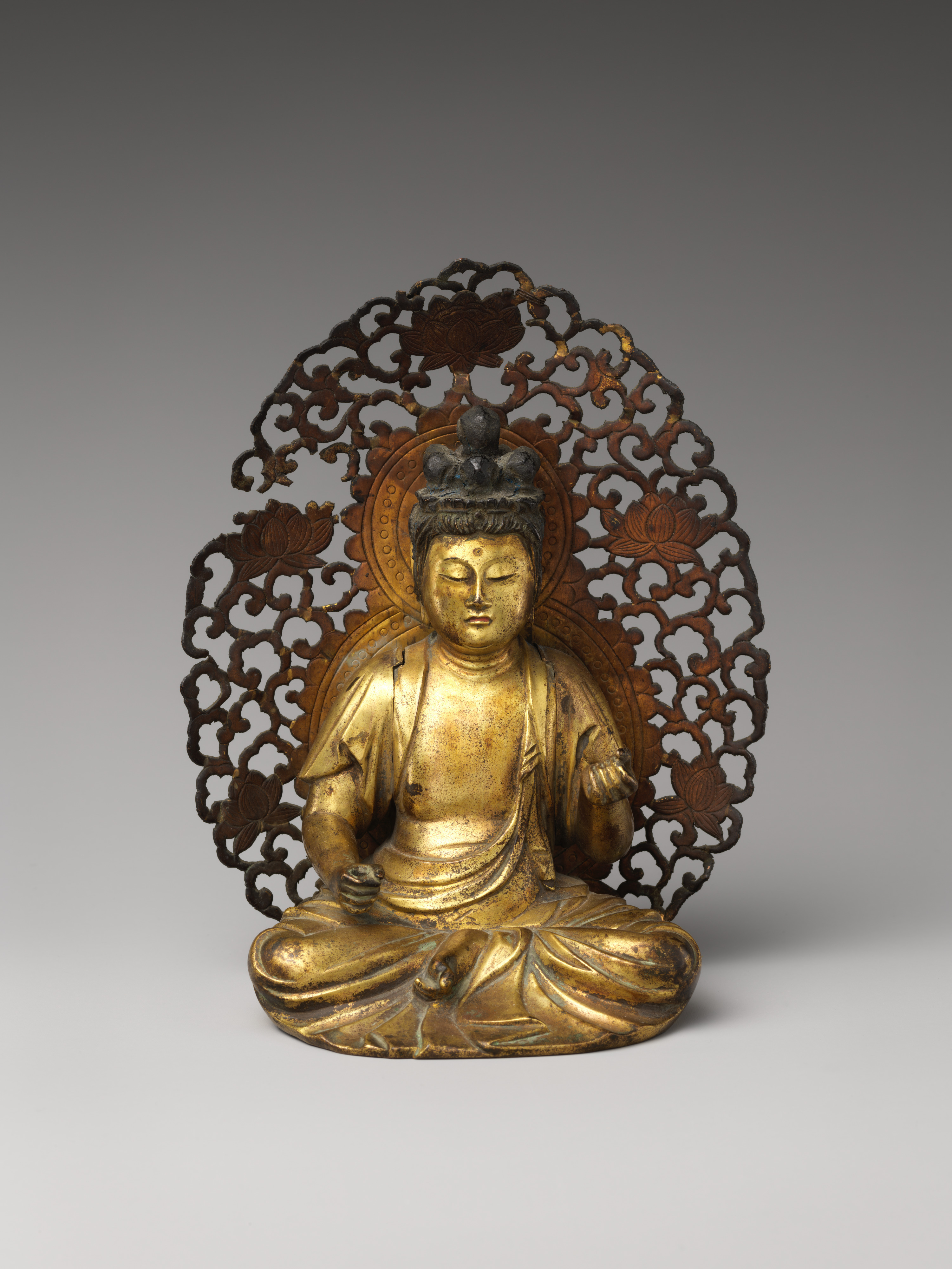
- Title
- The Bodhisattva Monju (Manjushri) with Eight Topknots — Met 2019.418.1, late 13th c.
- Period
- Kamakura period (1185–1333), late 13th century (1267–1299)
- Region
- Japan
- Medium
- Gilt bronze
- Dimensions
- Height 16.5 cm (6 1/2 in.); width 12.7 cm (5 in.); depth 7.6 cm (3 in.); depth including tangs on the back 11.4 cm (4 1/2 in.)
- Collection
- The Metropolitan Museum of Art, New York
- Accession
-
2019.418.1 - Rights
- Public Domain. The Metropolitan Museum of Art, New York, Gift of Sue Cassidy Clark, in honor of Barbara Brennan Ford, 2019 (acc. 2019.418.1). Met Open Access (OASC).
Met 2019.418.1 — a small gilt-bronze Hachiji Monju, late 13th c. The tangs on the back identify it as a former mandorla-attachment piece from the aureole of a larger sculpture.
A small bronze, once part of a larger ensemble
The figure is 16.5 cm tall, slightly larger than a hand. It is the wrong scale to have been a cult image. A cult image of Monju in a Kamakura temple was 60–120 cm; this is one-fifth that size. What the size tells us, taken together with the diagnostic feature on the back (the tangs, the small vertical metal projections extending 11.4 cm out from the body proper depth of 7.6 cm) is that this work was never meant to stand on its own.
The Met catalog reads the work directly: probably once formed part of a decorative program for the mandorla (aureole) of a much larger sculpture. The mandorla (kōhai in Japanese; the leaf-shaped or oval flame-haloed structure that frames a central seated Buddha or Bodhisattva) was, in major late-Heian and Kamakura cult sculpture, often decorated with small attendant figures cast separately and attached to the back via tangs that slotted into the wooden mandorla. The Byōdō-in Amida (1053, the Jōchō workshop) is the most famous surviving example: the great Amida’s mandorla carries fifty-two flying-bodhisattva attendants, each separately worked and mounted, surrounding the central figure. Smaller cult ensembles followed the same logic at smaller scale.
Met 2019.418.1 is a survivor from one such ensemble. The central sculpture (the larger Buddha or Bodhisattva whose mandorla this figure decorated) is unrecorded. The mandorla itself is unrecorded. The other attendant figures that originally accompanied it (and there would have been several, possibly a dozen or more) are unrecorded. What we have is one small fragment of a once-larger devotional ensemble.
Monju, Mañjuśrī, and the bodhisattva of wisdom
Monju Bosatsu (Sanskrit Mañjuśrī) is the bodhisattva of prajñā, perfected wisdom. The standard Japanese iconographic programme gives him two attributes: the sword in the right hand that cuts through delusion and ignorance, and the Prajñāpāramitā (Perfection of Wisdom) sutra scroll in the left hand. He is conventionally shown seated on a lion mount, the lion being the symbol of fearless wisdom in Buddhist iconography.
Monju’s prominence in Japan rises through the Heian period via the Tendai school’s connection with Mount Wutai (五台山) in China, the Chinese cultic centre of Mañjuśrī worship. The Tendai monk Ennin (794–864) made the pilgrimage to Mount Wutai in 840, brought back scriptures and images, and anchored the Heian Japanese Monju cult. By the Kamakura period the cult had spread across both Tendai and Shingon institutional networks, with major sculptural and painted programmes at Kōfuku-ji, Saidai-ji, Tōfuku-ji, and many provincial temples.
The Met figure’s bodily posture and proportions are typical of late-Kamakura small-bronze Monju depictions. The body is youthful and idealised: a bodhisattva form, not the elder-monk register of Jizō. The robes follow the bodhisattva-attendant scheme: inner sashed garment, outer scarf draped over both shoulders. The hands are not in the canonical sword-and-scroll position visible in larger Monju images; whether this is because the figure’s identity is read first off the Eight Topknots rather than off the attributes, or because the attributes were originally held but are now broken off, is not specified in the Met catalog.
The Eight Topknots and the eight-syllable mantra
The iconographic feature that gives the work its name is the hair. Rather than the single topknot of generic bodhisattva attire, or the crown that marks Kannon or Seishi, the hair on Met 2019.418.1 is gathered into eight discrete topknot-tufts arranged around the cranium. This is the Hachiji Monju (八字文殊, eight-character Monju) form, a variant Monju iconography specifically tied to the eight-syllable Sanskrit mantra invocation of the bodhisattva.
The system is elegant in its logic. Monju has multiple ritual mantra-forms varying by length: the one-syllable mantra has the Ichiji Monju (one-topknot) iconographic form; the five-syllable mantra has the Goji Monju (five-topknot) form; the six-syllable has the Rokuji Monju; the eight-syllable has the Hachiji Monju: this form. The number of hair-topknots is a direct visual index of which mantra-recitation programme the figure is iconographically calibrated to support. A practitioner using the eight-syllable mantra would, in principle, commission or place before her a Hachiji Monju image; a practitioner using the five-syllable mantra would use the Goji Monju.
The eight syllables themselves are recorded in the Eight-Syllable Monju Sutra ritual literature: eight Sanskrit bīja (seed syllables) each corresponding to one of the eight guardian-youth attendants who, in the Tantric Mañjuśrī mandala, surround the central bodhisattva. The Met holds a contemporary Kamakura Mandala of the Bodhisattva Monju of the Eight Syllables (Met 40137) that depicts this programme as a finished painted mandala: the 2D comparator to the small-bronze Hachiji Monju figure here.
The mandorla-attachment: why this figure has tangs
The diagnostic physical feature of Met 2019.418.1 (the one that turns the work from small Monju into attendant from a larger ensemble) is the back. The body depth is 7.6 cm. The depth including the tangs that project from the back is 11.4 cm. The difference, 3.8 cm, is the length of the integral metal projections that extended into the mandorla of the original ensemble.
This is workshop-standard hardware. A large-sculpture mandorla (typically wood, often gilded, attached behind the central figure on the throne) would carry a programme of cast bronze attendant figures slotted into pre-drilled holes in the mandorla wood, with the tangs hidden behind the figures. The viewer reading the central sculpture would see the small attendants as a distributed visual field across the aureole, framing the central figure with subsidiary bodhisattvas, deities, or attendant figures.
A late-Kamakura Buddha or Bodhisattva of, say, 100–150 cm seated height would carry a mandorla of roughly 200 cm height, large enough to accommodate twelve to twenty small attendant figures of Met 2019.418.1’s scale (16.5 cm) distributed across the aureole. A central Dainichi Nyorai, or a Vairocana, or a major Bodhisattva of the wisdom-and-protection register, could plausibly have carried a programme of mandorla-attendants that included a Hachiji Monju — given Monju’s association with wisdom and the protective ritual context.
What is lost. The central sculpture is lost. The mandorla is lost. The other attendant figures are dispersed or lost. The institutional setting (Tendai or Shingon, which temple, which province) is unrecorded. Met 2019.418.1 is a fragment in the strictest archaeological sense.
Gilt bronze production in late-Kamakura
The technique is straightforward but the survival rate is unusually low. Late-Kamakura gilt-bronze production (small cast figures, usually in the 10–30 cm range, gilded with mercury-amalgam gold over a copper-alloy core) was a workshop-standard medium for mandorla-attachment programmes, for portable altar figures (zushi-iri-butsu), and for the small subsidiary figures in larger cult ensembles. The wax-loss casting technique permitted relatively fine detail; the mercury-amalgam gilding gave a durable bright surface.
Survival is low for two reasons. First: small bronzes are easy to lose. They detach from their mandorlas in fires and survive when the larger wooden sculpture burns. They can be carried away by individual collectors during temple sales when the larger figures are not portable. Second: mercury-amalgam gilding wears down with handling, and many surviving late-Kamakura small bronzes have lost so much of their gilded surface that they are no longer recognisable as having been gilded. Met 2019.418.1 preserves the surviving gilding in patches across the high points of the body and the cranium, with the recesses worn back to the underlying bronze, the standard surviving-Kamakura register.
The technique is shared with the larger-bronze cult-image tradition (the Tōdai-ji Daibutsu, 7.5 m tall, cast 752 CE), but at a different production scale and for different ritual purposes. Small gilt bronzes are workshop production; large bronze cult images are state-level commissions. The two registers do not directly inform each other.
Sue Cassidy Clark, Barbara Brennan Ford, the 2019 gift
The Met provenance line is short. Sue Cassidy Clark, the New York collector and donor, owned the figure from 2007 to 2019. She gifted it to the Met in 2019 in honor of Barbara Brennan Ford (1953–2008), the Met’s Associate Curator of Japanese Art who died in 2008. Ford had served the Met’s Japanese department for fifteen years and had contributed to several of the department’s catalogs and exhibitions. The 2019 gift is a memorial: a small bronze placed into the institutional collection in memory of a curator who had spent her career building it.
The pre-2007 provenance is not documented in the Met record. A late-Kamakura small gilt bronze of this kind would have passed through the antique market via a series of Japanese-art dealerships and private collections; the trail is plausibly traceable through the post-war American Japanese-collecting network (Sherman Lee’s contacts, the Mary Griggs Burke and Harry Packard circles, the Setsu Gatōdo and Mayuyama dealerships) but the specific pre-2007 line for this figure is not on the Met page.
Where this figure sits in the Met’s Monju corpus
Reading the Met’s Kamakura-Nanbokuchō Monju holdings as a coherent group: Met 45236 (Goji Monju, Five Topknots, Kamakura) → Met 752004 (Hachiji Monju, Eight Topknots, late 13th c., this work) → Met 40137 (Eight-Syllable Mandala, Kamakura) → Met 45596 (Eight-Syllable Sanskrit-Syllable form, Nanbokuchō). Three iconographic variants, four works, one institutional collection. The 2019 gift completed the corpus.
What stays open
The original ensemble. The central sculpture, the mandorla, and the other attendant figures of the original programme are unrecorded. Action if a documented match surfaces (an inventoried late-Kamakura Buddha or Bodhisattva of 100–150 cm with a documented mandorla-attendant programme including a Hachiji Monju): cross-link.
The pre-2007 provenance. Documented record begins with Sue Cassidy Clark in 2007. Action when located: map the pre-2007 dealer chain.
The original temple. Not on Met record. Plausible candidates: a Shingon or Tendai esoteric centre in the Kantō or Kansai region.
The companion figures. The same mandorla likely held companion mantra-form Monjus (Ichiji, Goji, Rokuji) or related wisdom-bodhisattva figures. Action if companion mandorla-attachments surface in other collections: identify potential reassociations.
Related
Sources
-
[1]2026-05-13The Metropolitan Museum of Art, New York collectionapi.metmuseum.org/public/collection/v1/objects/752004Met OA API. Title *The Bodhisattva Monju (Manjushri) with Eight Topknots*; accession 2019.418.1; date late 13th c. (1267–1299); medium gilt bronze; dimensions H. 16.5 cm × W. 12.7 cm × D. 7.6 cm (body) / 11.4 cm (with tangs); classification sculpture; credit line *Gift of Sue Cassidy Clark, in honor of Barbara Brennan Ford, 2019*; public domain (CC0).
-
Met wall text / online description: 'This miniature sculpture represents the bodhisattva Monju, who personifies Buddhist wisdom, with his hair coiffed into eight knots, corresponding to the number of syllables in a corresponding incantation. It probably once formed part of a decorative program for the mandorla (aureole) of a much larger sculpture.' Confirms the *Hachiji Monju* identification, the mandorla-attachment reading of the tangs, and the eight-syllable mantra correspondence.
-
Reference overview of Monju iconography. Confirms: distinct Monju forms by topknot count (One Topknot, Five Topknots, Six Topknots, Eight Topknots) tied to the corresponding mantra syllable counts; the *Hachiji Monju* (eight-character Monju) form is the eight-syllable mantra variant; standard attributes are the wisdom-sword (right hand) and the *Prajñāpāramitā* sutra-scroll (left hand), usually seated on a lion mount. The topknot-count system rose to prominence with the Shingon and Tendai esoteric schools of the Heian period and was further developed in the late Heian and Kamakura zuzō literature.
-
The Tendai monk Ennin (Jikaku Daishi, 794–864) travelled to Tang China 838–847 and visited Mount Wutai (五台山) — the Chinese cultic centre of Mañjuśrī worship — in 840. He brought back scriptures and images of Monju that anchored the Heian-period Japanese Monju cult. The iconographic-topknot-count system descended from Tang-Tantric Mañjuśrī ritual practice via the Heian-period Tendai and Shingon transmission.
-
Met holdings of Monju Bosatsu: Met 45236 *Bodhisattva Monju with Five Topknots*, Kamakura; Met 45596 *Monju Bosatsu with Eight Sacred Sanskrit Syllables*, Nanbokuchō; Met 40137 *Mandala of the Bodhisattva Monju of the Eight Syllables*, Kamakura; Met 752004 *Monju with Eight Topknots* (this work). The 45236 (Five Topknots) and 752004 (Eight Topknots) are the small-bronze pair; the 45596 painting and 40137 mandala are the 2D comparators on the *eight-syllable* programme.
-
Ford served as Associate Curator of Japanese Art at the Metropolitan Museum from the 1990s through her death in 2008. She authored or contributed to several Met catalogs of the Japanese collection. The 2019 gift of 2019.418.1 by Sue Cassidy Clark *in honor of Barbara Brennan Ford* commemorates Ford's curatorial contribution to the Met's Japanese collection.