Fukūkenjaku Kannon: the lasso, the three eyes, the silver Amida
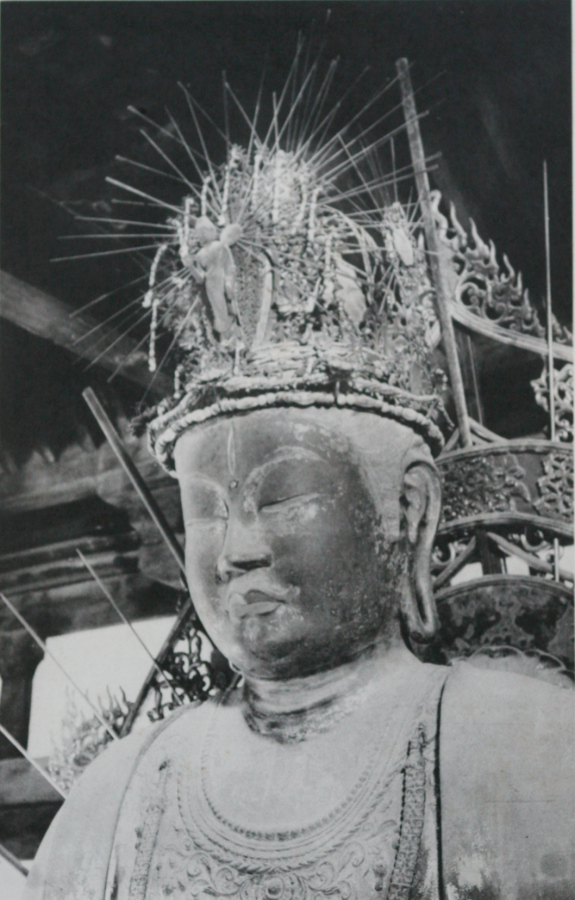
- Title
- Fukūkenjaku Kannon (不空羂索観音坐像) — Tōdai-ji Hokke-dō
- Period
- Nara period, Tenpyō, c. 747
- Region
- Yamato / Nara
- Medium
- *Dakkatsu-kanshitsu* (hollow dry-lacquer); originally polychromed and gilt; silver Amida figure in the crown
- Dimensions
- 362 cm seated
- Collection
- Tōdai-ji Hokke-dō (Sangatsudō), Nara
- Accession
-
Hokke-dō principal honzon - Rights
- Public domain (PD-Japan-oldphoto). Photograph by Ogawa Seiyō (小川晴暘, 1894–1960), February 1933, published in *Asukayen, Histoire des Beaux-Arts Japonais — Tōyō-bijutsu* Special Issue 4 (Asukayen, Nara). Source: Wikimedia Commons.
Fukūkenjaku Kannon, Tōdai-ji Hokke-dō (c. 747). The Tenpyō dry-lacquer prototype: eight arms, three eyes, *kenjaku* lasso, silver Amida in the crown, deer-skin mantle. Ogawa Seiyō plate, 1933.
Fukūkenjaku Kannon (不空羂索観音) reads through two canonical anchors. The Tōdai-ji Hokke-dō figure (c. 747, dry-lacquer, 362 cm) is the Tenpyō prototype: eight arms, three eyes, silver Amida in the crown, deer-skin mantle, the kenjaku (lasso) that names the form. The Kōfukuji Nan’endō figure (1188, Kōkei) is the Kamakura Hossō-school reconstruction after the 1180 Heike War destruction. Within the Tendai Six Kannon programme, Fukūkenjaku substitutes for Juntei in the realm-of-humans slot.
The lasso that never returns empty
The name carries the iconography. Fukū (不空) reads “never-empty”; kenjaku (羂索) reads “noose / lasso.” Together they render the Sanskrit amogha-pāśa, the lasso that never returns empty.
The figure’s iconographic role is to draw all sentient beings out of suffering with that lasso. The implement is the diagnostic. Of the eight arms in the canonical reading, one holds the kenjaku, and that one arm is the figure’s signature.
Two canonical Japanese anchors carry the form. The Tōdai-ji Hokke-dō (Sangatsudō) figure of c. 747 is the Tenpyō prototype, one of the supreme Nara dry-lacquer sculptures, the principal honzon of the oldest surviving Tōdai-ji hall. The Kōfukuji Nan’endō figure of 1188 is the Kamakura reconstruction by Kōkei after the 1180 Heike War burned the original 746 figure to nothing.
The two figures bracket the form across four and a half centuries. The Tenpyō original sits inside the Kegon-school institutional programme of Tōdai-ji’s earliest period, before Esoteric Buddhism reshapes the Heian image-corpus. The Kamakura reconstruction sits inside the Hossō-school programme of Kōfukuji, with the iconographic register reread through the Esoteric Six Kannon frame that develops between them.
What the figure shows
Eight arms. Three eyes. The lasso. The silver Amida in the crown. The deer-skin mantle. These five markers separate Fukūkenjaku from every other Kannon form, and the canonical Tenpyō figure preserves all five.
The eight arms in the canonical reading hold a defined implement set. The principal pair at the chest in anjali (palms together) or abhaya (palm-out, fearlessness) register. The remaining six radiate around the body, holding the kenjaku lasso, a lotus stem, a water-vase (kundikā), an aṅkuśa (goad or hook), a staff or pilgrim’s kakujō, and an open palm.
The principal arms vary by workshop and period. The lasso is the only implement that is invariant across the Fukūkenjaku corpus. If the lasso is absent, the figure is not a Fukūkenjaku.
The third eye is the second-most-reliable marker. Two canonical eyes plus a third eye in vertical position at the forehead, in the ūrṇā slot, the same position that on a Buddha image carries the ūrṇā curl.
The third eye is rare in the Kannon family; outside Fukūkenjaku, only the wrathful Bato Kannon and certain extended Esoteric forms carry it. On the placid Kannon family (Shō, Senju, Juichimen, Nyoirin) the canonical eye-count is two.
The jewelled crown is set with a small silver Amida figure at its centre. The Amida-in-crown is the Kannon-family marker generally, but on Fukūkenjaku the canonical material specification is silver.
The Tōdai-ji figure preserves the original silver Amida intact. On other Kannon forms the material is gilt-bronze, gilt-wood, or gold-leaf-on-wood; the silver specification is itself a small iconographic distinction that this article’s bodhi reader can use as a cross-check.
The deer-skin shoulder mantle (rokuhi, 鹿皮) drapes across one shoulder of the Tōdai-ji figure. The element tracks back to continental Tang precedent and becomes a feature of Esoteric eight-armed figures more broadly. The mantle is preserved on the canonical Tenpyō image but is not invariant across all later Fukūkenjaku.
The Tōdai-ji Hokke-dō canonical anchor
The Hokke-dō (法華堂, “Lotus Hall”) is the oldest surviving structure at Tōdai-ji. Built at earliest in 733, it predates the Daibutsu-den (Great Buddha Hall) by more than a generation. The hall takes its alternative name Sangatsudō (三月堂, “Third Month Hall”) from the Hokke-e (法華会, Lotus Sutra) ceremony held there in the third month of every year.
The Fukūkenjaku Kannon, c. 747, is the hall’s principal honzon. The figure stands on a lotus pedestal at 362 cm, reaching close to four metres total height with halo and pedestal. The construction is dakkatsu kanshitsu-zukuri (脱活乾漆造): hollow dry-lacquer over a wooden armature, finished with polychromy and gold leaf.
Dry-lacquer construction is the Tenpyō workshop signature. The technique builds an icon by laminating layers of lacquer-soaked hemp cloth over a clay or wooden core, then breaking out the core to leave a hollow lacquer shell. The labour-cost is significant (months of drying time per layer), but the resulting figure is dimensionally stable, lighter than wood, and permits crisp drapery folds and surface detail unavailable to single-block carving.
The figure stands inside a Hokke-dō populated by ten Nara-period sculptures, all designated National Treasures. The two flanking attendants are clay Nikkō Bosatsu and Gakkō Bosatsu, the same Sun-and-Moon attendant pair that conventionally accompanies Yakushi Nyorai (the Medicine Buddha), here repurposed as the Fukūkenjaku attendant set.
The eight arms preserve their original orientation. The third eye is intact. The silver Amida in the crown survives. The deer-skin mantle drapes across the shoulder.
The 1933 Ogawa Seiyō plate (from the Asukayen Tōyō-bizyutsu monograph series) is the most widely-reproduced photographic record. The same Ogawa-photographic-record-of-Nara-sculpture pattern carries across multiple major Tenpyō images; the 1933 plate is itself an institutional document of the early-20th-century scholarly attention to the Hokke-dō programme.
The Hossō school reading: Kōfukuji Nan’endō, 1188
The Kōfukuji Nan’endō (南円堂, “Southern Octagonal Hall”) in Nara is the institutional anchor of the Hossō (法相宗) school’s Fukūkenjaku devotion. The Hossō tradition of Fukūkenjaku worship runs separate from the Esoteric (Tendai / Shingon) lineage; the Hossō school treats the figure as a foundational devotional image without the Six Kannon programme overlay.
The original 746 Nan’endō Fukūkenjaku, contemporary with the Tōdai-ji Hokke-dō figure, was destroyed in December 1180 during Taira no Shigehira’s burning of Nara (南都焼討, Nanto Yakiuchi). The attack was a Heike-War retaliation against the Nara monastic establishment that had supported the Genji cause. Both Kōfukuji and Tōdai-ji burned heavily; the Tōdai-ji Hokke-dō survived because it stood at the temple’s eastern edge, distant from the main destruction.
The Nan’endō reconstruction was led by Kōkei (康慶), the founder of the Kei-school workshop and Unkei’s father. Kōkei’s career runs from c. 1175 to 1200; his Kōfukuji Nan’endō programme of 1188–1189 is his single most-documented body of work.
The 1188 Fukūkenjaku Kannon is the centerpiece. It sits surrounded by six Hossō Patriarch figures (the founding teachers of the Hossō school) and the Four Heavenly Guardians (Shitennō, 四天王) at the cardinal points. All six patriarchs and the four guardians are also Kōkei’s hand, all designated National Treasures.
The Kei-school sculptural register is on display in the figures: the bodily realism, the muscular tension, the individuated faces of the patriarch portraits. Kōkei’s son Unkei takes this realism further at Tōdai-ji’s Niō (1203) and Kōfukuji’s Hokuendō (1212); the Nan’endō figures show the realism in its earlier, more formal register, with the patriarch faces still legible as portrait subjects within a sculptural language only partly broken from Heian wayō convention.
In 1189, one year after the figure’s completion, Fujiwara no Kanezane (1149–1207, regent and Hossō patron) placed deposits inside the figure during its consecration. The deposits include both relics (shari, 舎利) and gorintō (五輪塔, the five-element pagoda form), among the earliest documented Japanese examples of a single image containing both ritual deposit types.
Halle O’Neal’s 2022 study (“Revealing the Miraculous: Objects Placed inside the Statue of the Kōfukuji Nan’endō Fukūkenjaku Kannon”) treats the deposits in detail and reads them as evidence of a sophisticated late-12th-century devotional culture around the form.
Within the Esoteric programme
Fukūkenjaku Kannon is the variant assigned to the realm of humans in the Tendai ordering of the Six Kannon programme. This is the Tendai substitution for the Shingon canonical Juntei (准胝観音) in the same slot.
The full Tendai Six Kannon: Shō → naraka, Senju → preta, Batō → animal, Jūichimen → asura, Fukūkenjaku → human, Nyoirin → deva.
Per Fowler 2016 (Accounts and Images of Six Kannon in Japan), the Shingon-vs-Tendai split at this single slot (Juntei in Shingon, Fukūkenjaku in Tendai) is the most-cited difference between the two Esoteric lineages’ Six Kannon readings. Fowler also notes that the realm-Kannon pairings were never strictly adhered to across the tradition; the substitution is the Tendai-canonical reference rather than the universal practice.
The pre-Esoteric Tōdai-ji image (c. 747) predates the Six Kannon programme as a coordinated doctrinal frame. Kūkai returns from Tang China in 806 with the Esoteric textual corpus; Saichō establishes Tendai institutional Esoterism in the early 9th century. The Heian Esoteric reading of Fukūkenjaku is a downstream interpretive overlay onto a figure that was already canonical for half a century before the doctrinal frame existed.
Reading the Tōdai-ji Fukūkenjaku through the Six Kannon programme is iconographically justified but historically anachronistic. The figure’s Tenpyō-period Buddhist context is broader than the later Esoteric frame: Kegon-school Avataṃsaka devotion, Hossō-school dharma-character analysis, the broader Nara-period Buddhist programme.
The Kōfukuji Nan’endō image (1188) is the Hossō-school institutional reading. The Tendai overlay arrives mediated through the Heian Esoteric image-programme tradition, but the Kōfukuji ritual context remains the Hossō-school devotional programme that Kōkei’s workshop built it inside.
Where the form is commonly misread
The eight-armed reading sometimes blurs into Senju Kannon, the thousand-armed form abbreviated to a count of forty-two principal arms, with eight prominent arms in some workshop renderings.
The disambiguation: Fukūkenjaku has three eyes and the lasso. Senju has the abbreviated forty-two arms in a fan or radial array, no third eye, and the canonical principal attributes are the alms-bowl and the abhaya-mudra rather than the lasso.
The third eye is the most reliable single field-reading distinction.
The lasso is sometimes confused with Fudō Myō-ō’s kenjaku; both figures hold a lasso. Everything else differs.
Fudō is wrathful (bared teeth, asymmetric tenchigan eyes), seated on a rock pedestal, holding the kurikara-ken sword in the other hand. Fukūkenjaku is placid, standing on a lotus pedestal, with the silver Amida in the crown.
The shared lasso is the iconographic crossover; the third eye, the standing posture, and the silver Amida in the crown disambiguate Fukūkenjaku from every other lasso-bearing Esoteric figure.
Where this work sits
Fukūkenjaku Kannon is one of the major Kannon variants but receives less popular attention than the more-photographed Senju (Sanjūsangen-dō) and Nyoirin (Kanshin-ji) anchors.
The Tōdai-ji Hokke-dō figure is on the standard Tenpyō-sculpture syllabus and accessible to the public on the temple’s regular schedule, but the hall is small and the figure is in a dim interior — the visitor experience is closer to the original Tenpyō devotional context than to the open-display galleries that house the Kanshin-ji Nyoirin or the Sanjūsangen-dō Senju.
The Kōfukuji Nan’endō figure is hibutsu (秘仏, “secret image”) shown only on a fixed annual schedule. The hall opens to the public on October 17 each year; the Fukūkenjaku Kannon and the surrounding Six Hossō Patriarchs and Four Heavenly Guardians can be seen on that single day. Outside the annual opening, the hall remains closed; photography of the interior is restricted at the temple’s discretion even on the open day.
For the reader looking at any later Japanese Fukūkenjaku, the Tōdai-ji figure is the iconographic reference and the Kōfukuji Nan’endō figure is the Kamakura institutional reference. Together they bracket the form — the Tenpyō dry-lacquer prototype and the Kei-school wood reconstruction, eight arms, three eyes, the lasso, the silver Amida, the deer-skin mantle.
Related
Sources
-
Temple-authoritative: Hokke-dō as the oldest surviving Tōdai-ji structure, predating the Daibutsu-den. Built at earliest 733; surrounding ten Nara-period National Treasure sculptures including the clay Nikkō and Gakkō Bosatsu. Hokke-e (Lotus Sutra) ceremony in the third month — gives the hall the alternative name Sangatsudō (三月堂)
-
Tendai Six Kannon programme: Fukūkenjaku substitutes for Juntei in the realm-of-humans slot — the most-cited difference between Shingon and Tendai Esoteric Six Kannon readings. Fowler's caveat that the realm-Kannon pairings were never strictly adhered to applies
-
Treats the 1189 deposits placed by Fujiwara no Kanezane within the Kōfukuji Nan'endō Fukūkenjaku Kannon — among the earliest documented examples to contain both relics and *gorintō* (five-element pagoda)
-
Tōdai-ji's Tenpyō sculptural programme; the Hokke-dō as the temple's earliest surviving hall and its iconographic core. Cited at work level; page numbers not verified.
-
Cross-checked for Kōkei's active period (1175–1200), the 1188 Fukūkenjaku Kannon, and the 1188–1189 Six Hossō Patriarchs + Four Heavenly Guardians. Kōkei as Kei-school founder and Unkei's father
-
Heian Esoteric programme placement; Fukūkenjaku as the lasso-form Kannon. Cited at work level; page numbers not verified.
-
Standard reference for the Esoteric multi-armed gestures and implement readings
-
The Kei-school sculptural programme; Kōkei's institutional position relative to Unkei. Cited at work level; page numbers not verified.
-
Taira no Shigehira's December 1180 attack on Nara destroys the Kōfukuji and Tōdai-ji complexes; the Kōfukuji Nan'endō Fukūkenjaku Kannon (746) is among the casualties, prompting the Kōkei 1188 reconstruction
-
January 1933 publication; pre-1957 PD-Japan-oldphoto eligible. Source for the bodhi cleared image of the Tōdai-ji Hokke-dō Fukūkenjaku Kannon