Jūichimen Kannon: eleven heads and the canonical stack
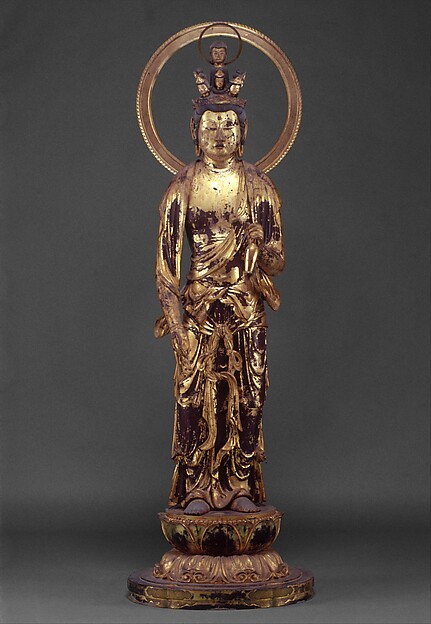
- Title
- Jūichimen Kannon, the Bodhisattva of Compassion with Eleven Heads: 十一面観音菩薩
- Period
- Nanbokuchō period (1336–92), mid- to late 14th century
- Region
- Japan
- Medium
- Wood with lacquer, gold leaf, and metal decoration
- Dimensions
- Figure: H. 199.1 × W. 54.6 × D. 58.7 cm (78 3/8 × 21 1/2 × 23 1/8 in.); with base: H. 234.5 cm; with halo: H. 236.9 cm
- Collection
- The Metropolitan Museum of Art
- Accession
-
1975.268.167 - Rights
- The Metropolitan Museum of Art (Public Domain / OASC). The Harry G. C. Packard Collection of Asian Art, Gift of Harry G. C. Packard, and Purchase, Fletcher, Rogers, Harris Brisbane Dick, and Louis V. Bell Funds, Joseph Pulitzer Bequest, and The Annenberg Fund Inc. Gift, 1975 (1975.268.167).
Met 1975.268.167: a Nanbokuchō-period wood Jūichimen Kannon, ~2 metres standing height with surviving polychromy and gilding. The eleven-headed crown is the diagnostic: a tiered stack of smaller faces above the bodhisattva's own head, completed by a metal halo above.
Jūichimen Kannon’s eleven heads sit above the principal face, not counting it. The textual programme is three benevolent, three wrathful, three fanged-grinning, one laughing turned to the rear, one Buddha-form crown, and the count itself is read two ways. The Shōrin-ji dakkanshitsu (Tenpyō, 209 cm) and Hokke-ji ichiboku (early Heian, 1 m kaya wood) are the Nara-Heian canonical anchors; the form has been ritually chanted to since 752 at the Tōdai-ji Nigatsu-dō. The Western record holds one Met sculpture (Nanbokuchō, ex-Kuhon-ji) and two Kamakura paintings, the painted record preserving the rarer four-armed Esoteric variant the canonical wood sculpture suppresses.
The face you have to walk around to see
When the Tokyo National Museum brought the Shōrin-ji Jūichimen Kannon up from Sakurai for the 2021 Mihotoke exhibition, it routed visitors around the figure at 360 degrees. The point of the routing was a single face.
At the back of the head, partly hidden by the stack, is a small open-mouthed laughing face turned away from the front. In two-dimensional reproduction it does not exist. In a temple installation, with the figure against a wall, it does not exist either. To read the iconography correctly you have to be allowed behind the figure, and most viewers, in most centuries, have not been.
The rear-facing laughing head is the iconographic signature of the form. It is also the first thing the popular reading of Jūichimen Kannon loses.
Eleven, counted two ways (and a third)
The Sanskrit name Ekādaśamukha is “of eleven faces”; the Japanese jūichimen (十一面) is the same count. What the count means depends on whether the principal face is included.
The standard textual reading lives in the Jūichimen Kannon shinjushin-gyō, the Xuanzang (Genjō) translation completed on the 28th day of the third lunar month of 656 CE and transmitted to Japan as part of the Mikkyō corpus. It gives eleven heads above the bodhisattva’s own. That puts the figure’s total head count at twelve, with the eleven of jūichimen referring strictly to the stacked subsidiary heads. A second reading folds the principal face into the count and reads the stack as ten subsidiary heads beneath an eleventh apex.
A third reading runs orthogonal to both. The Wikipedia Ekādaśamukha article, anchoring on the Indian-tradition reading that scholars including Tove E. Neville (Eleven-headed Avalokiteśvara, 1999) and Shobhana Gokhale (“Eleven-Headed Avalokiteśvara from Kanheri,” 1987) have developed, gives the eleven as the ten bodhisattva stages (bhūmis) plus buddhahood itself; the apex Buddha face is then the eleventh of the ascent, with the ten subsidiary heads below as the ten stages. When the form is shown with twelve heads total, the same Wikipedia reading flips: the twelve becomes the twelve links of dependent origination (pratītyasamutpāda).
The three readings are not mutually exclusive but they do produce different sculptural traditions. bodhi follows the eleven-above-the-principal reading on the grounds that the Xuanzang translation is unambiguous and the inclusive variant is a sculptural-counting convenience rather than a textual claim. The bhūmis-plus-buddhahood reading is the Indian-tradition gloss carried into the Tibetan and Sino-Japanese commentary literature, and bodhi treats it as iconographically compatible with the Genjō count rather than as a competitor. The residual uncertainty is whether the Nara and early-Heian canonical reproductions actually carved twelve heads (eleven above the principal) or used the inclusive ten-above-one structure; the surviving works are not all reliably countable and the documented counts vary across temple records.
The fanged register, not the smiling
The eleven-head programme, as the Genjō text specifies it and as the Japanese tradition codified it (Bosatsumen front; Shinnumen on one side; Kugejoshutsumen on the other; Daishōmen at the rear; Butsumen at the apex), comes out as follows.
| Position | Type | Count | Iconographic register |
|---|---|---|---|
| Front | Benevolent (ji 慈, Bosatsumen) | 3 | Bodhisattva countenance, downward-cast eyes, prim mouth |
| One side | Wrathful (funnu 憤怒, Shinnumen) | 3 | Bared teeth, furrowed brow, raised eyebrows; the Mikkyō wrathful aspect |
| Other side | Fanged-grinning (Kugejoshutsumen) | 3 | Open mouth with fangs protruding upward; not the same as benevolent, not the same as wrathful |
| Rear | Laughing (daishō 大笑, Daishōmen) | 1 | Open-mouthed, head turned to the rear |
| Apex | Buddha-form (butsumen 仏面) | 1 | Uṣṇīṣa, formal Buddha countenance; read as Amitābha |
The third register, fanged-grinning, is the one to hold onto, because the popular English reading folds it together with the wrathful or describes it as “smiling.” It is neither. The fanged grin in the Mikkyō iconographic vocabulary is a distinct register: an exposed-fang display that is not the bared teeth of the wrathful aspect and is not the closed-mouth small smile of the benevolent register.
It is its own thing, and the textual count gives three of them, the same as the count for benevolent and wrathful, which is structurally informative. The programme is symmetric across three of its registers and singular only at the laughing-rear and the Buddha-apex.
A finished sculptural reading therefore offers an unfussy ledger of nine subsidiary heads in three matched sets, plus two singular faces that close the programme, plus the principal face below the stack, which carries the bodhisattva’s own register and is not counted.
The fanged register is also the one most often lost in popular illustration. The fangs are small, the carving wear is heaviest at the middle tier, and the late Edo and Meiji-era reproductions tended to soften the fanged face into a benign grin. Reading a Jūichimen and getting all three middle-tier registers right is a museum-grade exercise.
Why the head split: the textual basis
The eleven-head form has an origin narrative attached. In the Eleven-Faced Avalokiteśvara Sutra tradition that travels with the Xuanzang translation, Avalokiteśvara, witnessing the suffering of beings in the world, was overwhelmed by compassion to the point that his head and arms split into pieces. The buddha Amitābha then restored him, giving him eleven heads and a thousand arms.
The textual gesture binds the eleven-headed form to the thousand-armed form. The same restoration narrative produces both, which is why Jūichimen and Senju travel together in the Six Kannon programme and across temple sets where both forms are iconographically present.
A second narrative gives the form a different origin: Avalokiteśvara assumed the eleven-headed aspect to subdue and convert a prideful ten-headed rakshasa demon. The two myths are not in tension. They are alternative readings of the same iconography, with the head-split-from-compassion myth being the dominant Mahāyāna reading and the rakshasa-subjugation myth carrying the wrathful and fanged registers’ iconographic charge.
The Xuanzang 656 text is not the only Chinese transmission. An earlier translation tradition (the form that fed the four-armed Esoteric variant) is associated with Atikūṭa’s Tuoluoni ji jing (Collected Dharani Sutras, T 901, completed ca. 654) and, in the Pure Mikkyō reading transmitted by Kūkai, with Bukong’s (Amoghavajra, 705–774) recension. The four-armed form draws on the Bukong / Atikūṭa textual tradition; the two-armed standard sculptural form, dominant in Japan, draws on the Genjō tradition. The split matters for reading the Cleveland and Freer paintings, which are four-armed and therefore textually rooted in the Bukong line rather than in the Genjō two-armed line that anchors the standing wood sculpture.
The textual basis explains the wrathful and fanged registers without making them character traits of the bodhisattva. The bodhisattva’s compassion has produced the heads. They are aspects of skillful means, in the Mikkyō reading; the same vocabulary the Wisdom Kings (Myō-ō) iconography draws on, and the reason Bogel’s With a Single Glance (2009) is the right book to read the wrathful-aspect Mikkyō register from.
Met 44893: Kuhon-ji’s standing 199-centimetre wood
The Met’s eleven-headed Kannon is the Western record’s only Jūichimen Kannon sculpture. The figure is 199.1 cm tall, a hair under the Shōrin-ji’s 209 cm and roughly the scale of a tall standing adult.
The medium is wood with lacquer, gold leaf, and metal decoration. The dating is Nanbokuchō (1336–1392), and the temple of origin is Kuhon-ji, a small Shingon-school temple northwest of Kyoto from which the Met also acquired the Heian Fudō Myō-ō (acc. 44842, treated as a single-work study elsewhere on bodhi).
Several of the original eleven heads above the principal have been lost. The surviving stack still allows the canonical programme to be read against the gaps: where a head is missing, the iconographic placeholder can be inferred from the adjacent surviving heads. The topmost head (Amitābha) survives. The Met catalog explicitly identifies it as Amida.
The Met catalog reads the figure’s drapery as Kei-school-influenced (the deeply carved fluid drapery characteristic of the thirteenth-century Nara workshops), but reads the more decorative robe treatment and the heavy, solemn face as a fourteenth-century date rather than Kamakura proper. The dating is therefore at the receiving end of the Kei-school stylistic transmission rather than at its centre. The Kuhon-ji provenance pairs the Jūichimen with a slightly earlier Heian Fudō from the same temple complex, and the workshop continuity at Kuhon-ji is one of the better-documented small-temple Mikkyō sculptural lineages in the Western institutional record.
Two Kamakura paintings, not three sculptures
The English-language references for the Western institutional Jūichimen holdings tend to lump all three principal works as iconographically continuous. They are not. Met 44893 is a sculpture; Cleveland 1970.79 and Freer F1904.350 are paintings. The medium difference matters because the iconographic conventions and the textual traditions behind them are different.
Cleveland Museum of Art acc. 1970.79 is a Kamakura hanging scroll, dated to the 1200s, in colour and kirikane (cut gold) on silk. The figure is 106.7 by 39.7 cm, a private-devotional scale, not a temple-icon scale. The Cleveland catalog records the work as showing “the modest size and high quality of the materials apparent in this work indicate its use as a private devotional image.”
More iconographically informative: the figure is four-armed, not two-armed. This is the rarer Esoteric variant of the form, rooted in the Bukong / Amoghavajra translation tradition rather than the Genjō line that anchors the two-armed standard. In the Cleveland figure one of the additional hands holds a thin staff (read as a shakujō or pilgrim’s staff, the same iconographic signature that distinguishes the Hasedera tradition) while the others form mudras. The kirikane-rendered halo and the muted-red robe place it firmly in the small-shrine private-icon register.
Smithsonian NMAA Freer acc. F1904.350 is also a Kamakura hanging scroll, also 13th century, in colour and gold on silk. The figure is 102.2 by 41 cm, within centimetres of the Cleveland scroll’s dimensions. The Freer scroll was purchased from Yamanaka & Company in 1904 and gifted by Charles Lang Freer; the dual-naming convention in the catalog (“Eleven-headed Bodhisattva Avalokiteshvara, Jūichimen Kannon”) preserves the early-20th-century Western collecting register.
The two paintings travel as a near-pair across institutional boundaries: similar scale, similar period, similar medium, both private-devotional rather than temple-icon, both featuring the four-armed Esoteric form rather than the two-armed standard.
That the surviving Western institutional record gives one wood sculpture and two near-twin Kamakura paintings is itself iconographically informative. The standing wooden Jūichimen, the Met 44893 form, is the temple-icon scale, the public-devotional form, the form that anchors the Hasedera, Murō-ji, and Shōrin-ji traditions. The painted hanging-scroll Jūichimen is a different devotional category, made for private cellar shrines or small altars, and the four-armed Esoteric variant is over-represented in the painted record.
Reading the three works together requires not flattening the medium difference. The two paintings are not “small versions of the sculpture.” They are a different iconographic register, and the four-armed form they preserve is the Bukong-line Esoteric reading that the two-armed canonical sculpture suppresses.
Shōrin-ji and Hokke-ji: the Nara-Heian sculptural anchors
The canonical Jūichimen sculpture in Japan is the Shōrin-ji figure at Sakurai in Nara prefecture. The figure is 209 cm tall, slightly taller than the Met figure, and is constructed by mokushin-kanshitsu, the wood-core dry-lacquer technique in which a carved wooden core is overlaid with multiple layers of thick lacquer to build up the surface modelling. The Shōrin-ji catalogue describes the surface today as showing “the lacquer and wooden core beneath” exposed where the original gold leaf has worn off; a different appearance from the kaya-wood Heian survivals further north.
The dating is Tenpyō era (729–749), eighth century. The figure has been at Shōrin-ji since the early Meiji period, when it was relocated from Ōmiwadera (the jingūji of Ōmiwa-jinja, the great shrine across the valley) during the shinbutsu bunri separation policy of 1868.
The Shōrin-ji figure’s status in Japanese cultural-property law is unique: under the 1951 Act on Protection of Cultural Properties, it was the first item designated as a National Treasure. The 1899 Meiji-era designation under the earlier law had already named it; the 1951 re-designation chose it as the inaugural entry in the post-war list. The choice was not accidental. The figure is the most iconographically intact eighth-century Jūichimen survival, and the Tenpyō-era dakkanshitsu-tradition figures are scarce.
The early-Heian canonical reading lives at Hokke-ji, the convent founded by Empress Kōmyō (701–760) at the northern edge of the old Heijō capital. Hokke-ji’s honzon (also a National Treasure) is a one-metre-tall standing Jūichimen Kannon carved from a single piece of Japanese kaya (Torreya) wood. Temple legend attributes it to a Gandhāran sculptor working in the likeness of Empress Kōmyō; the scholarly reading places the figure in the early Heian period, first half of the ninth century. The polychromy is unusually informative: the hair, eyebrows, and beard are painted ultramarine; the lips vermilion; the whites of the eyes white; the eyes, crown, and bracelets are fitted with copper plates; the remainder is finished in natural wood. The robe carries the “fluttering wave” alternation of thick and thin folds characteristic of the early ninth-century Nara ichiboku tradition.
Two further Nara-Heian survivals carry the canonical reading forward:
- Murō-ji Jūichimen Kannon: Heian early, ichiboku-zukuri. Sherry Fowler’s Murōji: Rearranging Art and History at a Japanese Buddhist Temple (2005) reads the Murō-ji holding in the broader Heian temple context.
- Hasedera (Sakurai, Nara) Jūichimen Kannon: the Sōhonzan of the Buzan school of Shingon, monumental scale, the principal devotional image of the Hasedera tradition. The Hasedera figure is iconographically distinct in carrying a shakujō in addition to the standard vase-and-lotus, and stands on a square platform rather than the canonical lotus throne; both readable, per the Ars Orientalis 50 (2020) volume on Kaikei-Chōkai-Hasedera, as Heian responses to late-mappō anxiety, the staff borrowed from Jizō to signal closeness-to-the-world. Statues carved in this convention across the Buzan-ha network are known as “Jūichimen Kannon of the Hase-dera style.” The Kamakura Hase-dera, founded by tradition in 736 after a 9.18-metre camphor-wood Kannon set adrift from Sakurai washed up on Nagai Beach, is the largest surviving figure in this lineage.
The Tōdai-ji Hokke-dō, sometimes named in popular sources as a Jūichimen site, is not. Its principal image is the eight-armed Fukūkensaku Kannon, a different form. The conflation is a common misreading and is worth flagging.
The ritual life of the form: 1,200 years at the Nigatsu-dō
Iconography is the form on the page. The form’s life in Japan is most visible at the Tōdai-ji Nigatsu-dō, the Second-Month Hall on the slope above the Great Buddha Hall.
The Nigatsu-dō houses two Jūichimen Kannon, the Ōkannon (Greater) and the Kogannon (Lesser), as the hall’s twin honzon. Both are absolute hibutsu, never opened to public view in any year. The temple’s own catalogue is explicit: no one is allowed to see them.
What does happen, every spring, is the Shuni-e: the two-week repentance rite that culminates on March 12–13 in the water-drawing ceremony (Omizutori) for which the hall is best known. The rite is dated continuously to 752, when it was first held in the second month of the lunisolar calendar; it has been held annually since 760, unbroken across more than 1,200 years and across all the wars and rebuilds that struck Tōdai-ji in the centuries between. The Nigatsu-dō itself was rebuilt in 1669 after a fire that began in a Shuni-e altar, and even that fire did not break the rite, which moved to a temporary altar and continued on schedule.
The core repentance, closed to the public, is performed by a select group of eleven monks called rengyōshū (“practising assembly”). Six times a day they recite the Jūichimen Shinjushin-gyō, the same Xuanzang 656 text that anchors the sculptural iconography, addressed to the hidden Ōkannon and Kogannon. The count is doctrinally exact: eleven practitioners for the eleven heads.
This is the part of the form’s history that the museum iconography alone cannot show. The standing wood sculpture is the iconographic object. The Nigatsu-dō rite is the form as practised: eleven priests reciting the heart-dharani text six times daily, in front of two figures no one is permitted to see, for the cleansing of the realm before the new year arrives.
Indian and Central Asian origins
The Japanese sculptural canon arrives ready-made out of an East Asian transmission that begins, in the surviving record, in late-Gupta India. The earliest extant Ekādaśamukha image is the relief in Kanheri Cave 41, near present-day Mumbai, dated by Wikipedia (citing Shobhana Gokhale’s 1987 Indica article “Eleven-Headed Avalokiteśvara from Kanheri”) to the late 5th to early 6th century. Gokhale’s reading identifies the relief as the type-source for the East Asian developments; Tove E. Neville’s Eleven-headed Avalokiteśvara (1999), the standard English-language monograph on the form, treats it as such.
By the 6th–8th centuries the form is “found to have existed almost simultaneously” across Central Asia, Dunhuang, Korea, and Japan: the Wikipedia phrase, which carries Lokesh Chandra’s earlier reading. The Japanese reception in the late seventh and early eighth centuries (the Shōrin-ji Tenpyō figure dates to 729–749) is therefore neither isolated nor late. It is the eastern terminus of an iconographic programme that had already stabilised across the Buddhist world.
Faure’s Protectors and Predators vol. 2 (2015) is the place to read the medieval Japanese iconographic charge of the form in the broader pantheon-politics frame; the Indian and Central Asian origins are best entered through Neville 1999 and the Kanheri scholarship Gokhale opened.
Where the iconography is read down the wrong register
Three readings of the form are common in popular English-language references, and all three pull the iconography sideways.
The first is the head count: the Genjō text gives eleven above the principal, putting the figure’s full head count at twelve. The popular reading often gives “eleven heads total including the principal,” which decodes as ten above one, and the apex Amitābha then becomes the eleventh of a set of ten subsidiary heads rather than the apex of an eleven-head stack. The two readings have produced different sculptural traditions; neither is wrong, but conflating them produces miscounts. The bhūmis-plus-buddhahood gloss (ten stages plus buddhahood) is iconographically compatible with the eleven-above-principal count but should not be confused with it as a count.
The second is the wrathful-face register. The funnu (wrathful) faces in the middle tier belong to the same Mikkyō iconographic vocabulary as the wrathful aspects of the Wisdom Kings (Myō-ō): not “anger” in any modern psychological sense, but a class of skillful means rendered in iconographically wrathful form. Reading the wrathful faces as expressions of the figure’s mood, or, worse, as expressions the practitioner is asked to inhabit, pulls the iconography into a register the textual and iconographic record does not support.
The third is the fanged-grinning register. The Genjō text gives three fanged-grinning faces in the middle tier, distinct from the wrathful and from the benevolent, and the fanged grin is the iconographic signature most often softened or lost in late reproduction. Reading the fanged faces as either “smiling” (which folds them together with the upturned-mouth benevolent register) or “wrathful” (which folds them together with the bared-teeth lower register) collapses what the textual programme keeps separate.
A fourth, easier to fix: the two-armed standard and the four-armed Esoteric variant are not the same form. The two-armed canonical Hasedera-Murō-ji-Shōrin-ji sculptural tradition follows the Genjō (Xuanzang 656) translation; the four-armed variant, the form seen in the Cleveland 1970.79 and Freer F1904.350 painted scrolls, draws on the Bukong (Amoghavajra) translation tradition that Kūkai brought back as part of the Pure Mikkyō transmission. The Japanese sculptural record overwhelmingly preserves the two-armed form; the painted record over-represents the four-armed. Read each on its own textual basis.
Bogel’s With a Single Glance treats the wrathful-aspect Mikkyō iconography in detail. For the canonical sculptural reading the Shōrin-ji figure remains the anchor, and the rear-facing laughing face is, still, the test of whether the iconography has been read all the way around or only from the front.
Related
- Kannon’s thirty-three bodies — reading Lotus Sūtra chapter 25
- Senju Kannon: reading the thousand arms: the head-split / Amitābha-restoration narrative produces both the eleven-headed and thousand-armed forms; the two travel together in the Six Kannon programme.
- Nyoirin Kannon: the wish-granting jewel: sibling Esoteric Kannon form, also read through iconographic markers; same Mikkyō vocabulary.
- Esoteric Buddhism in Heian Japan: the broader Mikkyō context the Bukong / Genjō translation split sits inside.
- Jūichimen Kannon (entity)
Further works cited
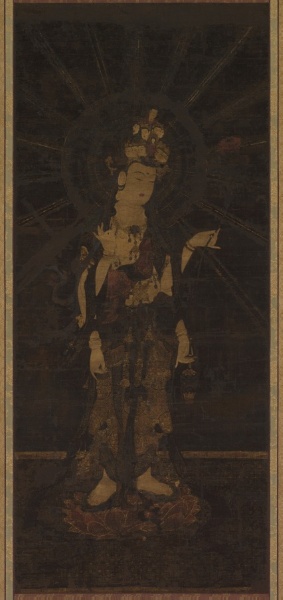
- Title
- Eleven-Headed Kannon (Jūichimen Kannon): 十一面観音菩薩像
- Period
- Kamakura period (1185–1333), 1200s
- Region
- Japan
- Medium
- Hanging scroll; color and cut gold (kirikane) on silk
- Dimensions
- 106.7 × 39.7 cm (42 × 15 5/8 in.)
- Collection
- Cleveland Museum of Art
- Accession
-
1970.79 - Rights
- Cleveland Museum of Art (Public Domain / CC0); John L. Severance Fund, 1970.79.
Cleveland 1970.79: a Kamakura silk Jūichimen Kannon, earlier rendering of the same type, here painted in cut-gold over coloured silk rather than carved in wood, and four-armed where the canonical wood-sculpture form is two-armed.
Sources
-
[12]2026-05-21Shōrin-ji (Sakurai, Nara) / Tokyo National Museum 2021 special exhibition record shorinji-temple.jp/en/elevenfaced