Senju Kannon: reading the thousand arms
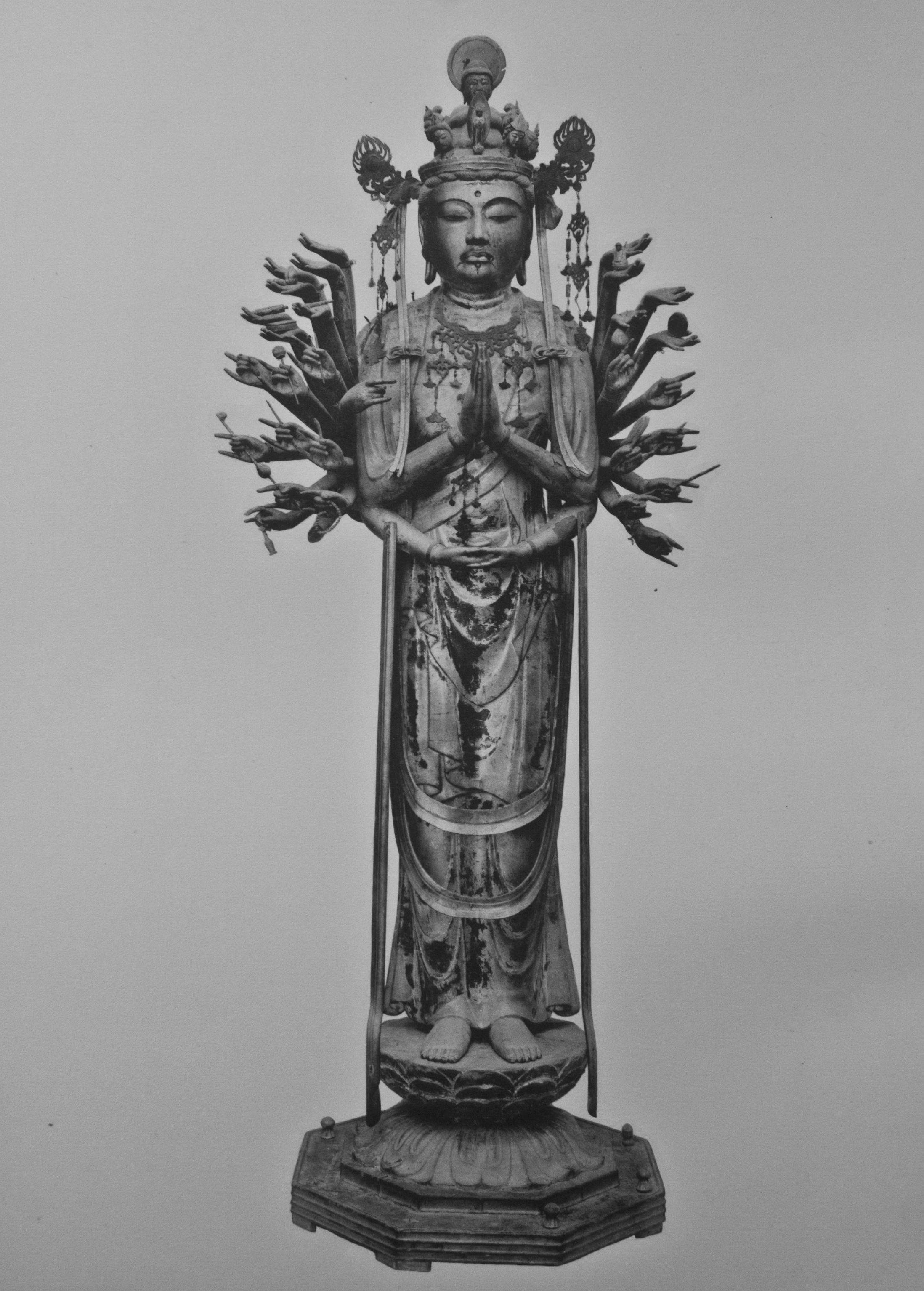
- Title
- Senju Kannon (千手観音), Sanjūsangen-dō chief image — Tankei, 1254
- Period
- Kamakura period (1185–1333), 1254
- Region
- Japan
- Medium
- Wood with lacquer, gold leaf, and polychromy; eleven heads; 42 sculpted arms standing in for a thousand
- Collection
- Sanjūsangen-dō (Rengeō-in), Kyoto — Japanese National Treasure (国宝)
- Rights
- Photograph: Nara Imperial Household Museum (奈良帝室博物館), 1933 — public domain in Japan (PD-Japan-oldphoto, 50-year photo term for pre-1957 photographs). Subject: Tankei (active 1185–1256), Sanjūsangen-dō chief image, 1254 — Japanese National Treasure (国宝).
The canonical anchor: Tankei's 1254 chief image at Sanjūsangen-dō. The 42-arm convention (40 outer × 25 worlds + two principal in gasshō) reads here at full scale; the eleven-head stack repeats Jūichimen at the crown. The 1,001-figure programme around it — 124 pre-fire Heian + 876 carved between 1251 and 1266 — is the institutional setting the article reads.
Senju Kannon is rendered with 42 sculpted arms standing in for a thousand: 40 outer arms × 25 worlds + two principal arms in gasshō. The 1,001-figure programme at Sanjūsangen-dō is the canonical reading: Tankei’s chief image (1254) at the centre, 124 pre-fire Heian figures, 876 carved between 1251 and 1266 by three workshops. The popular Kei-only attribution is a simplification.
In the long hall
Sanjūsangen-dō is 120 metres along its long axis. Walking south to north, the visitor crosses ten standing-figure ranks of fifty, passes the central seated chief image, and enters the second half of the same arrangement mirrored.1
At eye level the iconographic count collapses into a visual fact: the rear ranks recede in perspective, the gilding catches and breaks against the eastern light, and the 1,001 separate figures behave less like a thousand-and-one things than like one continuous phenomenon.
The iconography enforces this. Each of the 1,000 standing figures is independently carved, and the dhāraṇī-sutra tradition holds each as a discrete Senju Kannon rather than a copy, but the room reads them as a programme, and the chief image is centre because the geometry needs a fulcrum, not because it outranks the others.
This is the canonical Japanese Senju Kannon installation, and the article reads the iconography against it. The Sanskrit name Sahasrabhuja Avalokiteśvara and the textual basis in the Senju-sengen Kannon Bosatsu kōdai-enman muge daihishin darani-kyō (Bhagavaddharma’s 7th-century Chinese translation, transmitted to Japan by the 8th century) belong on the entity page; what follows is what the iconography actually is, and where the popular accounts collapse it.
The 42 arms and the thrift of one thousand
The thousand arms are an iconographic figure of speech. In sculpture they are almost never literally a thousand. The convention is thrifty: 42 carved arms, two principal arms held in gasshō at the chest, plus 40 outer arms each holding a ritual implement. The 40 × 25 worlds reckoning of the sangai triple-realm cosmology yields the figure of one thousand.
The convention is structural, not symbolic. A hinoki figure with a literal thousand arms is not feasible; the joinery would not survive the seasoning of the wood, and the iconographic content would be lost in the visual congestion.
The 42-arm settlement preserves the iconography (the canonical implement set, the eye-in-palm convention) at a scale where the carving holds and the figure can be installed as a temple honzon.
Saunders, Mudrā (1960) p. 107–112, treats the 40-arm set as a programme of upāya (skillful means) with each pair of outer arms encoding a class of suffering and the form of compassion that meets it: willow branch for the sick, vase for those who thirst, cintāmaṇi jewel for those in poverty, sun and moon discs for those in darkness. bodhi follows Saunders here.
The eye programme is rendered separately. One eye is depicted in the open palm of each of the 40 outer hands, with the principal-pair palms exempted. In sculpture the eyes are generally not painted in; in painted hibutsu (secret-image) traditions they appear as pale circles. On the Tankei chief image the eye-in-palm is carved at a scale that requires a deliberate lookup. Most visitors don’t know to look, and pass over it.
What the hands actually hold
Popular accounts almost always sample the implements with the same four or five attributes: willow, jewel, sword, lotus, vase. The Rengeō-in (Sanjūsangen-dō) tradition that survives in the temple’s actual statuary is more pluralistic. Onmark’s index of the Rengeō-in implement set, derived empirically from the temple’s 12th-13th-century figures rather than from the dhāraṇī sutra directly, gives 20 right-hand and 20 left-hand objects, including:
| Surprising or counter-stereotypical | Standard sample list |
|---|---|
| skull (left hand 14) | willow branch (right hand 15) |
| grapes (right hand 14) | wish-fulfilling jewel (right hand 5) |
| five-coloured cloud (left hand 6) | sword (left hand 12) |
| palace (left hand 3) | lotus blossom, blue / red / white / purple |
| sutra box and sutra scroll | conch shell |
| hand drum, prayer beads, whisk | bow, arrow, lasso, water jar |
The skull and the grapes are the most useful items to fix on. A reader who has been told that Senju Kannon “holds the willow branch and the wish-granting jewel” is reading half the iconography.
The upāya programme reaches further: the skull names the suffering of mortality directly, and the grapes (a Buddhist trope of generative abundance, with continental precedents) belong to the same class as the wheat-ear and lotus-bud attributes.
The temple’s empirical list and the dhāraṇī-sutra prescriptive list are not identical; this divergence is one of the live disagreements in the form’s reception, and the temple’s list rather than the sutra’s is what most visitors are actually reading when they look at a Senju Kannon.
Tankei’s chief image, his 82nd year
The seated chief image at Sanjūsangen-dō was completed by Tankei (湛慶, 1173–1256) in 1254. By Japanese kazoedoshi reckoning he was 82 in his birth-year-counted age; by Western reckoning he was 81. Mōri’s Sculpture of the Kamakura Period reads the chief image as the late-career synthesis of the Kei school: Tankei was Unkei’s eldest son, the workshop heir, and the image is the documented signed work of his late period.
The figure stands roughly 3.3 m tall on its lotus pedestal, in yosegi-zukuri (joined-block construction) over a hinoki core, lacquered and gilded, with the 42-arm canonical fan deployed in the seated convention: the principal pair in gasshō, the outer arms arranged symmetrically around the body and behind the back-halo (kōhai).
The eleven-head crown is intact: the principal head, ten subsidiary heads stacked above (three benevolent, three wrathful, three smiling, one Buddha-form crown), and the rear-facing laughing head turned away from the visitor’s standard sightline. The eleven-head pairing is canonical for the Japanese Senju form and is shared with Jūichimen Kannon (the eleven-headed form treated as a separate iconographic article on bodhi); the chief image carries both iconographies simultaneously.
What the figure does not carry is the elaborated mandorla complement that the smaller standing figures sometimes received: the 28 attendants (nijūhachi-bushū) and the Fūjin / Raijin pair are independent installations distributed elsewhere in the hall, not integrated with the chief image as a single sculptural unit.
The chief is alone in the centre. The arrangement is iconographically deliberate: the 1,000 standing figures are the company; the chief image is the formal centre; the attendants and storm gods are the boundary.
The 124 / 876 boundary
The 1,000 standing figures present a layered chronology, and this is where the popular accounts collapse the most aggressively. The temple as built in the 12th century burned in 1249. From the original Heian standing-figure programme, 124 figures were rescued from the fire; the remaining 876 were carved between 1251 and 1266 as part of the post-fire reconstruction.1 The current building dates from 1266.
The widely-repeated short version names “the Kei school” as the carving authority for the 876. The temple record names three workshops: Kei (Keiha), En (Enpa), and In (Inpa), three of the principal Kamakura sculptural workshops working in coordination, with Nara-affiliated sculptors also contributing.
Mōri’s broader treatment of the Kei school is correct that Tankei’s workshop was central; the temple’s three-school attribution names the rest of the corpus that Mōri’s chapter-level focus does not pursue. Subsequent Japanese-language scholarship classifies the 1,000 standing figures into roughly ten workshop types on stylistic grounds (face structure, drapery rhythm, the carving of the small attribute hands).
The disagreement bodhi finds more persuasive: the temple’s three-school record names the corpus accurately. The popular Kei-only attribution is a simplification that flattens the Kamakura workshop landscape: a landscape in which Kei, En, and In schools competed, collaborated, and produced distinct sculptural idioms across the same decades.
The residual uncertainty is workshop-by-workshop attribution within the surviving 876: the three-school record gives the institutional framework, but per-figure assignment is rarely possible without inscription or technical evidence, and the ten-type stylistic classification is itself an inference rather than a documented assignment.
A Heian painted precedent: Nara NM 1105
Most of the Senju Kannon scholarship reads the form sculpturally because the Sanjūsangen-dō programme dominates the Japanese record. The painted precedents are easier to overlook, and one of them is worth fixing on.
Nara National Museum holds a Heian painted Senju Kannon (acc. 1105 / 絵204 A; ink and colours on silk, hanging scroll, 93.8 × 39.5 cm, 12th century).2
The e-Museum (TNM-curated) catalogue entry makes a specific observation worth quoting in full: many of the figure’s arms are arranged circularly around the body, appearing as if they are part of the mandorla, a compositional choice the e-Museum reads as deliberate, to reduce the strangeness of the figure’s appearance. The bowl at the figure’s waist is rendered to resemble a lacquer bowl, and on those grounds the e-Museum suggests the painting was made for personal-worship installation rather than altar use.
Two readings come out of this. First, the iconographic problem of the multi-arm body is real: the painted convention works by integrating the outer arms into the back-halo silhouette, where the Sanjūsangen-dō sculptural convention works by stepping the arms into a fan-shaped outer outline that reads as iconographically separate from the kōhai.
The painted form is the older convention (Heian, 12th century, overlapping the original 1164 Sanjūsangen-dō foundation) and is iconographically more cautious about visual congestion.
Second, the personal-worship scale (under 100 cm tall) sits on the opposite end of the installation spectrum from the 3.3 m chief-image scale of the Tankei sculpture. The form is structurally accommodating: the same iconography reads at intimate scale and at hall scale, with different compositional discipline at each end.
The Nara painting is openly accessible through the e-Museum; bodhi does not reproduce the image here, as ColBase holdings carry their own attribution requirements. The catalogue text alone is enough to ground the comparison.
Reading the form outside Rengeō-in
The canonical Japanese Senju Kannon survives across a small number of named institutional holdings beyond Sanjūsangen-dō:
- Tōshōdai-ji, Nara: Senju Kannon, Nara period (8th c.), dakkanshitsu (hollow dry-lacquer) construction, National Treasure. The pre-Heian sculptural precedent; iconographically continuous with the later canonical form but materially distinct.
- Fujii-dera, Osaka: Senju Kannon, Nara period, dakkanshitsu, National Treasure. One of the small group of 8th-century Senju Kannon survivals.
- Sanjūsangen-dō (Rengeō-in), Kyoto: Tankei chief image (1254) + 1,000 standing figures, yosegi-zukuri, National Treasure (designated 1955; chief and the 1,000 figures designated as a single work).
- Cleveland Museum of Art acc. 1919.913: Kannon, Kamakura period (early 1200s), wood with lacquer and gold leaf; the figure stands on a lotus pedestal holding a lotus dais on which the soul of the faithful is received into paradise. Not a Senju form but a single-arm Kannon, useful as the iconographic baseline against which the multi-arm forms are read.
- Nara National Museum acc. 1105: Heian painted Senju, 12th c. (treated above).
The Western institutional sculptural record is thin. Most museum-collected Kannon works are of the Shō Kannon or Jūichimen forms: the simpler iconographies are more portable in collecting terms, and the multi-arm constructions are vulnerable to the loss or damage of outer arms in transit.
Painted Senju Kannon survives more widely in Western collections; the MFA Boston Senju Kannon and Twenty-Eight Attendants (acc. 11.4031) is a documented Heian painted example, and the painted record is the subject of a separate cluster article.
What the open-access institutional record currently makes available, then, is a scattered set: the two Nara dakkanshitsu survivals (Tōshōdai-ji, Fujii-dera), the Heian painted Senju at Nara NM, the Tankei chief and 1,000 standing figures at Sanjūsangen-dō, and the MFA Heian painted complement. Reading these together is the kind of cross-institutional iconographic exercise the form rewards.
Related
- The Met’s thousand-armed Kannon embroidery — Muromachi devotion in stitched silk
- Jūichimen Kannon: eleven heads and the canonical stack
- Senju Kannon
Footnotes
-
Sanjūsangen-dō Wikipedia entry, accessed 2026-05-06. Three-workshop attribution (Kei / En / In schools) and 1251–1266 reconstruction window cited verbatim. The 120 m hondō dimension and the 124-vs-876 figure-survival count are likewise from the Wikipedia entry; the entry tracks the temple’s own published documentation and Japanese-language secondary scholarship at the chapter level. ↩ ↩2
-
Nara National Museum acc. 1105 (絵204 A), e-Museum entry (National Institutes for Cultural Heritage), accessed 2026-05-06. The catalogue describes the painting as Heian-period (12th century), 93.8 × 39.5 cm, ink and colours on silk on hanging scroll. The compositional observations quoted (circular arm arrangement reading “as if they are part of the mandorla”; the lacquer-bowl rendering at the waist as a personal-worship indicator) are paraphrased from the e-Museum entry. ↩
Sources
-
Reads the 40-arm implement set as a programme of upāya (skillful means) — each pair encoding a class of suffering and the form of compassion that meets it.
-
Reads the 1254 Tankei chief image as the late-career synthesis of the Kei school. Cited at chapter level on the Sanjūsangen-dō programme, without page references.
-
Reads the post-1180 Tōdai-ji reconstruction and the Kei-school revival as the institutional context in which the canonical Senju Kannon reading stabilizes. Cited without page references.
-
Source for the three-workshop attribution of the 876 replacements (Kei / En / In schools, 1251–1266) and the building dimensions (120 m hondō, 1266 reconstruction).
-
[5]2026-05-06Nara National Museum / e-Museum (National Institutes for Cultural Heritage) emuseum.nich.go.jp/detailHeian painted Senju Kannon. The e-Museum entry notes the circular arrangement of arms reading 'as if they are part of the mandorla' — an artist's choice 'to reduce the strangeness of the figure's appearance.' The bowl at the figure's waist is rendered to resemble lacquer, suggesting personal-worship use.
-
Single-arm Kannon (not a Senju form); attendant to Amida iconography. Useful as the iconographic baseline against which the Senju multi-arm form is read.
-
Onmark's 40-implement list is empirically derived from the Rengeō-in (Sanjūsangen-dō) sculptural tradition, not from the dhāraṇī sutra directly. Useful as the temple-tradition reference, with the qualifier that it is one local stabilization rather than a universal canon.