Bato Kannon
Also known as 馬頭観音 · Bato Kannon Bosatsu · Hayagrīva Avalokiteśvara · Horse-Headed Avalokiteśvara · Mǎtóu Guānyīn
- Title
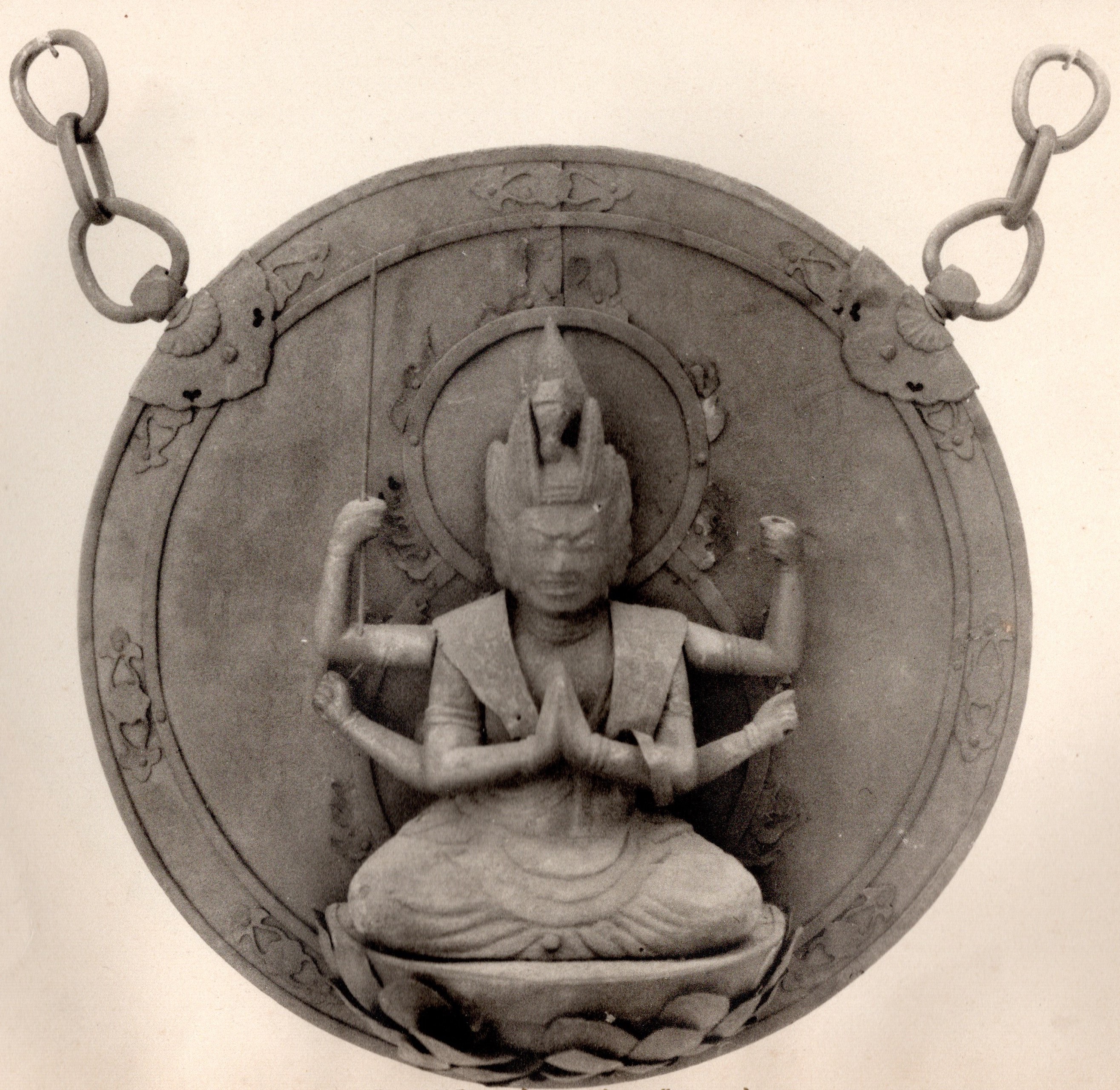
- Bato Kannon (馬頭観音) gilt-bronze kakebotoke (御正体) — 1271
- Period
- Kamakura period (1185–1333), 1271 (Bun'ei 8)
- Region
- Japan
- Medium
- Gilt bronze, hammered and chased, with figural relief
- Collection
- Tōkannon-ji (東観音寺), Toyohashi, Aichi — Important Cultural Property (重要文化財)
- Rights
- Photograph: 愛知県渥美郡役所『渥美郡史 附図』(Atsumi-gun History, illustrated supplement, Aichi Prefecture Atsumi District Office), 1923 — public domain in Japan (PD-Japan-oldphoto, 50-year photo term for pre-1957 photographs). Subject: 1271 gilt-bronze Bato Kannon kakebotoke, Tōkannon-ji (Toyohashi, Aichi), Important Cultural Property.
Tōkannon-ji's 1271 gilt-bronze Bato Kannon kakebotoke (Toyohashi, Aichi) — a Kamakura-period Important Cultural Property. The plaque shows the canonical wrathful Bato form: three wrathful faces, the small horse-head atop the hair (*batō*, the diagnostic), six arms with the *batō-in* mudra at the chest. The kakebotoke medium (gilt-bronze relief on a circular plate) was a Heian–Kamakura devotional format for canonical figures rendered at intimate scale.
Bato Kannon
Bato Kannon (馬頭観音) is the horse-headed wrathful form of Kannon, three-faced, six- or eight-armed. The diagnostic is the horse head atop the hair; the batō-in mudra (fingers crossed at the chest) and the kenjaku lasso are the secondary anchors. Within the Six Kannon programme, Bato is assigned to the realm of animals. The wrathful expression and three-faced reading separate Bato from the placid Kannon family — this is the only canonically wrathful Kannon form.
Iconography
The horse head atop the hair is the name and the diagnostic. Batō (馬頭) reads “horse head” directly; the figure carries a small horse-head form rising from the central crown of hair, often depicted with the horse’s mouth open. The horse-head element is visible above the central face and serves as the most reliable single marker.
Three faces, all wrathful. The principal face is forward; the side faces are turned outward and read as the same wrathful register. Bared teeth, glaring eyes, hair rising in a flaming corona around the heads. The body’s expression matches: muscular, tense, the limbs in active gesture.
Six or eight arms. The canonical arm count is six in the Shingon reading and eight in some Tendai readings; both are documented. The principal arms hold the batō-in mudra at the chest — fingers crossed in a gesture specific to this figure, distinct from the anjali-mudrā (palms together) of the placid Kannon forms. The remaining arms hold the kenjaku (lasso, 羂索), an axe, a sword, and a vajra in the canonical implement set; specific implements vary by workshop and period.
The flaming aureole behind the head — common to wrathful Esoteric figures — is canonically present. The placement of the figure on the lotus throne is canonical despite the wrathful register; Bato remains a Kannon, the wrath read as a manifestation of compassion’s reach into the realm of animals (the upāya of fierce form), not as a departure from the bodhisattva framework.
Within the Esoteric programme
Bato Kannon is the variant assigned to the realm of animals in the Six Kannon programme. The horse-head reading carries an iconographic charge specific to the realm assignment — the horse as the animal that bears, that travels, that suffers under the burdens of the realm; Bato’s iconographic role is to extend Kannon’s compassion into that domain. Bogel 2009 traces this reading against the Heian Mikkyō image programmes.
Where the form is commonly misread
Bato is the Kannon most often confused with Fudō Myō-ō in field reading. Both can have wrathful faces and three-headed forms. The diagnostic is the horse head atop the hair (Bato); Fudō has no horse head but rather an asymmetric face — one fang up, one fang down — and holds the kurikara sword and the kenjaku lasso, where Bato holds only the lasso among the wrathful implements. The batō-in mudra is also Bato-specific and absent from the Fudō reading.
In the collections
- Daigo-ji (Kyoto) — Bato Kannon Bosatsu zazō, Heian period.
- Kanzeon-ji (Fukuoka) — Bato Kannon Ritsuzō, Heian period, Important Cultural Property.
- Jōruri-ji (Kyoto) — Bato Kannon Bosatsu, Heian period.
- The Metropolitan Museum of Art — Bato holdings across the Asian Art collection.
Related
- Figures: Sho Kannon, Senju Kannon, Juichimen Kannon
Sources
-
[1]— Cynthea J. Bogel, With a Single Glance: Buddhist Icon and Early Mikkyō Vision (Honolulu: University of Hawai'i Press, 2009) print referenceHeian Esoteric programme placement; Bato as the wrathful Kannon.
-
[2]— E. Dale Saunders, Mudrā (Princeton, NJ: Princeton University Press / Bollingen Foundation, 1960) print reference*Batō-in* — the per-form mudra reading specific to Bato.
-
[3]— Hisashi Mōri, Sculpture of the Kamakura Period (Tokyo: Heibonsha / New York: Weatherhill, 1974) print referenceThe Kamakura Bato sculptural record.