Fukūkenjaku Kannon
Also known as 不空羂索観音 · 不空羂索観世音菩薩 · Fukūkensaku Kannon · Fukū Kensaku Kannon · Amoghapāśa Avalokiteśvara · Bùkōngjuànsuǒ Guānyīn · Never-Empty Lasso Avalokiteśvara
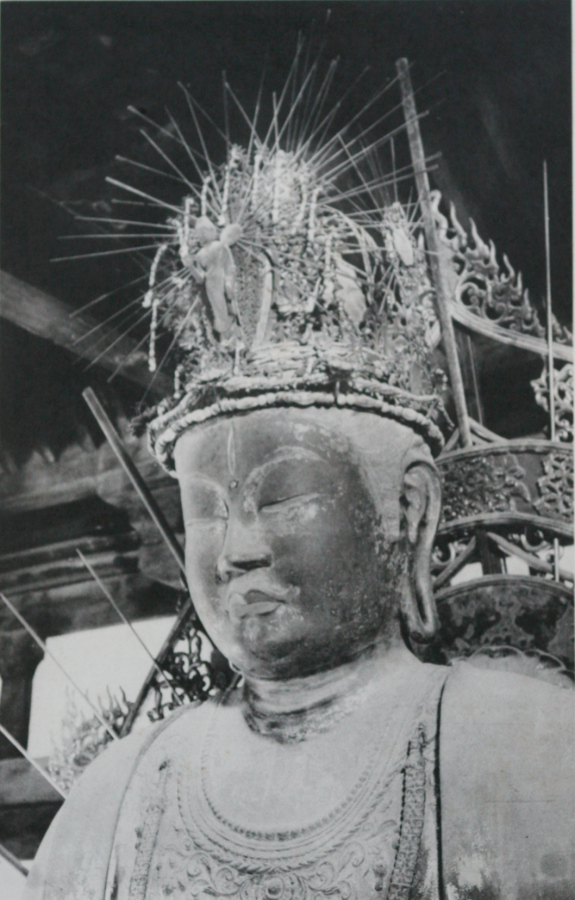
- Title
- Fukūkenjaku Kannon (不空羂索観音立像) — Tōdai-ji Hokke-dō (Sangatsudō), Tenpyō, c. 747
- Period
- Nara period, Tenpyō era, c. 747
- Region
- Japan
- Medium
- *Dakkatsu kanshitsu-zukuri* (脱活乾漆造) — hollow dry-lacquer over wooden armature, finished with polychromy and gold leaf; jewelled crown set with silver Amida figure
- Dimensions
- Height 362 cm (figure); approximately 3.6 m with halo and pedestal
- Collection
- Tōdai-ji Hokke-dō (東大寺法華堂 / 三月堂), Nara — Japanese National Treasure (国宝)
- Rights
- Photograph: Ogawa Seiyō (小川晴暘), in *ASUKAYEN, HISTOIRE DES BEAUX-ARTS JAPONAIS, TOYO-BIZYUTU* Special Issue 4, January 1933 (Nara: Asukayen) — public domain in Japan (PD-Japan-oldphoto, 50-year photo term for pre-1957 photographs). Subject: Tōdai-ji Hokke-dō (Sangatsudō) Fukūkenjaku Kannon, c. 747 — Japanese National Treasure (国宝).
The canonical Tenpyō anchor: Tōdai-ji Hokke-dō Fukūkenjaku Kannon, dry-lacquer, c. 747, 362 cm, National Treasure. The diagnostic markers — three eyes, eight arms, the *kenjaku* lasso, the silver Amida in the jewelled crown — read here together. The 1933 Ogawa Seiyō plate from the Asukayen *Tōyō-bizyutsu* monograph series is the standard pre-1957 photographic record. The Hokke-dō (Lotus Hall, also Sangatsudō) is itself the oldest surviving structure at Tōdai-ji, predating the Daibutsu-den; the figure has been the hall's principal honzon since the temple's earliest Tenpyō programme.
Fukūkenjaku Kannon
Fukūkenjaku Kannon (不空羂索観音) is the eight-armed standing form whose name names its diagnostic: the amogha-pāśa — the never-empty lasso. Three eyes, eight arms, the lasso held in one hand, a silver Amida figure mounted in the jewelled crown. The Tōdai-ji Hokke-dō image, c. 747, is the canonical Tenpyō dry-lacquer anchor. Within the Tendai Six Kannon programme, Fukūkenjaku substitutes for Juntei in the realm-of-humans slot (per Fowler 2016).
Iconography
The name carries the iconography. Fukū (不空, “never-empty”) and kenjaku (羂索, “noose / lasso”) together render the Sanskrit amogha-pāśa — the lasso that never returns empty.
The figure’s iconographic role is to draw all sentient beings out of suffering with that lasso. The implement is the diagnostic. One of the eight arms holds it.
Three eyes. Two canonical eyes plus a third eye in vertical position at the forehead, in the ūrṇā slot — the same position that on a Buddha image carries the ūrṇā curl.
The third eye is the most reliable single marker after the lasso. It separates Fukūkenjaku from the placid Kannon family (Shō, Senju, Juichimen, Nyoirin) where the canonical eye-count is two.
Eight arms in the Tenpyō canonical reading. The principal pair held at the chest in anjali or abhaya register; the remaining six holding the canonical implement set: the kenjaku lasso, a lotus stem, a water-vase (kundikā), an aṅkuśa (goad or hook), a staff or pilgrim’s kakujō, and an open palm in varada or empty for a now-lost attribute.
Specific implements vary by workshop and period. The lasso is invariant.
The jewelled crown carries a small silver Amida figure at its centre. The Amida-in-crown is the Kannon-family marker generally, but on Fukūkenjaku the canonical material specification is silver — where on other Kannon forms the material is gilt-bronze, gilt-wood, or gold-leaf-on-wood.
The Tōdai-ji figure preserves the original silver Amida intact. The silver specification is itself a small iconographic distinction.
The deer-skin shoulder mantle (rokuhi, 鹿皮) drapes across one shoulder of the Tōdai-ji figure — a dressing element that tracks back to continental Tang precedent and becomes a feature of Esoteric eight-armed figures more broadly. The mantle is preserved on the canonical figure but is not invariant across all Fukūkenjaku images.
Within the Esoteric programme
Fukūkenjaku Kannon is the variant assigned to the realm of humans in the Tendai ordering of the Six Kannon programme. The Tendai substitution for the Shingon canonical Juntei in the same slot.
The full Tendai Six Kannon: Shō → naraka, Senju → preta, Batō → animal, Jūichimen → asura, Fukūkenjaku → human, Nyoirin → deva.
Per Fowler 2016 (Accounts and Images of Six Kannon in Japan), the doctrinal Shingon-vs-Tendai split at this single slot — Juntei in Shingon, Fukūkenjaku in Tendai — is the most-cited difference between the two Esoteric lineages’ Six Kannon readings. Fowler notes the realm-Kannon pairings were never strictly adhered to across the tradition; the substitution is the Tendai-canonical reference rather than the universal practice.
The pre-Esoteric Tōdai-ji image (c. 747) predates the Six Kannon programme as a coordinated doctrinal frame. The Heian Esoteric reading is a downstream interpretive overlay onto a figure that was already canonical for a century before Kūkai and Saichō returned from Tang China with the Esoteric textual corpus.
Reading the Tōdai-ji Fukūkenjaku through the Six Kannon programme is iconographically justified but historically anachronistic. The figure’s Tenpyō-period Buddhist context is broader than the later Esoteric frame.
In the collections
- Tōdai-ji Hokke-dō (Sangatsudō) (Nara) — Fukūkenjaku Kannon Ritsuzō, Tenpyō, c. 747, dry-lacquer, 362 cm, National Treasure. The canonical Tenpyō anchor. Surrounded inside the hall by ten other Nara-period sculptures, all National Treasures, including the clay Nikkō Bosatsu and Gakkō Bosatsu attendant pair.
- Kōfukuji Nan’endō (Nara) — Fukūkenjaku Kannon Bosatsu zazō, 1189, by Kōkei (康慶), the Kei-school founder and Unkei’s father. Heian-Kamakura transitional sculpture; the Kei-school recovery of Tenpyō naturalism. Important Cultural Property.
- Daian-ji (Nara) — Fukūkenjaku Kannon, Heian period.
- Akishino-dera (Nara) — Fukūkenjaku Kannon, Heian period.
- The Metropolitan Museum of Art — Fukūkenjaku holdings across the Asian Art collection, accession-anchored under the Bodhisattva Avalokiteshvara search; the most-cited Western collection holding for the form.
Where the form is commonly misread
The eight-armed reading sometimes blurs into Senju Kannon — the thousand-armed form abbreviated to a count of forty-two principal arms, with eight prominent arms in some workshop renderings.
The disambiguation: Fukūkenjaku has three eyes and the lasso. Senju has the abbreviated forty-two arms in a fan or radial array, no third eye, and the canonical principal attributes are the alms-bowl and the abhaya-mudra rather than the lasso.
The third eye is the most reliable single field-reading distinction.
The lasso is sometimes confused with Fudō Myō-ō’s kenjaku — both figures hold a lasso. The disambiguation runs through everything else.
Fudō is wrathful (bared teeth, asymmetric tenchigan eyes), seated on a rock pedestal, holding the kurikara-ken sword in the other hand. Fukūkenjaku is placid, standing on a lotus pedestal, with the silver Amida in the crown.
The shared lasso is the iconographic crossover; everything else differs.
Related
- Figures: Sho Kannon, Senju Kannon, Juichimen Kannon, Nyoirin Kannon, Bato Kannon
- Articles: Fudō Myō-ō — iconographic markers
Sources
-
[1]— Sherry D. Fowler, Accounts and Images of Six Kannon in Japan (Honolulu: University of Hawai'i Press, 2016) print referenceTendai Six Kannon programme: Fukūkenjaku substitutes for Juntei in the realm-of-humans slot. Fowler's caveat that the realm-Kannon pairings were never strictly adhered to applies.
-
[2]— Cynthea J. Bogel, With a Single Glance: Buddhist Icon and Early Mikkyō Vision (Honolulu: University of Hawai'i Press / University of Washington Press, 2009) print referenceHeian Esoteric programme placement; Fukūkenjaku as the lasso-form Kannon.
-
[3]— Donald F. McCallum, The Four Great Temples (Honolulu: University of Hawai'i Press, 2009) print referenceTōdai-ji's Tenpyō sculptural programme; the Hokke-dō as the temple's earliest surviving hall and its iconographic core.
-
[4]— E. Dale Saunders, Mudrā: A Study of Symbolic Gestures in Japanese Buddhist Sculpture (Princeton, NJ: Princeton University Press / Bollingen Foundation, 1960) print referenceStandard reference for the Esoteric multi-armed gestures and implement readings.
-
Temple-authoritative source for the hall's history, the surrounding ten Nara-period National Treasures, and the figure's institutional context.