Yakushi-ji's Tōindō Shō Kannon: a Hakuhō body in a Kamakura room
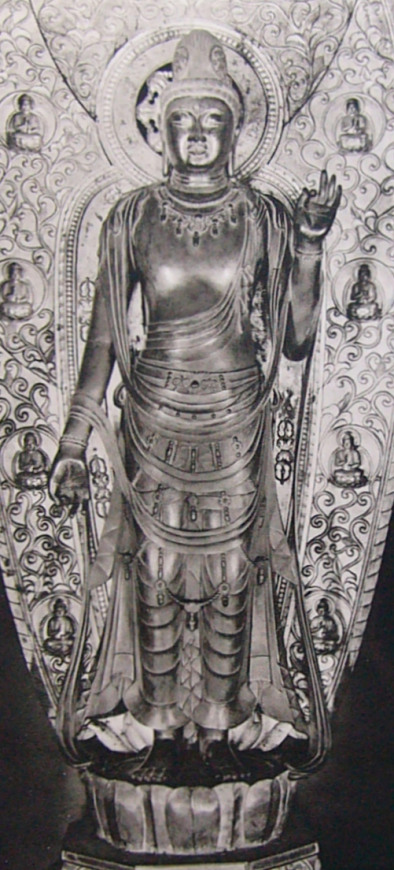
- Title
- Shō Kannon (聖観音) gilt-bronze standing figure — Yakushi-ji Tōindō
- Period
- Hakuhō / early Nara, late 7th–early 8th century
- Region
- Japan
- Medium
- Gilt bronze (most gilding worn since the 1528 fire)
- Dimensions
- Height 189 cm (figure)
- Collection
- Yakushi-ji Tōindō (薬師寺東院堂), Nara — Japanese National Treasure (国宝)
- Rights
- Photograph: Ogawa Seiyou (小川晴暘), in 『上代の彫刻 (Jōdai no Chōkoku, Ancient Japan Sculptures)』, Asahi Shimbun, Osaka, 1942 — public domain in Japan (PD-Japan-oldphoto, 50-year photo term for pre-1957 photographs). Subject: Yakushi-ji Tōindō Shō Kannon, late 7th–early 8th century — Japanese National Treasure (国宝).
Yakushi-ji's Tōindō Shō Kannon: the canonical anchor for the Shō form. 189 cm gilt bronze, Hakuhō / early Nara, National Treasure. The Amida-in-crown that marks the Kannon family elsewhere is not preserved on this figure — the canonical anchor lacks the canonical marker. The 1942 Ogawa Seiyou plate is the most widely-reproduced photographic record.
The Yakushi-ji Tōindō Shō Kannon (薬師寺東院堂聖観音) is the canonical anchor for the Shō Kannon form: 189 cm gilt-bronze standing figure of the Hakuhō / early Nara horizon, gilding lost since the 1528 fire, housed in a Kamakura-period (1285) rebuilt Tōindō that is itself a National Treasure. McCallum 2009 redates the related Yakushi Triad to c. 720–730; the Tōindō figure floats on the same Fujiwara-kyō-vs-Heijō dating debate. The canonical Amida-in-crown is absent.
A Hakuhō body in a Kamakura room
The Tōindō (東院堂, “East Hall”) at Yakushi-ji was built in 721, three years after the temple’s relocation from Fujiwara-kyō to the new Heijō capital, by Empress Genshō for the repose of her grandfather Emperor Tenmu, the temple’s founder. That original hall did not survive. The current Tōindō is a 1285 Kamakura-period reconstruction, designated a National Treasure for its own architectural value, and the oldest surviving Zen-style meditation hall in Japan. The Shō Kannon figure that stands as its principal image (honzon) is older than the building around it.
This is the strongest single observation about the work. The hall has been rebuilt; the figure has been there longer than the room. The 1528 fire that ran through Yakushi-ji turned much of the temple’s gilt-bronze sculpture from gold-surfaced to dark-bronze; the Tōindō Shō Kannon survived but lost most of its gilding in the same event. The figure that the visitor sees today is a Hakuhō body with most of its gold worn off, in a Kamakura room rebuilt around it after the 721 hall was lost.
The figure stands 189 centimetres (slightly above adult-eye-level on its pedestal) and is conventionally photographed in three-quarter view with the right arm raised at chest level and the left arm extended downward holding the water-vase (kundikā / suibyō). Ogawa Seiyou’s 1942 plate in Jōdai no Chōkoku is the most widely-reproduced photographic record; subsequent monochrome and colour photography preserves the same iconographic reading.
What the figure shows
The figure is single-faced and two-armed, the canonical Shō Kannon iconographic core, the form from which the Esoteric Six Kannon are read as elaborated variations. The body is upright, the tribhaṅga hip-shift modest or absent: the Tang-Indian continental precedent’s pronounced contrapposto is muted in the Japanese Hakuhō register. The face is round, youthful, with the calm closed-mouth expression that the Hakuhō bronze idiom carries from Yakushi-ji’s broader sculptural programme.
The right hand is raised at chest level. The gesture reads as abhaya/varada-adjacent (palm forward, fingers gently extended) without the formal mudra-discipline that Saunders 1960 documents for the elaborated Mikkyō programme. The left hand is lowered and holds the water-vase (kundikā), the canonical Avalokiteśvara attribute that the Japanese reception preserves from the continental precedent. There is no lotus stem in the surviving figure; whether one was originally held in either hand is undocumented in the accessible scholarly record.
The crown is an ornamental tiara. The small seated Amida figure (kebutsu, 化仏) that marks the Kannon family elsewhere (at the apex of the crown of Senju, Jūichimen, Nyoirin, and the broader Kannon corpus) is not preserved on this figure. This is iconographically significant: the canonical anchor for the Shō Kannon form lacks the canonical marker.
Pre-Mikkyō Kannon imagery did not always include the Amida-kebutsu, which becomes systematic only in the Heian Esoteric reception; the Tōindō figure’s omission may reflect the pre-Heian iconographic register, or the loss of an originally-present crown ornament, or both. The accessible scholarship does not resolve which.
The original gilding has worn substantially. The 1528 fire is the conventionally-cited inflection point. What remains is a dark bronze surface across most of the body, with traces of the original gold visible in protected areas. No conservation report quantifying the percentage of original gilding retained is accessible in the English-language scholarly record; this is one of the deferred research items the article opens.
The dating debate
The figure is conventionally dated to the late 7th or early 8th century: Hakuhō (645–710) at the conservative end, early Nara at the late end. The Wikimedia Commons metadata and the temple’s own framing both give “Hakuhō / early Nara” as the operative compound formulation. No documented eye-opening (kuyō) ceremony for this specific figure survives in the temple records.
The dating is unsettled by Donald McCallum’s The Four Great Temples and its companion Hakuhō Sculpture (both University of Hawai’i Press, 2009), which redate the Yakushi Triad in the Kondō (Yakushi Nyorai at 255 cm seated, with Nikkō and Gakkō at 320 cm each standing) to circa 720–730 on the basis of comparison with the Kōfukuji Buddha head and recent archaeological findings at the original Fujiwara-kyō Yakushi-ji site.
The McCallum redating disturbs the conventional Hakuhō-bronze chronology that placed the Triad in the 690s. The CAA Reviews assessment notes that McCallum argues the Hakuhō dating “caused significant confusion,” reframing the bronze as early Nara workshop production rather than as a late-7th-century fixture.
The Tōindō Shō Kannon floats on this debate. It is conventionally bracketed with the Triad’s workshop horizon (same temple, same gilt-bronze idiom, plausibly overlapping workshop tradition), but the more compact 189 cm body has not received the same redating attention as the Triad.
The honest position: the figure cannot be securely placed on either side of the 718 Heijō relocation. McCallum’s redating of the Triad pulls the centre of gravity toward early Nara workshop production, but the Tōindō figure could equally be a Fujiwara-kyō-era piece relocated with the temple, an early-Nara cast at the new site, or (least plausibly per the accessible scholarship but still not ruled out) a piece commissioned for the original 721 Tōindō.
The Korean Baekje-gift tradition, that the figure was a diplomatic gift from the Korean kingdom of Baekje to the Japanese court (a reading that circulates in tertiary tourist sources such as World History Encyclopedia and generalist guidebooks), does not appear in the scholarly literature accessed for this article. The temple’s own framing names “foreign influence” (India and Sri Lanka via Tang mediation) without endorsing a specific gift narrative. The Baekje-gift reading conflates the Tōindō figure with the Hōryū-ji Kudara Kannon folklore (where a similar tradition circulates with no firmer scholarly anchor) and should be retired from any serious treatment of the work.
Within the Six Kannon programme
The Heian Esoteric tradition develops a programme in which six Kannon variants are paired with the six realms of saṃsāric existence. The canonical Shingon ordering, attributed to Ningai (仁海, 951–1046) and codified across the Heian Mikkyō image programmes, is preserved in Sherry Fowler’s Accounts and Images of Six Kannon in Japan (Hawai’i, 2016), the current authoritative scholarly synthesis. Fowler’s reading of the Shingon assignment:
| Kannon variant | Realm |
|---|---|
| Shō Kannon | Naraka (hells) |
| Senju Kannon | Preta (hungry ghosts) |
| Bato Kannon | Animal |
| Jūichimen Kannon | Asura |
| Juntei Kannon | Human |
| Nyoirin Kannon | Deva (heaven) |
In Tendai, Fukūkenjaku Kannon substitutes for Juntei in the human-realm slot. This doctrinal split between the two Esoteric lineages on the Six Kannon assignment is the named structural difference between Shingon and Tendai readings of the programme.
Fowler explicitly notes that the Ningai list “was never strictly adhered to” across the tradition. Earlier and later orderings vary; school-internal differences and regional traditions diverge from the canonical ordering. The Ningai assignment is the most-cited canonical reference but not the universal reading. Older English-language treatments (including, as bodhi acknowledges in the Nyoirin Kannon entity primer and the Shō Kannon entity primer, corrected against Fowler) sometimes give different realm assignments derived from older sources or variant lineages.
The Ningai assignment of Shō to the naraka (hells) realm is iconographically stable in the Heian Esoteric programmes. The placement does not modify the Shō form itself; the figure does not change shape because of the realm assignment. What the assignment does is locate the figure within the soteriological cartography that the Six Kannon programme constructs: the base form of Kannon attends to the deepest realm of suffering, with the more elaborated variants distributed across the higher realms.
The Tōindō Shō Kannon precedes the Heian Mikkyō codification by centuries. The figure is not a Six-Kannon-programme honzon in any institutional sense; it is the standalone Shō Kannon image of an early Nara temple, executed before the realm-assignment system existed. Reading the figure through the Six Kannon programme is a downstream interpretive move; the figure itself is iconographically prior to the programme.
The Triad comparison
The Yakushi-ji Kondō (Main Hall) houses the temple’s most famous bronze sculpture: the Yakushi Triad (薬師三尊像): Yakushi Nyorai (the Medicine Buddha) flanked by Nikkō Bosatsu (Sun Bodhisattva) and Gakkō Bosatsu (Moon Bodhisattva). The Triad is on a different scale: Yakushi seated at 255 cm, Nikkō and Gakkō each standing at 320 cm, much larger than the Tōindō Shō Kannon’s 189 cm. Same temple, same gilt-bronze idiom, same Hakuhō / early Nara horizon, plausibly overlapping workshop tradition.
The Triad’s bronzes are conventionally read as the high point of the early Japanese gilt-bronze achievement. McCallum’s 2009 redating of the Triad places the workshop production around 720–730, after the Heijō relocation, against the older Hakuhō-only consensus. The Tōindō Shō Kannon, smaller and less monumentally programmed, has not received the same redating attention; the Triad carries the scholarly weight for the Yakushi-ji bronzes’ workshop and dating questions.
What the Triad comparison establishes is the institutional context: the Tōindō Shō Kannon is not an isolated bronze. It sits within a temple programme that produced gilt-bronze sculpture at the highest scale and quality available in the early Japanese institutional record. The Triad and the Tōindō figure are stylistic siblings, with the smaller scale of the Shō Kannon and the more compact iconographic programme (single figure rather than three-figure ensemble) the principal differences.
The 1528 fire affected both. The dark surfaces visible today on the Triad and on the Tōindō figure trace to the same event. What survives are the bronze cores: the sculptural form preserved despite the loss of the original gilt-bronze surface programme.
Where this work sits
The Yakushi-ji Tōindō Shō Kannon is the institutional anchor for the Shō Kannon form in the Japanese sculptural record. The figure is one of a small number of pre-Heian standing bronze Kannons preserved in Japanese institutional collections at the highest cultural-property tier (National Treasure). The Hōryū-ji Yumedono Guze Kannon and the Hōryū-ji Kudara Kannon are the principal pre-Heian Kannon comparanda; both are wood, not bronze, and both carry their own institutional and historiographical complications. The Yakushi-ji figure is the canonical bronze anchor for the form.
For the reader looking at any later Japanese Shō Kannon figure (Heian, Kamakura, Edo), the Tōindō figure is the iconographic-and-stylistic reference. The single-faced, two-armed, standing form with the water-vase in the left hand and the gentle right-hand gesture is the body-position the canonical anchor establishes. Variations from this baseline (the seated form, the lotus-stem variant, the Heian Esoteric programme placement, the elaborated Kamakura wooden Shō Kannons in the Kei-school workshop register) are read against the Hakuhō / early Nara bronze as the form’s foundational image.
The figure is hibutsu (秘仏, secret image) only in a soft sense at Yakushi-ji. The Tōindō is open to the public on the temple’s standard schedule, and the Shō Kannon is visible during normal visiting hours. The opening cycle is more permissive than the strict hibutsu of the Hōryū-ji Yumedono (33-year cycle, only opened in 1884 by Fenollosa and Okakura) or the Asakusa Kannon (closed, never opened). The reader who wants to see the canonical anchor in person can; the figure is accessible.
Related
- Gyoran Kannon — the fish-basket form and its Chinese legend, against the canonical anchor
- Nyoirin Kannon: iconographic markers
- Senju Kannon: reading the thousand arms
- Jūichimen Kannon: eleven heads and the canonical stack
- Bato Kannon: the horse-headed form
- Asuka Kannon: gilt-bronze, mid-600s
- Shō Kannon: entity primer
Sources
-
The current authoritative scholarly synthesis of the Six Kannon programme. Cited for Ningai's Shingon canonical realm assignments and for the explicit caveat that 'the list was never strictly adhered to'
-
Sometimes paired with McCallum's *Hakuhō Sculpture* (also UH 2009). The volume that redates the Yakushi Triad to c. 720–730 against the conventional Hakuhō-bronze chronology, on the strength of the Kōfukuji Buddha-head comparanda. Cited at chapter level; specific pages not verified
-
Heian Mikkyō context. Cited without page numbers
-
Standard reference for the *varada* and *abhaya* gestures. Used here for the Tōindō figure's right-hand reading
-
The temple's own description: 'No record remains of who crafted the Sacred Kannon.' Notes foreign-influence reading (India / Sri Lanka mediated through Tang). The temple authority's framing
-
The current National Treasure designation is post-1950 (Cultural Properties Protection Law). The pre-1950 designation date under the 1897 system has not been verified against the Bunkachō list
-
The current Tōindō is a 1285 Kamakura-period rebuild after destruction of the 721 original. Donated in the original phase by Empress Genshō for the repose of her grandfather Emperor Tenmu. Itself designated a National Treasure. The figure precedes the room around it
-
The 1528 great fire is the conventionally cited inflection point at which the Yakushi-ji bronzes turned from gold-gilded surface to dark bronze. The Tōindō Shō Kannon's worn gilding traces to this event
-
The 1942 Ogawa Seiyou plate is the most widely-reproduced photographic record of the figure. PD-Japan-oldphoto (50-year photo term, pre-1957). Source for the bodhi cleared image