Jūichimen Kannon
Also known as 十一面観音 · Jūichimen Kannon Bosatsu · Ekādaśamukha Avalokiteśvara · Eleven-Headed Avalokiteśvara · Shiyimian Guanyin
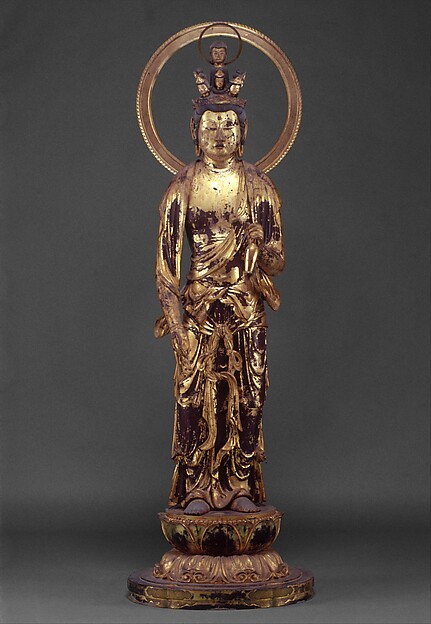
- Title
- Jūichimen Kannon, the Bodhisattva of Compassion with Eleven Heads — 十一面観音菩薩
- Period
- Nanbokuchō period (1336–92), mid- to late 14th century
- Region
- Japan
- Medium
- Wood with lacquer, gold leaf, and metal decoration
- Dimensions
- Figure: H. 199.1 × W. 54.6 × D. 58.7 cm (78 3/8 × 21 1/2 × 23 1/8 in.); with base: H. 234.5 cm; with halo: H. 236.9 cm
- Collection
- The Metropolitan Museum of Art
- Accession
-
1975.268.167 - Rights
- The Metropolitan Museum of Art (Public Domain / OASC). The Harry G. C. Packard Collection of Asian Art, Gift of Harry G. C. Packard, and Purchase, Fletcher, Rogers, Harris Brisbane Dick, and Louis V. Bell Funds, Joseph Pulitzer Bequest, and The Annenberg Fund Inc. Gift, 1975 (1975.268.167).
A canonical anchor for Jūichimen Kannon: Nanbokuchō wood, ~2m standing, surviving polychromy and gilding. The tiered head-stack is the diagnostic across all media.
Jūichimen Kannon
Jūichimen Kannon (十一面観音) is the eleven-headed Esoteric form of Kannon. The canonical stack reads as three benevolent faces forward, three wrathful at the sides, three smiling at the rear, one Buddha-form crown, and one rear-facing laughing head. Within the Six Kannon programme, Jūichimen is assigned to the realm of asuras. The body is canonically two-armed, distinguishing the form from Senju at the arm count even when both share the eleven-headed stack.
Iconography
The eleven-head stack is the diagnostic. The arrangement, reading from the principal face outward and around:
- Front three — benevolent (shōmen), the principal face plus two flanking, calm.
- Right three — wrathful (kongōmen), bared teeth or fang readings.
- Left three — smiling (shōmen in a different reading register), broad smile.
- Rear one — laughing face (bōnyū-mukomen), the most distinctive of the eleven; carries an iconographic charge of the figure’s omnidirectional vision.
- Crown one — Buddha-form face atop the stack; canonically Amida in the Japanese reception.
The body is canonically two-armed. Right hand in varada (gift-giving, palm-out and downward); left hand holds a water-vase (kundikā) with a lotus stem rising from it. Standing posture is canonical; seated forms exist but are the minority reading.
The expanded Esoteric programmes — chiefly the late-Heian and Kamakura ritual cycles — extend the arm count to four, six, or eight. In these expanded forms the eleven-head stack remains the primary diagnostic; the additional arms hold the canonical Esoteric implement set (lotus, vajra, jewel, lasso, sūtra) and do not displace the head-count diagnostic.
Within the Esoteric programme
Jūichimen Kannon is the variant assigned to the realm of asuras in the Six Kannon programme. The eleven-head reading is read doctrinally as the figure’s reach into the eleven bhūmi of bodhisattva attainment — a doctrinal frame Bogel 2009 traces against the Heian Mikkyō image programmes.
In the collections
- Hokke-ji (Nara) — Jūichimen Kannon Ritsuzō, Heian period (early 9th c.), National Treasure. The canonical Heian anchor.
- Murō-ji (Nara) — Jūichimen Kannon Ritsuzō, Heian period (9th c.), National Treasure. Sherry Fowler’s Murō-ji is the standard scholarly reading.
- Dōgan-ji (Shiga) — Jūichimen Kannon Ritsuzō, Heian period, National Treasure.
- Shōrin-ji (Nara) — Jūichimen Kannon Ritsuzō, Heian period, National Treasure.
- Kōgen-ji (Shiga) — Jūichimen Kannon Ritsuzō, Heian period, National Treasure (the Watanabe-Kōgen).
- The Metropolitan Museum of Art — multiple Jūichimen holdings across the Asian Art collection.
How to read in the field
The eleven-head stack is the primary diagnostic. The two-arm count distinguishes Jūichimen from Senju (forty-two-armed) when both share the stack. The water-vase and lotus pair confirms the canonical reading; the varada mudra in the right hand is the secondary anchor.
Related
- Figures: Sho Kannon, Senju Kannon, Nyoirin Kannon, Bato Kannon
Further works
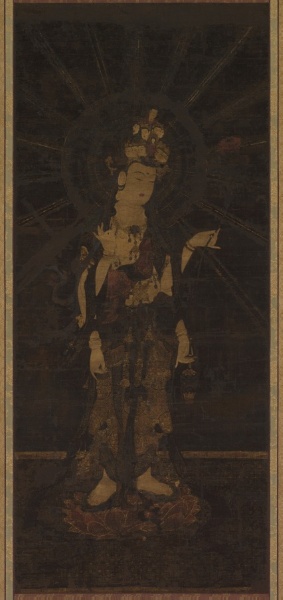
- Title
- Eleven-Headed Kannon (Jūichimen Kannon) — 十一面観音菩薩像
- Period
- Kamakura period (1185–1333), 1200s
- Region
- Japan
- Medium
- Hanging scroll; color and cut gold (kirikane) on silk
- Dimensions
- 106.7 × 39.7 cm (42 × 15 5/8 in.)
- Collection
- Cleveland Museum of Art
- Accession
-
1970.79 - Rights
- Cleveland Museum of Art (Public Domain / CC0); John L. Severance Fund, 1970.79.
Painted comparandum: Kamakura silk with cut-gold robes. Same iconographic stack across two centuries and two media.
Sources
-
[1]— Cynthea J. Bogel, With a Single Glance: Buddhist Icon and Early Mikkyō Vision (Honolulu: University of Hawai'i Press, 2009) print referenceHeian Esoteric programme placement; the eleven-head stack as iconographic system.
-
[2]— E. Dale Saunders, Mudrā (Princeton, NJ: Princeton University Press / Bollingen Foundation, 1960) print reference*Varada* and water-vase-holding gestures.
-
[3]— Hisashi Mōri, Sculpture of the Kamakura Period (Tokyo: Heibonsha / New York: Weatherhill, 1974) print referenceThe Kamakura Jūichimen sculptural record; the eleven-head stack as preserved across the Tōdai-ji and Kōfuku-ji rebuilding programmes.