Nyoirin Kannon
Also known as 如意輪観音 · Nyoirin Kannon Bosatsu · Cintāmaṇicakra Avalokiteśvara · Wish-Granting Wheel Avalokiteśvara · Rúyìlún Guānyīn
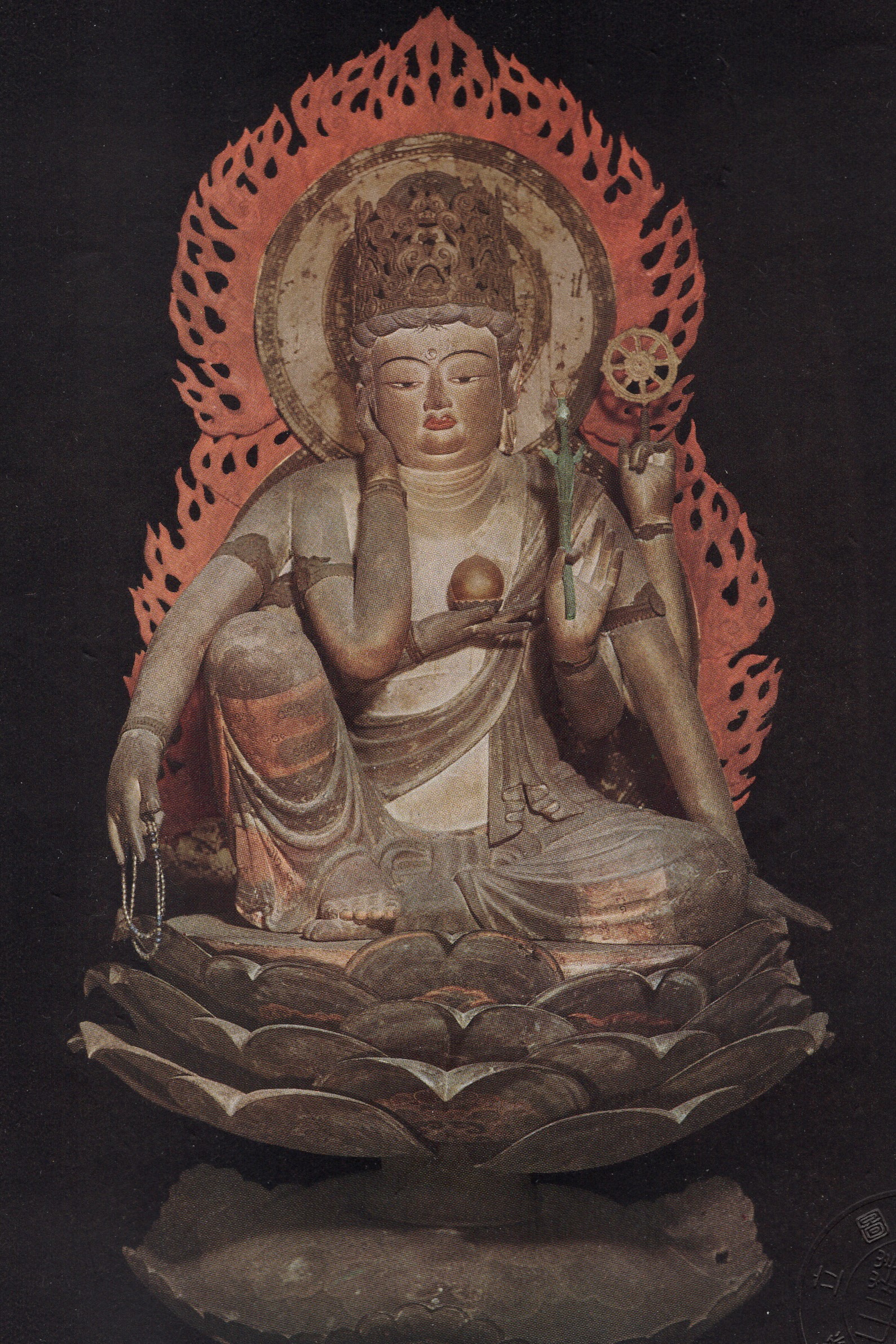
- Title
- Nyoirin Kannon (如意輪観音坐像) — Kanshin-ji, Heian, 9th c.
- Period
- Heian period (794–1185), 9th century
- Region
- Japan
- Medium
- Wood with lacquer, polychromy, and gold leaf — single-block (*ichiboku-zukuri*) construction
- Collection
- Kanshin-ji (観心寺), Kawachinagano, Osaka — Japanese National Treasure (国宝)
- Rights
- Photograph: 文化財協会 (Bunkazai Kyōkai / Cultural Properties Society), in 『国宝図録 第1集 (Kokuhō Zuroku, National Treasures Catalog, vol. 1)』, 1952 — public domain in Japan (PD-Japan-oldphoto, 50-year photo term for pre-1957 photographs). Subject: Nyoirin Kannon Bosatsu zazō, Kanshin-ji (Osaka), Heian period 9th c. — Japanese National Treasure (国宝).
The canonical anchor: Kanshin-ji's 9th-century Nyoirin Kannon (Osaka), Heian, National Treasure — the earliest documented Japanese six-armed Nyoirin and the iconographic reference for the form. The *rinnō-za* posture, the *shiyui-in* cheek-fingertip gesture, the *cintāmaṇi* and the dharma wheel — the four canonical diagnostics — read here together. The 1952 Kokuhō Zuroku plate is the standard pre-1957 photographic record.
Nyoirin Kannon
Nyoirin Kannon (如意輪観音) is the seated, six-armed Esoteric form of Kannon. The diagnostic is the rinnō-za posture (one knee raised) and the right-hand-to-cheek meditative gesture; the cintāmaṇi (wish-granting jewel) and the dharma wheel are the canonical attributes. Within the Six Kannon programme, Nyoirin is assigned to the realm of humans in the Shingon reading. An abbreviated two-armed seated form is documented in Edo lay-devotional contexts.
Iconography
The full Sanskrit name Cintāmaṇicakra Avalokiteśvara — “Avalokiteśvara of the wish-granting jewel and the wheel” — is rendered in Japanese as 如意輪観音: nyoi (如意, “as you wish” — the cintāmaṇi), rin (輪, “wheel” — the cakra of the dharma).
The canonical six-armed seated form, arms read from the figure’s right:
- Upper right — bent at the elbow, hand raised to the cheek in shiyui-in; index and middle fingers extended against the cheek, the third and fourth folded.
- Middle right — holds the cintāmaṇi (Japanese nyoi-hōju, 如意宝珠) at chest level.
- Lower right — rests by the side, hand on or above the bent knee.
- Upper left — bent at the elbow, holds a lotus stem at shoulder height.
- Middle left — holds the cakra (dharma wheel, Japanese rinpō, 輪宝).
- Lower left — rests against the lotus throne or holds rosary beads.
The seating is rinnō-za (輪王座), royal-ease — one knee raised, the other folded, the body weight on one hip. Distinct from the formal full-lotus kekka-fuza. The pose is iconographically charged: the body relaxed but alert, the elbow resting against the raised knee in support of the meditative-fingertip gesture.
The abbreviated two-armed form drops the four outer arms but preserves the seated meditative posture and the cintāmaṇi (in the left hand). The Met holding (acc. 49109, dated 1693) is one such abbreviated form, useful as the counter-example against which the canonical Esoteric reading is fixed.
Within the Esoteric programme
Nyoirin Kannon is the variant assigned to the realm of deva (heaven) in Ningai’s canonical Shingon ordering of the Six Kannon programme, per Fowler 2016 (Accounts and Images of Six Kannon in Japan). The full Shingon assignment: Shō → naraka (hells), Senju → preta (hungry ghosts), Batō → animal, Jūichimen → asura, Juntei → human, Nyoirin → deva. In Tendai, Fukūkenjaku substitutes for Juntei in the human-realm slot — the doctrinal split is one of the named differences between the two Esoteric lineages.
Fowler notes the realm-Kannon pairings were never strictly adhered to; the Ningai list is the most-cited canonical reference but not the universal reading. Bogel 2009 reads both lineages against the extant Heian Esoteric image programmes.
In the collections
- Kanshin-ji (Osaka) — Nyoirin Kannon Bosatsu zazō, Heian period (9th c.), National Treasure. The earliest documented Japanese six-armed Nyoirin; the iconographic anchor.
- Daigo-ji (Kyoto) — Nyoirin Kannon Bosatsu zazō, Heian period, Important Cultural Property. The Shingon-tradition reference image.
- Ishiyama-dera (Shiga) — Nyoirin Kannon, hibutsu (secret image), Heian period. Shown only at fixed intervals.
- The Metropolitan Museum of Art acc. 49109 — Nyoirin Kannon (Edo, 1693), abbreviated two-armed seated form.
- Smithsonian National Museum of Asian Art (Freer) acc. F1961.6 — Nyoirin Kannon, canonical six-armed Esoteric form.
How to read in the field
The rinnō-za posture with the cheek-fingertip gesture is the most reliable single diagnostic. A Kannon figure seated with one knee raised, right hand to cheek, jewel in the second right arm, is a Nyoirin. No other Japanese Buddhist figure carries this posture-and-attribute combination as canonical.
Where the form is commonly misread
The shiyui-in gesture is sometimes conflated with the hanka-shiyui of the Maitreya / Miroku Bosatsu in his half-lotus meditative pose. The two gestures are similar but the figures are distinct: Miroku in hanka-shiyui is a future-Buddha, single-armed in the gesture; Nyoirin is a Kannon, six-armed, with the gesture as one element among the canonical six. Cross-tradition comparisons sometimes also conflate Nyoirin with the Tibetan Tara (six-armed seated lotus-throne form); the disambiguating attribute is the cintāmaṇi and dharma wheel pair (Nyoirin) versus the utpala lotus stem (Tara).
Related
- Figures: Sho Kannon, Senju Kannon, Juichimen Kannon, Bato Kannon
Sources
-
[1]— Cynthea J. Bogel, With a Single Glance: Buddhist Icon and Early Mikkyō Vision (Honolulu: University of Hawai'i Press, 2009) print referenceHeian Esoteric programme placement; Nyoirin as a *honzon* across Shingon and Tendai.
-
[2]— Robert H. Sharf, 'On the Allure of Buddhist Relics,' Representations 66 (Berkeley: University of California Press, 1999): 75–99 print referenceThe *cintāmaṇi* read as a polyvalent ritual object across the Esoteric corpus.
-
[3]— E. Dale Saunders, Mudrā (Princeton, NJ: Princeton University Press / Bollingen Foundation, 1960) print reference*Shiyui-in* and the per-form mudra reading.
-
[4]— Hisashi Mōri, Sculpture of the Kamakura Period (Tokyo: Heibonsha / New York: Weatherhill, 1974) print referenceThe Kamakura Nyoirin sculptural record.