Senju Kannon
Also known as 千手観音 · 千手千眼観音 · Senju Kannon Bosatsu · Senju Sengen Kannon · Sahasrabhuja Avalokiteśvara · Sahasrabhujasahasranetra Avalokiteśvara · Thousand-Armed Avalokiteśvara · Qianshou Guanyin
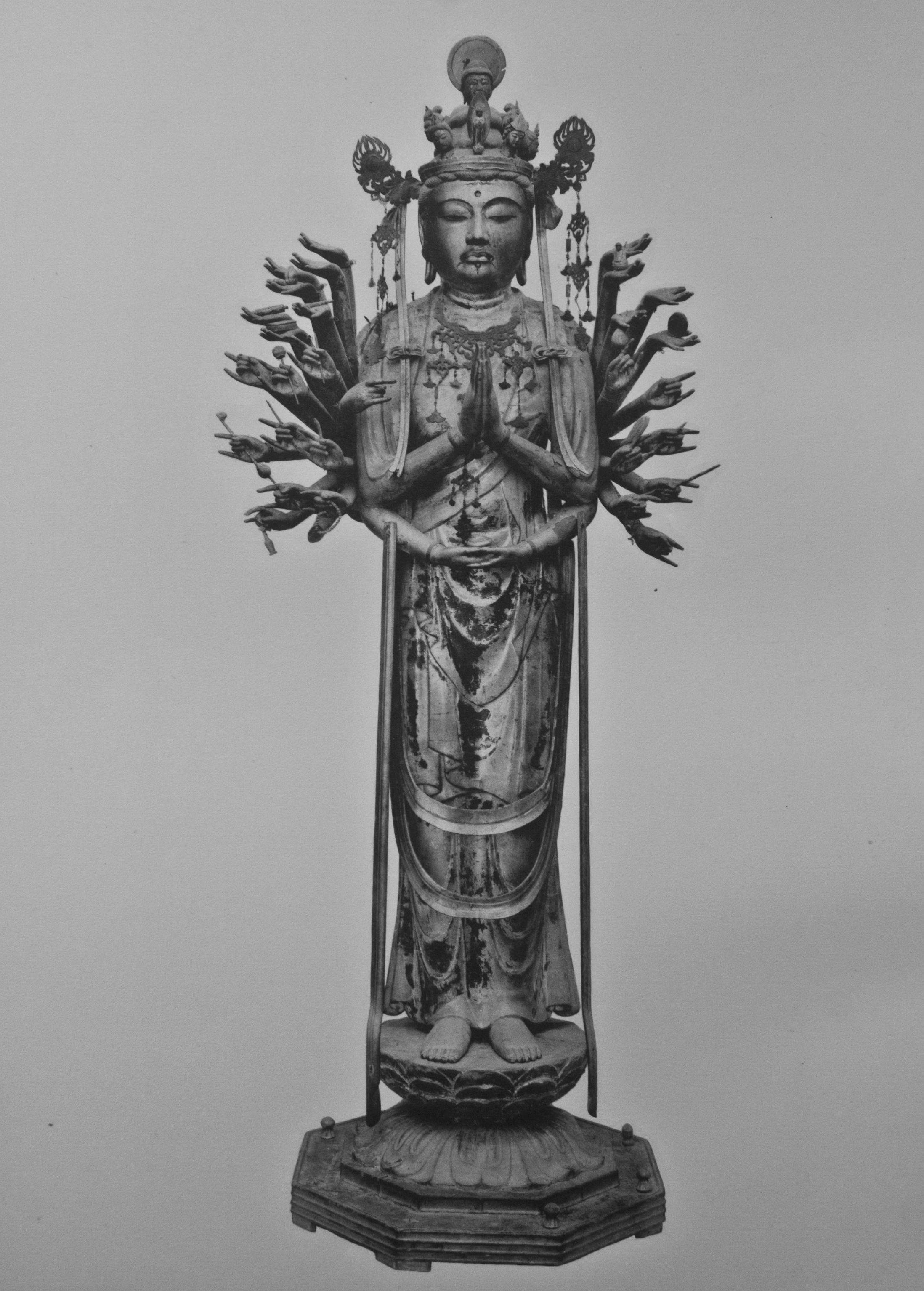
- Title
- Senju Kannon (千手観音), Sanjūsangen-dō chief image — Tankei, 1254
- Period
- Kamakura period (1185–1333), 1254
- Region
- Japan
- Medium
- Wood with lacquer, gold leaf, and polychromy; eleven heads; 42 sculpted arms standing in for a thousand
- Collection
- Sanjūsangen-dō (Rengeō-in), Kyoto — Japanese National Treasure (国宝)
- Rights
- Photograph: Nara Imperial Household Museum (奈良帝室博物館), 1933 — public domain in Japan (PD-Japan-oldphoto, 50-year photo term for pre-1957 photographs). Subject: Tankei (active 1185–1256), Sanjūsangen-dō chief image, 1254 — Japanese National Treasure (国宝).
The canonical anchor: Tankei's 1254 chief image at Sanjūsangen-dō. The 42-arm convention (40 outer × 25 worlds + two principal in gasshō) reads here at full scale; the eleven-head stack repeats Jūichimen at the crown.
Senju Kannon
Senju Kannon (千手観音) is the thousand-armed Esoteric form of Kannon. The canonical Japanese reading uses forty-two arms as sculptural shorthand for one thousand: two central in gasshō, forty outer arms each holding a different ritual implement. The eleven-headed stack is the canonical sub-iconography. Within the Six Kannon programme, Senju is assigned to the realm of hell-beings. The Sanjūsangen-dō chief image (Tankei, 1254) is the canonical anchor.
Iconography
The full Sanskrit name Sahasrabhujasahasranetra Avalokiteśvara — “the thousand-armed, thousand-eyed Avalokiteśvara” — is rendered in Japanese as 千手千眼観音 (Senju Sengen Kannon) and most often shortened to 千手観音 (Senju Kannon). The full reading places an eye in each of the thousand palms; the abbreviated reading drops the eyes from the iconographic checklist while keeping them implicit.
The sculptural canon uses forty-two arms as shorthand for one thousand. Two arms central, in gasshō (合掌, palms together at chest); forty outer arms arranged in a halo of attribute-bearing pairs. Each outer arm holds a distinct ritual implement — vajra, axe, sword, lotus, jewel, sūtra, water-vase, lasso, bell, drum, conch, and so on through the canonical implement list. Saunders 1960 lists the per-implement readings.
The eleven-headed stack — three benevolent, three wrathful, three smiling, one Buddha-form crown, one rear laughing face — is the canonical Heian sub-iconography. Senju in the Heian programme is often eleven-headed; this is why eleven heads alone are not always diagnostic for Jūichimen Kannon. Read face count alongside arm count to disambiguate.
Within the Esoteric programme
Senju Kannon is the variant assigned to the realm of hell-beings in the Six Kannon programme. The thousand-arm reading is read as the iconographic correlate of the figure’s reach into all six realms simultaneously — a doctrinal frame Bogel 2009 traces through the Heian Mikkyō image programmes.
In the collections
- Sanjūsangen-dō (Renge-ō-in, Kyoto) — 1,001 standing Senju Kannon, Kamakura period; the chief image is the seated Tankei work, dated 1254 by inscription, National Treasure. The canonical Japanese sculptural anchor.
- Tō-ji (Kyoto) — Senju Kannon Bosatsu, Heian period.
- Fujii-dera (Osaka) — Senju Kannon Bosatsu zazō, Nara period (8th c.), National Treasure. The earliest documented Japanese Senju Kannon.
- The Metropolitan Museum of Art — multiple Senju holdings across the Asian Art collection.
How to read in the field
The forty-two-armed form is unambiguous in unbroken sculpture; in damaged or stylized works, the gasshō central pair is the most reliable single marker. The eleven-headed stack is a Senju-or-Jūichimen marker — disambiguate by arm count.
Related
- Figures: Sho Kannon, Juichimen Kannon, Nyoirin Kannon, Bato Kannon
Sources
-
[1]— Hisashi Mōri, Sculpture of the Kamakura Period (Tokyo: Heibonsha / New York: Weatherhill, 1974) print referenceAnchors the Sanjūsangen-dō reading and the Tankei chief image (1254).
-
[2]— Cynthea J. Bogel, With a Single Glance: Buddhist Icon and Early Mikkyō Vision (Honolulu: University of Hawai'i Press, 2009) print referenceHeian Esoteric programme placement; the eleven-headed sub-iconography read alongside the thousand-arm canon.
-
[3]— E. Dale Saunders, Mudrā (Princeton, NJ: Princeton University Press / Bollingen Foundation, 1960) print reference*Gasshō* and the per-implement readings of the forty outer arms.