Shō Kannon
Also known as 聖観音 · 正観音 · Shō Kannon Bosatsu · Āryāvalokiteśvara · Holy Kannon · Sacred Avalokiteśvara
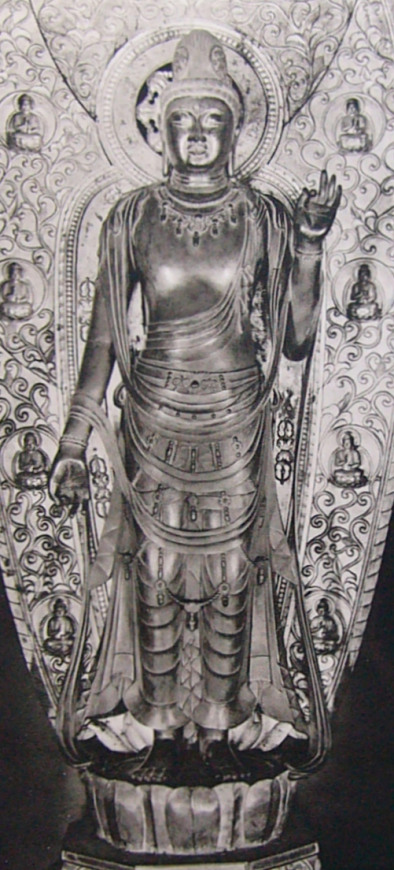
- Title
- Shō Kannon (聖観音) gilt-bronze standing figure — Yakushi-ji Tōindō
- Period
- Hakuhō / early Nara, early 8th century
- Region
- Japan
- Medium
- Gilt bronze (most gilding worn)
- Dimensions
- Height 189 cm (figure)
- Collection
- Yakushi-ji Tōindō (薬師寺東院堂), Nara — Japanese National Treasure (国宝)
- Rights
- Photograph: Ogawa Seiyou (小川晴暘), in 『上代の彫刻 (Jōdai no Chōkoku, Ancient Japan Sculptures)』, Asahi Shimbun, Osaka, 1942 — public domain in Japan (PD-Japan-oldphoto, 50-year photo term for pre-1957 photographs). Subject: Yakushi-ji Tōindō Shō Kannon, early 8th century — Japanese National Treasure (国宝).
The canonical anchor: Yakushi-ji's Tōindō Shō Kannon, gilt bronze, 189 cm, early 8th century, National Treasure. Single-headed, two-armed, standing — the base-form reading from which the Esoteric Six Kannon are read as variations. The continental hip-shift is muted in the Japanese reception; the upright body and the calm round face are the Hakuhō register. The 1942 Ogawa Seiyou plate is the most widely-reproduced photographic record of the figure.
Shō Kannon
Shō Kannon (聖観音) is the canonical base form of Kannon: single-headed, two-armed, standing or seated, holding a lotus stem and a water-vase. Within the Heian Esoteric Six Kannon programme (Ningai’s Shingon canonical, per Fowler 2016), Shō is assigned to the realm of naraka (hells); outside the programme it is the most widely depicted Kannon form in Japanese sculpture from the Asuka period forward. The realm-assignment was never strictly adhered to across the tradition.
Iconography
A single face, two arms. Standing or seated; both are canonical. The lotus stem held vertically in one hand and the water-vase (kundikā, 水瓶) in the other are the two diagnostic implements. The crown carries a small seated Amida figure — the Kannon-family marker, present whether or not the figure is named Shō.
The mudras vary by workshop and period. The varada (gift-giving, palm-out and downward) is the most common right-hand reading when the right hand is empty; the abhaya (palm-out and upward, fearlessness) appears in the Heian Esoteric programme readings. The body is upright, the tribhaṅga hip-shift modest or absent in the Japanese reception (more pronounced in the Tang and Korean precedent that fed into the Asuka and Hakuhō Japanese forms).
Within the Esoteric programme
Shō Kannon is the variant assigned to the realm of naraka (hells) in Ningai’s canonical Shingon ordering of the Heian Esoteric Six Kannon programme. The full Shingon assignment per Fowler 2016 (Accounts and Images of Six Kannon in Japan): Shō → naraka, Senju → preta (hungry ghosts), Batō → animal, Jūichimen → asura, Juntei → human, Nyoirin → deva (heaven). In Tendai, Fukūkenjaku substitutes for Juntei in the human-realm slot.
Fowler explicitly notes that the realm-Kannon pairings were never strictly adhered to across the tradition; the Ningai list is the most-cited canonical reference but not the universal reading. The programmatic placement is doctrinal, not iconographic — the Shō form does not change shape because of the realm assignment. The Esoteric reading is one frame; the broader devotional reading (Shō as the base Kannon, no programme implied) is the other.
In the collections
- Hōryū-ji (Nara) — Shō Kannon Ritsuzō, Asuka–Hakuhō period, National Treasure. The Kudara Kannon and the Yumedono Kannon both fall in the Hōryū-ji Shō-form holdings; together they fix the earliest Japanese iconographic reading.
- Yakushi-ji (Nara) — Shō Kannon Ritsuzō, Hakuhō, National Treasure. The standing form anchor.
- Tōdai-ji (Nara) — multiple Shō Kannon holdings across the temple’s halls.
- The Metropolitan Museum of Art — Shō Kannon holdings across the Asian Art collection, accession-anchored under the Bodhisattva Avalokiteshvara search.
Where the iconography is commonly read
Shō Kannon is the form most often meant when an unsourced caption simply says “Kannon.” The base-form reading is the working assumption; deviations (eleven heads, thousand arms, six arms with a jewel, horse head atop the hair) push the reading to the named variant. The Six Kannon programme treats Shō as the unmarked term — the shape from which the others are deviations.
Related
- Figures: Senju Kannon, Juichimen Kannon, Nyoirin Kannon, Bato Kannon
Sources
-
[1]— Cynthea J. Bogel, With a Single Glance: Buddhist Icon and Early Mikkyō Vision (Honolulu: University of Hawai'i Press, 2009) print referenceHeian Esoteric programme placement; Shō as the base form against which the other six are read.
-
[2]— E. Dale Saunders, Mudrā: A Study of Symbolic Gestures in Japanese Buddhist Sculpture (Princeton, NJ: Princeton University Press / Bollingen Foundation, 1960) print referenceStandard reference for *varada* and lotus-holding gestures.
-
[3]— The Metropolitan Museum of Art — Heilbrunn Timeline of Art History metmuseum.org/toah/hd/eboi/hd_eboi.htmPublic-facing context for the Esoteric programme placement.