Juntei Kannon — the Six Kannon's seventh slot, in Heian colour at the Tokyo National Museum
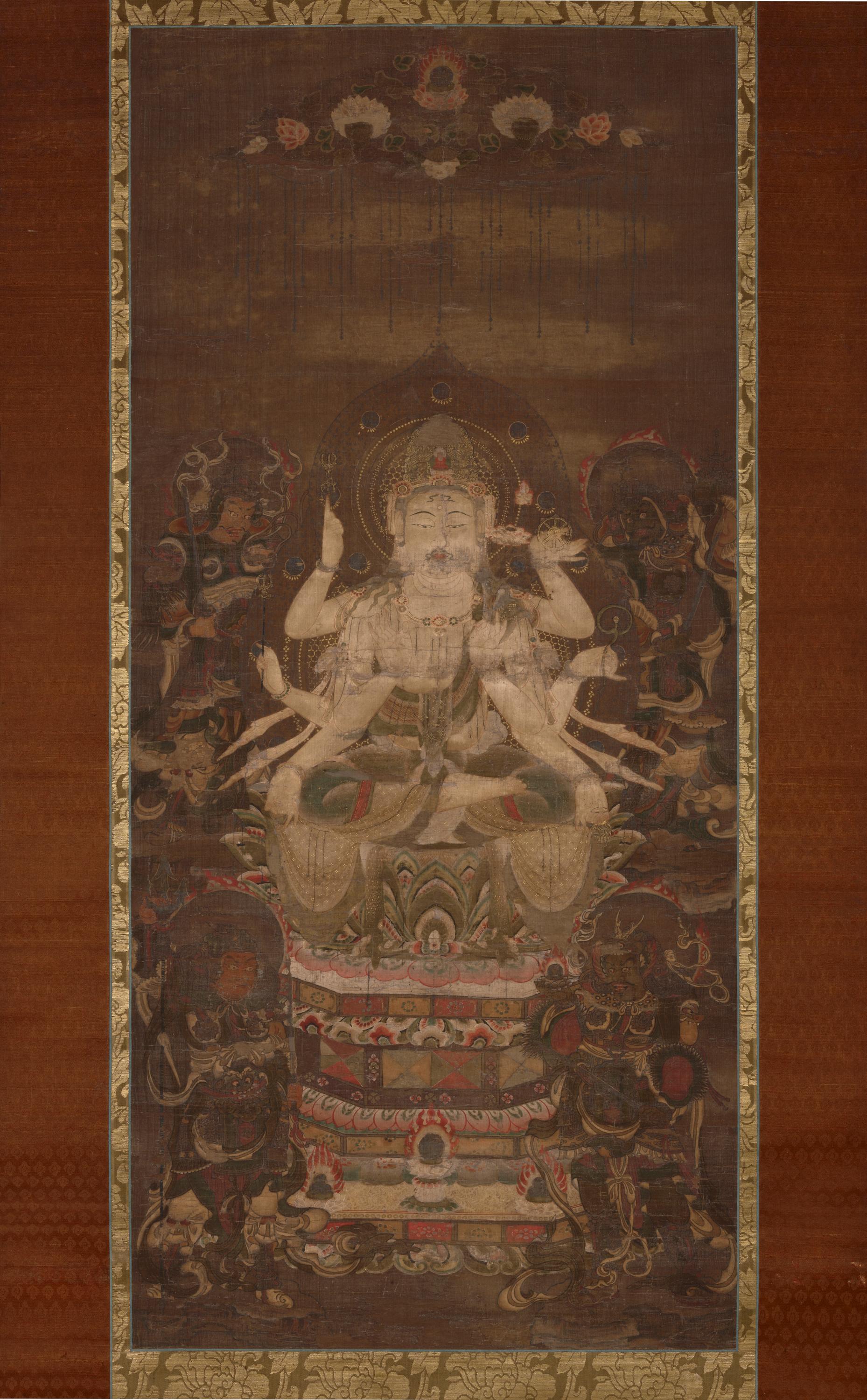
- Title
- The Bodhisattva Juntei Kannon (准胝観音像) — TNM A-11796, Heian 12th c.
- Period
- Heian period (平安時代), 12th century
- Region
- Japan
- Medium
- Hanging scroll; color and gold *kirikane* (截金) on silk (絹本着色)
- Dimensions
- 103.4 × 47.4 cm
- Collection
- Tokyo National Museum (東京国立博物館)
- Accession
-
A-11796 - Rights
- Tokyo National Museum (東京国立博物館). 田中親美氏寄贈 (Gift of Tanaka Shinbi). Important Cultural Property (重要文化財). 出典:ColBase(https://colbase.nich.go.jp/)
TNM A-11796 — Juntei Kannon, Heian 12th c., hanging scroll, color on silk, 103.4 × 47.4 cm. Important Cultural Property. The work closes the Six Kannon disambiguation table: in the Shingon recension the seventh slot is Juntei, not Fukūkenjaku. The TNM piece is one of the most readable surviving Heian Juntei images.
The figure who closes the Six Kannon
The Tokyo National Museum’s twelfth-century Juntei Kannon (acc. A-11796, Important Cultural Property, gift of Tanaka Shinbi) is the figure who closes the corpus’s Six Kannon disambiguation. As the seventh of the seven principal Kannon variants, it needs an image of sufficient resolution, and TNM A-11796 supplies it: color on silk, kirikane on the robes, the four Heavenly Kings (Shitennō) at the corners, Important Cultural Property.
Read the iconography first. The figure is a multi-armed seated bodhisattva, calm and pale-skinned at the centre of the field, with three small seed-syllable roundels arranged above the head and a tall jewelled headdress. The principal pair of hands meet at the chest in gasshō (joined-palm). The subsidiary arms, canonically eighteen in the Japanese standard, spread outward holding ritual attributes: bow, lotus, lasso, wheel, vajra-handled trident, and so on through the standard inventory. The colouration is the soft Heian register: warm flesh tones, dark drapery pigments, and kirikane (cut-gold-leaf) across the robes as a fine geometric overlay catching light against the silk.
At the four corners stand four armoured wrathful guardian figures: the Shitennō (Four Heavenly Kings). Their treatment is stylistically distinct from the central figure: more emphatic in line, more three-dimensional in modelling, more forceful in pose. The TNM curatorial note flags this directly: Heian-period elements (soft coloration and meticulous kirikane patterning of the Juntei Kannon figure) combined with Kamakura-period elements (the powerful depiction of the Four Heavenly Kings figures). Two periods in one composition, or one composition restored across two periods.
What you are looking at, iconographically
The seventh slot: why Juntei matters for the Six Kannon
The Six Kannon programme has a structural quirk that surprises first-time readers: it has seven possible members. Across the seven principal Kannon variants (Shō, Senju, Jūichimen, Batō, Nyoirin, Juntei, Fukūkenjaku) the canonical Six Kannon select six. The first five (Shō, Senju, Jūichimen, Batō, Nyoirin) are constant. The seventh slot is the institutional disambiguator: Shingon names Juntei Kannon as the seventh; Tendai names Fukūkenjaku Kannon as the seventh. Both schools call their set “the Six Kannon” (六観音); both sets save beings from the six realms; the difference is which deity carries the load.
Why two schools, two seventh-slots? Sherry Fowler’s Accounts and Images of Six Kannon in Japan (Hawai’i 2016) traces the institutional construction of the Six Kannon programme through the ninth and tenth centuries. The programme matches each Kannon variant to one of the six realms of rebirth, supplying a salvific schema in which each variant rescues sentient beings from a specific kind of suffering. Both schools agreed on the first five matches; both schools needed a sixth deity for the remaining realm; both schools made the choice based on the canonical texts and ritual practices most central to their own lineage. Shingon’s eighth- and ninth-century connection to Juntei worship at Daigo-ji (the Juntei-dō was a founding 874 component of Daigo-ji’s mountaintop programme) made Juntei the natural choice in Shingon. Tendai’s parallel emphasis on the Fukūkenjaku Sutra and the Tōdai-ji Fukūkenjaku cult made Fukūkenjaku the natural choice in Tendai. There is no historical reconciliation; the two schools simply name their sixth deity differently.
The TNM A-11796 piece is a Shingon Juntei. Its very existence in the iconographic record, separate from the Senju, Jūichimen, etc. that the Tendai recension would also include, locates it inside the Shingon institutional context. The work is one of the small set of surviving high-quality Heian Juntei images outside Daigo-ji and Kōya-san; together with the figures at Hōrai-ji, the late-Heian Daigo-ji Juntei sculptures, and a handful of preserved hanging scrolls in other temple and museum collections, it forms the documentary basis on which the Heian Juntei iconographic standard is reconstructed.
Juntei in the textual record: Cundī arrives in Japan
Juntei is the Japanese reading of the Chinese transliteration Zhǔndī (准胝), itself a Chinese rendering of the Sanskrit Cundī (or Cundā). The figure’s textual home is the Saptakoṭi-buddha-mātrā-cundī-dhāraṇī-sūtra (Sutra of the Cundī Dhāraṇī of the Mother of Seven Koṭi Buddhas), preserved in multiple Tang-period Chinese translations: Divākara (685, T.1077), Vajrabodhi (early 8th c., T.1075), and Amoghavajra (mid-8th c., T.1076). The text invokes Cundī as the butsumo (Mother of Buddhas): a yoginī-class figure who gives birth, through the protection and incantation of her mantra, to the wisdom out of which the Buddhas arise. The principal mantra-formula (Cundī-dhāraṇī, encoded in the seed-syllables visible above the head of the TNM figure) is one of the most widely recited dhāraṇīs in East Asian Buddhism, used for protection, longevity, healing, and the eradication of karmic obstructions.
The transmission to Japan came primarily through Kūkai’s 806 import of Amoghavajra’s lineage materials. Daigo-ji’s founding monk Shōbō (理源大師, 832–909), a third-generation Kūkai disciple, established the Juntei-dō at the Daigo-ji mountaintop complex in 874 as one of the founding installations of the temple. The Juntei-dō has been continuously cultically active since then (with one major rebuild after a 2008 fire); it is the eleventh stop on the Saigoku Thirty-Three Kannon Pilgrimage, the oldest Japanese pilgrimage circuit dedicated to Kannon worship. The institutional continuity at Daigo-ji is the anchor against which the entire Heian Juntei iconographic standardisation reads.
The Heian–Kamakura stylistic split in one painting
The TNM curatorial note flags the most interesting reading of the piece: the central Juntei figure reads as Heian-period in palette and technique; the four Shitennō at the corners read as Kamakura-period in figure-style and modelling. Two readings of this co-presence are possible.
Reading one: the piece was begun in the Heian period (so the central figure) and completed in the early Kamakura period (the Shitennō added later by a different hand or workshop). This is iconographically plausible: hanging scrolls were sometimes worked across multiple sittings and sometimes augmented decades after the initial commission. It would explain the very crisp stylistic divergence between the centre and the corners.
Reading two: the work is twelfth-century throughout, but the painter deliberately invoked Kamakura-period stylistic vigour in the Shitennō figures while preserving Heian softness in the central Kannon. This would make the piece a self-consciously archaic-and-contemporary composition: using the older Heian register for the doctrinally elevated central figure and the newer Kamakura register for the protective frame. This kind of deliberate stylistic register-mixing is documented in twelfth-century Japanese painting (Yamato-e narrative scrolls work this way), and it would mean the painter understood both registers and chose to combine them.
The TNM curatorial language does not commit to either reading. Sherry Fowler’s work on Heian Kannon iconography supplies the analytical apparatus that would let a closer art-historical reading distinguish the two (fingertip-mudra finesse, drapery-fold conventions, halo-fire treatment, ground-line handling), but a piece-specific decision on TNM A-11796 has not, to our knowledge, been published in English.
What stays open
The original commission record is lost. TNM provenance starts at the Tanaka Shinbi gift; what Heian-Kamakura temple or aristocratic chapel the piece was made for, and on what occasion, is not documented.
The Heian-versus-Kamakura stylistic split has not been definitively resolved in published scholarship. A close art-historical analysis comparing the figure-style of the central Juntei against dated 12th-century Daigo-ji and Kōya-san Heian Kannon paintings, and comparing the Shitennō against dated 13th-century Kamakura figures, would establish whether the work is composite-across-periods or stylistically-archaic-by-design.
The identification of the specific subsidiary attributes carried by the eighteen subsidiary hands has not, in the public TNM record, been enumerated. The canonical inventory (vajra, lotus, sword, bow, arrow, wheel, lasso, hook, axe, etc.) is supplied by the Cundī-dhāraṇī-sūtra and Tang–Heian iconographic manuals; an attribute-by-attribute reading of the TNM piece would be a useful complement to this article.
Sources
-
TNM official catalog (English + Japanese). 准胝観音像; 1幅; 絹本着色; 103.4×47.4 cm; 平安時代・12世紀; 重要文化財 (Important Cultural Property); 田中親美氏寄贈 (Gift of Tanaka Shinbi); 列品番号 A-11796.
-
Verbatim Japanese catalogue text: 「准胝観音は、真言密教で、地獄・餓鬼・畜生・修羅・人・天の六つの世界での苦を救う六観音の一つとして信仰されました。この作品は、准胝観音像の柔らかな色彩や精緻な截金文様にみる平安時代的要素と、四天王像の力強い描写にみる鎌倉時代的要素が共存した優品です。」 — Translation: 'Juntei Kannon was venerated in Shingon esoteric Buddhism as one of the Six Kannon, who save beings from suffering in the six realms (hell, hungry ghosts, animals, asuras, humans, heavens). This work is an outstanding example combining Heian-period elements — the soft coloration and meticulous kirikane patterning of the Juntei Kannon figure — with Kamakura-period elements — the powerful depiction of the Four Heavenly Kings.'
-
[3]2026-05-14ColBase (Integrated Collections Database of the National Institutes for Cultural Heritage) colbase.nich.go.jp/collection_items/tnm/A-11796ColBase open-access record. Integrated catalogue across the four national museums of Japan.
-
The canonical English-language monograph on the Six Kannon programme. Fowler reads the programme historically — its ninth-century institutional construction under Tendai and Shingon, its Heian-period expansion, the disambiguation problem in the seventh slot (Juntei in Shingon, Fukūkenjaku in Tendai) — and reads surviving images, including TNM A-11796, against the textual and ritual record. The reference text for any Juntei piece in the literature.
-
Fowler's article-length work on individual Heian Kannon images supplies the stylistic-analytical framework — kirikane technique, fingertip-mudra reading, multi-arm canonical configurations — that a close-reading of TNM A-11796 sits inside.
-
The Mahāyāna textual source for Juntei (Sanskrit *Cundī* / *Cundā*). Translated into Chinese in multiple recensions: Divākara (685, T.1077), Vajrabodhi (early 8th c., T.1075), and Amoghavajra (mid-8th c., T.1076). The text invokes Juntei as 'Mother of Seven Koṭi Buddhas' — a yoginī-type figure whose worship spread from Tang China to Heian Japan via Kūkai's 806 import and parallel Tendai transmissions. The 18-armed canonical form derives from this text; in Chinese tradition Juntei sometimes appears with two arms, but the multi-armed form is the standard Japanese visualisation.
-
The principal cultic site for Juntei Kannon in Japan. The Juntei-dō at the mountaintop sub-temple complex of Kami-Daigo (上醍醐) — established by Shōbō (理源大師, 832–909) as part of the Daigo-ji founding programme in 874 — is one of the Saigoku Pilgrimage's thirty-three Kannon temples (specifically the eleventh). The Juntei-dō burned down in 2008 and was rebuilt; the cultic continuity of Juntei worship at Daigo-ji is the institutional anchor for the figure's Heian-period iconographic standardisation.
-
Among the canonical Six Kannon (六観音), the first five are constant across Shingon and Tendai: Shō Kannon, Senju Kannon, Jūichimen Kannon, Batō Kannon, Nyoirin Kannon. The seventh slot diverges: Shingon names *Juntei Kannon*; Tendai names *Fukūkenjaku Kannon*. The Six Kannon programme thus has seven actual candidates, with the institutional affiliation determining which is included. See [[six-kannon]] for the full disambiguation table.
-
Heian-Kamakura Buddhist painting and sculpture technique in which gold leaf is cut into fine geometric shapes (squares, triangles, hexagons, straight lines) and applied to fabric, drapery, or sculptural surfaces with a gluing medium. The technique is distinct from *kindei* (powdered gold in glue, applied as paint) — kirikane is *cut shapes*, kindei is *brushed line*. The fine geometric overlay visible on the Juntei figure's robes in TNM A-11796 is kirikane. The technique's canonical practitioners were the *eshi* (Buddhist painters) of Heian Kyoto; it has been carried into the present by the line of Living National Treasure kirikane masters.
-
A major early-20th-century Japanese scholar and collector of Buddhist art, calligraphy, and esoteric iconography, deeply involved in the connoisseurship and reproduction of medieval Japanese painting. His donations to TNM include several Heian-Kamakura paintings of high quality; the Juntei Kannon (A-11796) is among the most important of his gifts. The donor record places the piece's modern provenance from his private collection into TNM ownership.
-
ColBase Japanese record.